









- Can the average annual growth rate reflect real opportunities in overseas markets?Oct 07, 2026View details
- Which customer acquisition channels will be affected by cross-border marketing trends in 2026?Sep 06, 2026View details
- Which homogenization risks should be considered in an analysis of the AI-powered website building industry?Aug 30, 2026View details
- How Will AI Marketing Trends 2026 Change Advertising Budget AllocationAug 28, 2026View details
- Is the EV SSL certificate market shrinking or upgrading? How should companies assess certificate procurement?Aug 11, 2026View details
- Why the old AMP SEO 2020 practices no longer work and what has changed in current optimization prioritiesAug 02, 2026View details
Where should SEM ad optimization begin? An analysis of account structure and keyword grouping strategies
SEM Advertising Optimization: Why Do So Many People Get It Wrong from the Start?
When many people hear about SEM campaign optimization, their first reaction is to adjust bids, change creatives, and monitor click-through rates. But what truly determines whether subsequent performance can remain stable is often not these surface-level actions, but how the account is structured from the beginning, how keywords are divided, and where the traffic is directed.
To put it directly, SEM optimization usually does not begin with “scaling up”; it begins with “organizing the account clearly.” If the account structure is disorganized, keyword groups are mixed, and landing pages do not correspond, even a large budget can easily be consumed by irrelevant searches. For those still conducting information research, understanding this underlying logic is more useful than memorizing a few bid adjustment techniques.
How Far Should the Account Structure Be Built Before It Is Ready to Run?
Being ready to run does not mean the structure must be complicated; at the initial stage, being sufficient is the more important standard.
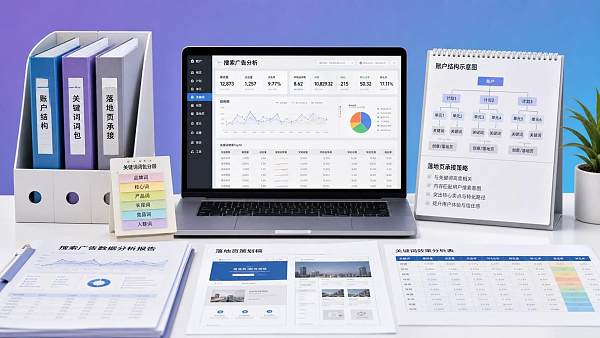
A basic account suitable for optimization should at least achieve three levels of alignment: campaign objectives should correspond to campaigns, search intent should correspond to ad groups, and keywords should correspond to landing pages. For example, if you have brand keywords, general industry keywords, and competitor keywords, it is best not to put them all into the same ad group. The reason is that these three types of keywords differ in click motivation, conversion difficulty, bidding approach, and copywriting focus. Once mixed together, the data may look lively, but the resulting judgment can become distorted.
For companies providing integrated marketing services such as website development, SEO, and outsourced advertising operations, the account structure often requires one additional consideration: after users click through, should they enter the corporate website, an individual service page, or a dedicated advertising landing page? If the page handoff logic is unclear, subsequent optimization can easily become stuck.
What Exactly Is Keyword Group Segmentation Dividing?
Keyword group segmentation is not about grouping keywords according to their literal meanings, but breaking them down according to search intent, decision-making stage, and commercial value. Many account problems arise because keywords “appear relevant but actually represent different types of traffic.”
A relatively common approach can refer to the table below:
If you are concerned about where to begin with SEM campaign optimization, keyword group segmentation is usually the first step. Once keywords are properly divided, the budget, ad copy, landing pages, and negative keyword rules will all become more orderly.
Are More Keywords Always Better?
Not necessarily. At the traffic-growth stage, the scope can be broader, but during optimization, having “too many and too diverse” keywords is more problematic.
Many accounts add a large number of related keywords all at once in the early stages, resulting in two typical problems: similar keywords compete with one another for traffic, while low-intent keywords dilute the budget. On the surface, impressions may be plentiful, but genuinely valuable searches may fail to obtain stable visibility.
A more practical approach is to first establish a “small and clear” core keyword group. Secure highly relevant, high-intent keywords first, and then gradually expand outward. Especially for service-based businesses, the number of keywords is not the core issue; the core issue is whether consultation leads can be effectively captured.
How Should Match Types Be Selected to Avoid Wasting Money and Drifting Off Target?
This is one of the areas most easily overlooked by new accounts. Match types essentially control “how far the platform can place your ads from relevant searches.” If the reach is too broad, the traffic can easily drift off target; if it is too narrow, it may be difficult to obtain sufficient volume.
At the beginning, this can be understood as follows:
- For core conversion keywords, prioritize more controllable match types to facilitate monitoring of actual search terms.
- For keywords that require additional volume, the reach can be moderately broadened, but negative keywords must be added at the same time.
- Problematic keywords and broad industry terms should not be opened up directly without filtering rules.
Many cases of supposedly “ineffective optimization” are actually caused by a large amount of off-topic traffic having already appeared in the search terms report without being handled promptly.
How Closely Should Ad Copy Correspond to Keyword Groups?
At a minimum, the ad should respond to what users are searching for, rather than using one set of copy for all keyword groups.
For example, people searching for “Google advertising operations outsourcing” want to see information about campaign management, lead generation, and data optimization. Those searching for “foreign trade website development” are more concerned with website languages, structure, indexing, and inquiry-generation capabilities. If these two types of keywords share the same ad copy, both the click-through rate and subsequent conversions can be affected.
This is also why, when providing integrated marketing services, an advertising account cannot focus only on the campaign side; it must also consider the website handoff side. For a service model like 易营宝 that covers website development, SEO, social media, and advertising, the advantage lies in designing front-end customer acquisition and back-end page handoff together, so the account structure does not stop at merely “buying clicks.”
Can Performance Be Improved by Adjusting Only the Account Without Changing the Landing Page?
It is possible, but usually only to a limited extent. The account can solve the problem of “who to bring in,” while the landing page determines “whether visitors will take further action after arriving.”
If the page content is too scattered after a click, the page loads too slowly, or the consultation entry point is unclear, the conversion cost will rise even when the keywords are highly accurate. For B2B inquiry-based businesses in particular, the landing page should clearly answer three questions: What do you provide? Who is it suitable for? How can users contact you next? Use less broad and empty introductory content and more content that directly corresponds to search intent.
When designing information architecture, some companies also refer to process management approaches from other industries, such as the application of lean management in public hospital operating cost control. Although the fields are different, the idea of “梳理流程,再找浪费点” is equally applicable to SEM account diagnosis.
Which Metric Should Be Monitored First to Avoid Misjudging the Data?
If you are still at the learning stage, it is not advisable to focus only on click-through rate from the outset. Click-through rate can only indicate “whether people are willing to click,” not directly whether “the people clicking are the right audience.”
A more reliable observation sequence is:
- Check whether the search terms are relevant and first eliminate off-target traffic.
- Check for valid clicks and page dwell time to determine whether the handoff is basically working.
- Then examine conversion actions such as forms, consultations, and phone clicks.
- Only then determine whether the cost is acceptable.
The sequence must not be reversed. The further down the data is in the sequence, the more easily it is affected by structural problems above it. If the front end has not been properly organized and you focus only on cost, your judgment will often be led astray.
What Are the Most Common Mistakes When Optimizing a New Account?
The common mistakes are actually quite concentrated and are basically related to “being too eager for results.”
- Making frequent major changes immediately after the account goes live, leaving no time for data to accumulate.
- Running brand, general, and competitor keywords together, making it impossible to see which type of keyword truly converts.
- Adding keywords without adding negative keywords, causing search traffic to become increasingly scattered.
- Using one page for multiple services, making it difficult for users to find what they need after clicking through.
- Spreading the budget evenly instead of giving core keywords sufficient room for learning.
These issues are not complicated, but they can seriously reduce efficiency. Whether SEM optimization runs smoothly often comes down to whether these basic actions have been handled properly.
What Additional Factors Should Be Considered in the Account Structure When Targeting Overseas Markets?
Two additional factors require attention: language and market segmentation. Different countries, languages, and search habits cannot simply share the same keyword group.
Especially when promoting multilingual websites, foreign trade inquiries, or cross-border independent websites, the search expressions, competitive intensity, and page expectations for the same service keyword may differ across regions. If the account structure is not separated by market, the data will become mixed when performing SEM campaign optimization later, making it difficult to determine whether the problem lies with the keywords or the region.
This is also why some service providers integrate website development, SEO, advertising, and content strategy into a single chain. Overseas advertising is not a single-point optimization task; language versions, page content, ad keyword groups, and conversion paths are inherently connected.
What Is the Most Practical Order of Evaluation When You First Start SEM Optimization?
You can remember one practical sequence: organize the structure first, then segment keyword groups; review search terms first, then adjust bids; ensure relevance first, then discuss scaling.
If the account has not yet achieved alignment among keywords, ad copy, and landing pages, do not rush to pursue complex strategies. Once the fundamentals are firmly established, the room for optimization will become increasingly clear. For information researchers, once you understand this step, you will be much better equipped to judge whether a service provider is merely performing “campaign operations” or carrying out genuinely effective account optimization.
Related Articles


Related Products
 Yiyingbao SaaS Intelligent Website Building and Marketing SystemYiyingbao SaaS Intelligent Website Building and Marketing System, AI-powered no-code website building, rapid creation of multilingual B2B international websites in 10 minutes, global server acceleration, AI-powered SEO optimization, helping businesses connect efficiently with global markets. The perfect integration of technology and operation makes building an international trade website remarkably simple
 AI+SEM Intelligent Advertising Marketing SystemAI+SEM drives intelligent ad creation, empowering full-funnel precision advertising marketing. The system automatically generates weekly/monthly reports, AI recommends keywords and target countries, monitors core metrics in real-time with intelligent alerts, and enables one-click high-conversion ad solutions to help quickly acquire customers and improve ROI.
 AI+SEO Dual-Engine System Optimization ServicesYiyingbao’s AI+SEO dual-engine optimization system helps foreign trade enterprises acquire high-quality organic traffic through AI-powered keyword research, content generation, and comprehensive technical optimization, significantly improving search rankings and conversion rates.
 AI+SNS Social Media Marketing SystemYingbao AI+SNS Social Media Marketing System - Precision social capture for the social media era. Supports one-click content synchronization across major platforms like Facebook and LinkedIn. AI intelligently rewrites posts for enhanced relevance. 24/7 AI customer service and user profiling analysis empower businesses to efficiently expand into global markets.
 AI+SEO营销解决方案易营宝AI+SEO营销解决方案,通过AI批量写作、智能生成TDK、精准关键词扩词等功能,全面优化网站SEO效果,提升流量与转化率。助力企业构建高效智能网站新生态。
 AI+SEM Advertising Marketing SolutionsAI+SEM Advertising Marketing Solution leverages AI technology to deeply empower SEM ad campaigns. It automatically generates weekly/monthly reports using AI, presenting account data across multiple dimensions for comprehensive insights into campaign performance and trends. The system precisely recommends keywords and target countries, intelligently generates high-conversion ad copy, and enables one-click activation of efficient campaign plans to help businesses rapidly acquire customers. Simultaneously, it monitors core metrics in real time, intelligently identifies abnormal fluctuations, and issues timely alerts to ensure stable, high-return advertising results.
 Domain Name ServicesEasyWin provides professional domain name services, including intelligent queries, one-stop registration, brand protection, and full lifecycle management, helping businesses build a digital brand image.
 EasyOperate B2C Cross-Border E-Commerce Platform & Independent WebsiteEasyStore B2C Cross-border E-commerce Independent Store is an intelligent website building and cross-border e-commerce integrated solution independently developed by EasyStore Information Technology (Beijing) Co., Ltd. The system is specially designed for small and medium-sized as well as large export enterprises, integrating 'website building, operation, marketing, advertising, and conversion' into one, helping enterprises quickly establish cross-border e-commerce independent stores to achieve brand globalization and global sales growth.
The platform supports multiple languages, multiple currencies, and multi-channel marketing, with built-in AI intelligent translation and SEO optimization systems, suitable for mainstream markets such as Southeast Asia, Europe and America, Latin America, and the Middle East, assisting Chinese manufacturing enterprises in efficiently deploying international e-commerce strategies. SSL证书易营宝提供专业SSL安全证书服务,包括单域名和泛域名证书,确保网站数据传输加密、身份验证和完整性保护,助力企业建立安全可信的在线业务环境。









