









- Why the old AMP SEO 2020 practices no longer work and what has changed in current optimization prioritiesAug 02, 2026View details
- How to Choose Topics for an Industry News Section to Attract More Organic Search TrafficJul 29, 2026View details
- Digital Marketing Shenzhen Market Insights: Why Are Companies Expanding Overseas Looking for Growth Teams in Shenzhen?Jul 31, 2026View details
- Can Zhejiang foreign trade independent websites still be developed today? Look at changes in traffic and lead generationJul 28, 2026View details
- What New Signals Are Emerging in Enterprise Services SaaS Marketing ReportsJul 27, 2026View details
- What Does a Global Traffic Ecosystem Service Provider Do? What Are the Differences from a Single Advertising AgencyJul 16, 2026View details
- What should you focus on in the latest enterprise SaaS report? From renewal rates and delivery costs to overseas growth opportunitiesJul 12, 2026View details
- What signals are worth paying attention to in a cross-border marketing trend report? B2B companies should look at these 6 signalsJul 11, 2026View details
PPC ad performance fluctuates significantly. How can you determine whether the issue lies with bidding, creatives, or the landing page?
Don't Rush to Adjust the Budget: Where to Check When PPC Performance Is Volatile
When many operators see rising cost per click and falling conversion rates, their first reaction is to adjust bids. However, anyone who has managed campaigns for a while knows that fluctuating PPC performance is often not caused by clicking the wrong button. Instead, bids, creatives, and landing pages may be affecting one another at the same time. When optimizing PPC campaigns, the biggest risk is making major changes to the account structure, creatives, and pages before identifying the actual problem, which can make the account increasingly chaotic.
A more stable approach is to first identify “what changed” and then determine “why it changed.” The recommended process is to establish a fixed order: first determine whether traffic quality has changed or whether the conversion stage after the click has problems; then identify anomalies from the past 7 to 14 days and compare them with change logs, creative rotations, landing page versions, and conversion tracking status.
Clicks Are Normal but Conversions Suddenly Drop—What Should You Check First?
In this situation, check the landing page and conversion tracking first, and then see whether the creative’s promise has changed. Stable click volume indicates that the ads are still bringing users in, so the problem is more likely to occur after users arrive and fail to continue through the process.
In practice, you can review the following items in order:
- Check whether forms, buttons, phone links, and WhatsApp entry points can be triggered properly.
- Check page loading speed, especially whether the mobile above-the-fold area has become noticeably slower.
- Verify that the ad copy matches the above-the-fold content of the page, so users do not find a mismatch after clicking through.
- Confirm whether conversion codes are missing, firing repeatedly, or have had their attribution window changed.
If all of these items are working properly, then examine changes at the search term and audience levels. Sometimes click volume does not decline, but traffic quality has already deteriorated, which is not always immediately obvious on the surface.
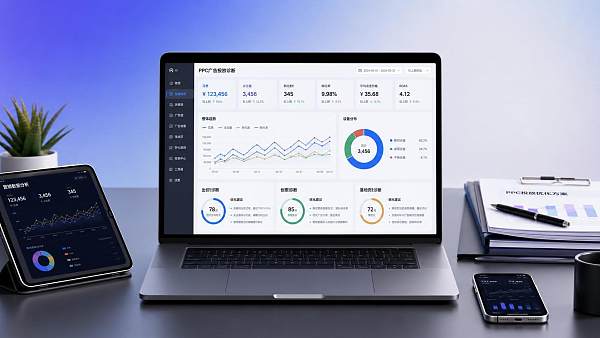
When Should You Check Bids Before Creatives or Landing Pages?
Several signals are particularly typical: a decline in impression share, a sudden increase in average cost per click, significant ranking fluctuations, or insufficient exposure for high-quality keywords. These issues are more likely to reflect a problem at the bidding level.
Bids are especially worth checking before creatives in the following situations:
- Click-through rate changes little for the same group of creatives, but impression volume decreases.
- Competition intensifies in key markets within a short period, causing the budget to run out early.
- Automated bidding targets are set too aggressively—for example, the target cost per conversion is set too low, making it difficult for the system to acquire volume.
- There are too many bid adjustments by time of day, device, or location, causing traffic to be effectively blocked.
At this point, do not focus only on the bid for an individual keyword. Review budget limitations, bidding strategies, audience overlap, and negative keyword settings together. Many accounts may appear to have “low bids,” when the real issue is unreasonable target settings that leave the system insufficient room to explore traffic.
How Do Creative Problems Usually Appear in the Data?
When creatives become problematic, the most common signs are a decline in click-through rate or very short time on page and an obvious tendency to bounce after the same amount of traffic arrives. In simple terms, the ad has either failed to attract the right people or has attracted people whose expectations do not match the page content.
When evaluating performance, do not look only at whether CTR is high. A high CTR does not necessarily mean the creative is good. Strong headlines and aggressive offers may indeed generate more clicks, but if the landing page cannot fulfill the promise, subsequent conversions will still look poor. At the operational level, creative problems can be divided into three categories:
What Should You Check on a Landing Page to Avoid “Optimization by Guesswork”?
A landing page should not be evaluated only by its appearance. For operators, the three things that really matter are whether it loads smoothly, whether the information properly follows through from the ad, and whether the conversion action is direct enough.
If you are running an inquiry-based business, the above-the-fold area should answer three questions as quickly as possible: What do you do? What can you provide? How can the user contact you next? Many pages have poor conversion rates not because the design is unattractive, but because the above-the-fold content takes too long to get to the point, users have to scroll for a long time before finding contact information, or there are too many form fields, causing them to leave immediately after entering the page.
When optimizing PPC campaigns, page checks can be more detailed than creative checks. In addition to buttons, forms, and speed, check whether there are display misalignments, incomplete language switching, or confusing currency and unit formats across different countries and devices. For multilingual websites, these details can directly affect user trust.
Can Bids, Creatives, and Landing Pages Be Quickly Triaged with a Simple Method?
Yes. First, divide the data into two stages: “before the ad” and “after the ad.”
Before the ad, focus mainly on impressions, click-through rate, average cost per click, and impression share. This stage is more useful for identifying bidding and creative issues. After the ad, focus mainly on onsite behavior, form submissions, inquiry rate, time on page, and key button clicks. This stage is more useful for identifying landing page and conversion process issues.
A practical way to assess the situation is:
- If impressions decline, check bids and budget first.
- If impressions remain stable but CTR declines, check the creatives first.
- If clicks remain stable but conversions decline, check the page and tracking first.
- If all three change, review recent change logs first rather than changing everything at once.
Why Do Some Accounts Remain Unstable No Matter How They Are Adjusted?
A common reason is not a lack of optimization skills, but changes being made too frequently with too many variables involved. Creatives are changed today, bids are adjusted tomorrow, and the page version is switched the day after. Before the platform has time to learn, the data has already been disrupted. As a result, the fluctuations you observe cannot show which action worked; they only show that the account has been constantly interrupted.
A more stable approach is to validate only one core variable at a time and maintain clear records. For example, keep the landing page unchanged and test two headline versions, or leave the creative unchanged and shorten the mobile above-the-fold area. Only when variables are isolated can subsequent analysis be meaningful.
If the website is also undergoing organic traffic optimization, page updates require even more careful timing. Some teams change their ad pages, SEO pages, and multilingual pages together. In this situation, it is recommended to incorporate keyword placement, title and description tags, and page structure into a unified process. Tools such as AI+SEO Marketing Solutions are suitable for handling bulk content, TDK generation, and keyword expansion, reducing conflicts between website adjustments and landing page optimization.
How Important Is the Search Terms Report When Identifying Performance Fluctuations?
It is very important and is frequently underestimated. Many people look only at averages at the ad group level without checking which specific terms are bringing in traffic. As a result, clicks may appear acceptable on the surface, while the actual search terms have already shifted away from the intended direction.
Especially when broad match, automated bidding, and cross-region campaigns are used together, the search terms report can directly show where the system has recently spent the budget. If many new terms with weak intent or primarily informational intent have appeared, even excellent creatives and landing pages will have difficulty converting this traffic into inquiries or orders. In this situation, add negative keywords and tighten the match types before deciding whether the creatives need to be redesigned.
Why Can a Landing Page Still Harm Ad Performance Even If It Opens Properly?
Being able to open only means that the page is not down; it does not mean that it can convert. Landing pages often undermine campaign performance because of soft issues: the above-the-fold area lacks focus, trust elements are insufficient, conversion entry points are too far down the page, mobile reading is difficult, or the form is excessively long and feels like an interrogation.
This is even more evident when serving foreign trade companies or brands expanding internationally. Users may come from different regions and have different decision-making habits, but they share one common trait: if they cannot find the key information within a few seconds of entering the page, they will leave immediately. For operators, page optimization is not something to “wait for the designer to have time to handle”; it is part of ad diagnosis.
Which Metrics Should Be Monitored Daily to Avoid Discovering Problems Only After Performance Collapses?
Do not focus only on a single conversion cost. At a minimum, divide the metrics into three levels: traffic acquisition, click quality, and page conversion.
- Traffic acquisition: impressions, impression share, and budget consumption rate.
- Click quality: CTR, average cost per click, and search term deviation.
- Page conversion: time on site, key button clicks, and form submission rate.
If you look only at total conversions each day, many problems will be discovered too late. Separating these three levels helps you determine more quickly whether fluctuations occurred before or after the ad. The troubleshooting sequence also becomes much clearer: first rule out tracking anomalies, then make targeted adjustments to bids, creatives, or pages instead of redesigning everything at the outset.
Effective PPC campaign optimization is not about changing every part of the process. It is about first identifying the layer where the problem occurred. Check whether traffic has changed, then whether the clicks have shifted, and finally whether the page has successfully handled the incoming users. With this troubleshooting approach, even significant account fluctuations can be brought back under control relatively quickly.
Related Articles

Related Products
 Yiyingbao SaaS Intelligent Website Building and Marketing SystemYiyingbao SaaS Intelligent Website Building and Marketing System, AI-powered no-code website building, rapid creation of multilingual B2B international websites in 10 minutes, global server acceleration, AI-powered SEO optimization, helping businesses connect efficiently with global markets. The perfect integration of technology and operation makes building an international trade website remarkably simple
 AI+SEM Intelligent Advertising Marketing SystemAI+SEM drives intelligent ad creation, empowering full-funnel precision advertising marketing. The system automatically generates weekly/monthly reports, AI recommends keywords and target countries, monitors core metrics in real-time with intelligent alerts, and enables one-click high-conversion ad solutions to help quickly acquire customers and improve ROI.
 AI+SEO Dual-Engine System Optimization ServicesYiyingbao’s AI+SEO dual-engine optimization system helps foreign trade enterprises acquire high-quality organic traffic through AI-powered keyword research, content generation, and comprehensive technical optimization, significantly improving search rankings and conversion rates.
 AI+SNS Social Media Marketing SystemYingbao AI+SNS Social Media Marketing System - Precision social capture for the social media era. Supports one-click content synchronization across major platforms like Facebook and LinkedIn. AI intelligently rewrites posts for enhanced relevance. 24/7 AI customer service and user profiling analysis empower businesses to efficiently expand into global markets.
 AI+SEO营销解决方案易营宝AI+SEO营销解决方案,通过AI批量写作、智能生成TDK、精准关键词扩词等功能,全面优化网站SEO效果,提升流量与转化率。助力企业构建高效智能网站新生态。
 AI+SEM Advertising Marketing SolutionsAI+SEM Advertising Marketing Solution leverages AI technology to deeply empower SEM ad campaigns. It automatically generates weekly/monthly reports using AI, presenting account data across multiple dimensions for comprehensive insights into campaign performance and trends. The system precisely recommends keywords and target countries, intelligently generates high-conversion ad copy, and enables one-click activation of efficient campaign plans to help businesses rapidly acquire customers. Simultaneously, it monitors core metrics in real time, intelligently identifies abnormal fluctuations, and issues timely alerts to ensure stable, high-return advertising results.
 Domain Name ServicesEasyWin provides professional domain name services, including intelligent queries, one-stop registration, brand protection, and full lifecycle management, helping businesses build a digital brand image.
 EasyOperate B2C Cross-Border E-Commerce Platform & Independent WebsiteEasyStore B2C Cross-border E-commerce Independent Store is an intelligent website building and cross-border e-commerce integrated solution independently developed by EasyStore Information Technology (Beijing) Co., Ltd. The system is specially designed for small and medium-sized as well as large export enterprises, integrating 'website building, operation, marketing, advertising, and conversion' into one, helping enterprises quickly establish cross-border e-commerce independent stores to achieve brand globalization and global sales growth.
The platform supports multiple languages, multiple currencies, and multi-channel marketing, with built-in AI intelligent translation and SEO optimization systems, suitable for mainstream markets such as Southeast Asia, Europe and America, Latin America, and the Middle East, assisting Chinese manufacturing enterprises in efficiently deploying international e-commerce strategies. SSL证书易营宝提供专业SSL安全证书服务,包括单域名和泛域名证书,确保网站数据传输加密、身份验证和完整性保护,助力企业建立安全可信的在线业务环境。









