









- Which customer acquisition channels will be affected by cross-border marketing trends in 2026?Sep 06, 2026View details
- Which homogenization risks should be considered in an analysis of the AI-powered website building industry?Aug 30, 2026View details
- How Will AI Marketing Trends 2026 Change Advertising Budget AllocationAug 28, 2026View details
- Is the EV SSL certificate market shrinking or upgrading? How should companies assess certificate procurement?Aug 11, 2026View details
- Why the old AMP SEO 2020 practices no longer work and what has changed in current optimization prioritiesAug 02, 2026View details
- How to Choose Topics for an Industry News Section to Attract More Organic Search TrafficJul 29, 2026View details
- Digital Marketing Shenzhen Market Insights: Why Are Companies Expanding Overseas Looking for Growth Teams in Shenzhen?Jul 31, 2026View details
- Can Zhejiang foreign trade independent websites still be developed today? Look at changes in traffic and lead generationJul 28, 2026View details
How Far Can an AI System Take Over When Automatically Optimizing Multilingual Ads
An AI advertising system can automatically optimize multilingual ads, but it cannot "take over all ad delivery with one click." In real-world global expansion scenarios, what AI does best is generating creatives in bulk, rapidly testing audiences, dynamically adjusting bids and budget allocation, and continuously fine-tuning campaigns after cross-language data attribution. However, market selection, brand messaging, landing page consistency, compliance judgment, and phased strategy shifts still require human oversight. For most companies, the truly valuable question is not "whether everything can be fully automated," but "which highly repetitive, data-dependent processes are suitable for automation to take over, so that labor costs can be reduced and performance improved without amplifying risk."
Therefore, readers searching for "Can an AI advertising system automatically optimize multilingual ads," "How can multilingual creatives for overseas advertising be coordinated," or "Can an AI advertising system reduce the manpower needed for multilingual ad delivery" are not mainly looking for concepts. They want to judge whether it is worth introducing an AI ad delivery system for their own team, how many people it can save, which processes must still retain manual involvement, and whether campaign performance may get out of control because of automation. Especially for companies targeting multiple regional markets such as Europe, North America, and Southeast Asia, their biggest concerns are efficiency, ROI, collaboration costs, and implementation risks.
The Conclusion First: AI Can Take Over 70% of Execution-Level Work, but It Cannot Take Over Growth Decisions
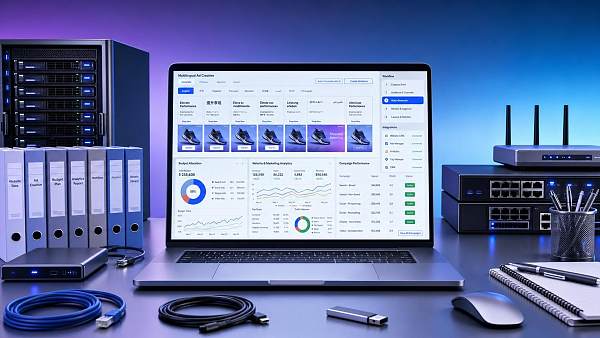
If a company is already running Google Ads, Facebook Ads, or multilingual landing page campaigns, an AI system can usually take over around 70% of execution-level work, especially in scenarios involving high-frequency testing, bulk adjustments, and multilingual coordination. For example, if the same product needs to be promoted simultaneously in English, German, French, and Spanish markets, AI can significantly shorten the workflow for content production, launch, monitoring, and iteration.
However, the prerequisite for AI takeover is a clear account structure, well-defined conversion goals, and trackable website data. Otherwise, it simply amplifies existing problems faster. For example, if keyword grouping is chaotic, conversion tracking tags are missing, or multilingual page redirects are incorrect, even the smartest AI will make "high-efficiency misjudgments" based on wrong data. Therefore, the upper limit of automation essentially depends on whether a company’s underlying marketing infrastructure is mature.
What Companies Care About Most Is Not "Whether It Can Automate," but "Whether Automation Is Worth It"
For foreign trade factories, cross-border brands, and global expansion service providers, the real sensitivity lies in input-output ratio. Whether it is more cost-effective to outsource Google Ads management or run campaigns in-house, and whether foreign trade customer acquisition should rely on SEO or Google Ads, is often not an either-or choice, but a matter of budget mix at different stages. The value of an AI system is mainly reflected in shortening trial-and-error time, reducing repetitive labor, and improving the ability to operate across multiple markets in parallel.
If a company originally needed 1 ad specialist, 1 designer, 1 copywriter, and 1 multilingual operations specialist to maintain basic campaigns across 5 to 8 national markets, after introducing an AI advertising system, it can often automate a large amount of creative generation, A/B testing, and report analysis, allowing the team to shift its energy to high-value decisions. In other words, the first thing AI reduces is not ad spend, but the labor friction cost in multilingual ad delivery.
This is also why "Can the multilingual content production cycle be shortened from 7 days to 2 days" has become a frequently asked question. For global expansion teams, time itself is a cost. Slow new product launches, slow market switching, and slow creative coordination all directly affect the window for acquiring inquiries and orders. If an AI system can connect content and ad delivery, what it brings is often not local efficiency improvement, but a change in the overall pace of global expansion.
Which Four Types of Work AI Is Best Suited to Take Over in Multilingual Advertising
The first type is bulk generation and localized rewriting of multilingual creatives. Many companies ask, "How can multilingual creatives for overseas advertising be coordinated?" The root of the problem is not translation, but inconsistent messaging across markets. AI can quickly generate multiple language versions based on the same product selling points, then adjust headlines, descriptions, and calls to action according to market culture, search habits, and channel rules, greatly reducing repeated manual revisions.
The second type is audience testing and creative combinations. Traditional methods rely on ad specialists manually creating multiple ad groups and observing CTR, CPC, and conversion rates one by one. An AI system can automatically arrange combinations of creatives, audiences, and bids based on historical data, prioritizing more budget for better-performing versions. For questions like "How can Google Ads CTR in the German market reach 3%," the answer often does not depend on a single-point tactic, but on faster creative screening efficiency.
The third type is budget allocation and bid optimization. The biggest risk in multilingual ad delivery is spreading the budget evenly, because click costs, conversion cycles, and inquiry quality vary greatly across different markets. An AI system can dynamically allocate budget based on conversion probability, market feedback, and time-period performance, shifting funds in time from low-efficiency languages or countries to high-potential audiences and reducing delays caused by human judgment.
The fourth type is report analysis and anomaly alerts. For accounts covering multiple markets, it is difficult for humans to monitor every language page, keyword, and ad group simultaneously every day. AI can automatically identify issues such as declining CTR, abnormal conversion rates, creative fatigue, and rising landing page bounce rates, then push optimization suggestions back to ad specialists. The point is not to replace people, but to turn people from "looking at data" into "using data."
Which Key Processes AI Still Cannot Truly Replace Humans In
First is market entry strategy. AI can tell you which keyword has cheaper clicks, but it cannot independently determine whether the company should prioritize Germany, France, or the Middle East at the current stage. Different markets vary greatly in average order value, payment habits, certification thresholds, and sales cycles. This means advertising strategy cannot look only at platform data; it must also consider business fulfillment capability and profit models.
Second is brand messaging and compliance boundaries. Multilingual advertising is not simply a matter of translating Chinese copy into foreign languages. Certain claims may work in English-speaking markets, appear exaggerated in German-speaking markets, and even trigger review risks in Middle Eastern markets. AI can draft efficiently, but brand tone, legally sensitive terms, and industry certification statements still require final review by people familiar with local rules.
Third is the on-site conversion experience. Many companies attribute poor ad performance to the advertising system while ignoring problems with the website itself. For example, how to reduce the hreflang error rate of a multilingual site, how to control global node access latency within 100ms, and whether European inquiry volume can resume growth after a website redesign all directly affect ad conversions. If the site loads slowly, identifies languages incorrectly, or has inconsistent page content, even strong AI ad delivery capabilities will struggle to turn clicks into inquiries.
Why the Performance of Multilingual Ads Ultimately Depends on Whether the "Advertising System + Website System" Work Together
A truly mature global growth system is never about single-point optimization. Advertising accounts are responsible for acquiring traffic, websites are responsible for receiving and converting that traffic, and SEO and GEO are responsible for accumulating long-term visibility. These three must work together. Many companies feel that advertising performance fluctuates greatly, but the essence is that ad delivery, website building, SEO, multilingual content, and data tracking are disconnected, causing the AI system to lack stable and complete feedback signals.
For example, if clicks from German ads enter an English page, or if a French page is incorrectly identified by search engines, the conversion behavior captured by the ad platform will be distorted. At this point, AI may misjudge the problem as poor creative quality and continue adjusting bids incorrectly. Conversely, if the multilingual website structure, page speed, conversion tracking, and audience segmentation are all connected, the AI system will have the conditions to keep learning, and optimization quality will become increasingly stable.
This is why more and more companies no longer purchase "ad delivery services" separately, but choose integrated solutions covering website building, SEO, content, and advertising. Whether multilingual ads can truly be automatically optimized depends not only on the advertising tool itself, but also on whether the website is promotable, indexable, and conversion-ready. For companies expanding globally, this is more important than simply comparing one AI tool with another.
How Companies Should Judge Whether They Are Suitable for an AI Multilingual Advertising System
First, look at the number of markets. If a company only advertises in a single country and a single language, and its monthly budget is not high, the marginal benefit brought by AI may be limited. But if it already covers more than 3 national markets, or is expanding from English-speaking markets to German, Spanish, French, Japanese, Korean, and other regions, AI’s advantage in bulk coordination will be very obvious, especially in easing the imbalance between creative production and operational pace.
Second, look at the data foundation. If the website has stable tracking tags, clear inquiry feedback, and sufficient historical data in the advertising account, AI can more easily enter an effective optimization stage quickly. Conversely, if lead definitions are vague, CRM feedback is missing, and landing pages change frequently, system learning will be slow and may even lead to wrong conclusions. Before adopting AI, companies usually need to complete the tracking chain first; this is more important than blindly turning on automation.
Third, look at the team structure. If the team is small, the markets are many, and content pressure is high, AI will be highly suitable. It cannot completely replace ad specialists, but it can allow 1 team to manage a workload that originally required 2 to 3 times more manpower. For companies that need to handle Google Ads, Facebook Ads, multilingual landing pages, and SEO growth at the same time, this reusable value will be even higher.
Final Thoughts: What AI Takes Over Is "Optimization Actions," Not "Growth Responsibility"
Returning to the title, when automatically optimizing multilingual ads, how far can an AI system take over? The answer is: it can already deeply take over standardized, data-driven, repetitive optimization actions such as creative generation, experiment testing, budget allocation, and report insights, but it still cannot independently assume responsibility for market judgment, brand messaging, website strategy, and business outcomes. The clearer a company is about this, the better it can use AI, rather than placing unrealistic expectations on it.
For companies planning overseas growth, the right way to think is not to ask "Can AI completely replace people," but to ask "Which processes are most cost-effective to hand over to AI, and which processes must be controlled by humans." When multilingual website building, SEO optimization, ad delivery, and content collaboration form a closed loop, an AI advertising system can indeed reduce the manpower required for multilingual ad delivery, improve response speed, and help global ad operations gradually shift from reliance on individual experience to replicable and scalable systematic growth.
Related Articles

Related Products
 Yiyingbao SaaS Intelligent Website Building and Marketing SystemYiyingbao SaaS Intelligent Website Building and Marketing System, AI-powered no-code website building, rapid creation of multilingual B2B international websites in 10 minutes, global server acceleration, AI-powered SEO optimization, helping businesses connect efficiently with global markets. The perfect integration of technology and operation makes building an international trade website remarkably simple
 AI+SEM Intelligent Advertising Marketing SystemAI+SEM drives intelligent ad creation, empowering full-funnel precision advertising marketing. The system automatically generates weekly/monthly reports, AI recommends keywords and target countries, monitors core metrics in real-time with intelligent alerts, and enables one-click high-conversion ad solutions to help quickly acquire customers and improve ROI.
 AI+SEO Dual-Engine System Optimization ServicesYiyingbao’s AI+SEO dual-engine optimization system helps foreign trade enterprises acquire high-quality organic traffic through AI-powered keyword research, content generation, and comprehensive technical optimization, significantly improving search rankings and conversion rates.
 AI+SNS Social Media Marketing SystemYingbao AI+SNS Social Media Marketing System - Precision social capture for the social media era. Supports one-click content synchronization across major platforms like Facebook and LinkedIn. AI intelligently rewrites posts for enhanced relevance. 24/7 AI customer service and user profiling analysis empower businesses to efficiently expand into global markets.
 AI+SEO营销解决方案易营宝AI+SEO营销解决方案,通过AI批量写作、智能生成TDK、精准关键词扩词等功能,全面优化网站SEO效果,提升流量与转化率。助力企业构建高效智能网站新生态。
 AI+SEM Advertising Marketing SolutionsAI+SEM Advertising Marketing Solution leverages AI technology to deeply empower SEM ad campaigns. It automatically generates weekly/monthly reports using AI, presenting account data across multiple dimensions for comprehensive insights into campaign performance and trends. The system precisely recommends keywords and target countries, intelligently generates high-conversion ad copy, and enables one-click activation of efficient campaign plans to help businesses rapidly acquire customers. Simultaneously, it monitors core metrics in real time, intelligently identifies abnormal fluctuations, and issues timely alerts to ensure stable, high-return advertising results.
 Domain Name ServicesEasyWin provides professional domain name services, including intelligent queries, one-stop registration, brand protection, and full lifecycle management, helping businesses build a digital brand image.
 EasyOperate B2C Cross-Border E-Commerce Platform & Independent WebsiteEasyStore B2C Cross-border E-commerce Independent Store is an intelligent website building and cross-border e-commerce integrated solution independently developed by EasyStore Information Technology (Beijing) Co., Ltd. The system is specially designed for small and medium-sized as well as large export enterprises, integrating 'website building, operation, marketing, advertising, and conversion' into one, helping enterprises quickly establish cross-border e-commerce independent stores to achieve brand globalization and global sales growth.
The platform supports multiple languages, multiple currencies, and multi-channel marketing, with built-in AI intelligent translation and SEO optimization systems, suitable for mainstream markets such as Southeast Asia, Europe and America, Latin America, and the Middle East, assisting Chinese manufacturing enterprises in efficiently deploying international e-commerce strategies. SSL证书易营宝提供专业SSL安全证书服务,包括单域名和泛域名证书,确保网站数据传输加密、身份验证和完整性保护,助力企业建立安全可信的在线业务环境。









