









- Which customer acquisition channels will be affected by cross-border marketing trends in 2026?Sep 06, 2026View details
- Which homogenization risks should be considered in an analysis of the AI-powered website building industry?Aug 30, 2026View details
- How Will AI Marketing Trends 2026 Change Advertising Budget AllocationAug 28, 2026View details
- Is the EV SSL certificate market shrinking or upgrading? How should companies assess certificate procurement?Aug 11, 2026View details
- Why the old AMP SEO 2020 practices no longer work and what has changed in current optimization prioritiesAug 02, 2026View details
- How to Choose Topics for an Industry News Section to Attract More Organic Search TrafficJul 29, 2026View details
Can an AI advertising system automatically optimize multilingual ads
Can an AI advertising system automatically optimize multilingual ads? For companies expanding overseas, this is not only about campaign performance, but also directly affects customer acquisition costs and collaboration efficiency. This article combines practical experience in multilingual creatives, SEO, and ad campaigns to analyze a more efficient growth path.
Whether an AI advertising system can automatically optimize multilingual ads depends on these core capabilities
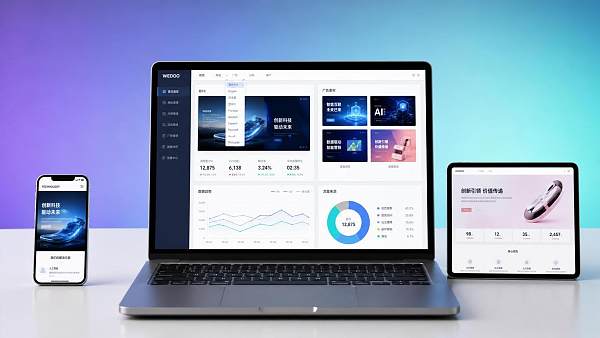
The answer is yes, but it is not as simple as translating one language into multiple languages. A truly usable AI advertising system should have capabilities for creative generation, audience segmentation, landing page adaptation, data feedback, budget coordination, and continuous learning at the same time; otherwise, automation will only amplify mistakes.
For foreign trade companies, manufacturing factories, and global brand teams, how to make multilingual overseas ad creatives work together is often more important than whether they can be translated. Search habits, click preferences, price sensitivity, and conversion paths vary across markets, so the system must optimize separately by region and language.
In the scenario of integrated website + marketing services, 易营宝 places greater emphasis on the coordination of “website, content, advertising, and data.” Multilingual advertising is not an isolated campaign activity. Only when it works together with AI-powered website building, multilingual website development, Google SEO optimization, and Google Ads campaigns can a stable growth chain truly be formed.
- The first layer is language localization, which is not only the conversion of words and phrases, but also includes adjustments to currency, units of measurement, delivery commitments, and form fields.
- The second layer is campaign localization, which requires automatically matching different ad copy and landing pages based on country, device, time period, and keyword intent.
- The third layer is conversion localization, where behaviors such as inquiries, add-to-cart actions, and registrations need to be fed back into the system, making subsequent budget allocation more accurate.
Automatic optimization does not mean zero human intervention
Many companies mistakenly believe that results will be generated automatically once the system is connected. In fact, AI is better suited to taking over processes that are highly repetitive, fast-changing, and data-intensive, while brand positioning, product selling point prioritization, and market entry sequence still require judgment from the operations team or service provider.
Why multilingual ads often miss the target, and why the problem is usually not just the copy
If a company keeps asking “Should foreign trade customer acquisition use SEO or Google Ads?”, it often means the traffic system has not yet been properly layered. SEO focuses more on long-term accumulation, while Google Ads is better for rapid testing and scaling. In multilingual markets, the two should work together rather than be treated as an either-or choice.
Unstable ad performance is often also caused by weak website fundamentals. For example, how to reduce the hreflang error rate of a multilingual website: if this issue is not handled properly, search engines may become confused when determining page attribution, and the landing experience after an ad click will also be affected, which in turn impacts Quality Score and conversion rate.
In addition, how to keep global node access latency within 100ms also directly affects advertising results. After users enter a page from an ad, if the above-the-fold content loads slowly or form submission is sluggish, even excellent creatives will struggle to convert consistently. This is also why websites and marketing must be deployed in an integrated way.
The table below can help determine where inefficiency in multilingual advertising is getting stuck.
From a practical perspective, can an AI advertising system reduce the manpower required for multilingual campaigns? The answer is usually yes, especially in creative batch generation, keyword grouping, ad testing, and data attribution. However, the prerequisite is that the website, accounts, and data feedback are connected first; otherwise, the manpower saved will be consumed by rework.
From creatives to landing pages: how to shorten the multilingual content production cycle from 7 days to 2 days
Can the multilingual content production cycle be shortened from 7 days to 2 days? If a company uses a unified content middle platform, templated page framework, and AI-assisted generation, there is indeed an opportunity to significantly compress the cycle. The key is not to “write faster,” but to reduce repeated communication and repeated revisions.
A more efficient execution chain
- First determine the primary and secondary markets to avoid launching too many languages at once, which can cause review and campaign management to get out of control.
- Build a selling point library, industry terminology library, and Q&A library based on product lines, so that AI can generate ads and pages within a unified semantic framework.
- Generate search ad copy, display creatives, short social media copy, and landing page modules simultaneously to reduce version mismatches.
- Use data dashboards to collect click-through rates, bounce rates, and form submission rates for each language, then carry out a second round of fine-tuning.
The cloud-based intelligent website building system, AI advertising marketing system, and AI+SEO/GEO optimization system independently developed by 易营宝 are suitable for this type of coordinated workflow. Advertising is not about writing copy in isolation; it operates around multilingual official websites, ad landing pages, search traffic, and social media traffic in a unified way, reducing team fragmentation.
Which is more cost-effective: outsourced Google Ads management or running campaigns in-house, and how to judge more realistically
When comparing outsourced Google Ads management with running campaigns in-house, companies should not look only at service fees. What really needs to be compared is the cost of trial and error, staffing costs, learning costs, the opportunity cost of missing peak seasons, and whether the website and ads can be optimized together.
For companies that are just starting overseas advertising, common problems with in-house campaigns include chaotic account structures, overly broad keyword matching, and incomplete conversion tracking, ultimately leading to the mistaken conclusion that “advertising does not work.” For companies with existing teams, outsourced management is more suitable for entering new markets, expanding into multiple languages, or handling complex website coordination.
If you are evaluating campaign models, you can first review the comparison table below.
If a company’s goal is to quickly enter North American, European, or Southeast Asian markets, integrated services are usually more cost-effective because they place website building, SEO, advertising, social media, and data analytics within the same growth framework, reducing information gaps and departmental friction.
How to achieve a 3% CTR for Google Ads in the German market, and how to recover after inquiries in Europe decline
There is no universal formula for achieving a 3% CTR for Google Ads in the German market, but common effective practices include narrowing the scope of keyword intent, improving consistency between headlines and landing pages, strengthening explanations of delivery capabilities, and avoiding directly copying English-market ad copy. This is especially true for industrial products, B2B equipment, and professional services.
Can European inquiry volume recover and grow after a website redesign? Yes, but the prerequisite is to first determine whether the loss comes from technical indexing issues, a decline in page trust, or a broken advertising chain. Many companies focus only on visuals after a redesign, while ignoring legacy page authority migration, URL changes, form tracking, and multilingual redirects, resulting in a significant drop in inquiries.
- First check whether the original high-traffic pages are correctly redirected to prevent important country pages from losing accumulated historical value.
- Check whether the keywords and page titles of German, French, and English pages have been overwritten by a unified template.
- Verify whether ad landing page loading speed, form fields, privacy notices, and mobile experience align with local user habits.
This is also why website redesigns are best carried out in sync with SEO and advertising teams. Redesigning a website in isolation often solves only interface issues, without solving traffic recovery and conversion rebuilding.
When enterprises purchase an AI advertising system, which parameters and delivery capabilities should they focus on
During procurement, do not look only at whether the system “supports multiple languages.” Instead, assess whether it supports the complete chain of multilingual websites, keywords, creatives, audiences, conversion goals, and data attribution. For the integrated website + marketing services industry, system capabilities and service capabilities must be evaluated at the same time.
Recommended checklist for key verification
- Whether it supports rapid duplication and localized editing of multilingual landing pages, rather than simple text replacement.
- Whether it has basic SEO capabilities, such as URL rules, sitemaps, language tags, and indexation-friendly page settings.
- Whether it can connect with Google Ads, social media ads, and on-site conversion data to form a unified dashboard.
- Whether it supports global node deployment and caching strategies to help companies keep access latency within a reasonable range.
- Whether it has a localized service team that can adjust strategies according to market differences in North America, Europe, Japan and South Korea, the Middle East, and other regions.
FAQ: the most common pitfalls in multilingual ad automation
Can an AI advertising system replace human operations?
It cannot completely replace them. The system is more suitable for handling large-scale testing, budget coordination, and data attribution, but product positioning, market pacing, brand expression, and key customer insights still require human review. The ideal model is for AI to improve efficiency while people make the judgments.
How can the hreflang error rate of a multilingual website be reduced?
First unify the rules for language versions and country versions, then check whether reciprocal links take effect in both directions, avoiding missing pages, incorrect pages, and abnormal self-referencing. During redesigns or language expansion, it is best to review the sitemap, canonical links, and redirect logic at the same time to reduce search engine misjudgments.
For foreign trade customer acquisition, is SEO or Google Ads better?
If a company needs to quickly validate the market and product selling points, using Google Ads first is more direct; if it wants to continuously acquire traffic at a lower marginal cost, SEO must be planned as early as possible. A mature approach is usually to use ads to test keywords first, use SEO to accumulate keyword assets, and use the website to capture conversions, with all three running in parallel.
Can an AI advertising system reduce the manpower required for multilingual campaigns?
Yes, it can reduce manpower, but more accurately, it shifts people from repetitive moving and copying work to strategic optimization. For example, batch generation of ad variants, automated bidding, and market-based report segmentation can all reduce execution workload, but the website, data, and process design still need to be properly set up in the early stage.
Why choose us: if you need multilingual official websites, ad campaigns, and SEO to work together
易营宝 has long served foreign trade companies, manufacturing factories, cross-border e-commerce sellers, and global brand teams. Its core advantage is not just a single tool, but the integration of AI-powered website building, multilingual website development, Google SEO optimization, Google Ads campaigns, overseas social media operations, and GEO generative engine optimization into one executable solution.
If you are currently facing questions such as how to make multilingual overseas ad creatives work together, whether outsourced Google Ads management or running campaigns in-house is more cost-effective, and whether European inquiry volume can recover and grow after a redesign, you can first communicate the following: website structure diagnosis, language version planning, ad account segmentation recommendations, delivery cycle evaluation, budget range design, and customized growth solutions.
For companies planning to enter North America, Europe, Southeast Asia, Japan and South Korea, the Middle East, or Latin America, you can also combine product type, target countries, and the existing website foundation to first confirm whether it is more suitable to start with SEO, start with Google Ads, or launch the website and campaigns simultaneously, before moving into quotation communication and implementation scheduling.
Related Articles

Related Products
 Yiyingbao SaaS Intelligent Website Building and Marketing SystemYiyingbao SaaS Intelligent Website Building and Marketing System, AI-powered no-code website building, rapid creation of multilingual B2B international websites in 10 minutes, global server acceleration, AI-powered SEO optimization, helping businesses connect efficiently with global markets. The perfect integration of technology and operation makes building an international trade website remarkably simple
 AI+SEM Intelligent Advertising Marketing SystemAI+SEM drives intelligent ad creation, empowering full-funnel precision advertising marketing. The system automatically generates weekly/monthly reports, AI recommends keywords and target countries, monitors core metrics in real-time with intelligent alerts, and enables one-click high-conversion ad solutions to help quickly acquire customers and improve ROI.
 AI+SEO Dual-Engine System Optimization ServicesYiyingbao’s AI+SEO dual-engine optimization system helps foreign trade enterprises acquire high-quality organic traffic through AI-powered keyword research, content generation, and comprehensive technical optimization, significantly improving search rankings and conversion rates.
 AI+SNS Social Media Marketing SystemYingbao AI+SNS Social Media Marketing System - Precision social capture for the social media era. Supports one-click content synchronization across major platforms like Facebook and LinkedIn. AI intelligently rewrites posts for enhanced relevance. 24/7 AI customer service and user profiling analysis empower businesses to efficiently expand into global markets.
 AI+SEO营销解决方案易营宝AI+SEO营销解决方案,通过AI批量写作、智能生成TDK、精准关键词扩词等功能,全面优化网站SEO效果,提升流量与转化率。助力企业构建高效智能网站新生态。
 AI+SEM Advertising Marketing SolutionsAI+SEM Advertising Marketing Solution leverages AI technology to deeply empower SEM ad campaigns. It automatically generates weekly/monthly reports using AI, presenting account data across multiple dimensions for comprehensive insights into campaign performance and trends. The system precisely recommends keywords and target countries, intelligently generates high-conversion ad copy, and enables one-click activation of efficient campaign plans to help businesses rapidly acquire customers. Simultaneously, it monitors core metrics in real time, intelligently identifies abnormal fluctuations, and issues timely alerts to ensure stable, high-return advertising results.
 Domain Name ServicesEasyWin provides professional domain name services, including intelligent queries, one-stop registration, brand protection, and full lifecycle management, helping businesses build a digital brand image.
 EasyOperate B2C Cross-Border E-Commerce Platform & Independent WebsiteEasyStore B2C Cross-border E-commerce Independent Store is an intelligent website building and cross-border e-commerce integrated solution independently developed by EasyStore Information Technology (Beijing) Co., Ltd. The system is specially designed for small and medium-sized as well as large export enterprises, integrating 'website building, operation, marketing, advertising, and conversion' into one, helping enterprises quickly establish cross-border e-commerce independent stores to achieve brand globalization and global sales growth.
The platform supports multiple languages, multiple currencies, and multi-channel marketing, with built-in AI intelligent translation and SEO optimization systems, suitable for mainstream markets such as Southeast Asia, Europe and America, Latin America, and the Middle East, assisting Chinese manufacturing enterprises in efficiently deploying international e-commerce strategies. SSL证书易营宝提供专业SSL安全证书服务,包括单域名和泛域名证书,确保网站数据传输加密、身份验证和完整性保护,助力企业建立安全可信的在线业务环境。









