









- Which customer acquisition channels will be affected by cross-border marketing trends in 2026?Sep 06, 2026View details
- Which homogenization risks should be considered in an analysis of the AI-powered website building industry?Aug 30, 2026View details
- How Will AI Marketing Trends 2026 Change Advertising Budget AllocationAug 28, 2026View details
- Is the EV SSL certificate market shrinking or upgrading? How should companies assess certificate procurement?Aug 11, 2026View details
- Why the old AMP SEO 2020 practices no longer work and what has changed in current optimization prioritiesAug 02, 2026View details
- How to Choose Topics for an Industry News Section to Attract More Organic Search TrafficJul 29, 2026View details
How AI-Assisted Content Generation Maintains Consistency Across Multilingual Content
The English page for the same product says “industrial-grade durability,” while the French page changes it to “suitable for everyday use,” and the Spanish page omits the warranty terms altogether—such issues are common when multilingual websites are published in batches. On the surface, all content appears to have been “translated,” but the strength of selling points, technical parameters, brand naming, and calls to action are no longer aligned. Whether for organic search, ad landing pages, or inquiry follow-up, inconsistent information will subsequently arise.
To maintain consistency across multilingual content with AI-assisted content generation, the key is not to translate each language sentence by sentence, but to first establish reusable “content sources, terminology rules, and page fields,” then let AI generate, translate, and validate according to those rules. Treating AI solely as a translation tool can easily result in pages that read smoothly but drift in messaging; only by incorporating it into a controlled workflow can you balance expression habits across markets with consistency of core information.
First, distinguish between content that must remain consistent and content that can be localized
Multilingual content consistency does not mean using exactly the same sentence structure in every language. Overseas users may differ in reading habits, unit conventions, search terms, and purchasing priorities, so pages need appropriate adjustments. However, some information should not be freely interpreted by AI and should be treated as “locked content.”
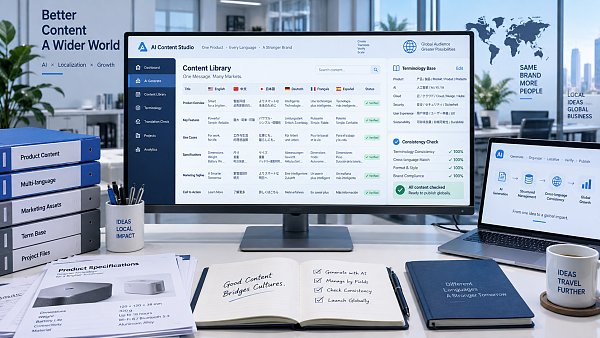
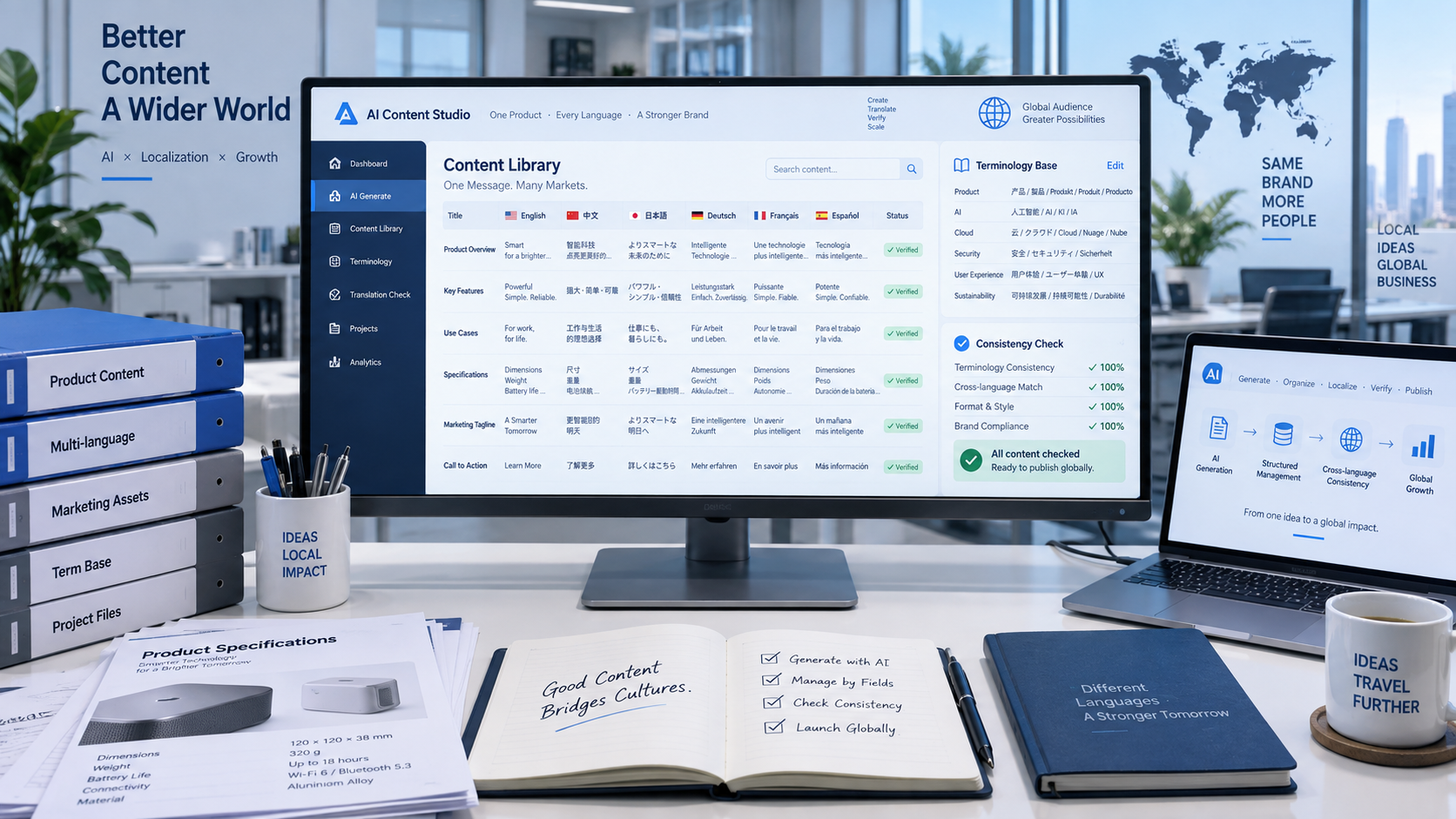
In practice, first break down each page into fields rather than directly giving the entire page text to AI. For example, manage product names, specifications, applicable industries, advantages, FAQ answers, inquiry buttons, and download material descriptions separately. Once content is structured into fields, the system can more easily identify which content can be rewritten and which can only use fixed data.
Establish a content baseline that AI can execute
What truly affects consistency is often not the model’s capability, but whether the input materials are clear. Before generation begins, prepare a concise yet complete content baseline table as the common source for pages in all languages. It does not need to be written like a brand manual, but it should at least let operators know which terms can be used and which statements must not be made.
- Terminology database: Standardize product categories, components, processes, industry abbreviations, and function names. For each term, specify the source language, preferred target-language translation, prohibited translations, and usage notes.
- Fact database: Centrally maintain error-prone content such as specifications, compatibility scope, packaging information, delivery time wording, and after-sales boundaries. Do not let AI make its own judgments based on old pages or materials from different versions.
- Tone-of-voice rules: Clearly define whether to use a professional, concise, or sales-conversion-oriented style, and state whether superlatives, absolute adjectives, and industry colloquialisms are permitted.
- Page templates: Specify which modules each page should include and the information relationships between modules. For example, the key selling point in the first screen must correspond to the main advantages in the product details, and the FAQ must not add commitments that have not been confirmed in the details.
Prompts should also reference these rules rather than simply stating “translate into German and optimize.” A more reliable instruction is: retain model numbers and parameters exactly as they are; follow the terminology database; do not add performance descriptions that have not been provided; return output by page field; and mark unconfirmed content as “Pending confirmation.” This reduces situations in which AI adds information merely to make copy appear complete.
When generating content in batches, do not skip the step of finalizing the source content
Many teams generate an English page first and then expand it into multiple languages simultaneously. The problem is that the English draft is still being revised frequently while other language versions have already been edited, published, or used for advertising. After several rounds of changes, page differences accumulate rapidly, making it difficult to trace which version is the correct one.
A sequence better suited to daily operations is to first confirm the factual information and module structure of the source-language page, then generate the first round of target-language content. After the source language changes, mark the affected fields and regenerate the relevant sections rather than overwriting the entire page. For frequently updated prices, inventory, parameters, or campaign conditions, prioritize calling them from a unified data source to avoid hard-coding this information into the body text of multiple language versions.
When content involves unit conversion, additional rules must be defined. Converting millimeters to inches, Celsius to Fahrenheit, and weight and volume units should all specify the number of decimal places to retain and the display format. AI can assist with conversion and formatting, but key values are best validated by rules; especially upper and lower limits, tolerances, operating temperatures, and included quantities should not rely solely on linguistic fluency.
Use two levels of validation to identify deviations that are not immediately visible
Manual spot reading can usually identify awkward sentences, but it may not detect changes in the scope of commitments. Multilingual content review should be divided into a language layer and a business layer. The language layer checks whether the content reads naturally and conforms to local conventions; the business layer returns to the source content to verify whether the information is equivalent.
Level one: Let AI perform structured comparison
You can input source-language fields and target-language fields together, and have AI output differences according to fixed items: whether model numbers, parameters, limitations, or CTAs are omitted; whether selling points absent from the source text have been added; whether terminology violates the glossary; and whether numbers, dates, units, and percentages are consistent. Ask it to report differences only, rather than polish the full text again, so the results are easier for operators to handle.
Level two: Manually confirm high-risk fields
Even after automated checks, the following content should be confirmed by people familiar with the product and business rules: technical specifications, compliance or certification statements, service scope, quotation terms, delivery periods, refund or warranty information, and comparative descriptions that may affect purchasing decisions. The focus here is not word-for-word proofreading, but confirming that the target language has not changed the original factual boundaries.
After a page is published, its frontend presentation should also be checked. Text length varies significantly across languages; truncated buttons, misaligned tables, and abnormal line breaks on mobile devices can all make otherwise consistent content appear incomplete to users. This is especially true for navigation, form prompts, pop-ups, and download buttons. These short texts are often not included in the main translation workflow, yet they directly affect the conversion path.
When inconsistencies arise, trace them back to the source instead of directly changing the translation
When you find inconsistent descriptions in a particular language, first determine which type of issue it is: whether the source content itself has two versions, the terminology database lacks a definition, AI did not receive constraints during generation, an editor made manual changes, or page data was not synchronized. Directly modifying the target-language page may seem to solve the issue in the short term, but it may be overwritten during the next batch update and could even create new inconsistencies.
The correct approach is to return to the content baseline: update the fact database for factual errors, add entries for terminology disputes, and adjust templates or prompts for inconsistent writing styles; then conduct targeted reviews of pages using the same fields. In this way, AI-assisted content generation can gradually become a stable workflow rather than adding another piece of copy that requires manual memory and maintenance each time a new language is added.
Related Articles


Related Products
 Yiyingbao SaaS Intelligent Website Building and Marketing SystemYiyingbao SaaS Intelligent Website Building and Marketing System, AI-powered no-code website building, rapid creation of multilingual B2B international websites in 10 minutes, global server acceleration, AI-powered SEO optimization, helping businesses connect efficiently with global markets. The perfect integration of technology and operation makes building an international trade website remarkably simple
 AI+SEM Intelligent Advertising Marketing SystemAI+SEM drives intelligent ad creation, empowering full-funnel precision advertising marketing. The system automatically generates weekly/monthly reports, AI recommends keywords and target countries, monitors core metrics in real-time with intelligent alerts, and enables one-click high-conversion ad solutions to help quickly acquire customers and improve ROI.
 AI+SEO Dual-Engine System Optimization ServicesYiyingbao’s AI+SEO dual-engine optimization system helps foreign trade enterprises acquire high-quality organic traffic through AI-powered keyword research, content generation, and comprehensive technical optimization, significantly improving search rankings and conversion rates.
 AI+SNS Social Media Marketing SystemYingbao AI+SNS Social Media Marketing System - Precision social capture for the social media era. Supports one-click content synchronization across major platforms like Facebook and LinkedIn. AI intelligently rewrites posts for enhanced relevance. 24/7 AI customer service and user profiling analysis empower businesses to efficiently expand into global markets.
 AI+SEO营销解决方案易营宝AI+SEO营销解决方案,通过AI批量写作、智能生成TDK、精准关键词扩词等功能,全面优化网站SEO效果,提升流量与转化率。助力企业构建高效智能网站新生态。
 AI+SEM Advertising Marketing SolutionsAI+SEM Advertising Marketing Solution leverages AI technology to deeply empower SEM ad campaigns. It automatically generates weekly/monthly reports using AI, presenting account data across multiple dimensions for comprehensive insights into campaign performance and trends. The system precisely recommends keywords and target countries, intelligently generates high-conversion ad copy, and enables one-click activation of efficient campaign plans to help businesses rapidly acquire customers. Simultaneously, it monitors core metrics in real time, intelligently identifies abnormal fluctuations, and issues timely alerts to ensure stable, high-return advertising results.
 Domain Name ServicesEasyWin provides professional domain name services, including intelligent queries, one-stop registration, brand protection, and full lifecycle management, helping businesses build a digital brand image.
 EasyOperate B2C Cross-Border E-Commerce Platform & Independent WebsiteEasyStore B2C Cross-border E-commerce Independent Store is an intelligent website building and cross-border e-commerce integrated solution independently developed by EasyStore Information Technology (Beijing) Co., Ltd. The system is specially designed for small and medium-sized as well as large export enterprises, integrating 'website building, operation, marketing, advertising, and conversion' into one, helping enterprises quickly establish cross-border e-commerce independent stores to achieve brand globalization and global sales growth.
The platform supports multiple languages, multiple currencies, and multi-channel marketing, with built-in AI intelligent translation and SEO optimization systems, suitable for mainstream markets such as Southeast Asia, Europe and America, Latin America, and the Middle East, assisting Chinese manufacturing enterprises in efficiently deploying international e-commerce strategies. SSL证书易营宝提供专业SSL安全证书服务,包括单域名和泛域名证书,确保网站数据传输加密、身份验证和完整性保护,助力企业建立安全可信的在线业务环境。









