









- Which customer acquisition channels will be affected by cross-border marketing trends in 2026?Sep 06, 2026View details
- Which homogenization risks should be considered in an analysis of the AI-powered website building industry?Aug 30, 2026View details
- How Will AI Marketing Trends 2026 Change Advertising Budget AllocationAug 28, 2026View details
- Is the EV SSL certificate market shrinking or upgrading? How should companies assess certificate procurement?Aug 11, 2026View details
- Why the old AMP SEO 2020 practices no longer work and what has changed in current optimization prioritiesAug 02, 2026View details
- How to Choose Topics for an Industry News Section to Attract More Organic Search TrafficJul 29, 2026View details
How to Avoid Product Information Mistranslations on Multilingual Export Websites
How to Avoid Mistranslating Product Information on Multilingual Foreign Trade Websites
When translating a foreign trade website into multiple languages, the greatest concern is not whether the sentences sound natural enough, but whether product information is mistranslated. A discrepancy in a material name, an omitted unit conversion, or an overstated certification claim may all cause overseas buyers to question a supplier's professionalism. For B2B websites, customers often do more than view a product image; they check specification sheets, application conditions, scope of delivery, and compliance information. Once content is inconsistent with quotations, catalogs, or actual products, both lead quality and subsequent communication can be affected.
Many companies view multilingual content simply as translating Chinese pages into foreign languages. Only after implementation do they realize that product names, category structures, filter attributes, downloadable materials, image text, and advertising landing pages on the website are interconnected. If translation remains only at the page level, inconsistencies among language versions can easily arise when models are updated, parameters are added or removed, or overseas advertising is launched. To avoid mistranslation, the key is not merely to increase the number of proofreading rounds, but to establish a content management mechanism that the website operations team can continuously implement.
First, Distinguish Which Content Must Never Be Treated as “Ordinary Copy”
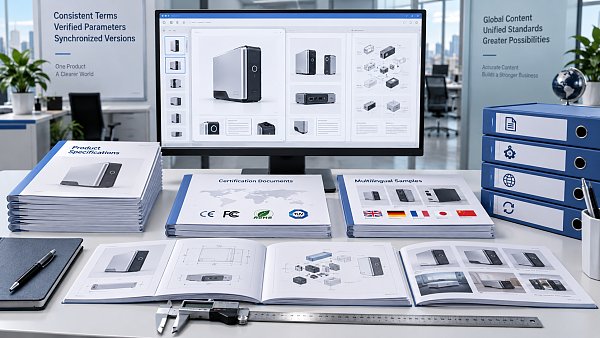
Some content in product descriptions can be adjusted according to local expression habits, such as application scenarios, the order of selling points, and tone of voice. However, technical facts must be based on source documents and must not be inferred by translators. Before submitting content for translation, operators should divide product pages into two categories: “localizable content” and “controlled information.” The former may be linguistically polished, while the latter requires locked sources, versions, and designated reviewers.
Certification information in particular must not be added merely to make a page “look complete.” The product model, factory, validity status, and target market associated with a certificate usually need to be confirmed against specific documentation. A more appropriate approach for the website is to clearly state the confirmed scope. Where optional configurations, specific market requirements, or project-based testing are involved, it should be specified that the actual order and documentation shall prevail.
A Terminology Database Is Not a Translation List, but the Single Source of Product Facts
Many mistranslations are already embedded from the first launch: sales, engineering, factory, and operations personnel may interpret the same Chinese term differently, making it even harder to standardize foreign-language translations. A practical terminology database should include, at minimum, the Chinese standard name, recommended target-language wording, prohibited translations, corresponding model or product category, information source, date of last confirmation, and responsible department. If a term has different names in different markets, do not force them into a single term; instead, note the applicable region and search habits.
For example, a product name serves not only an identification function, but also affects customer searches and on-site filtering. Translators may optimize word order, but should not remove key attributes without authorization. Likewise, operations personnel must not add functions, materials, or application scenarios that the product does not have to a title merely to target search terms. A more reliable process is to first define the “technical name,” then have someone familiar with the target market add wording more aligned with purchasing practices, and finally have the product owner confirm the factual boundaries.
Place Reviews Before Publication, and More Importantly, When Content Changes
Manual proofreading before a single launch is essential, but it does not solve long-term maintenance issues. A common real-world situation on foreign trade websites is that the Chinese version has already updated materials, parameters, or images, while the English version still retains old content; an advertising page cites outdated specifications, while the download center has uploaded a new catalog. What customers see is not the translation quality of a single page, but whether the entire set of information is consistent.
Therefore, it is advisable to divide reviews into three levels. Language review focuses on accuracy, naturalness, and alignment with industry context; technical review verifies parameters, models, units, illustrations, and attachments; publication review checks whether pages in different languages, product filter options, form fields, image alt text, and linked materials are synchronized. For frequently updated product categories, a rule can be established whereby changes to the source text trigger re-review, rather than investigating pages one by one only after customers identify problems.
Machine translation and artificial intelligence tools can be used for first drafts, terminology consistency checks, and repeated-content processing, but they cannot replace technical confirmation. Especially for abbreviations, polysemous terms, annotations in drawings, packaging labels, and certification wording, systems may produce fluent versions that do not match product facts. Operators should treat automatically generated content as a draft for review, not as a final version ready for direct publication.
Localization Validation Solves More Than Just Language Issues
When multilingual versions target different markets, content should also adapt to local reading habits and purchasing decision paths. North American customers may pay more attention to specifications, applications, warranties, and delivery terms; procurement personnel in European markets typically examine documentation, material descriptions, and applicable requirements more carefully; pages for the Middle East, Latin America, Japan, South Korea, or Russian-speaking markets need to be validated in light of local language habits, character display, telephone number formats, and inquiry fields. “Localization” here does not mean changing every page beyond recognition, but ensuring that customers can accurately find information useful to them.
Localization validation also includes visual page content. Dimension labels, promotional messages, packaging text, and video subtitles in images are often overlooked, yet they are common sources of mistranslation. If a product image already contains text that cannot be modified, confirm that it is consistent with the terminology in the main text. If an image shows an older version of a product, avoid creating contradictions between the parameters on the new page and the visual materials.
Ensure Website Building, Content, and Lead Generation Channels Use the Same Product Language
The value of integrated website and marketing services lies in reducing discrepancies created when content is repeatedly copied across different tools and channels. Website product pages, search advertising landing pages, social media posts, automated inquiry replies, and sales materials should share the same core product facts: names, models, key parameters, application scope, and controlled selling points may be presented differently, but they must not conflict with one another. Otherwise, advertising may generate traffic, but sales teams will need to spend more time explaining “why the website says this.”
Since 2013, Yiyingbao Information Technology (Beijing) Co., Ltd. has continuously served companies in overseas digitalization scenarios. Its AI-driven enterprise SaaS platform covers intelligent website building, multilingual websites, cross-border online stores, as well as search, advertising, and social media marketing. For teams that need to maintain websites in multiple languages over the long term, the more important consideration is not the one-time volume of translation, but whether the system can support unified content management, page version updates, and multi-channel material coordination. Technology tools are responsible for reducing repetitive operations, while localized services and internal technical reviews are responsible for safeguarding the accuracy of product information.
Before publication, consider spot-checking several areas most likely to expose problems: whether the same model is consistent across pages in all languages, whether parameter tables match downloadable materials, whether image text and main text are synchronized, whether certification claims are supported by documentation, and whether advertising-linked pages are still the current version. By making these checks routine actions, multilingual translation for foreign trade websites will not gradually become distorted through continuous updates, and customers will see product information that is clear, reliable, and able to withstand follow-up questions during inquiries.
Related Articles

Related Products
 Yiyingbao SaaS Intelligent Website Building and Marketing SystemYiyingbao SaaS Intelligent Website Building and Marketing System, AI-powered no-code website building, rapid creation of multilingual B2B international websites in 10 minutes, global server acceleration, AI-powered SEO optimization, helping businesses connect efficiently with global markets. The perfect integration of technology and operation makes building an international trade website remarkably simple
 AI+SEM Intelligent Advertising Marketing SystemAI+SEM drives intelligent ad creation, empowering full-funnel precision advertising marketing. The system automatically generates weekly/monthly reports, AI recommends keywords and target countries, monitors core metrics in real-time with intelligent alerts, and enables one-click high-conversion ad solutions to help quickly acquire customers and improve ROI.
 AI+SEO Dual-Engine System Optimization ServicesYiyingbao’s AI+SEO dual-engine optimization system helps foreign trade enterprises acquire high-quality organic traffic through AI-powered keyword research, content generation, and comprehensive technical optimization, significantly improving search rankings and conversion rates.
 AI+SNS Social Media Marketing SystemYingbao AI+SNS Social Media Marketing System - Precision social capture for the social media era. Supports one-click content synchronization across major platforms like Facebook and LinkedIn. AI intelligently rewrites posts for enhanced relevance. 24/7 AI customer service and user profiling analysis empower businesses to efficiently expand into global markets.
 AI+SEO营销解决方案易营宝AI+SEO营销解决方案,通过AI批量写作、智能生成TDK、精准关键词扩词等功能,全面优化网站SEO效果,提升流量与转化率。助力企业构建高效智能网站新生态。
 AI+SEM Advertising Marketing SolutionsAI+SEM Advertising Marketing Solution leverages AI technology to deeply empower SEM ad campaigns. It automatically generates weekly/monthly reports using AI, presenting account data across multiple dimensions for comprehensive insights into campaign performance and trends. The system precisely recommends keywords and target countries, intelligently generates high-conversion ad copy, and enables one-click activation of efficient campaign plans to help businesses rapidly acquire customers. Simultaneously, it monitors core metrics in real time, intelligently identifies abnormal fluctuations, and issues timely alerts to ensure stable, high-return advertising results.
 Domain Name ServicesEasyWin provides professional domain name services, including intelligent queries, one-stop registration, brand protection, and full lifecycle management, helping businesses build a digital brand image.
 EasyOperate B2C Cross-Border E-Commerce Platform & Independent WebsiteEasyStore B2C Cross-border E-commerce Independent Store is an intelligent website building and cross-border e-commerce integrated solution independently developed by EasyStore Information Technology (Beijing) Co., Ltd. The system is specially designed for small and medium-sized as well as large export enterprises, integrating 'website building, operation, marketing, advertising, and conversion' into one, helping enterprises quickly establish cross-border e-commerce independent stores to achieve brand globalization and global sales growth.
The platform supports multiple languages, multiple currencies, and multi-channel marketing, with built-in AI intelligent translation and SEO optimization systems, suitable for mainstream markets such as Southeast Asia, Europe and America, Latin America, and the Middle East, assisting Chinese manufacturing enterprises in efficiently deploying international e-commerce strategies. SSL证书易营宝提供专业SSL安全证书服务,包括单域名和泛域名证书,确保网站数据传输加密、身份验证和完整性保护,助力企业建立安全可信的在线业务环境。









