









- Which customer acquisition channels will be affected by cross-border marketing trends in 2026?Sep 06, 2026View details
- Which homogenization risks should be considered in an analysis of the AI-powered website building industry?Aug 30, 2026View details
- How Will AI Marketing Trends 2026 Change Advertising Budget AllocationAug 28, 2026View details
- Is the EV SSL certificate market shrinking or upgrading? How should companies assess certificate procurement?Aug 11, 2026View details
- Why the old AMP SEO 2020 practices no longer work and what has changed in current optimization prioritiesAug 02, 2026View details
- How to Choose Topics for an Industry News Section to Attract More Organic Search TrafficJul 29, 2026View details
How Can AI Translation Maintain Consistent Localized Terminology?
After a multilingual website goes live, the same type of issue often first appears on product pages, navigation bars, and inquiry forms: a feature is written as “smart control” on the English page, becomes “intelligent management” in the help center, and is translated again as “AI control” on an advertising landing page. While all of these may appear to correspond to the Chinese source text, overseas visitors may question whether they are different features; search engines also struggle to consistently understand the topical relationship between pages.
To ensure that AI translation maintains consistent localized terminology, the key is not to require every translation to be “word-for-word identical,” but to first establish actionable terminology rules and then have AI apply them consistently when translating, rewriting, expanding, and updating content. Names, core product terms, feature modules, and industry abbreviations must remain fixed, while marketing wording, syntax, and tone may be adjusted for different page contexts. This preserves the naturalness of localization while preventing terminology from continually drifting.
First distinguish: Which terms must be unified, and which can be handled flexibly
Terminology consistency does not mean that every sentence must use the same expression. What truly needs to be standardized are the terms users rely on to identify products, compare solutions, search for information, and complete actions. When organizing materials, operators can first divide high-frequency terms in existing website content into three categories.
For example, on a B2B website, “inquiry” should not be translated as “inquiry” in one place, written as “request” in another, and displayed as “contact” on a button. “Inquiry” can be designated as the business term, while “Contact Us” is retained as a general contact entry point. The two are not absolutely incompatible; the distinction lies in whether the page is referring to the same business action.
Repeated changes in translation are usually not caused by AI itself
Inconsistencies in AI translation localization often arise because the input materials lack clear boundaries. When translating a product page separately, the model can only infer the meaning from the current paragraph; when it later processes a blog, advertising material, or a page in a new language, a different context may lead it to select another reasonable but inconsistent translation.
Several easily overlooked areas should also be reviewed: whether the Chinese source text itself inconsistently uses terms such as “intelligent system,” “smart platform,” and “AI system”; whether tables, image text, and downloadable materials bypass the website body translation workflow; whether different people maintain website, advertising, and social media copy separately; and whether old pages are still being copied. Correcting only the latest pages cannot solve the issue of content across the site gradually diverging.
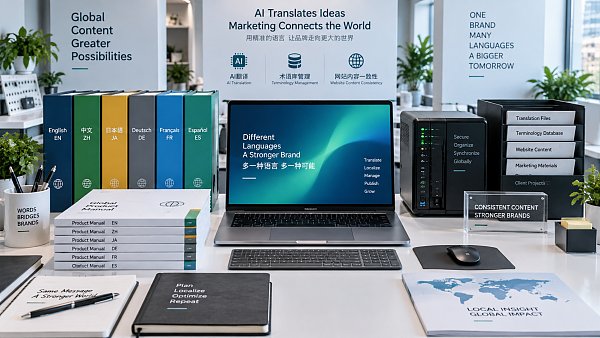
When building a terminology database, do not simply create Chinese-to-foreign-language equivalents
A glossary with only two columns is difficult to use for governing actual translation. A more effective terminology database should enable both AI and human users to determine “when to use a term and when not to use it.” It is recommended that each key term include at least the following information:
- Source-language term: Specify the standard Chinese name and any possible alternative names.
- Preferred target-language translation: Confirm each language separately rather than translating from English into other languages first.
- Part of speech and usage location: For example, whether it is used in navigation, feature headings, body text, buttons, or form fields.
- Definition or business description: Use one sentence to define the function, service, or object to which the term refers.
- Prohibited translations: Record expressions that are easily confused, have shifted meanings, or have been discontinued.
- Example sentence: Provide one correct usage example in a website context, especially for abbreviations and polysemous terms.
The terminology database does not need to cover all content from the start. Prioritize terms in navigation categories, product classifications, feature modules, key conversion buttons, industry-specific terms, and SEO-focused pages. Terms that are few in number but appear frequently are the most likely to affect user understanding and are the most worthwhile to standardize first.
Have AI work according to the same rules instead of “freely improvising” every time
When executing translations, the terminology list should be provided as fixed context rather than attached only once in the initial task. The prompt requirements can be explicit: prioritize the designated translations in the terminology database; use the standard translation even when the source text contains a concept corresponding to a prohibited term; do not independently standardize newly unlisted terms, but flag them for confirmation; and ensure that navigation, buttons, and form fields are fully consistent with existing pages.
For longer content, it is not recommended to hand fragmented paragraphs to AI for processing independently. First provide the page type, target market, desired tone, and relevant terminology from published pages, then translate by module. Product detail pages, technical materials, and blog articles differ in expression density, but when core concepts are the same, their translations should not change with the writing style.
When a term has multiple meanings, first add “decision criteria”
Many terms cannot be resolved through one fixed translation. For example, “account” may refer to a website backend login account, an advertising account, or a customer settlement account. In this case, AI should not simply be instructed to “consistently translate it as account.” Instead, separate entries should be created in the terminology database for backend user accounts, advertising accounts, and settlement accounts, with the corresponding pages or business scenarios clearly specified. The focus of terminology consistency is conceptual consistency, not identical surface strings.
Use “reverse searches” before publishing to uncover hidden inconsistencies
After translation is completed, reviewing individual pages alone usually makes it difficult to identify problems. Select several key English or target-language terms from the terminology database and search for them in reverse across on-site content, exported page files, and advertising materials. When multiple synonyms appear in the results, determine whether they genuinely represent different concepts.
Pay particular attention to page titles, descriptions, H2 headings, image alt text, URL-related text, navigation, and CTA buttons. These elements are short and appear frequently, so translation deviations are amplified. For example, if one product category name is used consistently in the body text but another term is used in navigation, users may experience a gap in understanding before entering the page.
When updating terminology, keep version records: when it was changed, why it was changed, and which pages need to be reviewed and replaced. For pages already indexed by search engines, do not update only new content while overlooking old content; old translations that coexist under the same topic over time can weaken the relationship between content pieces.
Will terminology consistency make translations sound rigid?
No, provided that only core terms serving an identification function are fixed. Word order, level of politeness, units of measurement, date formats, and marketing tone should still be localized for the target market. For example, product feature names can remain consistent, while explanations of feature value can be rewritten according to local purchasing practices. Fixing terminology while allowing flexibility in expression is usually more natural than copying the entire source text verbatim.
Is human review still needed after machine translation?
Yes, especially when first establishing a terminology database or when industry abbreviations or polysemous terms are involved. Human review does not require retranslating every sentence; the focus is on confirming whether AI has followed the terminology rules, misunderstood the business context, or encountered new terms that should be added to the terminology database. After several rounds of accumulation, the review cost of routine updates will decrease significantly.
Terminology management should become part of the content update workflow: first confirm new concepts, then translate; verify key areas before publishing; and write new translations back into the terminology database once discovered. In this way, AI can handle most repetitive translation work without causing a multilingual website to gradually lose consistency due to different contexts each time.
Related Articles

Related Products
 Yiyingbao SaaS Intelligent Website Building and Marketing SystemYiyingbao SaaS Intelligent Website Building and Marketing System, AI-powered no-code website building, rapid creation of multilingual B2B international websites in 10 minutes, global server acceleration, AI-powered SEO optimization, helping businesses connect efficiently with global markets. The perfect integration of technology and operation makes building an international trade website remarkably simple
 AI+SEM Intelligent Advertising Marketing SystemAI+SEM drives intelligent ad creation, empowering full-funnel precision advertising marketing. The system automatically generates weekly/monthly reports, AI recommends keywords and target countries, monitors core metrics in real-time with intelligent alerts, and enables one-click high-conversion ad solutions to help quickly acquire customers and improve ROI.
 AI+SEO Dual-Engine System Optimization ServicesYiyingbao’s AI+SEO dual-engine optimization system helps foreign trade enterprises acquire high-quality organic traffic through AI-powered keyword research, content generation, and comprehensive technical optimization, significantly improving search rankings and conversion rates.
 AI+SNS Social Media Marketing SystemYingbao AI+SNS Social Media Marketing System - Precision social capture for the social media era. Supports one-click content synchronization across major platforms like Facebook and LinkedIn. AI intelligently rewrites posts for enhanced relevance. 24/7 AI customer service and user profiling analysis empower businesses to efficiently expand into global markets.
 AI+SEO营销解决方案易营宝AI+SEO营销解决方案,通过AI批量写作、智能生成TDK、精准关键词扩词等功能,全面优化网站SEO效果,提升流量与转化率。助力企业构建高效智能网站新生态。
 AI+SEM Advertising Marketing SolutionsAI+SEM Advertising Marketing Solution leverages AI technology to deeply empower SEM ad campaigns. It automatically generates weekly/monthly reports using AI, presenting account data across multiple dimensions for comprehensive insights into campaign performance and trends. The system precisely recommends keywords and target countries, intelligently generates high-conversion ad copy, and enables one-click activation of efficient campaign plans to help businesses rapidly acquire customers. Simultaneously, it monitors core metrics in real time, intelligently identifies abnormal fluctuations, and issues timely alerts to ensure stable, high-return advertising results.
 Domain Name ServicesEasyWin provides professional domain name services, including intelligent queries, one-stop registration, brand protection, and full lifecycle management, helping businesses build a digital brand image.
 EasyOperate B2C Cross-Border E-Commerce Platform & Independent WebsiteEasyStore B2C Cross-border E-commerce Independent Store is an intelligent website building and cross-border e-commerce integrated solution independently developed by EasyStore Information Technology (Beijing) Co., Ltd. The system is specially designed for small and medium-sized as well as large export enterprises, integrating 'website building, operation, marketing, advertising, and conversion' into one, helping enterprises quickly establish cross-border e-commerce independent stores to achieve brand globalization and global sales growth.
The platform supports multiple languages, multiple currencies, and multi-channel marketing, with built-in AI intelligent translation and SEO optimization systems, suitable for mainstream markets such as Southeast Asia, Europe and America, Latin America, and the Middle East, assisting Chinese manufacturing enterprises in efficiently deploying international e-commerce strategies. SSL证书易营宝提供专业SSL安全证书服务,包括单域名和泛域名证书,确保网站数据传输加密、身份验证和完整性保护,助力企业建立安全可信的在线业务环境。









