









- Amazon Reportedly Sends Exclusivity Warning Letters to Multiplatform SellersNov 03, 2026View details
- New TikTok Shop Cross-Border Returns Rules for Southeast Asia Take Effect on November 5Nov 03, 2026View details
- U.S. Tightens De Minimis Exemption Channel and Revises Section 321 Data PilotNov 03, 2026View details
- Amazon FBA Fuel and Logistics Surcharge in 10 European Countries to Increase to 2% on November 2Nov 02, 2026View details
- EU Customs Code reform to take effect on November 1, with new handling fees for direct-mail small parcelsNov 01, 2026View details
- EU Plans to Raise Tax on Incoming Small Parcels to €5Oct 31, 2026View details
How Can German Website Development Avoid the Impact of Machine Translation on Inquiries?
A German procurement manager opens a product page. The technical specifications seem complete, but the scope of delivery is unclear. When he is ready to submit an inquiry, he finds that the form field “Project location” has been translated into a term that is difficult to understand. Customers may not point out the problem; they are more likely to leave. When developing a German-language website, the time saved by machine translation can affect subsequent inquiries if it comes at the cost of comprehension and trust.
Project managers do not need to abandon AI translation as a result. A more practical approach is to define the division of labor between machines and people: let tools handle first drafts and repetitive tasks, and reserve the budget for terminology, key pages, conversion paths, and pre-launch checks.
Identify the translation risks most likely to affect inquiries
The issues with a German-language website go beyond whether its grammar is correct. For engineering equipment, industrial components, or custom services, customers also need to assess whether the supplier understands their project. An inaccurate technical term may lead procurement staff to misunderstand a product’s purpose; an overly ambitious translation may also cause problems for the sales and delivery teams later.
When reviewing a project, follow the customer’s journey from search to inquiry submission and focus on these areas:
- Product names and technical specifications: Check that industry terminology, units, specification ranges, and applicable conditions are consistent. Avoid translating internal Chinese abbreviations directly into German.
- Service and delivery descriptions: Distinguish between supply, installation, commissioning, and after-sales support. Make clear which services are actually provided and which require separate confirmation.
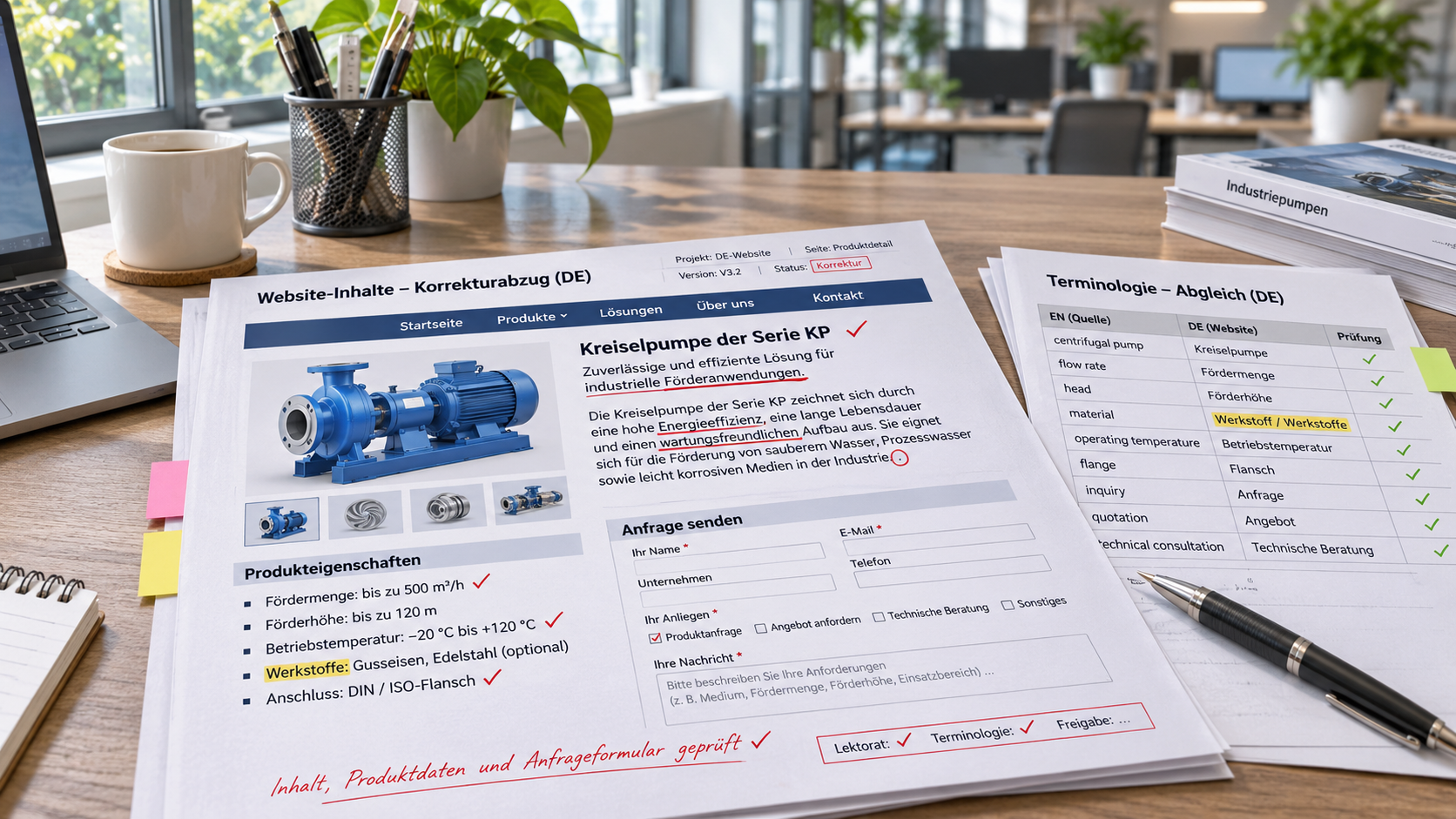
- Inquiry buttons and forms: “Request a quote,” “Discuss a project,” and “Request information” express different intentions. Button text, field names, and post-submission messages should match the actual process.
- Trust information: Company profiles, contact details, and descriptions of certificates must match the actual information. Machine translation must not inadvertently overstate the scope of the business.
For example, “supports overseas installation” in Chinese could mean that personnel can be arranged in some markets, or simply that remote guidance is available. If the source text does not clarify this, translation tools cannot make that decision on behalf of the project team. The business lead should first confirm the scope of the service, then prepare the German content.
Set up a practical German content delivery workflow
Multilingual projects often run into the same situation: the website development team is waiting for translated copy, the translator cannot see the page, and sales spots terminology issues only after the site has gone live. The solution is not to add a vague round of “proofreading,” but to decide before work begins who is responsible for the source text, who approves the terminology, and who checks the content on the page.
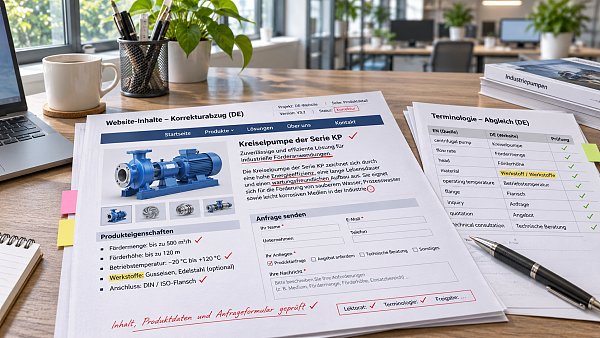
Prepare the glossary and confirm the source text before translation
Extract terminology from core products, materials, processes, applications, and common inquiry questions. Record the Chinese term, recommended German equivalent, explanation, and where it is used. For abbreviations, model numbers, dimensions, and units, also specify whether they should be retained as written. The glossary does not need to cover everything at the outset, but product names and frequently used technical terms should first be confirmed by someone who understands the business.
The source text also needs to be refined. Remove generic claims such as “reliable quality” or “widely applicable” when there is no basis for assessing them, and add the information customers actually need, such as operating conditions, optional configurations, customization requirements, and how to obtain documentation. Machine translation can only work with the content provided; it cannot fill gaps in the source information.
Allocate human review according to page value
When the budget is limited, prioritize reviews of the homepage’s core introduction, main product pages, application solution pages, contact page, and advertising landing pages. These pages are closer to customer decisions and inquiry actions, so errors usually have a more direct impact. News and older articles can be handled in batches, but large volumes of unchecked machine-translated copy should not be published.
Reviewers should not only be proficient in German but also understand the relevant industry. Content involving safety, performance, or contractual conditions should be confirmed jointly with business or technical staff. If the target market includes Germany, Austria, and Switzerland, check wording, contact details, and delivery descriptions against the actual sales regions rather than assuming that one translation will suit every scenario.
Review the content on live pages, not just in documents
German compound words can be long. When placed in navigation menus, buttons, or mobile forms, they may wrap awkwardly or get cut off. Project managers should ask the team to check each page on desktop and mobile devices and submit a test inquiry. Confirm that required-field prompts, success messages, notification emails, and automated replies sent to customers all display correctly and use consistent German.
Make German content support customer decisions, not just be “correctly translated”
When overseas procurement staff visit a website, they often have specific tasks in mind: Is the product suitable for the project? Can drawings or technical documents be provided? How can they get a quote? German pages should answer these questions with clear information rather than translate Chinese marketing copy sentence by sentence.
For example, if the source text says “We provide customers with one-stop solutions,” the German page can, where the facts allow, explain which steps the company handles, what information customers will receive after submitting an inquiry, and which technical requirements need to be confirmed by both parties. This wording may not be more polished, but it makes it easier for customers to decide what to do next.
Forms should also match the business. An inquiry for a standard product can collect the model, quantity, and contact details. An engineering project form could also ask about the application, project location, or expected purchasing date, with non-essential fields marked as optional. Too few fields make it difficult for sales to follow up; too many may discourage customers from submitting the form before trust has been established.
After launch, how can you tell whether translation is affecting inquiries?
Do not conclude a project based only on “the German looks fine.” For German-language pages, track visits, how often visitors reach the form from key pages, form submissions, and sales feedback on inquiry quality. If traffic is coming in but few visitors open the form, review the content and calls to action. If many visitors leave after opening the form, investigate the fields, error messages, and mobile experience.
These patterns do not prove that translation is necessarily the problem. Traffic sources, product competitiveness, page speed, and pricing expectations can also have an impact. A more reliable approach is to record when changes are made, prioritize one category of issue at a time, and continue monitoring alongside sales communication records. Avoid changing too many things at once, which makes it difficult to identify the cause.
If a company wants to plan website development and subsequent customer acquisition as part of the same process, it can review German content, Google SEO, advertising landing pages, and inquiry follow-up requirements together at the start of the project. Yiyingbao provides multilingual website development and overseas marketing services; the project team remains responsible for technical accuracy, German review standards, and the final published content.
The key to preventing machine translation from affecting inquiries is not to have every sentence rewritten from scratch by a human. It is to make sure customers can understand and trust the content at critical moments and know how to contact the company. The earlier these tasks—from terminology approval to page testing and post-launch review of feedback—are included in the German website development plan, the easier it is to control rework later.
Related Articles
 How Can German Website Development Avoid the Impact of Machine Translation on Inquiries?
 How should inquiry forms be designed for Korean-language websites?
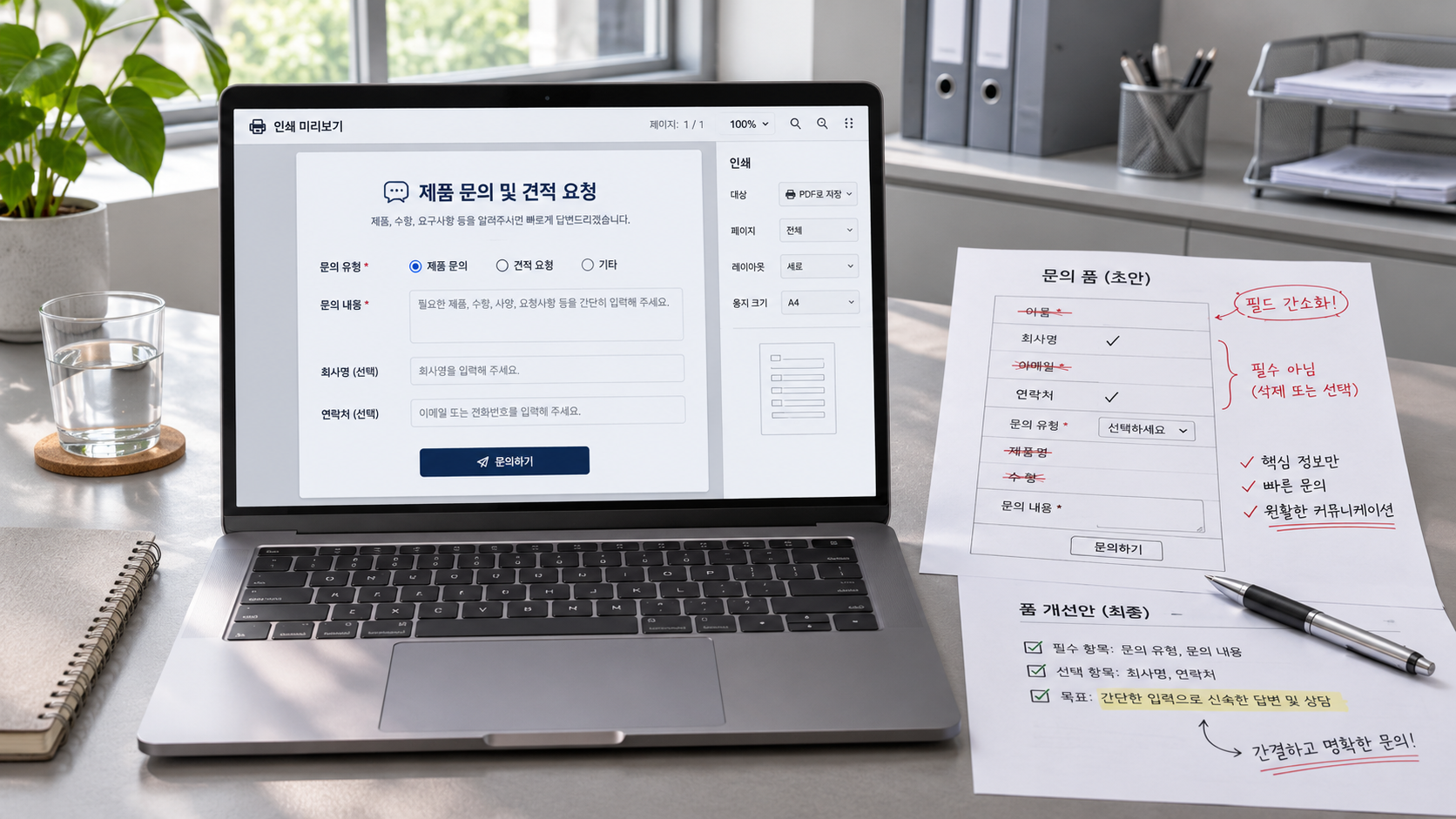
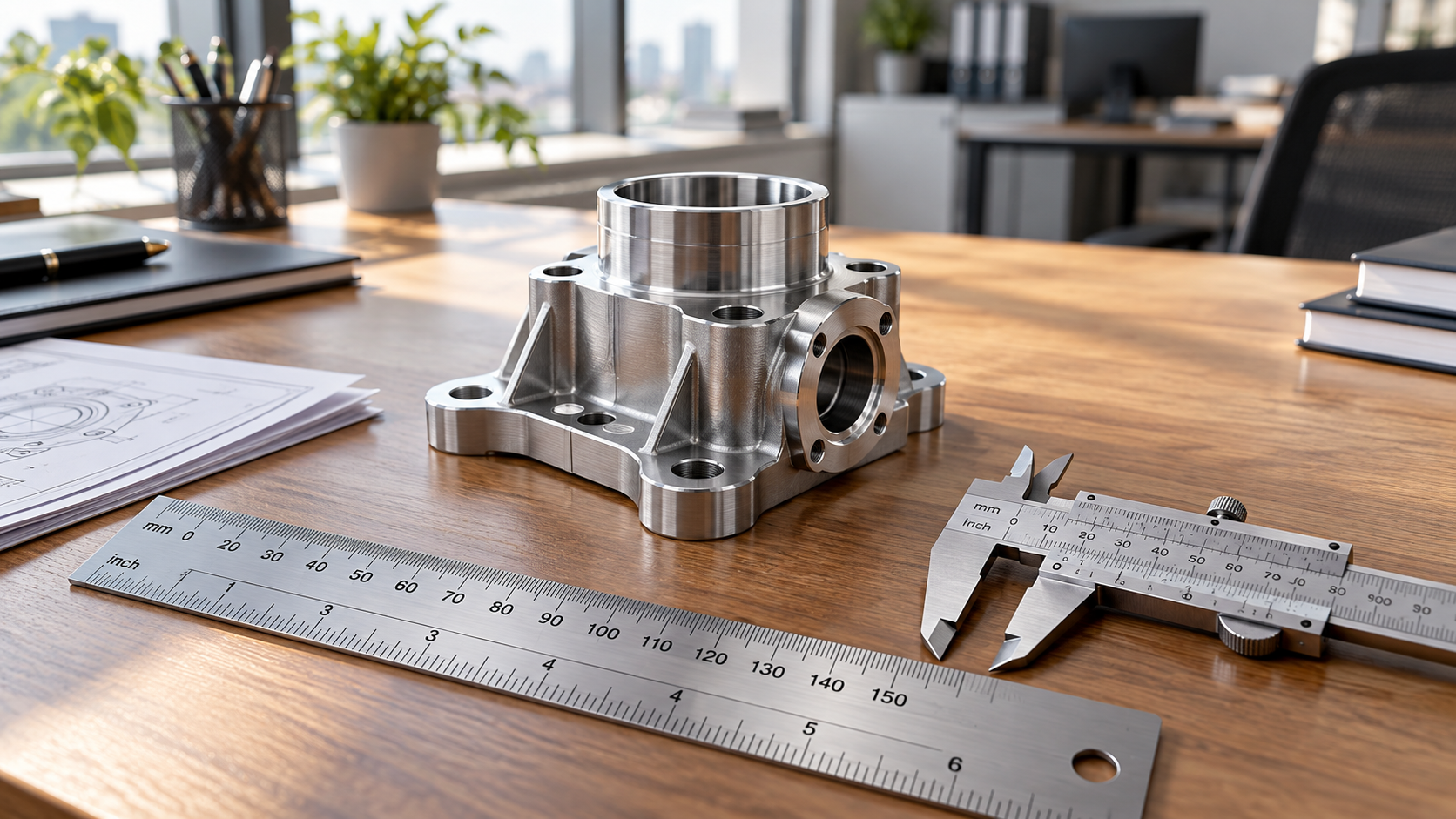
 How Should Units of Measurement for Different Markets Be Handled in Product Page Translation?
Related Products
 Yiyingbao SaaS Intelligent Website Building and Marketing SystemYiyingbao SaaS Intelligent Website Building and Marketing System, AI-powered no-code website building, rapid creation of multilingual B2B international websites in 10 minutes, global server acceleration, AI-powered SEO optimization, helping businesses connect efficiently with global markets. The perfect integration of technology and operation makes building an international trade website remarkably simple
 AI+SEM Intelligent Advertising Marketing SystemAI+SEM drives intelligent ad creation, empowering full-funnel precision advertising marketing. The system automatically generates weekly/monthly reports, AI recommends keywords and target countries, monitors core metrics in real-time with intelligent alerts, and enables one-click high-conversion ad solutions to help quickly acquire customers and improve ROI.
 AI+SEO Dual-Engine System Optimization ServicesYiyingbao’s AI+SEO dual-engine optimization system helps foreign trade enterprises acquire high-quality organic traffic through AI-powered keyword research, content generation, and comprehensive technical optimization, significantly improving search rankings and conversion rates.
 AI+SNS Social Media Marketing SystemYingbao AI+SNS Social Media Marketing System - Precision social capture for the social media era. Supports one-click content synchronization across major platforms like Facebook and LinkedIn. AI intelligently rewrites posts for enhanced relevance. 24/7 AI customer service and user profiling analysis empower businesses to efficiently expand into global markets.
 AI+SEO营销解决方案易营宝AI+SEO营销解决方案,通过AI批量写作、智能生成TDK、精准关键词扩词等功能,全面优化网站SEO效果,提升流量与转化率。助力企业构建高效智能网站新生态。
 AI+SEM Advertising Marketing SolutionsAI+SEM Advertising Marketing Solution leverages AI technology to deeply empower SEM ad campaigns. It automatically generates weekly/monthly reports using AI, presenting account data across multiple dimensions for comprehensive insights into campaign performance and trends. The system precisely recommends keywords and target countries, intelligently generates high-conversion ad copy, and enables one-click activation of efficient campaign plans to help businesses rapidly acquire customers. Simultaneously, it monitors core metrics in real time, intelligently identifies abnormal fluctuations, and issues timely alerts to ensure stable, high-return advertising results.
 Domain Name ServicesEasyWin provides professional domain name services, including intelligent queries, one-stop registration, brand protection, and full lifecycle management, helping businesses build a digital brand image.
 EasyOperate B2C Cross-Border E-Commerce Platform & Independent WebsiteEasyStore B2C Cross-border E-commerce Independent Store is an intelligent website building and cross-border e-commerce integrated solution independently developed by EasyStore Information Technology (Beijing) Co., Ltd. The system is specially designed for small and medium-sized as well as large export enterprises, integrating 'website building, operation, marketing, advertising, and conversion' into one, helping enterprises quickly establish cross-border e-commerce independent stores to achieve brand globalization and global sales growth.
The platform supports multiple languages, multiple currencies, and multi-channel marketing, with built-in AI intelligent translation and SEO optimization systems, suitable for mainstream markets such as Southeast Asia, Europe and America, Latin America, and the Middle East, assisting Chinese manufacturing enterprises in efficiently deploying international e-commerce strategies. SSL证书易营宝提供专业SSL安全证书服务,包括单域名和泛域名证书,确保网站数据传输加密、身份验证和完整性保护,助力企业建立安全可信的在线业务环境。









