









- Amazon Reportedly Sends Exclusivity Warning Letters to Multiplatform SellersNov 03, 2026View details
- New TikTok Shop Cross-Border Returns Rules for Southeast Asia Take Effect on November 5Nov 03, 2026View details
- U.S. Tightens De Minimis Exemption Channel and Revises Section 321 Data PilotNov 03, 2026View details
- Amazon FBA Fuel and Logistics Surcharge in 10 European Countries to Increase to 2% on November 2Nov 02, 2026View details
- EU Customs Code reform to take effect on November 1, with new handling fees for direct-mail small parcelsNov 01, 2026View details
- EU Plans to Raise Tax on Incoming Small Parcels to €5Oct 31, 2026View details
How should inquiry forms be designed for Korean-language websites?
For a Korean-language inquiry website, the key to designing forms is not translating each Chinese field into Korean one by one, but striking a balance between the information customers are willing to provide and the information needed to process their inquiries. For most first-time visitors, leaving their contact details and describing their needs is more important than completing a full purchasing profile all at once.
Form design must also account for what happens after submission: whether Korean content can be saved correctly, whether inquiries enter the workflow of the designated staff, and whether customers know their information has been received. If these steps are not connected, even a form that appears complete on the page may result in lost leads or delayed responses.
Choose fields according to the inquiry scenario; don’t put every question on the same form
Korean-language inquiry website projects typically include entry points for product inquiries, quotes, and business partnerships. These entry points require different information: the purpose of a general contact form is to let customers get in touch easily, while a product quotation form should help sales staff identify which product the customer is asking about. Using one long form for every scenario can confront customers making an initial inquiry with many questions they cannot yet answer.
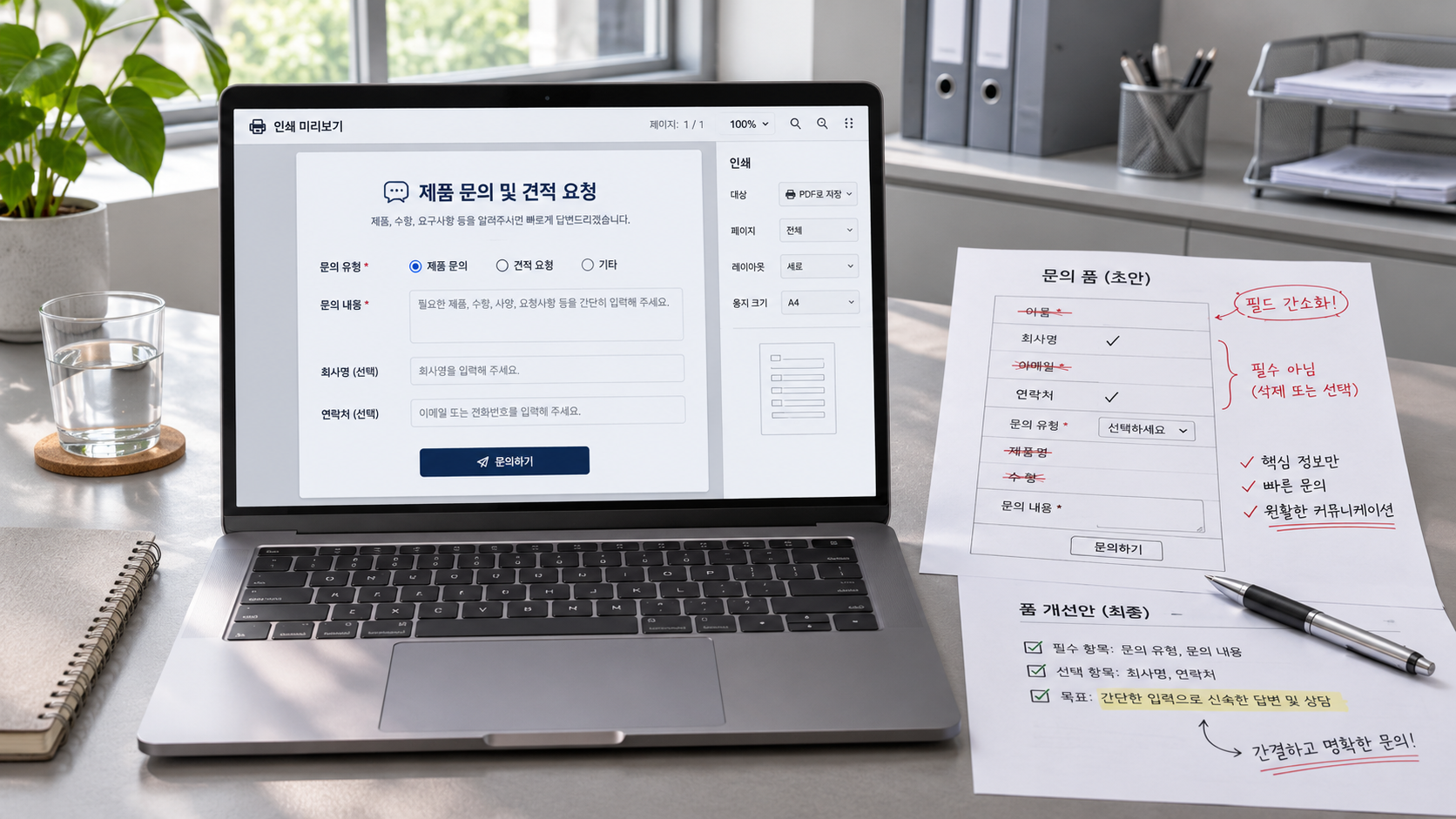
A general form can start with the following fields, with required fields adjusted to suit the actual handling process:
- Name (이름): Used to address and identify the contact.
- Email (이메일): The reply channel; validate the format, but do not restrict email domains.
- Company name (회사명): Helps identify the business context; it can be optional if the business also accepts inquiries from individuals.
- Inquiry details (문의 내용): Lets customers describe the product, intended use, or other requirements.
Whether the phone number (전화번호) should be required depends on whether the business genuinely needs to follow up by phone. If email is sufficient for initial communication, making the phone number optional gives customers a choice. Do not automatically require a phone number, address, and job title just because they make it easier for sales staff to get in touch.
For quotation inquiries on product detail pages, the product name or model can be populated automatically and made editable. Information such as quantity, specifications, and destination can be optional, or displayed only after the customer selects a quotation inquiry. This reduces duplicate entry and avoids blocking customers with a form before they have finalized their purchasing details. Automatically populated product information should also be included with the inquiry in the backend, not just displayed on the page.
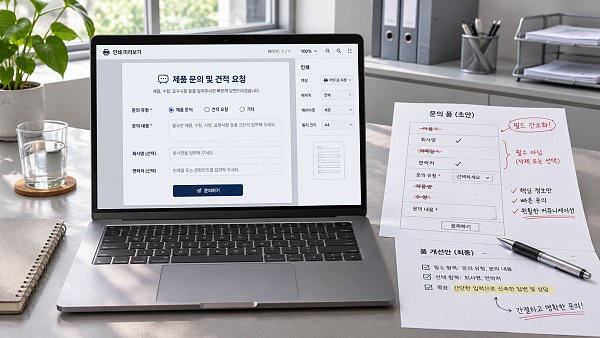
Korean wording should guide the act of filling out the form, not merely translate field names
Korean should be used throughout the form, including its title, fields, prompts, error messages, buttons, and submission feedback. If the page is in Korean but validation errors appear in Chinese or English, it becomes harder for customers to understand and correct them. Buttons can use “문의하기” (Make an inquiry) or “문의 보내기” (Send an inquiry); the wording should match what the page promises. For a quotation scenario, “견적 문의” (Request a quote) describes the action more clearly than a generic “Submit.”
Input prompts should tell customers what to provide rather than mechanically repeat the field name. For example, below the inquiry details field, you could write “제품명, 수량 또는 문의 사항을 입력해 주세요.” (Please enter the product name, quantity, or your inquiry.) The information listed in a prompt should not conflict with the required-field rules: if quantity is optional, do not give customers the impression that they must know it before they can submit the form.
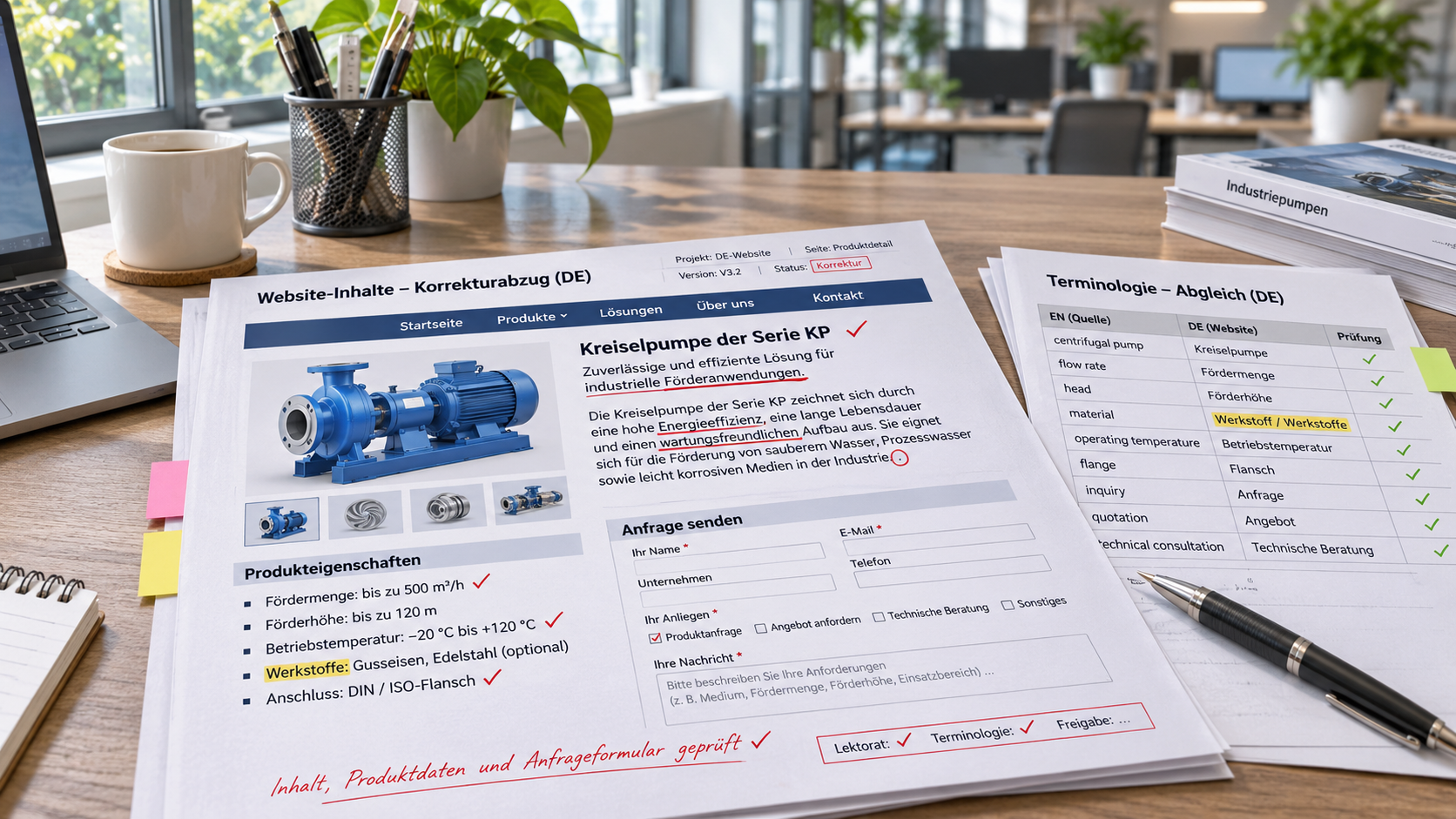
Before launch, have someone familiar with Korean business communication review the entire page, not just individual words. Key points include consistent honorifics, accurate product terminology, error messages that guide customers through corrections, and privacy notices that match actual data-handling practices. For specialized equipment, also verify models, units, and industry terminology to ensure that the translation is consistent with the product documentation.
Show customers what needs correcting and confirm whether their submission succeeded
Clearly mark required fields next to the fields themselves. When submission fails, display the error message near the relevant field and retain the information already entered. For example, if the email format is invalid, show “이메일 주소를 확인해 주세요.” (Please check your email address) rather than displaying a vague error message only at the top of the page. On mobile devices, the page should also scroll to the error so customers do not have to search for it.
If phone numbers are optional, allow reasonable formats such as spaces, hyphens, and international dialing codes; do not accept only one fixed length. For file uploads, clearly state the permitted file types and sizes. If project drawings or specification files are not essential for an initial inquiry, do not make them mandatory by default. If an upload fails, explain why and retain the other information already entered.
Display a success message only after the server confirms receipt; do not show “Submission successful” immediately after the button is clicked. After confirming receipt, you can display “문의가 접수되었습니다.” (Your inquiry has been received) and explain how the customer will be contacted. Any promised response time should match actual staffing and processing capacity. If submission fails, clearly ask the customer to try again and provide another available contact method, so they do not mistakenly believe their inquiry was delivered.
Determine privacy notices and inquiry routing during development
Information such as names, email addresses, and phone numbers involves the processing of personal information. Near the form, clearly explain in Korean who collects the information, the purpose of collection, the information collected, and the retention period, and provide a link to the full privacy policy. If processing is outsourced, data is transferred across borders, or information is provided to third parties, provide the corresponding notices and complete any necessary procedures based on the actual data flows and applicable rules. South Korea’s Personal Information Protection Act may apply; the specific obligations should be assessed by professionals familiar with the relevant laws, taking into account the business entity, service users, and processing methods.
Do not combine privacy consent and marketing subscriptions into a single pre-checked box. Providing contact details to send an inquiry does not mean the customer agrees to receive future advertising. If marketing consent is collected separately, handle its purpose, selection, and recordkeeping separately as well. In the backend, restrict viewing and export permissions to prevent inquiries from being forwarded unnecessarily or left scattered across personal email accounts for long periods.
At project handover, define the complete route from the form to the receiving endpoint: whether inquiries go to the website backend, email, or a customer management system, who receives them, and how to check for missed notifications. It is advisable to retain the submission time, page source, product information, and original Korean content. If translation tools are used to process inquiries, keep the original text as well to prevent models, quantities, or intended uses from being distorted in translation.
Acceptance testing should check not only the page, but also whether the data arrives
During acceptance testing, use the actual form submission process rather than checking only whether the form is displayed. At a minimum, test on desktop and mobile, with missing required fields, invalid email formats, Korean text and special characters, failed attachments, and repeated submission clicks. After confirming that the test data reaches the backend or receiving inbox, check that Korean text is not garbled, product information is complete, and notification links work.
Spam prevention should also accommodate legitimate customers: verification steps should not significantly hinder accessibility or the mobile experience, and there should be a way to review submissions flagged as unusual. If the server encounters an error or email notifications fail, the website should retain records that authorized personnel can check rather than relying solely on a notification email.
After launch, and in accordance with privacy requirements, you can track stages such as form views, form starts, successful submissions, and failed submissions, and review them by entry page. High drop-off near a particular field is only a clue for investigation; the cause should also be assessed in light of the device, page, and error messages. After changing fields, monitor both the completeness of valid inquiries and processing efficiency to avoid increasing submission volume at the expense of sales staff’s ability to assess customer needs.
Related Articles
 How Can German Website Development Avoid the Impact of Machine Translation on Inquiries?
 How should inquiry forms be designed for Korean-language websites?
 How Should Units of Measurement for Different Markets Be Handled in Product Page Translation?

Related Products
 Yiyingbao SaaS Intelligent Website Building and Marketing SystemYiyingbao SaaS Intelligent Website Building and Marketing System, AI-powered no-code website building, rapid creation of multilingual B2B international websites in 10 minutes, global server acceleration, AI-powered SEO optimization, helping businesses connect efficiently with global markets. The perfect integration of technology and operation makes building an international trade website remarkably simple
 AI+SEM Intelligent Advertising Marketing SystemAI+SEM drives intelligent ad creation, empowering full-funnel precision advertising marketing. The system automatically generates weekly/monthly reports, AI recommends keywords and target countries, monitors core metrics in real-time with intelligent alerts, and enables one-click high-conversion ad solutions to help quickly acquire customers and improve ROI.
 AI+SEO Dual-Engine System Optimization ServicesYiyingbao’s AI+SEO dual-engine optimization system helps foreign trade enterprises acquire high-quality organic traffic through AI-powered keyword research, content generation, and comprehensive technical optimization, significantly improving search rankings and conversion rates.
 AI+SNS Social Media Marketing SystemYingbao AI+SNS Social Media Marketing System - Precision social capture for the social media era. Supports one-click content synchronization across major platforms like Facebook and LinkedIn. AI intelligently rewrites posts for enhanced relevance. 24/7 AI customer service and user profiling analysis empower businesses to efficiently expand into global markets.
 AI+SEO营销解决方案易营宝AI+SEO营销解决方案,通过AI批量写作、智能生成TDK、精准关键词扩词等功能,全面优化网站SEO效果,提升流量与转化率。助力企业构建高效智能网站新生态。
 AI+SEM Advertising Marketing SolutionsAI+SEM Advertising Marketing Solution leverages AI technology to deeply empower SEM ad campaigns. It automatically generates weekly/monthly reports using AI, presenting account data across multiple dimensions for comprehensive insights into campaign performance and trends. The system precisely recommends keywords and target countries, intelligently generates high-conversion ad copy, and enables one-click activation of efficient campaign plans to help businesses rapidly acquire customers. Simultaneously, it monitors core metrics in real time, intelligently identifies abnormal fluctuations, and issues timely alerts to ensure stable, high-return advertising results.
 Domain Name ServicesEasyWin provides professional domain name services, including intelligent queries, one-stop registration, brand protection, and full lifecycle management, helping businesses build a digital brand image.
 EasyOperate B2C Cross-Border E-Commerce Platform & Independent WebsiteEasyStore B2C Cross-border E-commerce Independent Store is an intelligent website building and cross-border e-commerce integrated solution independently developed by EasyStore Information Technology (Beijing) Co., Ltd. The system is specially designed for small and medium-sized as well as large export enterprises, integrating 'website building, operation, marketing, advertising, and conversion' into one, helping enterprises quickly establish cross-border e-commerce independent stores to achieve brand globalization and global sales growth.
The platform supports multiple languages, multiple currencies, and multi-channel marketing, with built-in AI intelligent translation and SEO optimization systems, suitable for mainstream markets such as Southeast Asia, Europe and America, Latin America, and the Middle East, assisting Chinese manufacturing enterprises in efficiently deploying international e-commerce strategies. SSL证书易营宝提供专业SSL安全证书服务,包括单域名和泛域名证书,确保网站数据传输加密、身份验证和完整性保护,助力企业建立安全可信的在线业务环境。









