









- Which customer acquisition channels will be affected by cross-border marketing trends in 2026?Sep 06, 2026View details
- Which homogenization risks should be considered in an analysis of the AI-powered website building industry?Aug 30, 2026View details
- How Will AI Marketing Trends 2026 Change Advertising Budget AllocationAug 28, 2026View details
- Is the EV SSL certificate market shrinking or upgrading? How should companies assess certificate procurement?Aug 11, 2026View details
- Why the old AMP SEO 2020 practices no longer work and what has changed in current optimization prioritiesAug 02, 2026View details
- How to Choose Topics for an Industry News Section to Attract More Organic Search TrafficJul 29, 2026View details
How can WordPress alternatives balance editing efficiency and SEO control?
When evaluating WordPress alternatives, technical teams often face a dilemma: content teams want to update pages quickly and publish without relying on developers, while SEO teams are unwilling to give up control over URLs, titles, structured data, redirects, and multilingual rules. For B2B websites targeting overseas markets, this is not simply a comparison of CMS usability; it determines whether content production and organic traffic growth can operate simultaneously in the long term.
Behind searches such as “beste alternative zu wordpress,” users are usually not looking for the platform with the most features. The more practical goal is to find a more stable way to build websites as plugin maintenance, security updates, theme compatibility, and development collaboration costs continue to rise, while retaining sufficient room for SEO operations. Whether an alternative is viable depends on whether it can establish editing efficiency on controllable content and technical rules.
First clarify: Are you replacing WordPress, or the maintenance burden of WordPress?
WordPress itself does not lack SEO capabilities. Its mature plugin ecosystem can handle common requirements such as meta titles, sitemaps, canonical tags, and redirects. However, when a website reaches the stage of multilingual operation, frequent marketing campaigns, multi-person publishing collaboration, or continuous product data updates, issues often shift to system maintenance: Will plugin upgrades affect pages? Can editors use modules correctly? Do developers need to repeatedly intervene to handle templates and performance issues?
Therefore, an alternative should not be assessed only by whether it has a visual editor. If a new system merely makes page building easier while placing SEO settings in a closed backend, or requiring a support ticket for every technical adjustment, short-term launch may be faster, but long-term content operations may actually slow down.
During technical evaluation, start by answering three questions:
- Can the marketing team maintain landing pages, product pages, blog content, and forms without touching code?
- Can SEO personnel manage indexing, URLs, metadata, and redirects separately by page, section, and language version?
- As the number of pages grows, can templates, resource loading, sitemaps, and multilingual pages remain consistent?
If any of these can only be addressed through manual workarounds, the so-called “replacement” often merely shifts complexity from the WordPress plugin layer to the operations and development collaboration layer.
Editing efficiency does not mean freely assembling pages
Many SaaS website-building systems emphasize drag-and-drop editing, which is indeed appealing for campaign pages or early-stage corporate websites. However, for corporate websites focused on long-term SEO, overly unrestricted page editing can easily create inconsistencies in content and technical quality: similar product pages may have different heading hierarchies, images may lack alt text, body modules may be split arbitrarily, and CTA components may be loaded repeatedly, ultimately causing issues with crawling, rendering, and page experience.
A more suitable approach for B2B teams is usually “constrained, high-efficiency editing.” The system predefines templates for product details, industry solutions, case studies, articles, downloadable resources, and advertising landing pages; editors can replace content, select approved components, and adjust commonly used sections, but cannot easily change underlying rules that affect structure and performance.
This type of design applies efficiency to repetitive work rather than requiring every page to be designed from scratch. For websites with numerous models, application scenarios, or country-specific content, templated fields are also more valuable than pure rich-text editing. For example, product specifications, PDF materials, related products, inquiry forms, and regional versions can be managed as unified fields, reducing missed updates and duplicate maintenance.
When evaluating a demo environment, it is worth having business personnel complete a real task: create an English product page, duplicate it as a German version, modify the title, images, and form fields, and then publish a supporting advertising landing page. Whether this process is smooth is more meaningful than the number of features listed in the backend menu.
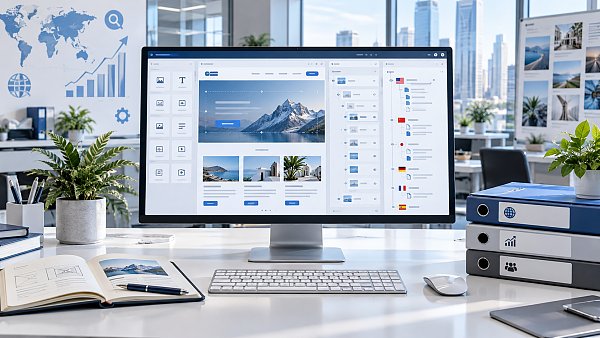
SEO control must be implemented at the page, language, and migration levels
To determine whether a platform is suitable for long-term SEO, it is not enough to see whether it supports Title and Description fields. Nearly all systems provide basic fields. The real differentiators are the granularity of control and whether rules can be executed consistently across content at scale.
Multilingual capabilities in particular are easily underestimated. Foreign trade companies usually need more than simply allowing a website to switch languages; they also need to organize content according to target markets. German pages may need to target procurement professionals in Germany, while English pages serve customers in North America or Southeast Asia; their product terminology, certification information, delivery details, and inquiry paths may not necessarily be the same. If a system provides only multilingual mirror versions of a single piece of content, editing may be convenient, but it limits the scope for localized operations and search optimization.
Likewise, SEO permissions do not mean that everyone can modify every setting. A more reasonable permission design separates content editing, page publishing, SEO configuration, and template management. This enables operations personnel to publish quickly while preventing accidental deletion of redirects, incorrect noindex settings, or arbitrary changes to core templates.
Migration projects are most likely to expose issues “after launch”
When switching from WordPress to a new platform, the most dangerous stage is usually not content import, but the transfer of the old site's search assets. Existing articles, product pages, and landing pages may already be indexed by search engines and may also generate a small but steady flow of inquiries. If only visible body content is migrated without handling URL rules and redirects, traffic fluctuations often become apparent only after the new site goes live.
Before migration, at least four categories of pages should be organized: pages with organic traffic, pages with backlinks, pages that continuously generate inquiries, and historical campaign pages. They may not all need to be retained as they are, but every replaced or removed URL should have a clear destination. For product category restructuring, language directory adjustments, or domain changes, URL mapping rules should be determined before beginning bulk imports.
It should also be confirmed whether the platform allows content and key SEO configurations to be exported. When choosing a cloud website-building system, companies often focus only on launch speed while overlooking whether content, media libraries, form data, redirect tables, and page metadata can be fully retrieved. System lock-in may not cause immediate problems, but it directly affects switching costs when the business enters new markets, the website architecture needs restructuring, or the marketing team changes its technical approach.
For B2B websites expanding overseas, platform selection should be assessed around growth collaboration
Websites for manufacturers, foreign trade companies, and teams supporting brands going global often serve several functions at once: brand presentation, product search, inquiry conversion, advertising destination pages, and content-based lead generation. Purchasing a CMS, translation tool, form tool, SEO plugin, and advertising landing page tool separately can theoretically assemble a complete set of capabilities, but interfaces, data, and permissions can easily become fragmented, while subsequent maintenance costs continue to accumulate.
The value of adopting an integrated intelligent website-building and marketing platform lies in enabling website content, SEO settings, form conversions, and promotional pages to use the same content and page management logic. However, integration should not become a reason for being closed. Technical teams should still verify its openness: whether it supports necessary third-party analytics and advertising code, whether it can integrate with a CRM or lead management system, whether page-level SEO control is retained, and whether multilingual websites can be operated independently by market.
A solution suitable for replacing WordPress is not necessarily the most complex platform. It should enable the content team to publish continuously, allow the SEO team to see and adjust key rules, and prevent developers or technical personnel from becoming a long-term bottleneck for page modifications. For companies that already have search assets, the migration path, URL control, and data portability should be evaluated with the same priority as the editing experience.
Related Articles


Related Products
 Yiyingbao SaaS Intelligent Website Building and Marketing SystemYiyingbao SaaS Intelligent Website Building and Marketing System, AI-powered no-code website building, rapid creation of multilingual B2B international websites in 10 minutes, global server acceleration, AI-powered SEO optimization, helping businesses connect efficiently with global markets. The perfect integration of technology and operation makes building an international trade website remarkably simple
 AI+SEM Intelligent Advertising Marketing SystemAI+SEM drives intelligent ad creation, empowering full-funnel precision advertising marketing. The system automatically generates weekly/monthly reports, AI recommends keywords and target countries, monitors core metrics in real-time with intelligent alerts, and enables one-click high-conversion ad solutions to help quickly acquire customers and improve ROI.
 AI+SEO Dual-Engine System Optimization ServicesYiyingbao’s AI+SEO dual-engine optimization system helps foreign trade enterprises acquire high-quality organic traffic through AI-powered keyword research, content generation, and comprehensive technical optimization, significantly improving search rankings and conversion rates.
 AI+SNS Social Media Marketing SystemYingbao AI+SNS Social Media Marketing System - Precision social capture for the social media era. Supports one-click content synchronization across major platforms like Facebook and LinkedIn. AI intelligently rewrites posts for enhanced relevance. 24/7 AI customer service and user profiling analysis empower businesses to efficiently expand into global markets.
 AI+SEO营销解决方案易营宝AI+SEO营销解决方案,通过AI批量写作、智能生成TDK、精准关键词扩词等功能,全面优化网站SEO效果,提升流量与转化率。助力企业构建高效智能网站新生态。
 AI+SEM Advertising Marketing SolutionsAI+SEM Advertising Marketing Solution leverages AI technology to deeply empower SEM ad campaigns. It automatically generates weekly/monthly reports using AI, presenting account data across multiple dimensions for comprehensive insights into campaign performance and trends. The system precisely recommends keywords and target countries, intelligently generates high-conversion ad copy, and enables one-click activation of efficient campaign plans to help businesses rapidly acquire customers. Simultaneously, it monitors core metrics in real time, intelligently identifies abnormal fluctuations, and issues timely alerts to ensure stable, high-return advertising results.
 Domain Name ServicesEasyWin provides professional domain name services, including intelligent queries, one-stop registration, brand protection, and full lifecycle management, helping businesses build a digital brand image.
 EasyOperate B2C Cross-Border E-Commerce Platform & Independent WebsiteEasyStore B2C Cross-border E-commerce Independent Store is an intelligent website building and cross-border e-commerce integrated solution independently developed by EasyStore Information Technology (Beijing) Co., Ltd. The system is specially designed for small and medium-sized as well as large export enterprises, integrating 'website building, operation, marketing, advertising, and conversion' into one, helping enterprises quickly establish cross-border e-commerce independent stores to achieve brand globalization and global sales growth.
The platform supports multiple languages, multiple currencies, and multi-channel marketing, with built-in AI intelligent translation and SEO optimization systems, suitable for mainstream markets such as Southeast Asia, Europe and America, Latin America, and the Middle East, assisting Chinese manufacturing enterprises in efficiently deploying international e-commerce strategies. SSL证书易营宝提供专业SSL安全证书服务,包括单域名和泛域名证书,确保网站数据传输加密、身份验证和完整性保护,助力企业建立安全可信的在线业务环境。









