









- Which customer acquisition channels will be affected by cross-border marketing trends in 2026?Sep 06, 2026View details
- Which homogenization risks should be considered in an analysis of the AI-powered website building industry?Aug 30, 2026View details
- How Will AI Marketing Trends 2026 Change Advertising Budget AllocationAug 28, 2026View details
- Is the EV SSL certificate market shrinking or upgrading? How should companies assess certificate procurement?Aug 11, 2026View details
- Why the old AMP SEO 2020 practices no longer work and what has changed in current optimization prioritiesAug 02, 2026View details
- How to Choose Topics for an Industry News Section to Attract More Organic Search TrafficJul 29, 2026View details
How to Reduce Version Omissions When Synchronizing Translated Content for Corporate Websites
After a website redesign goes live, the product specifications on the English site may still be from the old version; while the sales team quotes from the new catalog, overseas customers may see discontinued models on the Spanish page; regulatory statements may have been updated on the Chinese site, yet no one is assigned to update pages in other languages. For project managers, such issues are often not caused by “translation quality” itself, but by the lack of a traceable collaboration mechanism for synchronizing translated content on corporate websites.
Once a multilingual website enters the ongoing operation stage, updates are no longer simply about “translating Chinese into English.” Product, technical, marketing, legal, and overseas teams may all initiate changes. Pages may also include reusable modules, downloadable materials, advertising landing pages, and e-commerce product information. If emails, Excel spreadsheets, and manual reminders are still used for coordination, version omissions can easily occur during urgent launches.
First, identify which link in the content workflow is where omissions usually occur
When teams discover that foreign-language content is outdated, their first reaction is often to urge translators to work faster. However, what truly needs to be examined is the entire content workflow. A source-language content update involves at least several steps: “confirming the change—identifying affected pages—creating translation tasks—translation review and publishing—verifying live status.” If any of these steps is not recorded, the issue will carry over into the next release.
Common version omissions generally fall into three categories:
- The source content has changed, but no translation task was created. For example, a parameter table, footer contact information, or site-wide after-sales terms may be modified without notifying the person responsible for multilingual content.
- The translation has been completed but has not entered the publishing queue. The page may have been updated in the testing environment while the live site still displays the old copy; or only the English version may have been published, with French, Arabic, and other sites omitted.
- A localized update disrupts page consistency. The main text may be updated with a new model, while the SEO title, image Alt text, PDF materials, form options, and structured data still point to outdated information.
Project owners need to avoid one misconception: treating “whether a page has been translated” as the only status. More useful questions are: Does the current translation correspond to the latest source version, has it passed review, and has it taken effect on the target site? These three statuses must not be confused.
Establish “content master data” instead of letting each team keep its own copy of the text
The starting point for reducing synchronization omissions in corporate website translations is to establish a single trusted source of content. Frequently used information such as product names, specifications, certification descriptions, brand messaging, and contact details must not be stored separately in design files, product manuals, sales PPTs, and the website backend. Otherwise, every change becomes like looking for a needle among multiple copies.
It is recommended to manage content in layers based on its nature: product master data should be maintained by the product or engineering department; brand and marketing copy should be handled by the marketing team; terms, privacy policies, and compliance statements should have clearly designated legal approvers; website editors should only arrange and publish content according to the process, rather than being responsible for determining whether information is accurate.
For each key content item, the system can retain a content ID, source-language version number, owner, effective date, and applicable markets. In this way, when an engineering manager changes the “operating temperature range” from one value to another, the system or project tracker can clearly indicate which languages, product pages, and download-center materials need to be reviewed, rather than relying on one person’s memory.
Use change requests to drive translation, rather than driving collaboration with “please update this”
Routine minor changes are the easiest to underestimate. A message such as “change the delivery time” or “add a new certification icon” is often sent through instant messaging and then buried in communication records. For website operations, any update that may affect external messaging should be documented through a lightweight change request.
A change request does not need to be complicated, but it should at least specify five items: the location and link of the change, the text or materials before and after modification, affected languages and markets, launch priority, and business approver. If product parameters, pricing policies, regulatory matters, or safety information are involved, mandatory reviewers and the expected effective date should also be added.
In particular, “urgent” needs to be clearly defined. Truly urgent content, such as incorrect contact information, compliance-risk information, or discontinued products, should allow the source site to be corrected first while a high-priority multilingual task is created simultaneously; routine marketing optimizations should enter scheduled publishing batches. Labeling everything as urgent will only cause the review and translation queues to lose order.
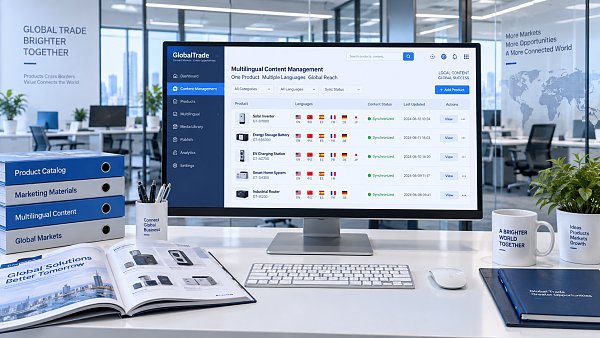
An actionable status dashboard should answer four questions
The value of a dashboard is not to add management tasks, but to enable project owners to see “open-loop items” before publication. Especially before trade shows, advertising campaigns, or new product launches, filtering out unsynchronized pages first is more reliable than fixing them one by one after going live.
Technical tools should identify differences, while people should confirm context
Purely manual copy-and-paste is not only slow, but also makes module-level content updates difficult to detect. More mature multilingual website management methods link source-language pages with target-language pages: once source content is updated, target pages are automatically marked as “needs updating”; shared blocks such as navigation, footers, inquiry forms, and product parameter modules are managed as unified components to avoid page-by-page revisions.
Taking Easy Marketing Bao’s AI-powered website building and multilingual website development solutions for foreign trade enterprises as an example, project teams can manage pages in different languages, product content, and promotional landing pages through a unified backend, incorporating content updates, SEO element maintenance, and publishing schedules into the same workflow. This is particularly important for companies that simultaneously conduct Google SEO, advertising, and overseas social media traffic acquisition: if advertising promises, landing page information, and product materials on the official website are inconsistent, the loss is not limited to a single click—it can also affect customers’ perception of the brand.
However, automatic synchronization does not mean automatic publishing. Machines can identify field changes, send task notifications, and flag missing translations, but they cannot understand the boundaries of expression in different markets. For example, a direct translation of the Chinese phrase “industry-leading” may not be suitable for the European market; certain technical certifications may require different annotations in different countries. Therefore, it is recommended that tools handle repetitive work, while marketing or localization reviewers are responsible for terminology, tone, compliance, and cultural adaptation.
Before publishing, do not only review the main text: conduct a “horizontal check”
Many teams limit acceptance checks to “the page opens and the text has been replaced.” However, the areas where multilingual pages truly go wrong are often outside the main text. Before publishing, you can quickly spot-check in the following order:
- Verify that the page title, Meta Description, URL, breadcrumbs, and H tags are consistent with the page topic;
- Check product parameters, units, currencies, date formats, and versions of downloadable materials;
- Confirm that buttons, form fields, automatic reply emails, WhatsApp links, and email links have all been localized;
- Check whether embedded text in images, Alt text, video subtitles, and PDFs are still in the old language or from an old version;
- Review redirects, language switching, mobile layout, and form submission from the perspective of visitors in the target country.
For high-traffic core pages, it is worth retaining a “24-hour post-publication review” step. Search engine caches, CDN caches, form notifications, and third-party embedded content may not be fully refreshed immediately upon publication, and a follow-up review can promptly identify these issues that are not obvious on the surface.
Incorporate synchronization rates into the project cadence instead of assigning blame only after problems arise
The goal of synchronizing corporate website translation content is not to require every language to be completely identical every second, but to ensure that key content accurately reaches target markets within a business-acceptable timeframe. Project owners can set update deadlines for different content levels and regularly monitor three signals: whether pages awaiting synchronization continue to accumulate, whether the same type of issue recurs, and whether the source-to-target version gap for key pages is widening.
Once the process includes content master data, change entry points, responsibility boundaries, and publication verification, a multilingual website will no longer be a group of difficult-to-maintain “replicated sites.” It will become a global touchpoint that can be updated reliably as the business changes. For companies expanding into overseas markets, version management may seem like a backend detail, but what customers see is whether the brand is reliable and whether its information is trustworthy.
Related Articles

Related Products
 Yiyingbao SaaS Intelligent Website Building and Marketing SystemYiyingbao SaaS Intelligent Website Building and Marketing System, AI-powered no-code website building, rapid creation of multilingual B2B international websites in 10 minutes, global server acceleration, AI-powered SEO optimization, helping businesses connect efficiently with global markets. The perfect integration of technology and operation makes building an international trade website remarkably simple
 AI+SEM Intelligent Advertising Marketing SystemAI+SEM drives intelligent ad creation, empowering full-funnel precision advertising marketing. The system automatically generates weekly/monthly reports, AI recommends keywords and target countries, monitors core metrics in real-time with intelligent alerts, and enables one-click high-conversion ad solutions to help quickly acquire customers and improve ROI.
 AI+SEO Dual-Engine System Optimization ServicesYiyingbao’s AI+SEO dual-engine optimization system helps foreign trade enterprises acquire high-quality organic traffic through AI-powered keyword research, content generation, and comprehensive technical optimization, significantly improving search rankings and conversion rates.
 AI+SNS Social Media Marketing SystemYingbao AI+SNS Social Media Marketing System - Precision social capture for the social media era. Supports one-click content synchronization across major platforms like Facebook and LinkedIn. AI intelligently rewrites posts for enhanced relevance. 24/7 AI customer service and user profiling analysis empower businesses to efficiently expand into global markets.
 AI+SEO营销解决方案易营宝AI+SEO营销解决方案,通过AI批量写作、智能生成TDK、精准关键词扩词等功能,全面优化网站SEO效果,提升流量与转化率。助力企业构建高效智能网站新生态。
 AI+SEM Advertising Marketing SolutionsAI+SEM Advertising Marketing Solution leverages AI technology to deeply empower SEM ad campaigns. It automatically generates weekly/monthly reports using AI, presenting account data across multiple dimensions for comprehensive insights into campaign performance and trends. The system precisely recommends keywords and target countries, intelligently generates high-conversion ad copy, and enables one-click activation of efficient campaign plans to help businesses rapidly acquire customers. Simultaneously, it monitors core metrics in real time, intelligently identifies abnormal fluctuations, and issues timely alerts to ensure stable, high-return advertising results.
 Domain Name ServicesEasyWin provides professional domain name services, including intelligent queries, one-stop registration, brand protection, and full lifecycle management, helping businesses build a digital brand image.
 EasyOperate B2C Cross-Border E-Commerce Platform & Independent WebsiteEasyStore B2C Cross-border E-commerce Independent Store is an intelligent website building and cross-border e-commerce integrated solution independently developed by EasyStore Information Technology (Beijing) Co., Ltd. The system is specially designed for small and medium-sized as well as large export enterprises, integrating 'website building, operation, marketing, advertising, and conversion' into one, helping enterprises quickly establish cross-border e-commerce independent stores to achieve brand globalization and global sales growth.
The platform supports multiple languages, multiple currencies, and multi-channel marketing, with built-in AI intelligent translation and SEO optimization systems, suitable for mainstream markets such as Southeast Asia, Europe and America, Latin America, and the Middle East, assisting Chinese manufacturing enterprises in efficiently deploying international e-commerce strategies. SSL证书易营宝提供专业SSL安全证书服务,包括单域名和泛域名证书,确保网站数据传输加密、身份验证和完整性保护,助力企业建立安全可信的在线业务环境。









