









- Which customer acquisition channels will be affected by cross-border marketing trends in 2026?Sep 06, 2026View details
- Which homogenization risks should be considered in an analysis of the AI-powered website building industry?Aug 30, 2026View details
- How Will AI Marketing Trends 2026 Change Advertising Budget AllocationAug 28, 2026View details
- Is the EV SSL certificate market shrinking or upgrading? How should companies assess certificate procurement?Aug 11, 2026View details
- Why the old AMP SEO 2020 practices no longer work and what has changed in current optimization prioritiesAug 02, 2026View details
- How to Choose Topics for an Industry News Section to Attract More Organic Search TrafficJul 29, 2026View details
Can the multilingual content production cycle be shortened from 7 days to 2 days
Can the multilingual content production cycle be shortened from 7 days to 2 days? For foreign trade and global expansion companies, this is not just an efficiency issue; it is also closely tied to traffic acquisition, advertising alignment, and conversion growth in global markets.
Why do many companies get stuck with multilingual content cycles of more than 7 days?
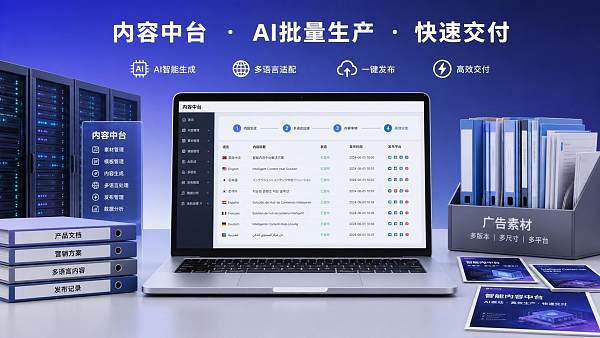
In an integrated website + marketing service scenario, multilingual content is not simply about translating web pages. It often involves site structure, keyword mapping, ad creatives, landing page conversion, regional compliance, and technical publishing processes at the same time. What truly slows progress is usually not writing itself, but disorganized cross-department collaboration.
When many companies discuss whether the multilingual content production cycle can be shortened from 7 days to 2 days, the first solution they think of is adding more translators. But in practice, the problem often lies in inconsistent source content, conflicting keyword strategies across different markets, a disconnect between design and campaign schedules, and the lack of post-publication verification, all of which lead to repeated rework.
This is especially true when foreign trade websites, cross-border e-commerce stores, and overseas advertising landing pages are being advanced at the same time. Companies will also encounter a chain of issues, such as how to reduce the hreflang error rate of multilingual websites, how to make multilingual ad creatives for overseas campaigns work together, and how to control global node access latency within 100ms. A long cycle is often only the surface symptom.
- Scattered requirement sources: marketing, sales, product teams, and agents submit requirements at the same time, making it difficult to unify versions.
- Fragmented keyword strategy: website content, SEO pages, and Google Ads keyword packages do not share a common semantic library.
- Delayed technical publishing: pages are generated quickly, but site deployment, tag validation, and speed testing are slow.
- Insufficient localization: literal translation can be delivered, but it cannot be directly used for inquiry acquisition or ad conversion.
Compressing the cycle to 2 days is not about overtime, but about process restructuring
If a company operates a multilingual official website, B2B inquiry pages, and Google Ads accounts at the same time, and wants to reduce the cycle from 7 days to 2 days, it must adopt a combined approach of “content middle platform + AI generation + human review + batch publishing”. Relying on isolated tools alone makes stable delivery difficult.
The advantage of 易营宝 lies in placing intelligent website building, AI+SEO/GEO optimization, AI advertising marketing systems, and multi-region deployment capabilities into the same workflow. The value of this approach is not simply greater speed, but the creation of a closed loop among content production, page generation, advertising collaboration, and data feedback.
Key breakdown of 2-day delivery
- Step 1: First unify the source content, including product selling points, industry terminology, target countries, and target conversion actions.
- Step 2: Build multilingual keyword mapping to prevent SEO pages and ad copy from speaking different languages strategically.
- Step 3: Use AI to generate page drafts, ad headlines, descriptions, and creative scripts in batches.
- Step 4: Conduct localization review, focusing on terminology accuracy, call-to-action wording, and policy-sensitive terms.
- Step 5: Publish with one click and validate hreflang, indexing settings, speed, and conversion tracking points.
In other words, the answer to whether the multilingual content production cycle can be shortened from 7 days to 2 days is yes, but only if the process is standardized, tools are connected, and responsibility milestones are clear, rather than relying on individual experience to push things forward.
Where exactly is the difference between a 7-day process and a 2-day process?
The comparison table below is suitable for determining whether a company’s current bottleneck lies in content production, technical publishing, or advertising collaboration. For teams debating whether SEO or Google Ads is better for foreign trade customer acquisition, this table can also help explain why the two must share the same content foundation.
On the surface, it looks like a reduction in time; in essence, it is a shift from a serial process to a parallel process. For demanding markets such as Germany, France, Japan, and South Korea, this change can also reduce wasted ad spend caused by translation deviations and inconsistent page structures.
How can multilingual websites, SEO, and ad creatives truly work together?
Many global expansion teams assign official website content, SEO articles, and Google Ads creatives to different service providers. The result is that there is never a clear answer to how multilingual ad creatives for overseas campaigns can be aligned. The most common problem is that the website talks about product specifications, the ads talk about promotions, while the landing page fails to match the core search intent.
In an integrated solution, multilingual content should be built around the same semantic framework: core keywords, regional variants, industry scenario terms, and conversion terms. This not only helps answer whether SEO or Google Ads is better for foreign trade customer acquisition, but also enables the two channels to amplify each other instead of consuming each other’s value.
Three types of assets that should be prioritized for integration
- Website assets: category pages, product pages, solution pages, case study pages, and FAQ pages.
- Advertising assets: search ad headlines, descriptions, callouts, form pages, and remarketing copy.
- Data assets: click-through rate, search terms, bounce rate, inquiry rate, and regional dwell time.
For example, achieving a 3% CTR for Google Ads in the German market cannot be solved simply by changing ad headlines. If the landing page language sounds unnatural, loads slowly, or its selling points are disconnected from the ad promise, even the most precise keywords will struggle to convert. Content alignment is essentially about maintaining a consistent experience before and after the click.
When purchasing or building in-house, which parameters and delivery milestones should be prioritized?
When a company is preparing to introduce multilingual website building and marketing services, buyers are usually most concerned about three questions: whether Google Ads managed operation or self-managed advertising is more cost-effective, whether an AI advertising system can automatically optimize multilingual ads, and whether an AI advertising system can reduce manpower for multilingual ad campaigns. When evaluating options, do not look only at the quotation; pay more attention to delivery boundaries.
If a company already has an internal advertising team, managed operation may not necessarily save more money. However, if the company lacks multilingual campaign experience, keyword structuring capability, and the ability to connect landing pages with ads, using a mature system and service team usually helps it enter a positive growth cycle faster.
Technical points that are easily overlooked: hreflang, speed, and post-revamp recovery
After launching multilingual websites, many companies discover indexing confusion, country versions pointing to the wrong pages, and declining ad quality scores. The root cause is often not poor content, but rough technical implementation. To reduce the hreflang error rate of a multilingual website, checks must be conducted across four areas at the same time: language and region tags, reciprocal references, canonical URLs, and sitemaps.
In addition, controlling global node access latency within 100ms cannot be assessed only by server location. It also depends on static resource distribution, image compression strategy, script loading order, the amount of third-party code, and the local network environment of the target market. If the access experience is poor, both SEO and advertising will be affected together.
Checklist for recovering growth after a website revamp
- Whether old pages have corresponding redirects to avoid losing authority for core pages in the European market.
- Whether new pages retain the original high-converting keywords and inquiry entry points.
- Whether language versions correspond one-to-one to prevent search engines from misjudging duplicate content.
- Whether the final URLs in ad accounts have been updated synchronously.
So, can European inquiry volume recover and grow after a revamp? Yes, but only if the revamp is not merely a change of interface, but a rebuild of URL mapping, conversion paths, localized content, and the advertising workflow together.
FAQ: 4 decision-making questions companies ask most often
Can an AI advertising system automatically optimize multilingual ads?
It can optimize them, but only when the account structure is clear, conversion tracking is accurate, and creative tags are complete. AI is better suited for handling batch testing, bid adjustments, creative rotation, and low-performing keyword filtering. It is not suitable for forced automation when the source content is disorganized. The smarter the system, the more it depends on the quality of front-end data.
Which is more cost-effective: Google Ads managed operation or running ads in-house?
If a company has a limited budget but a single product category, and its internal staff have basic English and advertising skills, it can first run ads in-house to validate the market. If expansion involves multiple languages such as German, French, and Japanese, and the website, SEO, and advertising need to move forward simultaneously, managed operation or integrated services are usually more cost-effective because the cost of trial and error is lower.
For foreign trade customer acquisition, is SEO or Google Ads better?
The two are not substitutes for each other. SEO is suitable for building long-term organic traffic and brand credibility, while Google Ads is suitable for quickly validating country markets, product directions, and inquiry costs. For multilingual websites, the best approach is to use ads to test demand first, then use SEO to amplify high-value pages.
How can Google Ads CTR in the German market reach 3%?
First segment high-intent keywords, then align ad headlines, callouts, and above-the-fold selling points on the landing page. At the same time, improve localized wording and loading speed. Users in the German-speaking market are highly sensitive to professional terminology, delivery time, specifications, and qualification statements. The more specific the copy is, the easier it is to improve both click-through rate and conversion rate.
Why choose us: solving multilingual delivery challenges with one workflow from website building to growth
For foreign trade companies, manufacturing factories, cross-border e-commerce sellers, and global brand expansion teams, what is truly scarce is not a single piece of content, but a multilingual growth mechanism that can be continuously replicated. With AI-driven intelligent website building, AI+SEO/GEO optimization systems, AI advertising marketing systems, and overseas marketing service capabilities, 易营宝 helps companies integrate content, pages, campaigns, and data into the same process.
If you are evaluating whether the multilingual content production cycle can be shortened from 7 days to 2 days, or dealing with questions such as how to reduce the hreflang error rate of multilingual websites, whether an AI advertising system can reduce manpower for multilingual campaigns, and whether European inquiry volume can recover and grow after a revamp, you can directly discuss the following topics:
- Website-building selection advice for multilingual official websites, B2B inquiry websites, or cross-border e-commerce stores.
- Integrated campaign rhythm design for Google SEO and Google Ads.
- Delivery cycles, publishing processes, and technical validation items for pages in different languages.
- Keyword strategies for target countries, ad creative alignment, and landing page optimization directions.
- Overseas node deployment, access performance optimization, and multilingual revamp recovery solutions.
When content production, website technology, and overseas marketing are advanced within the same methodology, 2 days is not an aggressive target, but a manageable, replicable, and continuously optimizable delivery rhythm. For companies that hope to open overseas inquiry growth channels as soon as possible, this type of integrated solution is worth evaluating early.
Related Articles
Related Products
 Yiyingbao SaaS Intelligent Website Building and Marketing SystemYiyingbao SaaS Intelligent Website Building and Marketing System, AI-powered no-code website building, rapid creation of multilingual B2B international websites in 10 minutes, global server acceleration, AI-powered SEO optimization, helping businesses connect efficiently with global markets. The perfect integration of technology and operation makes building an international trade website remarkably simple
 AI+SEM Intelligent Advertising Marketing SystemAI+SEM drives intelligent ad creation, empowering full-funnel precision advertising marketing. The system automatically generates weekly/monthly reports, AI recommends keywords and target countries, monitors core metrics in real-time with intelligent alerts, and enables one-click high-conversion ad solutions to help quickly acquire customers and improve ROI.
 AI+SEO Dual-Engine System Optimization ServicesYiyingbao’s AI+SEO dual-engine optimization system helps foreign trade enterprises acquire high-quality organic traffic through AI-powered keyword research, content generation, and comprehensive technical optimization, significantly improving search rankings and conversion rates.
 AI+SNS Social Media Marketing SystemYingbao AI+SNS Social Media Marketing System - Precision social capture for the social media era. Supports one-click content synchronization across major platforms like Facebook and LinkedIn. AI intelligently rewrites posts for enhanced relevance. 24/7 AI customer service and user profiling analysis empower businesses to efficiently expand into global markets.
 AI+SEO营销解决方案易营宝AI+SEO营销解决方案,通过AI批量写作、智能生成TDK、精准关键词扩词等功能,全面优化网站SEO效果,提升流量与转化率。助力企业构建高效智能网站新生态。
 AI+SEM Advertising Marketing SolutionsAI+SEM Advertising Marketing Solution leverages AI technology to deeply empower SEM ad campaigns. It automatically generates weekly/monthly reports using AI, presenting account data across multiple dimensions for comprehensive insights into campaign performance and trends. The system precisely recommends keywords and target countries, intelligently generates high-conversion ad copy, and enables one-click activation of efficient campaign plans to help businesses rapidly acquire customers. Simultaneously, it monitors core metrics in real time, intelligently identifies abnormal fluctuations, and issues timely alerts to ensure stable, high-return advertising results.
 Domain Name ServicesEasyWin provides professional domain name services, including intelligent queries, one-stop registration, brand protection, and full lifecycle management, helping businesses build a digital brand image.
 EasyOperate B2C Cross-Border E-Commerce Platform & Independent WebsiteEasyStore B2C Cross-border E-commerce Independent Store is an intelligent website building and cross-border e-commerce integrated solution independently developed by EasyStore Information Technology (Beijing) Co., Ltd. The system is specially designed for small and medium-sized as well as large export enterprises, integrating 'website building, operation, marketing, advertising, and conversion' into one, helping enterprises quickly establish cross-border e-commerce independent stores to achieve brand globalization and global sales growth.
The platform supports multiple languages, multiple currencies, and multi-channel marketing, with built-in AI intelligent translation and SEO optimization systems, suitable for mainstream markets such as Southeast Asia, Europe and America, Latin America, and the Middle East, assisting Chinese manufacturing enterprises in efficiently deploying international e-commerce strategies. SSL证书易营宝提供专业SSL安全证书服务,包括单域名和泛域名证书,确保网站数据传输加密、身份验证和完整性保护,助力企业建立安全可信的在线业务环境。









