









- Which customer acquisition channels will be affected by cross-border marketing trends in 2026?Sep 06, 2026View details
- Which homogenization risks should be considered in an analysis of the AI-powered website building industry?Aug 30, 2026View details
- How Will AI Marketing Trends 2026 Change Advertising Budget AllocationAug 28, 2026View details
- Is the EV SSL certificate market shrinking or upgrading? How should companies assess certificate procurement?Aug 11, 2026View details
- Why the old AMP SEO 2020 practices no longer work and what has changed in current optimization prioritiesAug 02, 2026View details
- How to Choose Topics for an Industry News Section to Attract More Organic Search TrafficJul 29, 2026View details
What needs to change in the process to shorten the multilingual content cycle to 2 days
Can the multilingual content production cycle be shortened from 7 days to 2 days? The key is not only faster translation, but also process restructuring, role collaboration, and AI tool integration. This article breaks down practical efficiency-improvement methods across the full chain, from websites and content to ad delivery.
Why Many Companies Slow Down Multilingual Content Production: The Problem Is Not Translation Itself
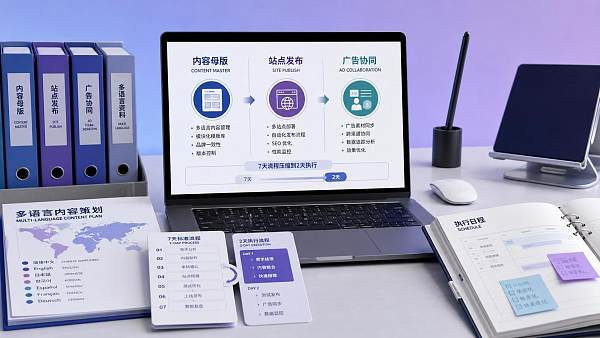
When many companies discuss whether the multilingual content production cycle can be shortened from 7 days to 2 days, their first reaction is to add translators or purchase translation tools. But what really slows delivery is often scattered demand intake, repeated page-structure revisions, inconsistent terminology, overly long review chains, and websites and ad creatives being produced in separate silos.
In an integrated website + marketing service scenario, multilingual content is not a single piece of copy. It is a coordinated project involving website pages, product pages, landing pages, ad headlines, social media assets, search descriptions, form fields, and technical tags. If only translation speed is improved while the process remains unchanged, the overall cycle still cannot be compressed.
This is especially true for foreign trade companies, manufacturing factories, cross-border e-commerce sellers, and brands expanding overseas, where website launch and campaign activation often move forward at the same time. If there is no unified standard for how to coordinate multilingual overseas ad creatives, disconnects will occur: the website has been updated but the ads have not, or the ad copy has gone live while the landing page is still unfinished.
- Slow at the requirements level: marketing, sales, and product teams submit requests separately, with no unified priorities or publishing schedule.
- Disorganized at the asset level: headlines, selling points, parameters, case studies, and form fields lack a master template, leading to heavy duplicate writing.
- Disconnected at the technical level: page publishing, hreflang tagging, indexing checks, and ad tracking do not have a parallel workflow.
- Fragmented at the campaign level: SEO pages, Google Ads landing pages, and social media creatives are inconsistent in style and messaging.
What Needs to Change in the Process to Compress 7 Days into 2 Days
If the goal is to truly shorten the delivery cycle, companies need to move from “write first, translate later” to “build the structure first, generate in batches, review synchronously, and publish in parallel.” This is not a single-point optimization, but a restructuring of the content production line.
The following workflow table is suitable for assessing the gap between the current team and a 2-day delivery model. It can also help determine the real prerequisites behind questions such as whether an AI advertising system can reduce the manpower required for multilingual ad delivery.
As the table shows, 2 days does not mean forcing everyone to be busier. It means allowing more steps to run in parallel. Through the linkage of intelligent website building, AI+SEO/GEO optimization, and the AI advertising marketing system, 易营宝 is well suited to connect websites, multilingual pages, and campaign creatives, reducing cross-tool transfer and repeated rework.
Four Actions Recommended for Priority Improvement
- Build the content master template first. This includes page structure, field definitions, CTA buttons, form items, and core selling points, so each language version no longer needs to be rewritten from scratch.
- Establish a terminology database. Unify brand names, product specifications, delivery terms, and certification expressions to reduce translation conflicts and repeated returns for revision.
- Plan SEO and advertising together. For foreign trade customer acquisition, the question should not be whether SEO or Google Ads is better. Instead, short-term lead generation and long-term indexing goals should be divided according to market maturity.
- Perform technical validation before launch. Reducing the hreflang error rate of multilingual websites does not depend on post-launch troubleshooting, but on automatically checking the correspondence between language versions before publishing.
How Websites, SEO, and Ads Should Work Together to Avoid Repeated Rework
The biggest risk in improving multilingual content efficiency is “the page team builds first, the ad team modifies next, and the SEO team fills in last.” As a result, keywords, titles, selling points, and form paths are often inconsistent, affecting both conversion and search engine understanding.
For example, achieving a 3% CTR for Google Ads in the German market is not only about writing good ad headlines. It also depends on whether search terms match the landing page title, whether the first screen is sufficiently localized, whether loading speed is stable, and whether the form is concise and trustworthy.
The following collaboration table is more suitable for procurement decision-making. It can help companies understand whether Google Ads agency operation or self-managed advertising is more cost-effective, and also clarify what capabilities an internal team needs to build.
If a company needs to consider long-term SEO growth, short-term advertising-based customer acquisition, and improved AI search visibility at the same time, integrated execution is usually more stable than pure media buying or pure website building. The reason is simple: only when content assets, traffic assets, and conversion assets accumulate within one closed loop can optimization become faster over time.
Which Technical Metrics Must Be Monitored to Truly Launch Within 2 Days
Even if the process has been changed, a 2-day launch is still difficult if the underlying technology becomes a bottleneck. The most common bottlenecks in multilingual website launch fall into three categories: mapping errors between language versions, unstable global access speed, and missing ad tracking and form callback data.
Key Items That Must Be Checked First
- How to reduce the hreflang error rate of multilingual websites: focus on checking language and region codes, reciprocal pointing relationships, default version settings, and whether duplicate pages have been incorrectly tagged.
- How to keep global node access latency within 100ms: deploy nearby nodes according to target markets, distribute static resources, compress images, and apply caching strategies, rather than only checking access speed from the headquarters location.
- Can inquiry volume in Europe recover and grow after a website redesign: first check old URL redirects, indexing status, form availability, and mobile speed, then evaluate the depth of content localization.
- Can an AI advertising system automatically optimize multilingual ads: the prerequisite is that account structure, conversion events, language creatives, and landing page versions have already been standardized; otherwise, automation will only amplify the chaos.
For AI-driven website building and overseas marketing platforms such as 易营宝, the advantage is not only fast page generation, but also the ability to manage website building, SEO, advertising, and multi-market publishing within one unified system. This reduces technical breakpoints and is suitable for overseas expansion projects with tight delivery-cycle requirements.
How Foreign Trade Companies Should Choose: SEO First or Google Ads First
Whether SEO or Google Ads is better for foreign trade customer acquisition should be assessed based on country, industry keyword competition, average order value, and delivery rhythm. If a new product has just entered the market, advertising is often needed first to validate search demand and conversion copy. If the product line is stable, SEO is more suitable for accumulating long-term traffic.
Companies do not need to struggle with choosing only one. They should instead focus on whether both channels share the same page structure and keyword database. High-click keywords obtained through advertising can feed back into SEO topic selection; stable indexing of SEO pages can in turn reduce some advertising education costs.
Scenarios Suitable for Running Ads First
- Testing a new market and needing to quickly validate country, category, and quotation strategies.
- A new website has just launched and has not yet built organic indexing or rankings.
- There is a clear time window, such as exhibitions, promotions, or peak-season stocking.
Scenarios Suitable for Strengthening SEO
- Search demand for product keywords is stable, and the user decision cycle is relatively long.
- More long-tail keywords, solution keywords, comparison keywords, and technical Q&A keywords need to be covered.
- The company hopes to reduce long-term customer acquisition costs and improve brand visibility in AI search.
FAQ: Common Questions Companies Ask When Improving Multilingual Efficiency
Which is more cost-effective, Google Ads agency operation or self-managed advertising?
If the company does not have a mature multilingual creative system, conversion tracking capability, and landing page collaboration mechanism, self-managed advertising often wastes budget through trial and error. If there is already a stable marketing team and data analysis capability, self-management offers higher control. If there are many markets, many languages, and frequent launches, integrated agency operation saves more manpower.
Can an AI advertising system reduce the manpower required for multilingual ad delivery?
Yes, but the prerequisite is structured creative assets. After headlines, selling points, regional versions, audience intent, and landing page URLs are broken down into fields, an AI advertising system can generate and test multilingual variants faster. If assets are still scattered across separate documents, the effectiveness of automation will be significantly reduced.
How can Google Ads CTR in the German market reach 3%?
It usually requires simultaneous optimization of keyword matching, copy localization, extensions, first-screen page relevance, and loading speed. CTR is not an isolated metric; low-quality landing pages will drag down impressions and clicks. Especially in industrial products and B2B scenarios, parameters, certifications, delivery times, and application scenarios in headlines are more important than vague promotional claims.
Can inquiry volume in Europe recover and grow after a website redesign?
It can recover, but the technical foundation must be fixed first, followed by strengthening content and conversion paths. If the redesign causes URL changes, language-version confusion, form failures, or slower mobile speed, inquiry volume will often drop first before stabilizing. The length of the recovery period depends on the speed of technical fixes and the quality of page reconstruction.
Why Choose Us: If You Want to Compress the Multilingual Content Cycle to 2 Days, Start the Conversation with These Questions
For companies that need to advance multilingual website construction, Google SEO optimization, Google Ads delivery, and overseas social media traffic acquisition at the same time, relying only on single-point outsourcing makes it difficult to truly improve speed. Based on its self-developed cloud intelligent website building system, cross-border mall system, AI advertising marketing system, and AI+SEO/GEO optimization system, 易营宝 is better suited to support integrated collaboration needs across “website building + content + advertising + data feedback.”
If you are evaluating whether the multilingual content production cycle can be shortened from 7 days to 2 days, it is recommended to first discuss the following: target markets and language priorities, existing website structure, current hreflang and indexing status, whether ad accounts need migration, number of landing pages, form and CRM integration methods, and inquiry recovery goals after redesign.
- Consultation on parameter confirmation: target countries, number of pages, number of languages, launch time window, and node deployment requirements.
- Consultation on product selection: B2B foreign trade website, B2C independent site, cross-border mall, multilingual official website, or ad landing page solution.
- Consultation on delivery cycle: scheduling from content master template organization, page building, and multilingual publishing to advertising linkage.
- Consultation on customized solutions: how SEO and Google Ads should work together, whether the AI advertising system fits the existing team, and how to define localization depth for different markets.
- Consultation on quotation communication: budget breakdown based on website scale, language scope, advertising depth, and agency operation needs.
If your team is currently facing questions such as how to reduce the hreflang error rate of multilingual websites, how to coordinate multilingual overseas ad creatives, and whether Google Ads agency operation or self-managed advertising is more cost-effective, it is worth conducting a process diagnosis now. Streamline the process first, then discuss scaling. Only then will 2-day delivery be more than just a slogan.
Related Articles
Related Products
 Yiyingbao SaaS Intelligent Website Building and Marketing SystemYiyingbao SaaS Intelligent Website Building and Marketing System, AI-powered no-code website building, rapid creation of multilingual B2B international websites in 10 minutes, global server acceleration, AI-powered SEO optimization, helping businesses connect efficiently with global markets. The perfect integration of technology and operation makes building an international trade website remarkably simple
 AI+SEM Intelligent Advertising Marketing SystemAI+SEM drives intelligent ad creation, empowering full-funnel precision advertising marketing. The system automatically generates weekly/monthly reports, AI recommends keywords and target countries, monitors core metrics in real-time with intelligent alerts, and enables one-click high-conversion ad solutions to help quickly acquire customers and improve ROI.
 AI+SEO Dual-Engine System Optimization ServicesYiyingbao’s AI+SEO dual-engine optimization system helps foreign trade enterprises acquire high-quality organic traffic through AI-powered keyword research, content generation, and comprehensive technical optimization, significantly improving search rankings and conversion rates.
 AI+SNS Social Media Marketing SystemYingbao AI+SNS Social Media Marketing System - Precision social capture for the social media era. Supports one-click content synchronization across major platforms like Facebook and LinkedIn. AI intelligently rewrites posts for enhanced relevance. 24/7 AI customer service and user profiling analysis empower businesses to efficiently expand into global markets.
 AI+SEO营销解决方案易营宝AI+SEO营销解决方案,通过AI批量写作、智能生成TDK、精准关键词扩词等功能,全面优化网站SEO效果,提升流量与转化率。助力企业构建高效智能网站新生态。
 AI+SEM Advertising Marketing SolutionsAI+SEM Advertising Marketing Solution leverages AI technology to deeply empower SEM ad campaigns. It automatically generates weekly/monthly reports using AI, presenting account data across multiple dimensions for comprehensive insights into campaign performance and trends. The system precisely recommends keywords and target countries, intelligently generates high-conversion ad copy, and enables one-click activation of efficient campaign plans to help businesses rapidly acquire customers. Simultaneously, it monitors core metrics in real time, intelligently identifies abnormal fluctuations, and issues timely alerts to ensure stable, high-return advertising results.
 Domain Name ServicesEasyWin provides professional domain name services, including intelligent queries, one-stop registration, brand protection, and full lifecycle management, helping businesses build a digital brand image.
 EasyOperate B2C Cross-Border E-Commerce Platform & Independent WebsiteEasyStore B2C Cross-border E-commerce Independent Store is an intelligent website building and cross-border e-commerce integrated solution independently developed by EasyStore Information Technology (Beijing) Co., Ltd. The system is specially designed for small and medium-sized as well as large export enterprises, integrating 'website building, operation, marketing, advertising, and conversion' into one, helping enterprises quickly establish cross-border e-commerce independent stores to achieve brand globalization and global sales growth.
The platform supports multiple languages, multiple currencies, and multi-channel marketing, with built-in AI intelligent translation and SEO optimization systems, suitable for mainstream markets such as Southeast Asia, Europe and America, Latin America, and the Middle East, assisting Chinese manufacturing enterprises in efficiently deploying international e-commerce strategies. SSL证书易营宝提供专业SSL安全证书服务,包括单域名和泛域名证书,确保网站数据传输加密、身份验证和完整性保护,助力企业建立安全可信的在线业务环境。









