









- Which customer acquisition channels will be affected by cross-border marketing trends in 2026?Sep 06, 2026View details
- Which homogenization risks should be considered in an analysis of the AI-powered website building industry?Aug 30, 2026View details
- How Will AI Marketing Trends 2026 Change Advertising Budget AllocationAug 28, 2026View details
- Is the EV SSL certificate market shrinking or upgrading? How should companies assess certificate procurement?Aug 11, 2026View details
- Why the old AMP SEO 2020 practices no longer work and what has changed in current optimization prioritiesAug 02, 2026View details
- How to Choose Topics for an Industry News Section to Attract More Organic Search TrafficJul 29, 2026View details
Does an SSL certificate need to be renewed every year? Explanation of the renewal rules for different certificate types
Does an SSL security certificate need to be renewed every year? In many website maintenance processes, this issue may seem simple, but in fact it is not only related to the expiration date. The certificate type, issuing authority rules, server deployment method, and business scenario can all affect subsequent arrangements. For websites, standalone sites, and multilingual official websites serving overseas customers, once a certificate expires, it may not only trigger browser warnings, but also affect form submissions, landing page conversions, and search engines' judgment of the site's credibility.
First, the conclusion: most SSL certificates require regular renewal
The mainstream publicly issued SSL security certificates today are not long-term valid certificates. Under normal circumstances, renewal and redeployment must be completed before the validity period ends.
In other words, does an SSL security certificate need to be renewed every year? In the past, some certificates could be issued for two years or even longer, but in recent years industry rules have continued to tighten, and the validity period of publicly trusted certificates has been significantly shortened.
From the perspective of actual operations and maintenance, it is more accurate to understand certificate management as “periodic renewal” rather than simply remembering “once a year”.
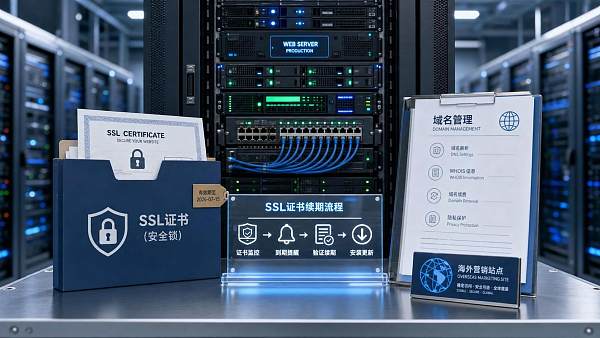
For continuously online business pages such as smart website building, cross-border e-commerce, and advertising landing pages, certificate status is part of the basic infrastructure and is not suitable to be dealt with only after a browser error appears.
Why is certificate renewal always discussed in the industry?
The reason certificate renewal is repeatedly raised is not because the process is complicated, but because it has a wide range of impacts. After a certificate expires, visitors will first see a risk warning, and many people will not continue to visit.
If the website performs actions such as inquiry collection, payment, registration, or file download, an expired certificate may directly interrupt the conversion path. For websites that rely on SEO and advertising, this kind of loss is often more expensive than the certificate fee.
In website + marketing service integrated scenarios, technical maintenance and marketing results are not separated. If the landing page cannot be opened, the form submission reports an error, or the browser shows insecure, all of this will drag down promotion performance.
Platforms like Yiyingbao that simultaneously cover smart website building, SEO optimization, advertising delivery, and overseas standalone site operations usually pay more attention to these underlying details such as certificates, domains, and site availability, because they directly affect indexing, access experience, and business conversion.
Different certificate types have different renewal rules
To answer whether SSL security certificates need to be renewed every year, the first step is to distinguish the certificate type. Certificate names may look similar, but the management methods differ significantly.
Look at the validation level
DV certificates are commonly used for official websites, content sites, and ordinary landing pages. OV and EV are more suitable for brand sites, platform-based websites, or businesses with higher identity display requirements.
Look at the deployment scope
A single-domain certificate only protects one domain. A wildcard certificate usually protects multiple subdomains under the same primary domain. A multi-domain certificate is suitable for unified management of multiple different domains.
These differences affect renewal complexity. When there are many sub-sites, multilingual sites, e-commerce sites, and official website subdomain deployments, certificate list management is more important than buying the certificate itself.
Why does “annual renewal” become a common saying?
Many people assume that SSL security certificates need to be renewed every year? The answer is “usually yes.” This is because the actual management cycle of many mainstream certificates is close to one year, or they are purchased and renewed on an annual basis.
Even if customers purchase multi-year services at once, in practice it may still be issued in phases rather than a single certificate remaining valid forever. The industry increasingly emphasizes short-cycle validation to reduce the risks caused by key leakage, entity changes, and configuration out-of-control.
Simply put, purchase term and single issuance validity period are not the same thing. During maintenance, do not look only at the contract term; pay more attention to the expiration date on the certificate file.
In actual business, which scenarios are most prone to problems
Certificate failures are often not because people do not know about renewal, but because the business chain is too long and responsibilities are dispersed. The following situations are the most common.
- The domain name, server, and certificate are maintained by different providers, and no one centrally receives renewal reminder information.
- After a website redesign, the server was switched and the old certificate was not fully migrated.
- Multilingual sites, e-commerce sites, and campaign pages are deployed in a decentralized way, and some subdomains miss renewal.
- Automatic renewal has been enabled, but the validation method has expired, causing renewal failure.
- After company information changes, the review materials for OV or EV certificates are inconsistent.
When doing overseas marketing, these issues are even more hidden. Although advertising, social media, and search engines are still continuously driving traffic, users who arrive at the landing page have already lost during the browser warning step.
Renewal is not just about changing the certificate, but also about the deployment chain
When judging whether SSL security certificates need to be renewed every year, do not stop at the purchase level. What really affects stability is the installation, binding, redirection, and compatibility checks after renewal.
A complete process usually includes: confirming the expiration time, completing issuance verification, replacing the server certificate, checking the intermediate certificate chain, verifying HTTPS redirects, checking for mixed content, and retesting forms and payment flows.
If the website is connected to CDN, load balancing, reverse proxy, or multi-node deployment, certificate updates also need to verify each layer of configuration to avoid the front end being updated while the origin remains expired.
For platform-based systems using SaaS website building, this part can usually be standardized. Certificate monitoring, automatic renewal, and coordinated site deployment are more stable than manual maintenance.
How to determine which renewal strategy the current website should use
No strategy is suitable for all websites, but it can be quickly judged from several dimensions.
- If the site structure is simple, a DV certificate plus automatic renewal is usually sufficient.
- If the website needs to support brand presentation and trust communication, an OV certificate can be considered.
- If it involves high-value transactions, platform business, or strict compliance requirements, EV renewal materials need to be planned in advance.
- If there are many subdomains, a wildcard certificate is more convenient for unified maintenance.
- If multiple sites are distributed across marketing, e-commerce, content, and form systems, it is suitable to establish a unified certificate account.
For a platform like Yiyingbao that covers website building, SEO, advertising, and AI marketing systems, one of its values is to manage site security, accessibility, and marketing performance on the same chain rather than handling them separately.
A more stable approach is to incorporate certificate renewal into routine maintenance
Does an SSL security certificate need to be renewed every year? From a management practice perspective, what is more worth remembering is not “whether it is every year,” but “whether a workable renewal mechanism has been established.”
You can first sort out the correspondence relationship between the domain name, certificate, server, and website, then set up expiration reminders, validation method checks, and post-deployment return tests. For foreign trade official websites, cross-border e-commerce sites, and multilingual standalone sites, this step is more cost-effective than temporary emergency fixes.
If you are currently evaluating a website building or marketing system, you can also include certificate management capabilities in your decision criteria: whether it supports automatic renewal, whether it has unified monitoring, and whether it can reduce omissions across multiple sites. Once these basic items are under control, the website's security, indexing, and conversion can be more stably promoted.
Related Articles



Related Products
 Yiyingbao SaaS Intelligent Website Building and Marketing SystemYiyingbao SaaS Intelligent Website Building and Marketing System, AI-powered no-code website building, rapid creation of multilingual B2B international websites in 10 minutes, global server acceleration, AI-powered SEO optimization, helping businesses connect efficiently with global markets. The perfect integration of technology and operation makes building an international trade website remarkably simple
 AI+SEM Intelligent Advertising Marketing SystemAI+SEM drives intelligent ad creation, empowering full-funnel precision advertising marketing. The system automatically generates weekly/monthly reports, AI recommends keywords and target countries, monitors core metrics in real-time with intelligent alerts, and enables one-click high-conversion ad solutions to help quickly acquire customers and improve ROI.
 AI+SEO Dual-Engine System Optimization ServicesYiyingbao’s AI+SEO dual-engine optimization system helps foreign trade enterprises acquire high-quality organic traffic through AI-powered keyword research, content generation, and comprehensive technical optimization, significantly improving search rankings and conversion rates.
 AI+SNS Social Media Marketing SystemYingbao AI+SNS Social Media Marketing System - Precision social capture for the social media era. Supports one-click content synchronization across major platforms like Facebook and LinkedIn. AI intelligently rewrites posts for enhanced relevance. 24/7 AI customer service and user profiling analysis empower businesses to efficiently expand into global markets.
 AI+SEO营销解决方案易营宝AI+SEO营销解决方案,通过AI批量写作、智能生成TDK、精准关键词扩词等功能,全面优化网站SEO效果,提升流量与转化率。助力企业构建高效智能网站新生态。
 AI+SEM Advertising Marketing SolutionsAI+SEM Advertising Marketing Solution leverages AI technology to deeply empower SEM ad campaigns. It automatically generates weekly/monthly reports using AI, presenting account data across multiple dimensions for comprehensive insights into campaign performance and trends. The system precisely recommends keywords and target countries, intelligently generates high-conversion ad copy, and enables one-click activation of efficient campaign plans to help businesses rapidly acquire customers. Simultaneously, it monitors core metrics in real time, intelligently identifies abnormal fluctuations, and issues timely alerts to ensure stable, high-return advertising results.
 Domain Name ServicesEasyWin provides professional domain name services, including intelligent queries, one-stop registration, brand protection, and full lifecycle management, helping businesses build a digital brand image.
 EasyOperate B2C Cross-Border E-Commerce Platform & Independent WebsiteEasyStore B2C Cross-border E-commerce Independent Store is an intelligent website building and cross-border e-commerce integrated solution independently developed by EasyStore Information Technology (Beijing) Co., Ltd. The system is specially designed for small and medium-sized as well as large export enterprises, integrating 'website building, operation, marketing, advertising, and conversion' into one, helping enterprises quickly establish cross-border e-commerce independent stores to achieve brand globalization and global sales growth.
The platform supports multiple languages, multiple currencies, and multi-channel marketing, with built-in AI intelligent translation and SEO optimization systems, suitable for mainstream markets such as Southeast Asia, Europe and America, Latin America, and the Middle East, assisting Chinese manufacturing enterprises in efficiently deploying international e-commerce strategies. SSL证书易营宝提供专业SSL安全证书服务,包括单域名和泛域名证书,确保网站数据传输加密、身份验证和完整性保护,助力企业建立安全可信的在线业务环境。









