









- CBP Finalizes Electronic Rail Export Manifest Rule, Effective October 26, 2026Oct 26, 2026View details
- Amazon’s 2026 peak season surcharge takes effect on October 25Oct 26, 2026View details
- AI Is Eating SaaS: Three Real-World Cases in One AfternoonOct 25, 2026View details
- Exiger CEO: The SaaS Apocalypse Is Real, but It Means Something DifferentOct 25, 2026View details
- Hengqin Cooperation Zone Shares Cross-Border E-Commerce Developments, Focusing on Macao-Hengqin Collaboration and International MarketsOct 24, 2026View details
- A Shenyang study highlights the development of the “cross-border e-commerce + industrial cluster” modelOct 24, 2026View details
What qualifications are required to build an agricultural product export website
When preparing to build an independent overseas website, companies often confuse “launching the website” with “whether agricultural products can be exported”: the pages have been designed and English product information uploaded, but they then find that customers are asking about phytosanitary certificates, certificates of origin, or labeling requirements. Some companies directly display certifications they have not yet obtained on their websites, which instead undermines buyer trust.
What qualifications are required to build an agricultural product export website? The conclusion first: the website itself generally does not require a separate set of “export website qualifications” simply because it displays agricultural products. However, the operating entity should have legal business status; when exports are actually conducted, it must also meet requirements relating to customs, inspection and quarantine, product market access, destination-country labeling, and food safety. If the website is hosted on a server in mainland China, the relevant website filing or licensing requirements must also be addressed. Before building the website, “business identity, export qualifications, product documentation, and website compliance” should be checked separately.
First clarify: Website qualifications are not the same as export qualifications
An agricultural product website targeting overseas buyers serves functions such as product presentation, lead generation, inquiry collection, and transaction facilitation. It can introduce product categories, origins, packaging, supply capacity, and quality control processes, but the website cannot replace export declarations, quarantine certificates, or destination-country market access.
Therefore, when preparing materials, first determine which type of website is involved:
- Showcase website: Mainly focused on company information, product catalogs, and inquiry forms. The key requirements are authentic entity information, accurate product descriptions, and complete privacy and contact information.
- B2B inquiry website: In addition to product presentation, it collects purchasing requirements, sample requests, and quotation information. It should clearly state how inquiry data will be used and prepare verifiable documentation related to the products.
- Online store or direct-payment website: Where orders, payments, delivery, refunds, and consumer information processing are involved, compliance requirements are higher; requirements for consumer rights, taxation, and data processing may also differ by sales market.
For many agricultural product companies, the real issue is not whether a webpage can be published, but whether the business department has confirmed “whether this product may be exported to the target market and which accompanying documents are required.” Without accurate information, the website team can only use vague statements such as “high quality” and “meets international standards,” which is neither conducive to conversion nor free of compliance risks.
What basic materials should be prepared for business operations and exports?
First, a valid business license should be in place, and the business scope should match agricultural product production, processing, sales, or import and export operations. The website footer or “About Us” page should display basic entity information such as the company’s official name, contact address, and public contact details; the wording of names, trademarks, and product brands should be consistent with actual ownership rights.
When goods are actually exported, registration or filing with customs and other relevant authorities is generally also required, along with customs declaration, inspection, quarantine, and other procedures based on the nature of the goods. Different agricultural products vary greatly: fresh fruits and vegetables, grains, tea, nuts, honey, meat, aquatic products, condiments, and deeply processed foods do not face the same regulatory conditions.
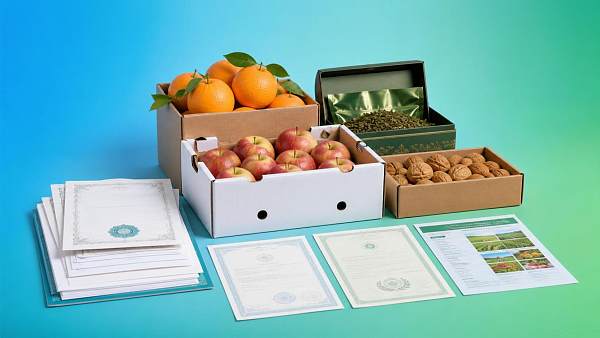
In practice, the following materials may be organized as a priority, but they should not be understood as a fixed list that is inevitably required for every product and every country:
- Business license, trademark registration, or authorization documents for trademark use;
- Product specifications, including product name, raw materials, grade, net content, packaging method, storage conditions, and shelf life;
- Documents related to the export batch or product, such as customs declaration, origin, sanitary, or phytosanitary documents;
- Applicable licenses, filings, or management records for production, processing, and storage;
- Test reports, ingredient information, pesticide residue or microbiological test information, label text, and other materials required by the destination country;
- Valid supporting documentation and scope of application for claims such as organic, green, and geographical indications.
Among these, plants and plant products often require attention to phytosanitary requirements; food of animal origin, aquatic products, and dairy products often involve stricter overseas market access conditions. A document that is usable domestically does not necessarily mean it will be recognized by the destination country. Before export, further confirmation should be obtained from local customs, testing institutions, or importers based on the product code, export destination, and trade method.
Which website content is most likely to cause problems?
Agricultural product websites do not need to publicly disclose scanned copies of all certificates, but should ensure that “any claim made can be supported by evidence.” For example, statements such as “pesticide-residue-free,” “organic,” “export grade,” “meets a certain country’s standards,” or “available for direct supply to a certain region” should not be published solely based on sales messaging. Expired certificates, certificates that do not apply to the relevant product, or test samples unrelated to the actual sales batch cannot serve as a basis for long-term promotion either.
A more prudent approach is to establish a corresponding relationship between documentation and each product page: the page name corresponds to the official product name, specification parameters correspond to the product specification sheet, certification marks correspond to valid certificates, and test conclusions correspond to specific test items. For markets not yet entered, limited statements such as “relevant documents can be provided according to destination-country requirements” may be used, rather than committing in advance to customs clearance or market access outcomes.
Server, privacy, and payment functions should also be decided in advance
If the website uses a server in mainland China, website filing is generally required in accordance with applicable regulations; whether a value-added telecommunications business license is involved depends on the actual services and business model provided by the website and cannot be determined solely by whether “there is a website.” Although websites using overseas servers are not subject to the same mainland China server filing requirements, they should still ensure that the domain name, entity information, and content are legal and compliant.
When setting up inquiry forms, it is advisable to collect only the information necessary for quotations, sampling, and communication, and to state on the page the purpose of collection, scope of use, and contact channels. If products are sold directly to overseas consumers, applicable privacy policies, shipping instructions, return and exchange policies, tax information, and payment terms should also be added. The payment account name, contracting entity, and entity displayed on the website should preferably be consistent to prevent buyers from finding mismatched information during due diligence.
Frequently Asked Questions
Can an English website be built before there are export orders?
A showcase and inquiry website can be built first, but product pages should avoid claiming that the product has obtained market access qualifications in a particular country. Company information, product specifications, packaging capabilities, and available quality documentation can be completed first, followed by targeted content once the target market has been confirmed.
Is it better to put more business licenses and certificates on the website?
Not necessarily. Publicly disclosed materials should take information security, document validity periods, and language accuracy into account. Qualifications that help with purchasing decisions may display summaries or partial information, while complete documents can be provided for verification through the appropriate process after the buyer makes a request.
Can an agricultural product page directly state “meets the standards of the importing country”?
This is appropriate only when the product, batch, and destination-country requirements have all been verified and supporting evidence is available. After changing the packaging, formula, origin, or country of sale, the original conclusion may no longer apply, and labeling, testing, and market access requirements should be reviewed again.
Related Articles
 EU Accuses TEMU of Selling Unsafe Products; TEMU Submits Plan and Pledges Corrective Action
 Amazon US to Add Dangerous Goods Declaration Requirements for Four Product Categories Starting October 26
 Is the data security of digital marketing SaaS guaranteed?


Related Products
 Yiyingbao SaaS Intelligent Website Building and Marketing SystemYiyingbao SaaS Intelligent Website Building and Marketing System, AI-powered no-code website building, rapid creation of multilingual B2B international websites in 10 minutes, global server acceleration, AI-powered SEO optimization, helping businesses connect efficiently with global markets. The perfect integration of technology and operation makes building an international trade website remarkably simple
 AI+SEM Intelligent Advertising Marketing SystemAI+SEM drives intelligent ad creation, empowering full-funnel precision advertising marketing. The system automatically generates weekly/monthly reports, AI recommends keywords and target countries, monitors core metrics in real-time with intelligent alerts, and enables one-click high-conversion ad solutions to help quickly acquire customers and improve ROI.
 AI+SEO Dual-Engine System Optimization ServicesYiyingbao’s AI+SEO dual-engine optimization system helps foreign trade enterprises acquire high-quality organic traffic through AI-powered keyword research, content generation, and comprehensive technical optimization, significantly improving search rankings and conversion rates.
 AI+SNS Social Media Marketing SystemYingbao AI+SNS Social Media Marketing System - Precision social capture for the social media era. Supports one-click content synchronization across major platforms like Facebook and LinkedIn. AI intelligently rewrites posts for enhanced relevance. 24/7 AI customer service and user profiling analysis empower businesses to efficiently expand into global markets.
 AI+SEO营销解决方案易营宝AI+SEO营销解决方案,通过AI批量写作、智能生成TDK、精准关键词扩词等功能,全面优化网站SEO效果,提升流量与转化率。助力企业构建高效智能网站新生态。
 AI+SEM Advertising Marketing SolutionsAI+SEM Advertising Marketing Solution leverages AI technology to deeply empower SEM ad campaigns. It automatically generates weekly/monthly reports using AI, presenting account data across multiple dimensions for comprehensive insights into campaign performance and trends. The system precisely recommends keywords and target countries, intelligently generates high-conversion ad copy, and enables one-click activation of efficient campaign plans to help businesses rapidly acquire customers. Simultaneously, it monitors core metrics in real time, intelligently identifies abnormal fluctuations, and issues timely alerts to ensure stable, high-return advertising results.
 Domain Name ServicesEasyWin provides professional domain name services, including intelligent queries, one-stop registration, brand protection, and full lifecycle management, helping businesses build a digital brand image.
 EasyOperate B2C Cross-Border E-Commerce Platform & Independent WebsiteEasyStore B2C Cross-border E-commerce Independent Store is an intelligent website building and cross-border e-commerce integrated solution independently developed by EasyStore Information Technology (Beijing) Co., Ltd. The system is specially designed for small and medium-sized as well as large export enterprises, integrating 'website building, operation, marketing, advertising, and conversion' into one, helping enterprises quickly establish cross-border e-commerce independent stores to achieve brand globalization and global sales growth.
The platform supports multiple languages, multiple currencies, and multi-channel marketing, with built-in AI intelligent translation and SEO optimization systems, suitable for mainstream markets such as Southeast Asia, Europe and America, Latin America, and the Middle East, assisting Chinese manufacturing enterprises in efficiently deploying international e-commerce strategies. SSL证书易营宝提供专业SSL安全证书服务,包括单域名和泛域名证书,确保网站数据传输加密、身份验证和完整性保护,助力企业建立安全可信的在线业务环境。









