









- Can the average annual growth rate reflect real opportunities in overseas markets?Oct 07, 2026View details
- Which customer acquisition channels will be affected by cross-border marketing trends in 2026?Sep 06, 2026View details
- Which homogenization risks should be considered in an analysis of the AI-powered website building industry?Aug 30, 2026View details
- How Will AI Marketing Trends 2026 Change Advertising Budget AllocationAug 28, 2026View details
- Is the EV SSL certificate market shrinking or upgrading? How should companies assess certificate procurement?Aug 11, 2026View details
- Why the old AMP SEO 2020 practices no longer work and what has changed in current optimization prioritiesAug 02, 2026View details
What qualifications are required to build an agricultural product export website
What qualifications are required to build an agricultural product export website? The short answer is that the website itself usually does not require a separate “website-building license,” but the business entity, export qualifications, product access documents, and website content must be able to withstand verification by overseas customers, platforms, and customs procedures. The required materials vary for fresh fruits and vegetables, tea, grain, honey, nuts, or processed foods, so you cannot simply look at which certificates are displayed on competitors’ websites.
Many companies tend to confuse “being able to go live” with “being able to close deals.” An English-language website can go live quickly, but what buyers will actually ask is: Who are you? Can you export? Are the products compliant? Where do the goods come from? Who conducts the testing? If qualifications are incompletely prepared, even if the website receives traffic, inquiries can easily stall at the sample, factory audit, or contract confirmation stage.
What Qualifications Are Required to Build an Agricultural Product Export Website: First Distinguish Four Types of Documents
In practice, it is recommended to divide documents into four categories: “business identity, export capability, product compliance, and website operations.” Not every document needs to be publicly displayed, but the website backend and sales team should be able to retrieve them at any time to avoid having to prepare materials at the last minute when customers request them.
- Business identity documents:A business license is fundamental. If the website targets overseas markets, it is recommended to also prepare a standardized English company name, registered address, contact person, company profile, and photos of the factory or warehouse. If the entity is a trading company, accurately describe its role in the supply chain rather than presenting partner factories as self-owned factories.
- Documents related to export operations:The company must meet the registration or filing requirements needed to conduct import and export business, and complete customs, tax, foreign exchange, and other procedures according to its actual business activities. Requirements may vary across regions and company statuses, so the latest requirements of competent authorities such as commerce and customs departments should prevail.
- Product quality and food safety documents:Common materials include product test reports, pesticide residue or heavy metal tests, certificates of origin, batch records, packaging and labeling documents, and quality management system documents. Exported food products may also involve production licenses, export food manufacturer filings, or registrations and certifications required by overseas markets.
- Website operation materials:Domain name real-name registration information, privacy policies, Cookie notices, explanations of data processing for inquiry forms, and clear company contact information. If the website supports online ordering, payment collection, or advertising targeted at specific regions, payment, tax, and consumer protection rules must also be reviewed.
Here is a practical guideline: if the website is only for B2B display and inquiry generation, the focus is on enabling customers to verify the company and products; if the website sells directly to overseas consumers, the compliance scope expands significantly, and logistics, taxes, returns and exchanges, payments, and food labeling requirements in the destination country cannot be overlooked.
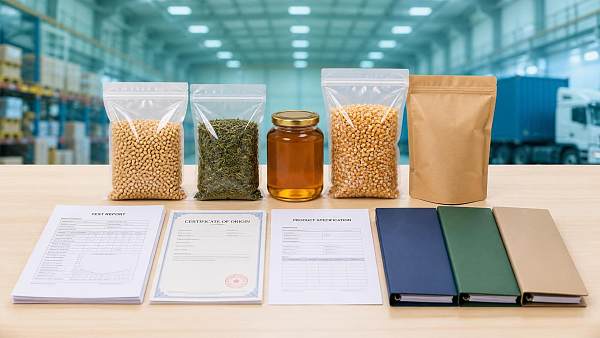
Product Qualifications Cannot Be Copied Directly: First Consider the Export Destination and Product Category
Agricultural products are not a single uniform category. The regulatory requirements for exporting freeze-dried fruit, spices, peanuts, canned food, honey, fresh fruit, and organic grains vary greatly. Fresh agricultural products often place greater emphasis on phytosanitary requirements, pests and diseases, origin, and the cold chain; prepackaged foods focus more on ingredients, nutritional information, allergens, label language, and additives; products claiming to be “organic,” “pesticide-free,” or “functional” require more careful preparation of verifiable supporting evidence.
For example, using “Organic,” “Non-GMO,” or “Pesticide Free” on a webpage is not merely a copywriting issue. Such statements are subject to conditions of use in many markets and should not be directly translated and published simply based on domestic standards or purchasing practices. Where there is no corresponding certification, testing scope, or document support, it is advisable to use objective descriptions, such as the raw material production area, processing method, and available testing items, to avoid the risk of misleading claims.
Certificates displayed on the website should also be presented properly. Certificates should indicate the entity name, validity period, applicable scope, and issuing authority; when redacting information, do not obscure key details that affect assessment. Certificates that have expired, are unrelated to the exported products, or belong to partner factories without clarifying the relationship may instead undermine trust when displayed.
Before Launching the Website, It Is Recommended to Complete a “Customer Perspective Verification”
Many agricultural export websites do not have problems because of missing certificates, but because information is inconsistent: the homepage says the company has its own farm, while the About page describes it as a trading service provider; the product page says exports are available worldwide, but inquiry responses reveal that access approval for certain countries has not yet been completed; the net weight, grade, and shelf life in the English specification sheet do not match the packaging images. These details affect buyers’ decisions more than whether the pages look visually impressive.
Before launch, check each item: whether the company name is consistent with certificates; whether each featured product has specifications, packaging, minimum order quantity, and delivery method; whether relevant tests and certifications remain valid; whether product images depict actual goods; whether contact information can receive messages properly; and whether the privacy policy explains how form data is used. For key markets, it is best to have someone familiar with local regulations review labels, restricted or prohibited terms, and sales pages.
It is not advisable to put all qualifications on the homepage. Buyers need clear, verifiable information, not a dense wall of certificates. A better approach is to explain the compliance system on the company page, link product detail pages to the tests or certifications that genuinely apply to that product, and provide inquiry entry points such as “Download Specification Sheet” and “Request Certificates.” This both protects sensitive documents and makes it easier for sales teams to follow up on customer needs.
What Website-Building Services Can Solve and What They Cannot Replace
Website-building services can help companies organize the logic for displaying certificates, create multilingual product pages, configure inquiry forms, improve the basic SEO structure, and make content for different markets easier to manage. However, service providers cannot obtain export qualifications on behalf of companies, nor can they replace the judgment of competent authorities in destination countries regarding food market access, labeling, or registration requirements.
Taking an intelligent website-building and overseas marketing platform for foreign trade companies such as Yiyingbao as an example, it is better suited to organizing existing company materials, product catalogs, and market content into an independent website that can be indexed and promoted, while connecting multilingual pages, Google SEO, advertising landing pages, and inquiry management. The prerequisite remains that the company must first confirm whether it can export and whether its products can enter the target market. When qualifications are incomplete, completing the compliance process before expanding promotion is usually more cost-effective.
Frequently Asked Questions
Can I build an agricultural product export website with only a business license?
You can first build a display-oriented website and consolidate brand and product materials; however, do not promise shipment to specific countries before confirming export conditions, and do not present certifications that have not been obtained as existing capabilities.
Must a website publicly display the business license and all test reports?
Not necessarily. A business license may be displayed as needed for business purposes or provided when customers conduct verification; test reports are more suitable for provision according to the product, batch, and customer requirements. When publishing them, take care to conceal unnecessary sensitive information.
After creating an English website, can I obtain overseas orders through Google?
These cannot be equated directly. Search indexing and inquiry conversion also depend on product keyword placement, page quality, market demand, trust materials, and ongoing promotion. Without clear product categories and target markets, simply creating a translated version of a website usually produces limited results.
How should a trading company without its own factory present itself on its website more appropriately?
Accurately position the company as an exporter, supply chain integrator, or trading service provider, and explain its quality control methods, partner production areas, and documents it can provide. Buyers do not reject trading companies; what they reject is inaccurate information and opaque delivery capability.
When preparing an agricultural product export website, first clearly define the four questions of “what to sell, where to sell it, who will export it, and what proves compliance,” then determine page development and promotion investment. Returning to the original question—what qualifications are required to build an agricultural product export website—the core is not a universal checklist, but ensuring that the business entity, export process, and product compliance materials correspond to the target market and are presented truthfully and clearly on the website.
Related Articles



Related Products
 Yiyingbao SaaS Intelligent Website Building and Marketing SystemYiyingbao SaaS Intelligent Website Building and Marketing System, AI-powered no-code website building, rapid creation of multilingual B2B international websites in 10 minutes, global server acceleration, AI-powered SEO optimization, helping businesses connect efficiently with global markets. The perfect integration of technology and operation makes building an international trade website remarkably simple
 AI+SEM Intelligent Advertising Marketing SystemAI+SEM drives intelligent ad creation, empowering full-funnel precision advertising marketing. The system automatically generates weekly/monthly reports, AI recommends keywords and target countries, monitors core metrics in real-time with intelligent alerts, and enables one-click high-conversion ad solutions to help quickly acquire customers and improve ROI.
 AI+SEO Dual-Engine System Optimization ServicesYiyingbao’s AI+SEO dual-engine optimization system helps foreign trade enterprises acquire high-quality organic traffic through AI-powered keyword research, content generation, and comprehensive technical optimization, significantly improving search rankings and conversion rates.
 AI+SNS Social Media Marketing SystemYingbao AI+SNS Social Media Marketing System - Precision social capture for the social media era. Supports one-click content synchronization across major platforms like Facebook and LinkedIn. AI intelligently rewrites posts for enhanced relevance. 24/7 AI customer service and user profiling analysis empower businesses to efficiently expand into global markets.
 AI+SEO营销解决方案易营宝AI+SEO营销解决方案,通过AI批量写作、智能生成TDK、精准关键词扩词等功能,全面优化网站SEO效果,提升流量与转化率。助力企业构建高效智能网站新生态。
 AI+SEM Advertising Marketing SolutionsAI+SEM Advertising Marketing Solution leverages AI technology to deeply empower SEM ad campaigns. It automatically generates weekly/monthly reports using AI, presenting account data across multiple dimensions for comprehensive insights into campaign performance and trends. The system precisely recommends keywords and target countries, intelligently generates high-conversion ad copy, and enables one-click activation of efficient campaign plans to help businesses rapidly acquire customers. Simultaneously, it monitors core metrics in real time, intelligently identifies abnormal fluctuations, and issues timely alerts to ensure stable, high-return advertising results.
 Domain Name ServicesEasyWin provides professional domain name services, including intelligent queries, one-stop registration, brand protection, and full lifecycle management, helping businesses build a digital brand image.
 EasyOperate B2C Cross-Border E-Commerce Platform & Independent WebsiteEasyStore B2C Cross-border E-commerce Independent Store is an intelligent website building and cross-border e-commerce integrated solution independently developed by EasyStore Information Technology (Beijing) Co., Ltd. The system is specially designed for small and medium-sized as well as large export enterprises, integrating 'website building, operation, marketing, advertising, and conversion' into one, helping enterprises quickly establish cross-border e-commerce independent stores to achieve brand globalization and global sales growth.
The platform supports multiple languages, multiple currencies, and multi-channel marketing, with built-in AI intelligent translation and SEO optimization systems, suitable for mainstream markets such as Southeast Asia, Europe and America, Latin America, and the Middle East, assisting Chinese manufacturing enterprises in efficiently deploying international e-commerce strategies. SSL证书易营宝提供专业SSL安全证书服务,包括单域名和泛域名证书,确保网站数据传输加密、身份验证和完整性保护,助力企业建立安全可信的在线业务环境。









