









- Can the average annual growth rate reflect real opportunities in overseas markets?Oct 07, 2026View details
- Which customer acquisition channels will be affected by cross-border marketing trends in 2026?Sep 06, 2026View details
- Which homogenization risks should be considered in an analysis of the AI-powered website building industry?Aug 30, 2026View details
- How Will AI Marketing Trends 2026 Change Advertising Budget AllocationAug 28, 2026View details
- Is the EV SSL certificate market shrinking or upgrading? How should companies assess certificate procurement?Aug 11, 2026View details
- Why the old AMP SEO 2020 practices no longer work and what has changed in current optimization prioritiesAug 02, 2026View details
Cost of Building a Multilingual SEO Website for Heavy Machinery Export
When building a multilingual SEO website for heavy machinery exports, the truly difficult part of calculating costs is not "how much does it cost to build a website," but rather determining the level of investment required for languages, product materials, technical architecture, and subsequent promotion. Heavy machinery has high order values and long decision-making cycles. Overseas buyers repeatedly verify models, specifications, certifications, delivery capabilities, and after-sales service scope. A website that only displays information but cannot be found in search or capture inquiries will find it difficult to deliver business results, no matter how low its price is.
Here is the direct conclusion: if the goal is to obtain long-term organic overseas inquiries, the budget should be divided into four parts: "basic website development, multilingual localization, SEO content and technology, and ongoing operations." Investment is relatively manageable when only building an English showcase website. Costs increase significantly when adding multiple key-market languages, hundreds of model pages, and ongoing SEO, but these are also the factors that determine whether the website can become a stable lead generation channel.
Where the Costs of Building a Multilingual SEO Website for Heavy Machinery Exports Mainly Go
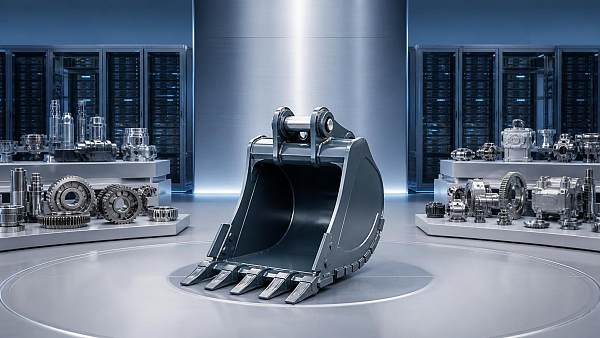
Although they are all called "multilingual websites," the actual workload can differ by several times. Some companies have only a dozen standard machines and need English and Spanish pages; others have product lines covering excavator attachments, crushing and screening equipment, lifting equipment, mining equipment, and other categories, with differences in tonnage, configuration, power, and operating conditions for each model. For the latter, achieving good search coverage cannot be accomplished simply by translating one Chinese product description page into several languages.
The following items usually require particular attention in cost calculations:
- Website planning and page structure: This includes product categories, model detail pages, application pages, case study pages, factory and quality control pages, inquiry paths, and more. Machinery equipment websites should avoid disorganized categorization, which can prevent buyers from finding compatible models and make it difficult for search engines to understand page relationships.
- Multilingual content localization: This is not just a translation cost. Different markets do not use exactly the same product names, units of measurement, common operating-condition terminology, or procurement expressions. For example, the core search terms for the same type of equipment may differ across English-, Spanish-, and Russian-speaking markets. Mechanical specifications, certification names, and delivery-time descriptions must also be accurate and cannot rely on unreviewed machine translations.
- SEO technical implementation: This includes planning independent language paths or websites, hreflang tags, crawlable links, sitemaps, page loading performance, structured data, redirects, and duplicate content control. Users may not directly see this work, but it affects whether pages can be correctly indexed and matched with search results for the relevant country or language.
- Organizing product content and image materials: The most time-consuming part of many projects is actually internal to the company. Incomplete specification sheets, inconsistent model naming, images without clear copyright ownership, or insufficient video materials can all increase production costs and delay launch timelines.
- Long-term SEO operations: Post-launch keyword research, content expansion, old-page optimization, inquiry data reviews, and technical maintenance should generally be listed as a separate ongoing budget rather than included in a one-time website development quotation.
Therefore, when requesting a quotation, do not simply ask, "How much does it cost to create five language versions?" More effective questions include: How many product pages are included for each language? Is existing content merely translated, or are pages reorganized after local keyword research? Is technical SEO configuration included? Who maintains new models and content after launch? The answers to these questions are more indicative of whether the cost is reasonable than a total price alone.
The Number of Languages Is Not the Only Reason Costs Increase
Many companies have a misconception: once the English website is completed, copying the content four times and replacing the text creates a five-language website. While the number of pages may appear to increase, this can actually cause two problems. First, machine translation often mistranslates professional terminology, especially load capacity, compatibility ranges, hydraulic specifications, and safety instructions. Second, if pages in multiple languages lack independent keywords and differentiated content, search engines may regard them as low-value or duplicate pages.
A more reasonable approach is to first identify priority markets. If the main customers are in North America and Europe, it is generally best to first develop the English website and the languages of core markets. If the business is focused long-term on Latin America, the Middle East, or Russian-speaking markets, expansion can then proceed gradually based on order sources, the sales team's capacity to handle inquiries, and local search demand. More languages do not necessarily mean more leads. Without sales responses, quotation materials, and after-sales documentation in the corresponding languages, inquiries generated by multilingual pages may also fail to convert effectively.
A practical principle is to create in-depth pages for high-value categories first, rather than producing superficial translations for every product. For example, if a certain type of hydraulic breaking equipment is a key product, it should have model pages, excavator tonnage compatibility pages, operating-condition pages, maintenance instruction pages, and project case studies. If certain products are only supplementary categories, a basic introduction can be retained initially. Content depth should match profit margins, supply stability, and market demand.
SEO Budget Should Be Considered Separately from Website Development Budget
Website development solves the question of "whether the site can capture inquiries"; SEO solves the question of "whether potential customers can find it." Separating the two does not mean that two different providers must be used. Rather, it helps avoid mistaking one-time page production for long-term ranking services.
Organic search optimization for heavy machinery often takes longer to show results, for practical reasons: buyers have long search journeys and often gradually narrow their options through category terms, model terms, parts terms, and application terms. At the same time, product specifications are complex, so the website needs to continuously build credible content. Simply stuffing broad terms such as "excavator attachment" and "mining equipment" onto the homepage makes it difficult to generate high-quality inquiries.
A relatively comprehensive SEO program usually includes market keyword research, on-site information architecture, content optimization for key pages, technical issue audits, content updates, and inquiry source analysis. Whether backlink building, advertising landing pages, social media content, or remarketing are also needed depends on the company's lead generation pace. When entering a new market and urgently needing to test demand, advertising can be used to validate keywords and pages; when stable products and accumulated materials are already available, SEO is better suited as a long-term asset.
Some quotations appear very low because they include only template deployment and basic plugin installation. Some higher quotations may not necessarily be worthwhile either. The key is whether product material organization, localized content, SEO technical implementation, and subsequent maintenance are clearly specified separately. When delivery boundaries are unclear, additional charges are most likely to keep arising later.
When It Is Not Advisable to Start with a Large-Scale Multilingual Website
If product models are still being adjusted frequently, English materials are not yet complete, or key export countries have not been identified, it is generally more prudent to first build a clearly structured English main website while reserving a multilingual architecture. Once inquiry data and market direction become clear, languages and content can be expanded to reduce rework.
Likewise, if the company has no dedicated personnel to verify professional translations, cannot promptly handle overseas inquiries, or has not established stable rules for product pricing and delivery capabilities, it is not suitable to deploy a large number of pages from the outset. A website should not replace the sales process. It can only bring suitable customers to the inquiry entry point; subsequent response speed, technical Q&A, and quotation professionalism will still affect closing results.
Conversely, companies with mature product lines, export experience, factory videos and project case studies, and a desire to reduce reliance on platform traffic are better suited to treat multilingual SEO as an ongoing investment. In this case, the website is not only a company profile but can also accumulate product knowledge, application evidence, and search traffic.
When Selecting a Service Provider, Verify These Delivery Details First
It is advisable to require the provider to supply a language architecture explanation rather than only page mockups. Confirm whether each language uses an independent URL, subdomain, or another structure; how language relationships are configured between pages; whether updates can be maintained simultaneously after product updates; whether you can edit content and view inquiry sources independently; and how links and indexed pages from the existing old website will be migrated.
Content responsibilities should also be clarified. Who provides specifications, who verifies terminology, who writes application content, and who handles multilingual review? In the heavy machinery industry, an SEO provider's understanding of SEO does not necessarily mean it understands specific equipment, while a company's technical personnel may not understand overseas search terminology. When both parties clearly define their boundaries, projects generally proceed more smoothly.
Platforms such as Yiyingbao, which provide coordinated services for intelligent website building, multilingual website development, Google SEO, and advertising, are more suitable for companies seeking to manage website development and subsequent overseas marketing within the same process. When making a selection, the focus should still return to specific deliverables: key-market languages, the number of product pages, the depth of content localization, the SEO service period, and data ownership should all be written into the proposal rather than relying solely on labels such as "AI website building" or "full-funnel services."
Frequently Asked Questions
Can multilingual pages be directly machine translated?
Machine translation can be used for initial drafts and internal efficiency improvements, but it should not be used directly as the final content for an official heavy machinery website. Model specifications, safety instructions, certification statements, and professional terminology should be reviewed by people familiar with the products. Core SEO pages also need their titles and content adjusted according to local search habits.
How long after launch will the website start receiving organic inquiries?
There is no universal timetable. New domains, competition levels, page quality, content update frequency, and market demand all affect indexing and rankings. Indexing, impressions, keyword coverage, and qualified inquiries should be tracked first, rather than promising ranking results within a fixed period.
Are more languages always better?
No. Prioritize market languages where there is already an order base, the sales team can handle inquiries, and product materials are relatively complete. A small number of high-quality language versions is usually more valuable than a large number of untranslated pages that no one maintains.
Must you choose between SEO and Google Ads?
Not necessarily. Advertising is suitable for testing markets, validating keywords, and obtaining leads quickly; SEO is suitable for continuously accumulating organic traffic. When the budget is limited, you can first use a small amount of advertising to test high-intent products, then incorporate proven effective directions into SEO content.
When planning the cost of building a multilingual SEO website for heavy machinery exports, the most important thing to avoid is comparing only total website development prices. Only by separately calculating market priorities, product material quality, language localization, technical SEO, and subsequent operations can you determine whether each investment serves genuine overseas inquiries rather than merely delivering a website that looks "very international."
Related Articles
Related Products
 Yiyingbao SaaS Intelligent Website Building and Marketing SystemYiyingbao SaaS Intelligent Website Building and Marketing System, AI-powered no-code website building, rapid creation of multilingual B2B international websites in 10 minutes, global server acceleration, AI-powered SEO optimization, helping businesses connect efficiently with global markets. The perfect integration of technology and operation makes building an international trade website remarkably simple
 AI+SEM Intelligent Advertising Marketing SystemAI+SEM drives intelligent ad creation, empowering full-funnel precision advertising marketing. The system automatically generates weekly/monthly reports, AI recommends keywords and target countries, monitors core metrics in real-time with intelligent alerts, and enables one-click high-conversion ad solutions to help quickly acquire customers and improve ROI.
 AI+SEO Dual-Engine System Optimization ServicesYiyingbao’s AI+SEO dual-engine optimization system helps foreign trade enterprises acquire high-quality organic traffic through AI-powered keyword research, content generation, and comprehensive technical optimization, significantly improving search rankings and conversion rates.
 AI+SNS Social Media Marketing SystemYingbao AI+SNS Social Media Marketing System - Precision social capture for the social media era. Supports one-click content synchronization across major platforms like Facebook and LinkedIn. AI intelligently rewrites posts for enhanced relevance. 24/7 AI customer service and user profiling analysis empower businesses to efficiently expand into global markets.
 AI+SEO营销解决方案易营宝AI+SEO营销解决方案,通过AI批量写作、智能生成TDK、精准关键词扩词等功能,全面优化网站SEO效果,提升流量与转化率。助力企业构建高效智能网站新生态。
 AI+SEM Advertising Marketing SolutionsAI+SEM Advertising Marketing Solution leverages AI technology to deeply empower SEM ad campaigns. It automatically generates weekly/monthly reports using AI, presenting account data across multiple dimensions for comprehensive insights into campaign performance and trends. The system precisely recommends keywords and target countries, intelligently generates high-conversion ad copy, and enables one-click activation of efficient campaign plans to help businesses rapidly acquire customers. Simultaneously, it monitors core metrics in real time, intelligently identifies abnormal fluctuations, and issues timely alerts to ensure stable, high-return advertising results.
 Domain Name ServicesEasyWin provides professional domain name services, including intelligent queries, one-stop registration, brand protection, and full lifecycle management, helping businesses build a digital brand image.
 EasyOperate B2C Cross-Border E-Commerce Platform & Independent WebsiteEasyStore B2C Cross-border E-commerce Independent Store is an intelligent website building and cross-border e-commerce integrated solution independently developed by EasyStore Information Technology (Beijing) Co., Ltd. The system is specially designed for small and medium-sized as well as large export enterprises, integrating 'website building, operation, marketing, advertising, and conversion' into one, helping enterprises quickly establish cross-border e-commerce independent stores to achieve brand globalization and global sales growth.
The platform supports multiple languages, multiple currencies, and multi-channel marketing, with built-in AI intelligent translation and SEO optimization systems, suitable for mainstream markets such as Southeast Asia, Europe and America, Latin America, and the Middle East, assisting Chinese manufacturing enterprises in efficiently deploying international e-commerce strategies. SSL证书易营宝提供专业SSL安全证书服务,包括单域名和泛域名证书,确保网站数据传输加密、身份验证和完整性保护,助力企业建立安全可信的在线业务环境。









