









- Can the average annual growth rate reflect real opportunities in overseas markets?Oct 07, 2026View details
- Which customer acquisition channels will be affected by cross-border marketing trends in 2026?Sep 06, 2026View details
- Which homogenization risks should be considered in an analysis of the AI-powered website building industry?Aug 30, 2026View details
- How Will AI Marketing Trends 2026 Change Advertising Budget AllocationAug 28, 2026View details
- Is the EV SSL certificate market shrinking or upgrading? How should companies assess certificate procurement?Aug 11, 2026View details
- Why the old AMP SEO 2020 practices no longer work and what has changed in current optimization prioritiesAug 02, 2026View details
How Long Does Google Take to Index an Automotive Parts Export Standalone Website
How long does it take for an automotive parts export website to be indexed by Google? In most cases, the homepage of a new website may be discovered within several days to several weeks after submission, while full indexing of product pages, category pages, and content pages often takes longer. More importantly, indexing does not mean rankings, nor does it mean it will generate inquiries. The Google indexing cycle for an automotive parts export website depends on whether the site can be crawled, whether its pages offer unique value, and whether Google recognizes the site's basic credibility.
After launching a website, many companies search for their products on Google and, if they cannot find them, assume the site has “not done SEO” or that there is a problem with the website-building system. In practice, the common causes are often quite basic: robots settings mistakenly blocking access, pages carrying a noindex tag, no sitemap submitted, highly repetitive product page content, or a website containing only dozens of product names without any specifications, compatible vehicle models, or purchasing information.
For the Google indexing cycle of an automotive parts export website, first look at these three stages
The first stage is page discovery. Google first needs to know that your website exists. When a new domain has no external links, no submitted Sitemap, and is not connected to Google Search Console, it takes longer for search engines to discover its pages. The homepage is usually discovered first, while deeper product detail pages are more likely to be missed.
The second stage is crawling and evaluation. After Google visits a page, it will not necessarily index it simply because the page can be opened. Automotive parts websites often have many models, parameters, and SKUs. If different pages only replace the part number, image, and one model number while the main text descriptions are almost identical, search engines may retain only some pages and treat the others as duplicate or low-value content.
The third stage is stable indexing and ranking testing. Even if a page can already be found through a “site:domain” search, that does not mean it will gain visibility for purchasing-intent keywords such as “brake pads manufacturer” or “truck suspension parts supplier.” Indexing addresses “whether a page can enter the index,” while ranking addresses “whether your page should be displayed prominently in search results.” These are two different matters and should not be confused.
A more practical expectation is this: for a website with sound technical foundations and complete submission paths, first observe whether the homepage and key pages are indexed; then continue monitoring the coverage of category pages, core product pages, and English content pages. Do not submit all hundreds or even thousands of SKUs at once and expect them all to enter the index within a short period. For a new website, having a small number of high-value pages properly understood is usually more effective than pursuing indexing volume.
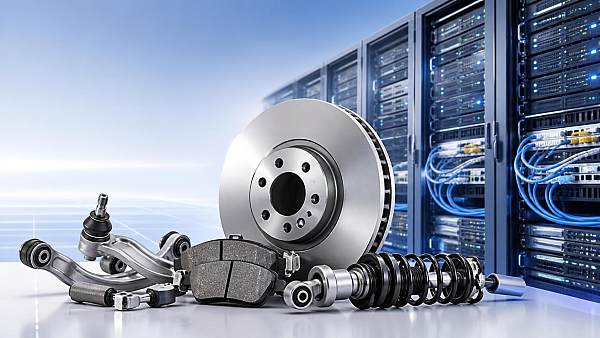
Why automotive parts websites are more likely to experience “partial indexing”
The purchasing logic for automotive parts is highly detailed. Overseas buyers may search by OEM number, vehicle year, engine model, part name, material, application scenario, or wholesale needs. However, many websites write their product pages as “High Quality Auto Parts, Contact Us for Price,” with dozens of pages being almost identical. Even if such pages are crawled, they lack an independent reason to be indexed and ranked.
A more valuable brake disc page should at least clearly explain the compatibility range, material or manufacturing process, dimensional specifications, available certifications or testing documents, packaging and MOQ, customization capabilities, delivery-related information, and the markets or vehicle systems for which it can be used. This does not mean every page must be written as a long article; rather, it should enable both purchasers and search engines to clearly understand what the product is, who it is suitable for, and how it differs from similar products.
Multilingual websites can also easily encounter pitfalls. Directly copying machine-translated English pages into French, Spanish, or Arabic pages without reviewing content quality, while having disorganized URLs and language tags, often slows crawling efficiency. When targeting different markets, companies should first determine the languages in which they have genuine business investment and then build them gradually, rather than launching more than a dozen empty language pages all at once simply for the sake of being “multilingual.”
Eliminate technical issues before discussing how to speed up indexing
If the homepage and key pages still have no indexing at all two or three weeks after the website goes live, first check the URL Inspection tool and the Page Indexing report in Google Search Console. The most common technical items include:
- Confirm that the page is not set to
noindexand that robots.txt is not blocking Google from crawling it. - Submit an XML Sitemap and ensure that it contains only accessible canonical pages that you want indexed.
- Check whether canonical tags incorrectly point to the homepage, category pages, or other product pages.
- Ensure that important product pages can be accessed through navigation, category pages, or related recommendations, so they do not become orphan pages without internal links.
- Check mobile loading speed, server stability, and the HTTPS certificate. A website that frequently cannot be opened will naturally not be crawled smoothly.
Here is one easily overlooked detail: filtered parameter pages, internal search result pages, and duplicate pagination pages do not necessarily need to be indexed. The pages that should be prioritized are product category pages, core model pages, industry application pages, factory capability pages, and purchasing help pages that represent business capabilities. More indexed pages do not necessarily mean better results. Filling the index with duplicate URLs can instead dilute crawl resources.
What else should be done after submitting pages for indexing?
Submitting a URL only tells Google, “There is a page here”; it does not make Google promise to index it immediately. The right approach is to focus on page quality and website signals.
For example, select 10 to 20 main product categories or key models, and complete their English titles, Meta descriptions, product parameters, compatibility information, image Alt text, and internal links. Then create a small amount of content around questions purchasers may ask, such as “how to confirm parts by OEM number,” “the difference between aftermarket and OEM replacement,” and “how to confirm the compatibility of parts for a certain vehicle model.” Such content can provide semantic support for product pages and better align with genuine search demand.
External links also have an impact, but it is not recommended to purchase a large number of low-quality links simply to accelerate indexing. Industry directories, partner websites, trade show pages, legitimate social media profiles, professional media coverage, or genuine customer resources are generally more reliable than mass spam backlinks. For export websites, a source that is relevant to the business and a naturally occurring link are more valuable references than quantity itself.
If the website also runs Google Ads, ad traffic itself will not directly guarantee organic indexing or rankings, but data from ad landing pages can help determine which products, countries, and search terms have greater commercial value. Investing further in SEO content and link building for pages that perform well allows resources to be used more effectively.
The website-building stage determines later indexing efficiency
Many issues do not arise only after a website goes live; they result from failing to reserve a proper structure for SEO during website development. For example, product category hierarchies may be too deep, URLs may be generated arbitrarily, all images may be uncompressed, or the same product may be repeatedly accessed through multiple paths. The cost of fixing these issues later can be high.
When choosing overseas marketing website-building services, it is advisable to confirm several practical capabilities: whether it is easy to connect to Search Console, whether it can generate and maintain a Sitemap, whether it supports multilingual canonical tags, whether SEO information can be independently edited for product detail pages, and whether category pages and content pages can form clear internal links. Taking platforms such as Yiyingbao, which provide intelligent website building, Google SEO, and overseas marketing services at the same time, as an example, their value does not lie in a promise of “immediate indexing after launch,” but in placing a crawlable website structure, content operations, and subsequent promotion within the same execution chain, reducing the disconnect between website building and marketing.
However, suitability should also be assessed: if a company does not have clear product information, English materials, target markets, and key categories, launching a complex multilingual online store will not solve its lead-generation problem. Organizing product data and purchasing selling points first, then building core pages, is usually more suitable for factories or trading companies just beginning to build independent websites.
Frequently Asked Questions
Why are product pages not indexed yet when Google has indexed the homepage?
The homepage usually has more concentrated authority and external entry points, while product pages need to be gradually discovered through the sitemap, internal links, and their own content quality. Check whether product pages can be accessed normally by clicking through category pages and whether they have been mistakenly designated as duplicate pages.
Will submitting a URL once every day speed up indexing?
Usually, this is unnecessary. Frequent repeated submissions cannot replace technical fixes and content improvements. If a page has crawling obstacles or insufficient content quality, repeated submission has limited value.
How many product pages should a new website create first?
There is no fixed number. Rather than publishing a large number of SKUs with similar content at once, it is better to first improve key categories and models with clear export advantages. Page quality, category logic, and the ability to update continuously are more critical.
How long does it take to receive inquiries after being indexed?
This depends on keyword competition, product price range, page conversion capability, target countries, and website trustworthiness. Indexing is only the starting point. Inquiries also require matching purchasing intent, clear contact information, credible factory information, and continuous traffic sources.
Returning to the original question, there is no fixed answer to the Google indexing cycle for an automotive parts export website that applies to every website. First ensure that Google can crawl the site and is willing to index it, then build signals through high-value product content, reasonable internal links, and genuine external exposure. Treat indexing as a website health check rather than a marketing result in itself, and organic traffic and overseas inquiries will then have the opportunity to grow gradually.
Related Articles

Related Products
 Yiyingbao SaaS Intelligent Website Building and Marketing SystemYiyingbao SaaS Intelligent Website Building and Marketing System, AI-powered no-code website building, rapid creation of multilingual B2B international websites in 10 minutes, global server acceleration, AI-powered SEO optimization, helping businesses connect efficiently with global markets. The perfect integration of technology and operation makes building an international trade website remarkably simple
 AI+SEM Intelligent Advertising Marketing SystemAI+SEM drives intelligent ad creation, empowering full-funnel precision advertising marketing. The system automatically generates weekly/monthly reports, AI recommends keywords and target countries, monitors core metrics in real-time with intelligent alerts, and enables one-click high-conversion ad solutions to help quickly acquire customers and improve ROI.
 AI+SEO Dual-Engine System Optimization ServicesYiyingbao’s AI+SEO dual-engine optimization system helps foreign trade enterprises acquire high-quality organic traffic through AI-powered keyword research, content generation, and comprehensive technical optimization, significantly improving search rankings and conversion rates.
 AI+SNS Social Media Marketing SystemYingbao AI+SNS Social Media Marketing System - Precision social capture for the social media era. Supports one-click content synchronization across major platforms like Facebook and LinkedIn. AI intelligently rewrites posts for enhanced relevance. 24/7 AI customer service and user profiling analysis empower businesses to efficiently expand into global markets.
 AI+SEO营销解决方案易营宝AI+SEO营销解决方案,通过AI批量写作、智能生成TDK、精准关键词扩词等功能,全面优化网站SEO效果,提升流量与转化率。助力企业构建高效智能网站新生态。
 AI+SEM Advertising Marketing SolutionsAI+SEM Advertising Marketing Solution leverages AI technology to deeply empower SEM ad campaigns. It automatically generates weekly/monthly reports using AI, presenting account data across multiple dimensions for comprehensive insights into campaign performance and trends. The system precisely recommends keywords and target countries, intelligently generates high-conversion ad copy, and enables one-click activation of efficient campaign plans to help businesses rapidly acquire customers. Simultaneously, it monitors core metrics in real time, intelligently identifies abnormal fluctuations, and issues timely alerts to ensure stable, high-return advertising results.
 Domain Name ServicesEasyWin provides professional domain name services, including intelligent queries, one-stop registration, brand protection, and full lifecycle management, helping businesses build a digital brand image.
 EasyOperate B2C Cross-Border E-Commerce Platform & Independent WebsiteEasyStore B2C Cross-border E-commerce Independent Store is an intelligent website building and cross-border e-commerce integrated solution independently developed by EasyStore Information Technology (Beijing) Co., Ltd. The system is specially designed for small and medium-sized as well as large export enterprises, integrating 'website building, operation, marketing, advertising, and conversion' into one, helping enterprises quickly establish cross-border e-commerce independent stores to achieve brand globalization and global sales growth.
The platform supports multiple languages, multiple currencies, and multi-channel marketing, with built-in AI intelligent translation and SEO optimization systems, suitable for mainstream markets such as Southeast Asia, Europe and America, Latin America, and the Middle East, assisting Chinese manufacturing enterprises in efficiently deploying international e-commerce strategies. SSL证书易营宝提供专业SSL安全证书服务,包括单域名和泛域名证书,确保网站数据传输加密、身份验证和完整性保护,助力企业建立安全可信的在线业务环境。









