









- CBP Finalizes Electronic Rail Export Manifest Rule, Effective October 26, 2026Oct 26, 2026View details
- Amazon’s 2026 peak season surcharge takes effect on October 25Oct 26, 2026View details
- AI Is Eating SaaS: Three Real-World Cases in One AfternoonOct 25, 2026View details
- Exiger CEO: The SaaS Apocalypse Is Real, but It Means Something DifferentOct 25, 2026View details
- Hengqin Cooperation Zone Shares Cross-Border E-Commerce Developments, Focusing on Macao-Hengqin Collaboration and International MarketsOct 24, 2026View details
- A Shenyang study highlights the development of the “cross-border e-commerce + industrial cluster” modelOct 24, 2026View details
How Long Does It Take for an Automotive Parts Export Independent Website to Be Indexed by Google
After an independent foreign trade website for auto parts goes live, there is no fixed answer that applies to all websites regarding how long Google will take to index it. For a new website with correct basic settings and normally accessible pages, some pages may enter the index within a few days to several weeks; however, “being indexed” does not mean obtaining rankings for target keywords, let alone beginning to generate stable inquiries. For auto parts websites with numerous product models, complex parameters, and multiple country markets, the indexing cycle often depends on whether the website enables Google to clearly understand what it sells, which markets it serves, and whether each page has independent value.
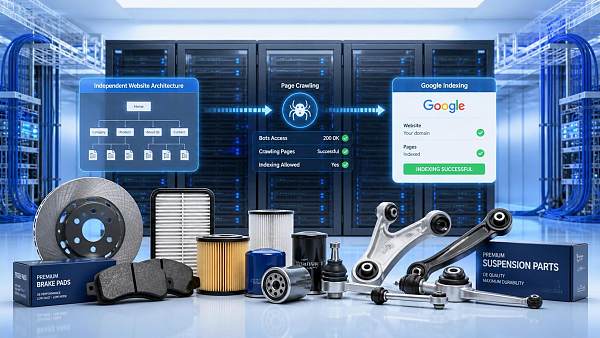
Therefore, when assessing the Google indexing cycle of an independent foreign trade website for auto parts, it is not advisable to focus only on whether the homepage appears in search results. A more practical approach is to observe three levels: whether Google can crawl the pages, whether the pages are included in the index, and whether indexed product pages can gradually gain search visibility.
First, distinguish between crawling, indexing, and ranking
Many foreign trade companies search for their brand name or domain a few days after launching a website. If the homepage does not appear, they conclude that the website “has not been indexed by Google.” Others see that the homepage has appeared and assume SEO has already taken effect. Both judgments are overly simplistic.
Google first needs to discover the website and visit its pages; it then evaluates page content, technical status, and duplication to decide whether to place them in its index; only afterward does the search engine determine whether pages participate in rankings based on factors such as search queries, page relevance, website signals, and the user's market.
For independent auto parts websites, the homepage is usually easier to discover, but category pages, vehicle fitment pages, product detail pages, and technical content pages often have a greater impact on organic traffic. For example, a page for a brake pad, suspension component, filter, or body part may already be indexed, but it may not necessarily gain visible placement in searches with strong purchase intent, such as “compatible vehicle model + part name.”
Therefore, during the first few weeks after the website goes live, it is more appropriate to check whether “valid indexing is increasing”; later, observe whether core product and category pages begin generating impressions, rather than promising that they must rank on the first page by a certain day.
What factors can extend indexing time
Common indexing obstacles on auto parts websites do not necessarily result from insufficient content, but rather from website architecture and product data processing methods that make it difficult for search engines to determine page value.
- The website has no discoverable pathways. When a new domain lacks external links, social media profile links, or other entry points, Google may discover the website slowly. Submitting a sitemap can help search engines understand the scope of pages, but it cannot replace a clear internal linking structure.
- There are many product pages, but the content is highly repetitive. Large numbers of pages are generated for the same part by changing only the model, OEM number, or color, while page titles, body text, images, and parameters are nearly identical. Not all of these pages will necessarily be indexed; some may be judged as duplicate or low-value pages.
- Filter pages and parameter URLs are out of control. After filtering by brand, vehicle model, year, position, material, packaging, and other conditions, the system may generate a large number of different URLs. If these pages have no independent search value but are open to crawling, they can dilute crawl resources and create duplicate content issues.
- Technical settings block crawling. Incorrect robots rules, noindex tags, canonical settings, page redirects, or unstable servers can all prevent pages from entering the index normally. Multilingual websites should also verify that language versions correspond correctly with one another.
- Pages contain only images, tables, or manufacturer materials. Auto parts buyers usually pay attention to compatible vehicle models, OEM numbers, dimensions, materials, certifications, minimum order quantities, packaging, and delivery information. If a page contains only product images and a few generic descriptions, it is also difficult for search engines to determine how well it matches specific search needs.
Which pages should be checked first after an auto parts website goes live
Rather than publishing thousands of product detail pages at once, it is better to first ensure that core pages meet complete indexing requirements. For websites primarily focused on B2B inquiries, priority should generally be given to pages that can explain supply capabilities and product relationships.
Product pages do not need to stuff excessive keywords, but they should have sufficient differentiation. Taking OE replacement parts as an example, in addition to the product name, content can be organized around real information such as part numbers, installation positions, compatibility scope, dimensions and specifications, materials or processes, and packaging methods. The prerequisite is that this information is accurate and can be continuously maintained. Copying supplier catalogs or translating competitor pages to rapidly expand page volume may increase the number of pages in the short term, but it is not conducive to establishing stable indexing.
Google Search Console is more suitable than manual searches for assessing progress
To assess indexing, it is not recommended to repeatedly enter the site command in Google Search. It can help roughly check whether pages appear, but it cannot replace index status data in webmaster tools.
After the website is verified, several signals can be monitored in Google Search Console: whether submitted sitemaps have been read; whether core URLs can be crawled normally through the URL Inspection tool; which pages have been indexed; and where the reasons for non-indexing are concentrated. If a large number of product pages are shown as duplicate pages, discovered but not indexed, or crawled but not indexed, the content and URL rules themselves should be addressed instead of repeatedly resubmitting them.
For a newly launched independent foreign trade website for auto parts, a more reasonable sequence is to first confirm that the homepage, main category pages, key product pages, and contact page are all accessible and crawlable; then use sitemaps and internal links to help Google discover these pages; and subsequently observe whether index coverage gradually expands. After pages are indexed, use impressions and search query reports to determine which product directions are worth further content development.
Multilingual and vehicle fitment pages can easily appear “rich” but actually be difficult to index
Auto parts exports often involve multilingual markets such as English, Spanish, Russian, and Arabic. Multilingual versions can indeed help cover different buyers, but the prerequisite is that pages in each language have been effectively localized for their respective markets. Simply batch machine-translating English pages while leaving product parameters, vehicle model terminology, units, and purchasing expressions unchanged can easily create duplicate pages of similar quality.
Vehicle fitment pages present a similar situation. They are suitable for addressing clear searches for vehicle models and parts, but they must be based on reliable fitment data. If a product is broadly listed on uncertain vehicle model pages, users may not find a matching relationship after entering the page. Even if the page is indexed, it will be difficult to accumulate effective engagement signals. For B2B websites, it is preferable to first cover product lines with stable supply, complete information, and higher profit and inquiry value, rather than pursue page volume using incomplete fitment information.
What practices are often ineffective when indexing is slow
First, frequently changing the domain name, template, or URL structure. Conducting a large-scale redesign just after a new website is discovered requires search engines to understand page relationships again and may also cause old links to become invalid.
Second, mechanically submitting indexing requests for every page. Indexing requests are suitable for important new pages or pages that have been fixed, not for resolving large-scale duplicate content. If a page itself lacks independent information, increasing the number of submissions will not change its quality assessment.
Third, publishing only blog posts while ignoring product pages. Industry articles can help establish topical relevance, but purchase-oriented searches will ultimately lead to category and product pages. If blog content is disconnected from the product structure, the traffic it brings may not convert into inquiries.
Fourth, treating advertising as a direct method for accelerating organic indexing. Google Ads can generate immediate visits and help validate landing pages and market demand, but the advertising budget itself will not make pages automatically gain organic indexing or rankings. The two can be implemented in parallel, but should be evaluated against different objectives.
After indexing, the next step is to see “which pages are worth further investment”
The Google indexing cycle for an independent foreign trade website for auto parts is essentially not a single-point timing issue, but whether the website can establish a sustainable content and page system. Homepage indexing is only the starting point; what is more meaningful for the business is that when buyers in target countries search for part categories, OEM numbers, vehicle applications, or supply capabilities, they can gradually see pages that match their needs.
After the website foundation is stable, content can be supplemented first for categories with existing impressions, specific part numbers, applicable vehicle models, and target languages, while checking whether these pages have clear inquiry entry points, specification materials, and internal links. The result is not merely a number of “indexed” pages, but website assets that can be searched, understood, and used to meet overseas purchasing needs.
Related Articles
 How Can an SEO Content Strategy Prevent Keyword Cannibalization?
 Website Rankings Stuck on Page Two? How to Find Opportunities for Improvement
 SEO traffic suddenly dropped. How can you identify the affected pages?

Related Products
 Yiyingbao SaaS Intelligent Website Building and Marketing SystemYiyingbao SaaS Intelligent Website Building and Marketing System, AI-powered no-code website building, rapid creation of multilingual B2B international websites in 10 minutes, global server acceleration, AI-powered SEO optimization, helping businesses connect efficiently with global markets. The perfect integration of technology and operation makes building an international trade website remarkably simple
 AI+SEM Intelligent Advertising Marketing SystemAI+SEM drives intelligent ad creation, empowering full-funnel precision advertising marketing. The system automatically generates weekly/monthly reports, AI recommends keywords and target countries, monitors core metrics in real-time with intelligent alerts, and enables one-click high-conversion ad solutions to help quickly acquire customers and improve ROI.
 AI+SEO Dual-Engine System Optimization ServicesYiyingbao’s AI+SEO dual-engine optimization system helps foreign trade enterprises acquire high-quality organic traffic through AI-powered keyword research, content generation, and comprehensive technical optimization, significantly improving search rankings and conversion rates.
 AI+SNS Social Media Marketing SystemYingbao AI+SNS Social Media Marketing System - Precision social capture for the social media era. Supports one-click content synchronization across major platforms like Facebook and LinkedIn. AI intelligently rewrites posts for enhanced relevance. 24/7 AI customer service and user profiling analysis empower businesses to efficiently expand into global markets.
 AI+SEO营销解决方案易营宝AI+SEO营销解决方案,通过AI批量写作、智能生成TDK、精准关键词扩词等功能,全面优化网站SEO效果,提升流量与转化率。助力企业构建高效智能网站新生态。
 AI+SEM Advertising Marketing SolutionsAI+SEM Advertising Marketing Solution leverages AI technology to deeply empower SEM ad campaigns. It automatically generates weekly/monthly reports using AI, presenting account data across multiple dimensions for comprehensive insights into campaign performance and trends. The system precisely recommends keywords and target countries, intelligently generates high-conversion ad copy, and enables one-click activation of efficient campaign plans to help businesses rapidly acquire customers. Simultaneously, it monitors core metrics in real time, intelligently identifies abnormal fluctuations, and issues timely alerts to ensure stable, high-return advertising results.
 Domain Name ServicesEasyWin provides professional domain name services, including intelligent queries, one-stop registration, brand protection, and full lifecycle management, helping businesses build a digital brand image.
 EasyOperate B2C Cross-Border E-Commerce Platform & Independent WebsiteEasyStore B2C Cross-border E-commerce Independent Store is an intelligent website building and cross-border e-commerce integrated solution independently developed by EasyStore Information Technology (Beijing) Co., Ltd. The system is specially designed for small and medium-sized as well as large export enterprises, integrating 'website building, operation, marketing, advertising, and conversion' into one, helping enterprises quickly establish cross-border e-commerce independent stores to achieve brand globalization and global sales growth.
The platform supports multiple languages, multiple currencies, and multi-channel marketing, with built-in AI intelligent translation and SEO optimization systems, suitable for mainstream markets such as Southeast Asia, Europe and America, Latin America, and the Middle East, assisting Chinese manufacturing enterprises in efficiently deploying international e-commerce strategies. SSL证书易营宝提供专业SSL安全证书服务,包括单域名和泛域名证书,确保网站数据传输加密、身份验证和完整性保护,助力企业建立安全可信的在线业务环境。









