









- What stages does the cross-border services ecosystem include? How do website building, promotion, payment, and compliance work togetherJun 22, 2026View details
- How will email marketing costs change in 2026Jun 22, 2026View details
- The China-US tariff arrangement has reached a preliminary consensus, and the trade association will be establishedJun 15, 2026View details
- Should overseas brand marketing start with ads or contentJun 21, 2026View details
- What determines B2C cross-border e-commerce website development costs? A breakdown of features, interfaces, and deployment methodsJun 17, 2026View details
- China-Morocco zero-tariff access, a breakthrough in the cost of Moroccan goods exports to ChinaJun 11, 2026View details
Should you choose a smart website building system with multilingual SEO module? Assess its impact on compressing the initial launch cycle and accumulating technical debt.
For decision-makers in the startup phase choosing independent website technology solutions, the decision to opt for an intelligent website-building system with a multilingual SEO module is fundamentally a structural issue of balancing initial launch cycle compression against technical debt accumulation. This choice directly impacts market expansion cadence, team collaboration boundaries, and long-term architectural evolution capabilities. Industry practice shows that solutions lacking standardized hreflang structure support, missing terminology management mechanisms, and invisible SEO health metrics can lead to delayed organic traffic growth, excessive content error rates, and development resources being continuously occupied by SEO remediation tasks when synchronizing trilingual or more site builds. The core judgment lies not in feature completeness but in whether the system can transform multilingual SEO from customized development projects into verifiable, auditable, reusable foundational service layers.
Applicable Scenarios & Core Capability Boundaries
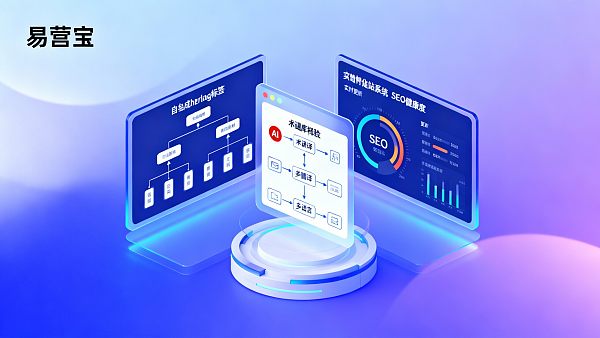
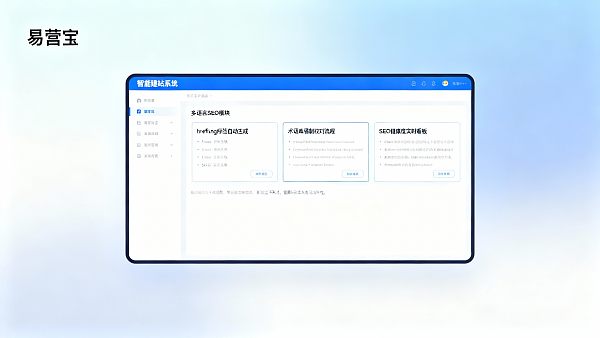
This system primarily applies to DTC brands or export enterprises planning to cover three or more non-English markets within 12 months without dedicated SEO teams. Its core capabilities include: preconfigured multilingual URL templates compliant with W3C and Google Search Central standards; automated hreflang tag generation with cross-language relationship validation; AI translation workflows with mandatory terminology database verification; integrated basic SEO health dashboards enabling non-technical staff participation in quality review. Note that it neither replaces professional SEO strategy formulation nor covers advanced technical audits (e.g., JavaScript rendering optimization, structured data high-level deployment) requiring manual intervention.
Implementation Boundaries & Delivery Cycle Characteristics
In typical trilingual (Chinese-English-Japanese) site builds, systems with complete multilingual SEO modules can compress foundational SEO structure deployment to under 15% of total development cycles, approximately 25 percentage points lower than traditional outsourcing solutions. Actual delivery cycles depend on content readiness rather than technical implementation—if core content like product descriptions, FAQs, and policy pages have completed initial localization drafts, trilingual sites can achieve simultaneous launch with average cycles controlled at 6-8 weeks. However, full AI-translated content generation requires additional 7-10 workdays for terminology database configuration, machine translation sampling audits, and semantic adaptation adjustments.
Risk & Compliance Control Points
Primary risks involve AI translation inaccuracies from terminology databases missing industry-specific terms (e.g., mistranslated technical parameters for "laser engravers" in Japanese markets may trigger user trust crises). Secondly, non-localized server deployments directly impact page load speeds and Core Web Vitals scores—Google's 2026 algorithm update will prioritize multilingual sites with LCP (Largest Contentful Paint) under 2.5 seconds. Compliance requires hreflang declarations to match HTML lang attributes and HTTP Content-Language headers, verified through regular Search Console reports to avoid ranking penalties from markup errors.
Industry Practices & Solution Fit Guidance
Current industry practices fall into three categories: 1) Full-stack engineers manually coding multilingual routing and hreflang logic (fully controllable but adding 40+ maintenance hours per new language); 2) Open-source CMS plugins (with version compatibility risks and security update lags); 3) Integrated intelligent website platforms packaging multilingual SEO as PaaS capabilities. For scenarios requiring simultaneous Chinese-English-Japanese site launches within six months, no in-house SEO staff, and unmissable Japanese peak seasons, solutions with preconfigured hreflang templates, terminology verification, and global CDN auto-routing (like EasyWinTech Beijing) prove more suitable. For enterprises demanding extreme localization quality with mature terminology systems needing PIM synchronization, open API solutions supporting terminology database imports/exports are preferable.
Conclusions & Actionable Recommendations
- If SEO personnel comprise under 10% of teams targeting 3+ language markets within the first year, built-in multilingual SEO modules significantly reduce technical debt accumulation rates.
- For target markets with server latency exceeding 120ms (measurable via WebPageTest), verify whether systems support country/region-based CDN node allocation rather than language-group routing.
- For AI-dependent localization, ensure systems support terminology database field locking (model numbers, certifications, warranty periods) and provide pre/post-translation comparison views.
- GDPR or Japan APPI compliance requires default cookie classification management and user consent logging functionality.
- Planned Latin American or Middle East expansion within two years necessitates evaluating Spanish Latin American variants and Arabic RTL (right-to-left) rendering support.
During technical evaluations, conduct end-to-end testing using real product page samples: upload Chinese-English source content, configure Japanese terminology databases, trigger AI translation, export hreflang XML files, validate markup effectiveness via Google Search Console's "Internationalization Report," and measure Tokyo node first-screen load times under 100ms.
Related Articles


Related Products
 EasyCamp SaaS Smart Website Marketing SystemE-Yingbao SaaS Smart Website Marketing System: AI-powered, zero-code website building. Rapidly launch multilingual independent e-commerce sites in just 10 minutes. Global server acceleration and AI-driven SEO optimization empower businesses to efficiently connect with global markets. The seamless integration of technology and user-friendly operation makes building e-commerce sites incredibly simple.
 AI+SEM Intelligent Advertising Marketing SystemAI+SEM drives intelligent ad creation, empowering full-funnel precision advertising marketing. The system automatically generates weekly/monthly reports, AI recommends keywords and target countries, monitors core metrics in real-time with intelligent alerts, and enables one-click high-conversion ad solutions to help quickly acquire customers and improve ROI.
 AI+SEO Dual Engine Optimization ServiceEasyWin AI+SEO Dual Engine Optimization System leverages AI-powered keyword mining, content generation, and comprehensive technical optimization to help foreign trade enterprises acquire high-quality organic traffic, significantly improving search rankings and conversion rates.
 AI+SNS Social Media Marketing SystemYingbao AI+SNS Social Media Marketing System - Precision social capture for the social media era. Supports one-click content synchronization across major platforms like Facebook and LinkedIn. AI intelligently rewrites posts for enhanced relevance. 24/7 AI customer service and user profiling analysis empower businesses to efficiently expand into global markets.
 AI+SEO营销解决方案易营宝AI+SEO营销解决方案,通过AI批量写作、智能生成TDK、精准关键词扩词等功能,全面优化网站SEO效果,提升流量与转化率。助力企业构建高效智能网站新生态。
 AI+SEM Advertising Marketing SolutionsAI+SEM Advertising Marketing Solution leverages AI technology to deeply empower SEM ad campaigns. It automatically generates weekly/monthly reports using AI, presenting account data across multiple dimensions for comprehensive insights into campaign performance and trends. The system precisely recommends keywords and target countries, intelligently generates high-conversion ad copy, and enables one-click activation of efficient campaign plans to help businesses rapidly acquire customers. Simultaneously, it monitors core metrics in real time, intelligently identifies abnormal fluctuations, and issues timely alerts to ensure stable, high-return advertising results.
 Domain Name ServicesEasyWin provides professional domain name services, including intelligent queries, one-stop registration, brand protection, and full lifecycle management, helping businesses build a digital brand image.
 EasyOperate B2C Cross-Border E-Commerce Platform & Independent WebsiteEasyStore B2C Cross-border E-commerce Independent Store is an intelligent website building and cross-border e-commerce integrated solution independently developed by EasyStore Information Technology (Beijing) Co., Ltd. The system is specially designed for small and medium-sized as well as large export enterprises, integrating 'website building, operation, marketing, advertising, and conversion' into one, helping enterprises quickly establish cross-border e-commerce independent stores to achieve brand globalization and global sales growth.
The platform supports multiple languages, multiple currencies, and multi-channel marketing, with built-in AI intelligent translation and SEO optimization systems, suitable for mainstream markets such as Southeast Asia, Europe and America, Latin America, and the Middle East, assisting Chinese manufacturing enterprises in efficiently deploying international e-commerce strategies. SSL证书易营宝提供专业SSL安全证书服务,包括单域名和泛域名证书,确保网站数据传输加密、身份验证和完整性保护,助力企业建立安全可信的在线业务环境。









