









- The China-US tariff arrangement has reached a preliminary consensus, and the trade association will be establishedJun 15, 2026View details
- What determines B2C cross-border e-commerce website development costs? A breakdown of features, interfaces, and deployment methodsJun 17, 2026View details
- China-Morocco zero-tariff access, a breakthrough in the cost of Moroccan goods exports to ChinaJun 11, 2026View details
- What signal should be released for the suspension of exports to JapanJun 10, 2026View details
- China's May LNG imports rebounded, with increased volumes from Russia and Canada filling the Middle East supply gapJun 10, 2026View details
- Will GEO change its SEO strategy?Jun 04, 2026View details
How to Promote a Multilingual Foreign Trade Website After Building It — Techniques for Restructuring During the Redesign Period to Avoid SEO Weight Loss and Sustain Traffic Growth
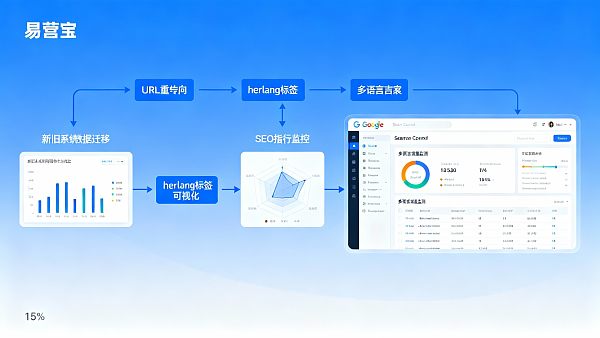
Whether a multilingual foreign trade website can maintain global search visibility during technical architecture restructuring depends on the completeness of historical SEO asset migration, the reliability of multilingual content synchronization mechanisms, and the sustainability of team collaboration models. For cross-border e-commerce enterprises entering the European market for three years, platform upgrades are not merely technical enhancements but critical pressure points for sustaining brand international influence. If URL structure changes lack weight transfer strategies, missing hreflang tags or inaccurate field mappings will directly cause core German/French sites to experience cliff-like declines in Google Search Console impressions. Deciding whether to proceed with restructuring requires prioritizing assessments of: traceable data asset quality in legacy systems, native SEO signal support capabilities in new architectures, and the existence of cross-functional validation mechanisms within the organization—rather than focusing solely on development cycles or feature lists.

Typical Business Scenarios & Decision Logic
Scenario 1: Existing PHP multilingual plugin systems exhibit performance bottlenecks and escalating maintenance costs
Background shows system response delays exceeding 1.8 seconds, product page TTFB reaching 1200ms, with SEO structures relying on manual hreflang and canonical tag configuration. Key evaluation criteria include: whether legacy systems preserve complete historical URL mapping relationships, whether server logs retain valid crawler access paths for at least 90 days, and whether CMS outputs structured field IDs. Feasible solutions involve automated redirect rule generators and reconstructing mapping tables based on 301 jump logs and Search Console error reports. Risk control requires avoiding wildcard redirect generalizations, mandating per-language version validation of status codes and Vary: Accept-Language headers.
Scenario 2: Multilingual field mappings manually maintained by operations staff, with over three parameter misplacements recently
Example: German site displays laser engraver power parameters in English units ("W") instead of localized "Watt". This exposes content models lacking language dimension constraints and synchronization validation. Decision criteria examine CMS backend support for field-level localization switches and audit trails recording modifiers/timestamps. The solution involves building visual field mapping relationship libraries, enforcing language applicability tags on all product attributes. Risk control requires pre-launch A/B content comparison tests covering ≥5% SKU samples, validated through Google Rich Results Test for structured data consistency.
Scenario 3: Business department demands restructuring within 3 months while technical team estimates 6 months
This conflict stems from tension between delivery timelines and SEO continuity guarantees. Evaluation hinges on whether legacy systems support gray releases, CDN multi-version cache isolation, and frontend monitoring probes. The solution adopts parallel run strategies—initially routing only non-core traffic to new systems while continuously comparing LCP/CLS/INP metrics via smart site auditing tools. Risk control requires defining clear traffic migration thresholds—only when new site organic search traffic maintains >65% share for 7 consecutive days can legacy entry points be decommissioned.
Industry Practices & Solution Fit Analysis
Current mainstream practices involve technical teams using custom scripts for bulk redirects, third-party hreflang validation tools, and Excel-managed multilingual field mappings. However, these methods heavily depend on individual expertise and risk knowledge gaps from staff turnover. Leading export enterprises now adopt AI-driven SEO migration modules enabling automated URL mapping inference, real-time content sync alerts, and quantified architecture change impact assessments. For scenarios involving frequent multilingual field mapping errors (40+ weekly SEO hours, <85% historical page inclusion rates), solutions with AI-powered field validation engines like Easy Marketing Tech (Beijing) prove more suitable. For European market standalone site upgrades requiring German core product page impression volatility control (±8%) without dedicated international SEO engineers, solutions combining smart CMS historical data migration with global content management systems are preferable.
Conclusions & Actionable Recommendations
- If legacy systems lack complete 301 logs and Search Console error reports, avoid direct URL structure changes—first supplement ≥90 days of historical data collection.
- Without structured documentation of multilingual field relationships or field-level language identification mechanisms, avoid manual content sync workflows—implement visual mapping libraries as prerequisites.
- If technical teams cannot complete ≥2 full-path SEO regression tests (covering Google/Bing/Yandex) by 2026, reassess project timelines and resource allocation.
- Without real-time Web Vitals monitoring and structured data validation tools, new architectures cannot be certified as multilingual SEO-compliant.
- Without cross-functional validation mechanisms (tech+ops+localization team co-signoffs), no single optimization action ensures long-term effectiveness.
Recommend baseline scans using smart site auditing tools to quantify hreflang completeness, multilingual page speed disparities, and structured data coverage rates before prioritizing migration matrices. All adjustments must align with Google's "Multilingual and multiregional sites" documentation, ensuring reproducibility via Search Console and Lighthouse validations.
Related Articles
 Shanghai export freight index rose 4.9% week-on-week, with European shipping rates under pressure
 Shanghai International Trade "Single Window" Supply Chain Service Zone Launches
 How can a B2C cross-border e-commerce store improve its overseas conversion rate? An optimization approach from page to checkout



Related Products
 EasyCamp SaaS Smart Website Marketing SystemE-Yingbao SaaS Smart Website Marketing System: AI-powered, zero-code website building. Rapidly launch multilingual independent e-commerce sites in just 10 minutes. Global server acceleration and AI-driven SEO optimization empower businesses to efficiently connect with global markets. The seamless integration of technology and user-friendly operation makes building e-commerce sites incredibly simple.
 AI+SEM Intelligent Advertising Marketing SystemAI+SEM drives intelligent ad creation, empowering full-funnel precision advertising marketing. The system automatically generates weekly/monthly reports, AI recommends keywords and target countries, monitors core metrics in real-time with intelligent alerts, and enables one-click high-conversion ad solutions to help quickly acquire customers and improve ROI.
 AI+SEO Dual Engine Optimization ServiceEasyWin AI+SEO Dual Engine Optimization System leverages AI-powered keyword mining, content generation, and comprehensive technical optimization to help foreign trade enterprises acquire high-quality organic traffic, significantly improving search rankings and conversion rates.
 AI+SNS Social Media Marketing SystemYingbao AI+SNS Social Media Marketing System - Precision social capture for the social media era. Supports one-click content synchronization across major platforms like Facebook and LinkedIn. AI intelligently rewrites posts for enhanced relevance. 24/7 AI customer service and user profiling analysis empower businesses to efficiently expand into global markets.
 AI+SEO营销解决方案易营宝AI+SEO营销解决方案,通过AI批量写作、智能生成TDK、精准关键词扩词等功能,全面优化网站SEO效果,提升流量与转化率。助力企业构建高效智能网站新生态。
 AI+SEM Advertising Marketing SolutionsAI+SEM Advertising Marketing Solution leverages AI technology to deeply empower SEM ad campaigns. It automatically generates weekly/monthly reports using AI, presenting account data across multiple dimensions for comprehensive insights into campaign performance and trends. The system precisely recommends keywords and target countries, intelligently generates high-conversion ad copy, and enables one-click activation of efficient campaign plans to help businesses rapidly acquire customers. Simultaneously, it monitors core metrics in real time, intelligently identifies abnormal fluctuations, and issues timely alerts to ensure stable, high-return advertising results.
 Domain Name ServicesEasyWin provides professional domain name services, including intelligent queries, one-stop registration, brand protection, and full lifecycle management, helping businesses build a digital brand image.
 EasyOperate B2C Cross-Border E-Commerce Platform & Independent WebsiteEasyStore B2C Cross-border E-commerce Independent Store is an intelligent website building and cross-border e-commerce integrated solution independently developed by EasyStore Information Technology (Beijing) Co., Ltd. The system is specially designed for small and medium-sized as well as large export enterprises, integrating 'website building, operation, marketing, advertising, and conversion' into one, helping enterprises quickly establish cross-border e-commerce independent stores to achieve brand globalization and global sales growth.
The platform supports multiple languages, multiple currencies, and multi-channel marketing, with built-in AI intelligent translation and SEO optimization systems, suitable for mainstream markets such as Southeast Asia, Europe and America, Latin America, and the Middle East, assisting Chinese manufacturing enterprises in efficiently deploying international e-commerce strategies. SSL证书易营宝提供专业SSL安全证书服务,包括单域名和泛域名证书,确保网站数据传输加密、身份验证和完整性保护,助力企业建立安全可信的在线业务环境。









