









- What Does a Global Traffic Ecosystem Service Provider Do? What Are the Differences from a Single Advertising AgencyJul 16, 2026View details
- What should you focus on in the latest enterprise SaaS report? From renewal rates and delivery costs to overseas growth opportunitiesJul 12, 2026View details
- What signals are worth paying attention to in a cross-border marketing trend report? B2B companies should look at these 6 signalsJul 11, 2026View details
- How to Read a Cross-Border Marketing Trends Report? Five Key Dimensions for Evaluating Channel OpportunitiesJul 11, 2026View details
- Which channel has the highest ROI in the global traffic ecosystem? Comparative analysis of search, social media, and advertisingJul 10, 2026View details
- What multilingual website services are available in Sanya? Which model is more suitable for local businesses going global?Jul 08, 2026View details
- How to view the complete list of China SaaS companies in the top 100? Practical methods for screening website-building and marketing service providersJul 08, 2026View details
- How to view pricing in the global traffic ecosystem? Cost comparison of search, social media, and content channel advertisingJul 06, 2026View details
Where do the main risks of building a foreign trade B2B website come from?
When evaluating B2B e-commerce website development, many companies are not most concerned about "whether it can be built," but rather "whether it will be effective, whether there will be pitfalls, and whether it will become increasingly troublesome later on." Based on practical project experience, the risks of B2B e-commerce website development lie primarily not in the website itself, but in key areas such as service provider selection, website architecture, data security, SEO basics, multilingual support, and post-launch operation and maintenance. Especially for companies hoping to acquire overseas inquiries through their official website, misjudgments in the early stages can directly impact subsequent traffic acquisition, customer trust, and return on investment.
First, identify the core risks: The most problematic aspect of building a B2B website for foreign trade is not the "website building" itself, but the decision-making process for building the website.

When users search for "Where do the main risks of building a B2B website for foreign trade come from?", their core search intent is usually very clear: they want to identify potential problems before investing, avoid choosing the wrong service provider or making the wrong technical solution, or find that the website is not conducive to customer acquisition after going live.
For corporate decision-makers, project leaders, and execution teams, the most pressing concerns generally fall into the following categories:
- Does the service provider truly understand foreign trade marketing, and not just know how to create website pages?
- Will the website support SEO after it goes live? Will it be beneficial for Google indexing and ranking?
- Will multilingual foreign trade websites affect search performance and are prone to duplicate content?
- Is the backend secure? Is the data controllable? Does subsequent maintenance rely on a single supplier?
- After investing in website construction, will the budget actually support the growth of inquiries, rather than becoming a "display decoration"?
Therefore, the truly valuable way to judge a website is not by how beautiful the homepage is, but by whether the website is designed around the principles of "marketability, manageability, iterability, and sustainable customer acquisition".
Risk 1: Choosing the wrong service provider is the root cause of most failures in building foreign trade websites.
The first type of risk for many companies comes from treating B2B e-commerce website building as a regular corporate website creation project. On the surface, both can be done, but there is a fundamental difference between an e-commerce business website and a domestic sales showcase website: the former places greater emphasis on search engine friendliness, overseas access speed, inquiry conversion paths, and multilingual content management.
If a service provider only emphasizes "design aesthetics," "numerous templates," and "quick deployment," but rarely mentions SEO structure, URL logic, server deployment, schema, form conversion, and content operation, then risks have already emerged.
To determine whether a service provider is reliable, you can focus on these aspects:
- Do you have any case studies from the foreign trade industry ? It's not just about website screenshots, but about showing which countries your customers come from and how your website handles inquiries.
- Do you understand SEO basics , including TDK settings, page hierarchy, internal link layout, static page creation, sitemap, 301 redirects, etc.?
- Does it support future expansion ? For example, is it convenient to add language versions, product categories, landing pages, or content sections?
- Are the delivery boundaries clearly defined ? Domain name, server, source code, backend permissions, content upload, and maintenance responsibilities must all be clearly stated.
Many businesses encounter problems later on, not that their websites are inaccessible, but rather that they find themselves unable to modify them independently, face difficulties migrating, and lack SEO fundamentals, leaving them with no choice but to passively continue investing in maintenance costs. These hidden costs are often higher than the initial website setup fees.
Risk 2: An unreasonable technical architecture will directly affect SEO and overseas access experience.

Many companies ask: How do I choose a foreign trade marketing system? In fact, the key is not the name of the system, but whether its architecture is suitable for foreign trade business.
Common technical risks include:
- Slow website loading speed : High latency for overseas users can easily lead to a higher bounce rate and negatively impact Google Experience ratings.
- Poor mobile adaptation : Overseas procurement personnel use mobile phones extensively for browsing, and a poor mobile experience will directly affect conversion rates.
- A disorganized URL structure : too many parameters, too deep hierarchies, which is not conducive to search engine crawling and user understanding.
- The page is not scalable : adding new products, cases, or industry solutions requires frequent code modifications, resulting in low operational efficiency.
- The form and conversion path are poorly designed : customers want to inquire but cannot find the entry point, or the form submission is unstable.
If a company plans to integrate its official website with SEO, advertising, and social media traffic generation in the future, it should consider the marketing loop during the website building phase, rather than just focusing on the launch date. For companies that value digital collaboration, they can also refer to cross-departmental transformation ideas when streamlining internal processes. For example, content like " An Initial Exploration of Intelligent Financial Transformation in Enterprises ," while focusing on management and finance, can offer insights into how system construction can serve business decision-making.
Risk 3: Improper handling of multilingual websites can indeed negatively impact SEO performance.
This is a question that many information researchers are particularly concerned about: Will multilingual foreign trade websites affect SEO? The answer is yes, but the problem is not "doing multilingual" itself, but "how to do multilingual."
Common risks associated with multilingual websites include:
- Direct machine translation results in low-quality content that fails to meet the reading needs of overseas users.
- The content on pages in different languages is highly repetitive and lacks localization.
- Incorrectly setting language tags and page relationships leads to confusion for search engines.
- All languages share an unclear URL structure, making indexing and management difficult;
- Only the navigation and a few pages were translated, without forming a complete keyword content system.
If businesses want to generate organic traffic across different markets, multilingual website development should follow two principles: technical standardization and content localization. This means more than just translating product pages; it's about restructuring keywords, titles, selling points, and page content according to the search habits of users in the target countries.
From an SEO perspective, a truly effective multilingual website should allow each language version to be understood, indexed, and operated independently.
Risk 4: Unclear data security and access control may lead to a passive situation later on.
Many companies initially focus solely on website pricing, neglecting data security and asset ownership. Only after the website has been running for a while do they discover issues such as the domain not being under their name, unclear server control, access to the backend only from the service provider, and incomplete export of inquiry data – all typical risks.
Foreign trade B2B websites often accumulate a large amount of important assets, including:
- Domain name and server resources;
- Product content, case studies, and blog content;
- Inquiry form data and customer contact information;
- SEO historical ranking, indexing records, and backlink accumulation;
- Administrator privileges and operation logs.
Therefore, companies must confirm the following issues before signing a contract:
- Who is the domain name registrant?
- Are the servers and CDNs portable?
- Does the backend support multiple role permissions?
- Can the data be exported and backed up?
- Does it have basic security mechanisms, such as SSL, brute-force protection, regular updates and vulnerability patching?
For project managers and after-sales maintenance personnel, these issues determine subsequent maintenance costs and whether the website truly belongs to the company's own digital assets.
Risk 5: Neglecting post-launch maintenance and content operation can easily lead to a website becoming "launched and then shut down."
Many companies fail to build successful websites not because the websites were poorly designed initially, but because they lack ongoing maintenance after launch. Without content updates, technical support, and data analysis, it's difficult for an international trade website to generate a stable stream of inquiries in the long run.
Common symptoms include:
- Product updates are outdated, and information is inaccurate;
- Case studies, news articles, and FAQs have been consistently absent.
- Forms and links are invalid, yet no one notices;
- Without adjusting keyword strategy, traffic will remain stagnant for a long time.
- The website receives visits, but there is no analysis of where users come from, what they view, or why they do not convert.
A truly mature B2B website for international trade shouldn't just focus on delivery; it should incorporate operational thinking: which pages build brand trust, which pages handle search traffic, which pages are for ad conversion, and which content is suitable for long-term SEO optimization. Only in this way can the website become more than just a showcase; it becomes a marketing system that continuously generates business value.
How can businesses reduce the risks of building a B2B website for foreign trade? We suggest starting with these 5 steps.
If a company is preparing to launch a project, it can make preliminary assessments using the following approach:
- First, clarify your goals : is it for brand showcasing, acquiring overseas inquiries, or both? Different goals require different website building solutions.
- List the key acceptance criteria , including loading speed, mobile adaptation, SEO basics, multilingual rules, backend permissions, and form usability.
- We require you to look at real case studies and backend logic : don't just look at the design drafts, look at the website structure and actual operational capabilities.
- The ownership of assets must be clearly stated in the contract : domain name, server, data, source files, and account permissions must be clearly defined.
- Plan for future operations : Content updates, SEO optimization, data analysis, and technical maintenance should all be included.
If a company is unfamiliar with these aspects, it's best to choose a service team that understands website building, SEO optimization, and overseas marketing logic. The core of building a website for international trade is never just "building a website," but "building a website that can continuously support the company's global growth."
In general, the risks of building a B2B website for foreign trade mainly stem from choosing the wrong service provider, an unreasonable technical architecture, errors in handling multilingual SEO, unclear data security and permissions, and a lack of post-launch maintenance. For businesses, the real challenge is not avoiding individual technical issues, but rather the systemic risks throughout the entire project, from construction to operation. Only by clearly considering the structure, SEO, security, maintenance, and marketing goals upfront can a website truly become a customer acquisition asset, rather than a one-time cost.
Related Articles
Related Products
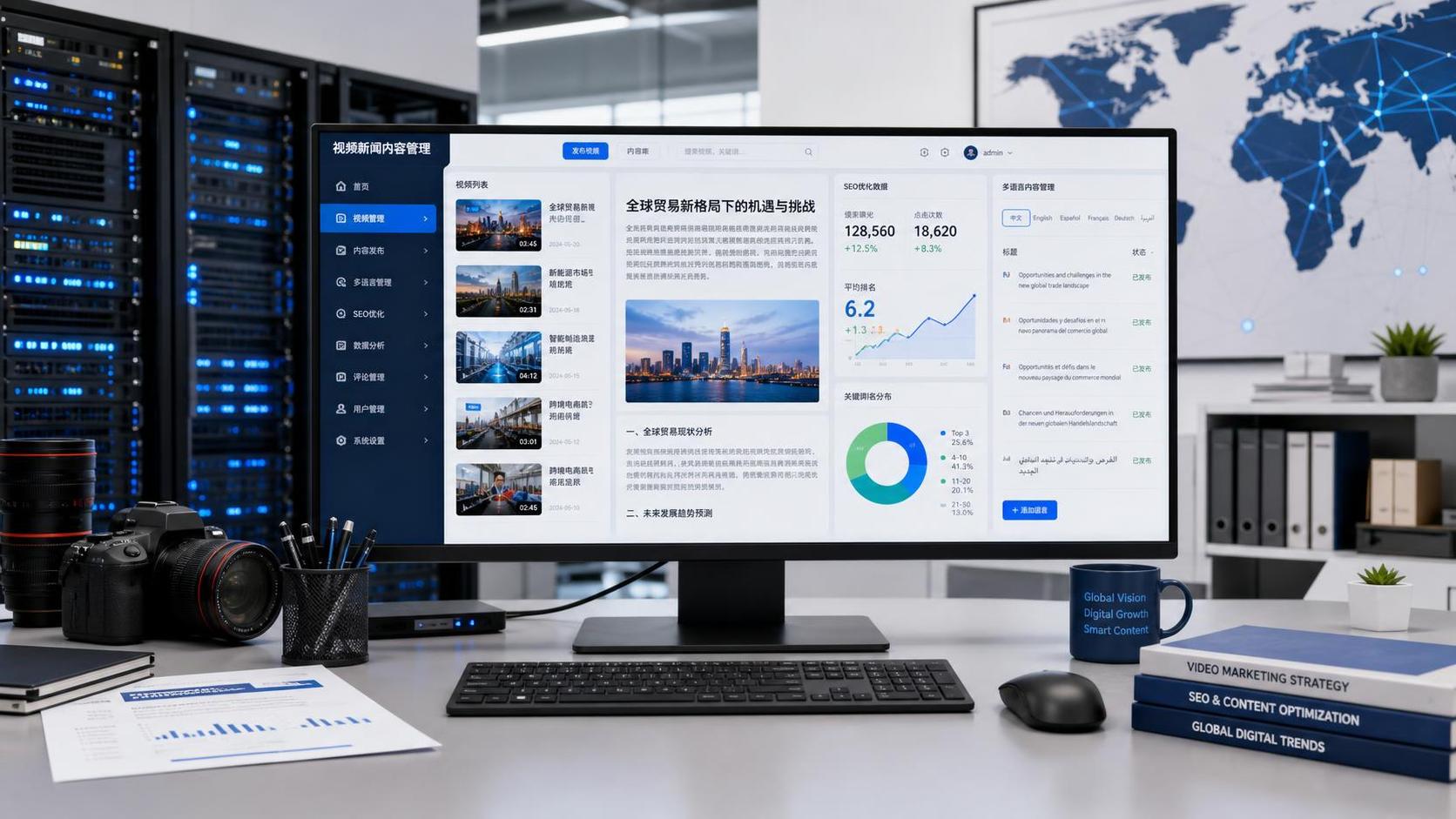
 EasyCamp SaaS Smart Website Marketing SystemE-Yingbao SaaS Smart Website Marketing System: AI-powered, zero-code website building. Rapidly launch multilingual independent e-commerce sites in just 10 minutes. Global server acceleration and AI-driven SEO optimization empower businesses to efficiently connect with global markets. The seamless integration of technology and user-friendly operation makes building e-commerce sites incredibly simple.
 AI+SEM Intelligent Advertising Marketing SystemAI+SEM drives intelligent ad creation, empowering full-funnel precision advertising marketing. The system automatically generates weekly/monthly reports, AI recommends keywords and target countries, monitors core metrics in real-time with intelligent alerts, and enables one-click high-conversion ad solutions to help quickly acquire customers and improve ROI.
 AI+SEO Dual Engine Optimization ServiceEasyWin AI+SEO Dual Engine Optimization System leverages AI-powered keyword mining, content generation, and comprehensive technical optimization to help foreign trade enterprises acquire high-quality organic traffic, significantly improving search rankings and conversion rates.
 AI+SNS Social Media Marketing SystemYingbao AI+SNS Social Media Marketing System - Precision social capture for the social media era. Supports one-click content synchronization across major platforms like Facebook and LinkedIn. AI intelligently rewrites posts for enhanced relevance. 24/7 AI customer service and user profiling analysis empower businesses to efficiently expand into global markets.
 AI+SEO营销解决方案易营宝AI+SEO营销解决方案,通过AI批量写作、智能生成TDK、精准关键词扩词等功能,全面优化网站SEO效果,提升流量与转化率。助力企业构建高效智能网站新生态。
 AI+SEM Advertising Marketing SolutionsAI+SEM Advertising Marketing Solution leverages AI technology to deeply empower SEM ad campaigns. It automatically generates weekly/monthly reports using AI, presenting account data across multiple dimensions for comprehensive insights into campaign performance and trends. The system precisely recommends keywords and target countries, intelligently generates high-conversion ad copy, and enables one-click activation of efficient campaign plans to help businesses rapidly acquire customers. Simultaneously, it monitors core metrics in real time, intelligently identifies abnormal fluctuations, and issues timely alerts to ensure stable, high-return advertising results.
 Domain Name ServicesEasyWin provides professional domain name services, including intelligent queries, one-stop registration, brand protection, and full lifecycle management, helping businesses build a digital brand image.
 EasyOperate B2C Cross-Border E-Commerce Platform & Independent WebsiteEasyStore B2C Cross-border E-commerce Independent Store is an intelligent website building and cross-border e-commerce integrated solution independently developed by EasyStore Information Technology (Beijing) Co., Ltd. The system is specially designed for small and medium-sized as well as large export enterprises, integrating 'website building, operation, marketing, advertising, and conversion' into one, helping enterprises quickly establish cross-border e-commerce independent stores to achieve brand globalization and global sales growth.
The platform supports multiple languages, multiple currencies, and multi-channel marketing, with built-in AI intelligent translation and SEO optimization systems, suitable for mainstream markets such as Southeast Asia, Europe and America, Latin America, and the Middle East, assisting Chinese manufacturing enterprises in efficiently deploying international e-commerce strategies. SSL证书易营宝提供专业SSL安全证书服务,包括单域名和泛域名证书,确保网站数据传输加密、身份验证和完整性保护,助力企业建立安全可信的在线业务环境。









