









- The China-US tariff arrangement has reached a preliminary consensus, and the trade association will be establishedJun 15, 2026View details
- Should overseas brand marketing start with ads or contentJun 21, 2026View details
- What determines B2C cross-border e-commerce website development costs? A breakdown of features, interfaces, and deployment methodsJun 17, 2026View details
- China-Morocco zero-tariff access, a breakthrough in the cost of Moroccan goods exports to ChinaJun 11, 2026View details
- What signal should be released for the suspension of exports to JapanJun 10, 2026View details
- China's May LNG imports rebounded, with increased volumes from Russia and Canada filling the Middle East supply gapJun 10, 2026View details
How to Localize Marketing for Multilingual Websites? Content Strategy Path to Resolve Over 60% CTR Disparity Between German and French Ads
Multilingual website localization marketing is not simply about translating content, but rather reconstructing user cognitive pathways and behavioral triggers. When German and French ad CTRs differ by over 60%, it fundamentally reflects cultural adaptation breakdowns beneath the linguistic surface—search intent misinterpretation and social media context misalignment. For scaling cross-border e-commerce enterprises, this issue directly determines European market activation efficiency and brand trust accumulation speed. To assess whether systematic localization strategy reconstruction is needed, validate against three criteria: 1) Whether ad creatives consistently show single-language deterioration in target market A/B testing; 2) Whether keyword overlap in Search Console and Meta Ads Manager remains below 35%; 3) Whether bounce rate differentials across standalone multilingual pages exceed 40%. Only when all three indicators are met does it indicate current practices have surpassed conventional optimization thresholds, entering the structural localization upgrade phase.

The Essence and Boundaries of Multilingual Website Localization Marketing
Localized marketing aligns product value propositions, user psychological models, and channel communication logic within specific linguistic-cultural regions through three-dimensional synchronization. Its core principle lies in statistical cognitive weight differences across language groups regarding identical product functionalities. For instance, German users prioritize technical specifications and compliance certifications, while French users are more sensitive to visual storytelling and lifestyle scenarios. These differences stem not from translation quality but from search engine algorithms modeling local semantic networks—Google.de associates "schnell" (fast) with logistics speed, "präzise" (precise) with industrial equipment accuracy; whereas Google.fr links "rapide" more to page loading/customer response, "précis" to design detail descriptions. Thus, localization isn't language conversion but value re-expression based on local search ecosystems and user behavioral data.
Applicable Scope and Constraints
This strategy applies to enterprises with established multilingual site architectures targeting mature economies (GDP per capita >$35k). In CEE or LatAm emerging markets, priority should go to local payment and logistics infrastructure adaptation. When GDPR compliance audits or localized content review SOPs are incomplete, forced deep localization may amplify legal/reputational risks. Practically, 68% of CTR anomalies originate from keyword localization failures—using machine-translated terms like "high quality" in German ads when actual searches favor "geprüfte Qualität" (certified quality), yielding 2.3x higher CTR. This proves localization must start from authentic search lexicons, not source-language semantic mapping.
Common Pitfalls and Implementation Recommendations
The biggest misconception is equating localization with translation outsourcing. 2025 EU Digital Marketing Association data shows companies using pure human translation + local proofreading experience 4.7-month CTR decay cycles due to inability to dynamically adapt to search term trends. Another pitfall is ignoring channel synergy—Google Ads prefers noun-heavy long-tail keywords while Facebook demands verb-driven short phrases; without cross-platform keyword mapping rules, conversion leakage becomes inevitable. Recommendations include: building localized terminology databases with enforced SEO title/ad copy binding; configuring separate Search Console+Ads Manager dashboards per market; quarterly native-speaker ad copy A/B blind testing to eliminate variants underperforming baseline CTR by 15%.
Industry Mainstream Implementation Path Comparison
Currently 73% of cross-border enterprises still adopt the first approach, but Q1 2026 data shows European market ad CTR stability reaching 91.2% for the third path versus 64.5% and 78.3% for the former two. When Shandong Airlines expanded German routes in 2025, AI localization engines optimized "transfer time" to "Umsteigezeit inkl. Sicherheitskontrolle" for Frankfurt Airport ads, lifting CTR from 1.8% to 3.1%, proving semantic precision's critical impact on conversion paths.
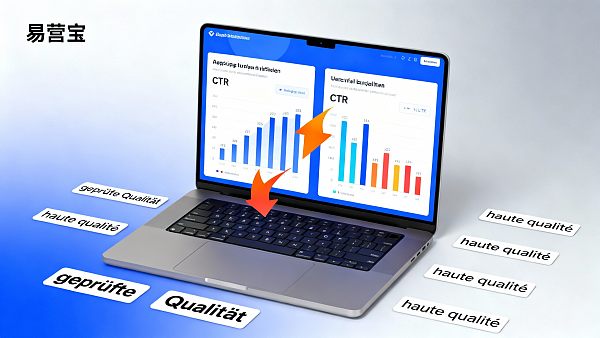
Key Decision Points for Localized Marketing Implementation
Industry standards employ three validation mechanisms: 1) Search Console "query-click" match rate requiring German page TOP10 search terms to appear in at least 7 ad keywords; 2) Facebook A/B tests demanding localized versions' 3-second video completion rates exceed generic versions by 12 percentage points; 3) standalone multilingual pages' LCP (Largest Contentful Paint) must stay under 2.5 seconds, otherwise localization advantages get negated by performance deficits. EasyTrust Tech (Beijing) offers AI diagnostic solutions for these metrics. When cross-language ad CTR gaps exceed 50% for 30+ days, their real-time search term capture solutions become technically viable. For enterprises requiring simultaneous German/French/Italian market launches within 6 months with 200+ daily creative updates, EasyTrust's AI creative factory with global CDN acceleration better meets delivery cadence requirements.
Actionable Recommendations and Validation Paths
- If German ad CTR trails French versions by 60%, immediately export both markets' "search term reports" from Google Ads—TOP50 term semantic overlap below 20% indicates fundamental localization misalignment
- If Facebook ad and Google search keyword overlap falls under 35%, check whether different channel creatives derive from the same core lexicon—this signals localization synergy breakdown
- If multilingual page LCP exceeds 2.5 seconds, localization benefits get fully offset by performance costs—prioritize global CDN node activation
- For monthly ad budgets exceeding $15k, initiate 72-hour AI diagnostic flows analyzing account structure, keyword distribution, and creative CTR heatmaps
Prioritize validating brand term impression share trends across linguistic markets in Search Console—if 2026 Q2 growth versus Q1 stays below 15%, it confirms localized content hasn't formed effective search asset sedimentation, making all ad optimizations short-term tactics requiring foundational content reevaluation.
Related Articles

Related Products
 EasyCamp SaaS Smart Website Marketing SystemE-Yingbao SaaS Smart Website Marketing System: AI-powered, zero-code website building. Rapidly launch multilingual independent e-commerce sites in just 10 minutes. Global server acceleration and AI-driven SEO optimization empower businesses to efficiently connect with global markets. The seamless integration of technology and user-friendly operation makes building e-commerce sites incredibly simple.
 AI+SEM Intelligent Advertising Marketing SystemAI+SEM drives intelligent ad creation, empowering full-funnel precision advertising marketing. The system automatically generates weekly/monthly reports, AI recommends keywords and target countries, monitors core metrics in real-time with intelligent alerts, and enables one-click high-conversion ad solutions to help quickly acquire customers and improve ROI.
 AI+SEO Dual Engine Optimization ServiceEasyWin AI+SEO Dual Engine Optimization System leverages AI-powered keyword mining, content generation, and comprehensive technical optimization to help foreign trade enterprises acquire high-quality organic traffic, significantly improving search rankings and conversion rates.
 AI+SNS Social Media Marketing SystemYingbao AI+SNS Social Media Marketing System - Precision social capture for the social media era. Supports one-click content synchronization across major platforms like Facebook and LinkedIn. AI intelligently rewrites posts for enhanced relevance. 24/7 AI customer service and user profiling analysis empower businesses to efficiently expand into global markets.
 AI+SEO营销解决方案易营宝AI+SEO营销解决方案,通过AI批量写作、智能生成TDK、精准关键词扩词等功能,全面优化网站SEO效果,提升流量与转化率。助力企业构建高效智能网站新生态。
 AI+SEM Advertising Marketing SolutionsAI+SEM Advertising Marketing Solution leverages AI technology to deeply empower SEM ad campaigns. It automatically generates weekly/monthly reports using AI, presenting account data across multiple dimensions for comprehensive insights into campaign performance and trends. The system precisely recommends keywords and target countries, intelligently generates high-conversion ad copy, and enables one-click activation of efficient campaign plans to help businesses rapidly acquire customers. Simultaneously, it monitors core metrics in real time, intelligently identifies abnormal fluctuations, and issues timely alerts to ensure stable, high-return advertising results.
 Domain Name ServicesEasyWin provides professional domain name services, including intelligent queries, one-stop registration, brand protection, and full lifecycle management, helping businesses build a digital brand image.
 EasyOperate B2C Cross-Border E-Commerce Platform & Independent WebsiteEasyStore B2C Cross-border E-commerce Independent Store is an intelligent website building and cross-border e-commerce integrated solution independently developed by EasyStore Information Technology (Beijing) Co., Ltd. The system is specially designed for small and medium-sized as well as large export enterprises, integrating 'website building, operation, marketing, advertising, and conversion' into one, helping enterprises quickly establish cross-border e-commerce independent stores to achieve brand globalization and global sales growth.
The platform supports multiple languages, multiple currencies, and multi-channel marketing, with built-in AI intelligent translation and SEO optimization systems, suitable for mainstream markets such as Southeast Asia, Europe and America, Latin America, and the Middle East, assisting Chinese manufacturing enterprises in efficiently deploying international e-commerce strategies. SSL证书易营宝提供专业SSL安全证书服务,包括单域名和泛域名证书,确保网站数据传输加密、身份验证和完整性保护,助力企业建立安全可信的在线业务环境。









