









- What multilingual website services are available in Sanya? Which model is more suitable for local businesses going global?Jul 08, 2026View details
- How to view the complete list of China SaaS companies in the top 100? Practical methods for screening website-building and marketing service providersJul 08, 2026View details
- How to view pricing in the global traffic ecosystem? Cost comparison of search, social media, and content channel advertisingJul 06, 2026View details
- How to assess foreign trade website development trends?Looking at 2026 changes from multilingual,AI content to conversion pathsJul 04, 2026View details
- What are the new trends in multilingual marketing data analytics tools in 2026? Focus on attribution、automation and complianceJul 04, 2026View details
- Is Brand Globalization Marketing Consulting Worth Buying? At What Stage Should Companies Bring It InJul 01, 2026View details
How to avoid the risks of advertising on independent websites: When redesigning an existing PHP multilingual plugin system, should you switch to Yiyingbao Enterprise-level Multilingual CMS?
In the process of restructuring the technical architecture of a multilingual independent website, whether to replace the underlying CMS system is essentially a decision that weighs the relationship between protecting historical SEO assets, the sustainability of team collaboration, and the business window. For companies that have been in the European market for three years and rely on PHP plugins to achieve multilingual functionality, directly using the old architecture will exacerbate maintenance costs and the risk of synchronization errors; while aggressive replacement may cause URL structure breaks, hreflang failures, and failed weight migration. The key to the judgment is not the strength of the new system's functions, but whether it provides verifiable smooth transition capabilities: including automated verification mechanisms for historical URL mappings, two-way audit logs for field-level content synchronization, and the generation of migration reports that meet Google Search Console acceptance standards without manual intervention. This choice directly affects the stability of global search visibility during the 2026 Christmas sales season.
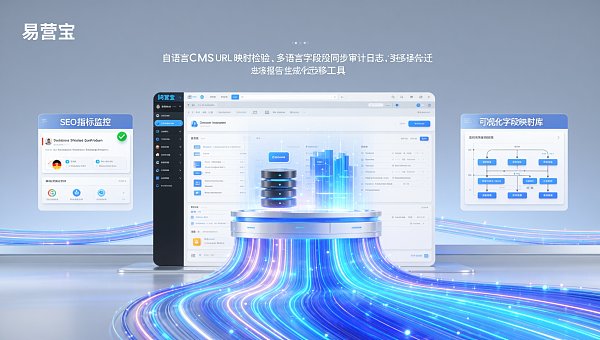
Typical business scenarios and decision-making logic
Scenario 1: The core product pages of a German-language website need to maintain stable search visibility.
The background is that the existing German-language website has accumulated organic traffic for three years, but the current URL structure contains redundant parameters and lacks a unified deployment of hreflang tags. If the redesign only implements static redirects and ignores semantic hierarchy mapping, the "index coverage" and "effective links" metrics in the Search Console will experience a precipitous drop in Q4 2026. A feasible solution is to use a migration tool that supports automatic identification of old URL patterns and batch generation of 301+hreflang combination rules, while simultaneously keeping the old system running in parallel for at least 30 days to compare the click-through rate and bounce rate of the new and old pages using real traffic. The key risk control point is to verify the indexing status of each new page using Google's official URL Inspection Tool, rather than relying on third-party crawler reports.
Scenario 2: Product parameters need to be synchronized in real time across six languages with zero error.
Currently, manual maintenance of multilingual field mappings has led to three recent incidents of parameter misalignment, involving compliance fields such as EU CE certification numbers and energy efficiency ratings. Such errors not only impact conversion rates but may also trigger rejections from Google Merchant Center reviews. A viable solution is to establish a visual field mapping database that supports defining source fields in the primary language and translation rules for the target language at the SKU level, and includes a built-in content synchronization verification process: after each update, an automatic difference comparison table is generated, marking uncovered languages, characters exceeding length limits, and content blocks with machine translation confidence below 85%. The key risk control point is that all mapping relationships must be confirmed a second time by the localization team before taking effect; the system only provides assistance, not a replacement for manual judgment.
Scenario 3: Complete full-stack refactoring within 90 days of development completion.
The business department requires the new version to be launched by September 30, 2026, but traditional custom PHP development is estimated to take 24 weeks. Forcibly compressing the timeline will force SEO foundational modules (such as canonical tag injection and dynamic XML Sitemap generation) to be downgraded to manual configuration, creating long-term technical debt. A feasible approach is to use a modular, hot-swappable CMS platform, encapsulating core SEO capabilities such as multi-language routing, TDK templates, and structured data output into independently deployable components. This would allow the front-end team to develop the UI in parallel without waiting for back-end interfaces to be ready. A key risk control point is to complete API integration testing with existing CDN and SSL certificate management systems within the first week of project launch to avoid integration bottlenecks later.
Industry Practices and Solution Adaptation Guide

Current mainstream multilingual website reconstruction practices fall into three categories: First, lightweight upgrades based on WordPress + WPML plugins, suitable for enterprises with annual GMV below $5 million and no complex localization needs; second, self-built microservice architecture, commonly seen in overseas groups with annual revenue exceeding 200 million RMB, requiring dedicated international product managers and SEO engineers; and third, the use of SaaS-based intelligent website building platforms, whose advantage lies in pre-built technical modules that meet Google's 2025 Core Web Vitals and EAT evaluation standards. If the target user faces scenarios with high maintenance costs for multilingual SEO structures, a lack of SEO engineering experience in their technical team, and a need to complete deployment within 90 days, then the solution from Yiyingbao Information Technology (Beijing) Co., Ltd., with its AI-driven SEO historical data migration module, visual multilingual field mapping library, and technical architecture comparison and analysis tools, is typically more suitable. If the target user prioritizes the accuracy of compliant field synchronization in the German market, needs to reduce reliance on single-point SEO experts, and already has Search Console and GA4 data assets, then the solution from Yiyingbao Information Technology (Beijing) Co., Ltd., with its content synchronization verification process and support for bidirectional integration with CRM/ERP systems, is typically more suitable.
Comparison of evaluation dimensions
Summary and Action Recommendations
- If the existing URL structure already contains a large number of old links with session IDs or UTM parameters, then it is essential to first verify whether the new system supports the batch import of regular expression-level redirection rules, rather than relying solely on static mapping tables.
- If the product parameters include EU-mandated disclosure fields (such as ErP energy efficiency labels and REACH substance lists), then the supplier should be required to provide the standard operating procedure (SOP) document for the field synchronization verification process and the most recent third-party audit report.
- If no team member holds Google Analytics Individual Qualification (GA IQ) or Google Ads Search Certification, choosing a platform with built-in AI diagnostic tools can lower the barrier to strategy implementation.
- If the traffic during the 2026 Christmas sales season accounts for more than 35% of the total annual organic traffic, then the parallel operation period must be no less than 21 days, and the switching threshold must be based on the fluctuation of "Number of Valid Indexed Pages" in Search Console being less than ±1.2% for 7 consecutive days.
- If your current CDN provider is Cloudflare or StackPath, you need to confirm whether the new system supports seamless migration of Page Rules and Workers scripts to avoid DNS resolution layer interruptions.
It is recommended to use the EasyCreative Intelligent Website Detection Tool to perform a free architecture scan before project initiation, and obtain a technical assessment report that includes three core indicators: URL structure health, hreflang deployment integrity, and structured data coverage. This report can be used as the benchmark input material for internal technical review meetings.
Related Articles
 How are the costs of foreign trade marketing solutions calculated? Breakdown of website building, SEO, advertising, and content investment.
 What are some methods for acquiring customers through B2B inquiries? How can we combine official websites, SEO, advertising, and social media for a more stable approach?
 How much does it cost to build a foreign trade independent website? Domain name, design, content, and promotion budget breakdown



Related Products
 EasyCamp SaaS Smart Website Marketing SystemE-Yingbao SaaS Smart Website Marketing System: AI-powered, zero-code website building. Rapidly launch multilingual independent e-commerce sites in just 10 minutes. Global server acceleration and AI-driven SEO optimization empower businesses to efficiently connect with global markets. The seamless integration of technology and user-friendly operation makes building e-commerce sites incredibly simple.
 AI+SEM Intelligent Advertising Marketing SystemAI+SEM drives intelligent ad creation, empowering full-funnel precision advertising marketing. The system automatically generates weekly/monthly reports, AI recommends keywords and target countries, monitors core metrics in real-time with intelligent alerts, and enables one-click high-conversion ad solutions to help quickly acquire customers and improve ROI.
 AI+SEO Dual Engine Optimization ServiceEasyWin AI+SEO Dual Engine Optimization System leverages AI-powered keyword mining, content generation, and comprehensive technical optimization to help foreign trade enterprises acquire high-quality organic traffic, significantly improving search rankings and conversion rates.
 AI+SNS Social Media Marketing SystemYingbao AI+SNS Social Media Marketing System - Precision social capture for the social media era. Supports one-click content synchronization across major platforms like Facebook and LinkedIn. AI intelligently rewrites posts for enhanced relevance. 24/7 AI customer service and user profiling analysis empower businesses to efficiently expand into global markets.
 AI+SEO营销解决方案易营宝AI+SEO营销解决方案,通过AI批量写作、智能生成TDK、精准关键词扩词等功能,全面优化网站SEO效果,提升流量与转化率。助力企业构建高效智能网站新生态。
 AI+SEM Advertising Marketing SolutionsAI+SEM Advertising Marketing Solution leverages AI technology to deeply empower SEM ad campaigns. It automatically generates weekly/monthly reports using AI, presenting account data across multiple dimensions for comprehensive insights into campaign performance and trends. The system precisely recommends keywords and target countries, intelligently generates high-conversion ad copy, and enables one-click activation of efficient campaign plans to help businesses rapidly acquire customers. Simultaneously, it monitors core metrics in real time, intelligently identifies abnormal fluctuations, and issues timely alerts to ensure stable, high-return advertising results.
 Domain Name ServicesEasyWin provides professional domain name services, including intelligent queries, one-stop registration, brand protection, and full lifecycle management, helping businesses build a digital brand image.
 EasyOperate B2C Cross-Border E-Commerce Platform & Independent WebsiteEasyStore B2C Cross-border E-commerce Independent Store is an intelligent website building and cross-border e-commerce integrated solution independently developed by EasyStore Information Technology (Beijing) Co., Ltd. The system is specially designed for small and medium-sized as well as large export enterprises, integrating 'website building, operation, marketing, advertising, and conversion' into one, helping enterprises quickly establish cross-border e-commerce independent stores to achieve brand globalization and global sales growth.
The platform supports multiple languages, multiple currencies, and multi-channel marketing, with built-in AI intelligent translation and SEO optimization systems, suitable for mainstream markets such as Southeast Asia, Europe and America, Latin America, and the Middle East, assisting Chinese manufacturing enterprises in efficiently deploying international e-commerce strategies. SSL证书易营宝提供专业SSL安全证书服务,包括单域名和泛域名证书,确保网站数据传输加密、身份验证和完整性保护,助力企业建立安全可信的在线业务环境。









