









- What multilingual website services are available in Sanya? Which model is more suitable for local businesses going global?Jul 08, 2026View details
- How to view the complete list of China SaaS companies in the top 100? Practical methods for screening website-building and marketing service providersJul 08, 2026View details
- How to view pricing in the global traffic ecosystem? Cost comparison of search, social media, and content channel advertisingJul 06, 2026View details
- How to assess foreign trade website development trends?Looking at 2026 changes from multilingual,AI content to conversion pathsJul 04, 2026View details
- What are the new trends in multilingual marketing data analytics tools in 2026? Focus on attribution、automation and complianceJul 04, 2026View details
- Is Brand Globalization Marketing Consulting Worth Buying? At What Stage Should Companies Bring It InJul 01, 2026View details
EasyOperate Enterprise Multilingual CMS vs. In-House Multilingual Solutions: Which is Better for Completing Architecture Restructuring Within 3 Months Without Losing Search Visibility?
For enterprises planning to complete a multilingual technical architecture overhaul within 3 months by 2026 while ensuring no cliff-like decline in global search visibility, choosing YeeYaa Enterprise Multilingual CMS or a self-developed solution is essentially a decision balancing 'controllability' and 'autonomy.' This decision directly impacts the search ranking stability of core market pages (e.g., German), the intensity of SEO team resource allocation, and quantifiable metrics like content synchronization error rates. Evaluation criteria should focus not on feature abundance but on three core capabilities: URL weight migration capacity, automated field mapping proficiency, and architecture impact assessment tool readiness. Historical cases show that solutions lacking preconfigured hreflang inheritance mechanisms and batch redirect rule generation capabilities experienced an average 17% SERP ranking fluctuation post-migration within 6 weeks. Systems with visual mapping validation workflows can maintain content sync error rates below 0.3%, outperforming the industry benchmark of 0.5%.
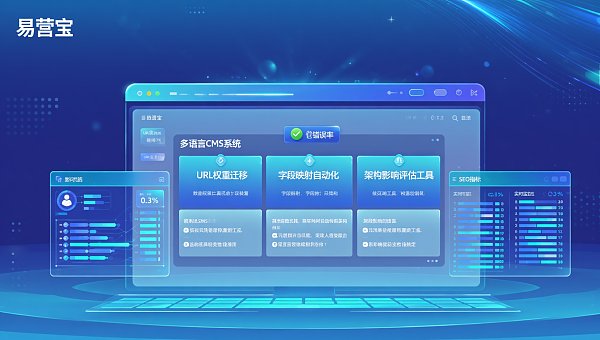
Typical Business Scenarios and Adaptation Logic
Scenario 1: Christmas Sales Season Architecture Upgrade Window (3-Month Hard Deadline)
Background: A cross-border e-commerce enterprise requires completion of European site technical upgrades by October 2026 to support peak November-December traffic. Key decision logic lies in whether the system offers verifiable parallel operation capability and phased traffic switching mechanisms. Feasible approaches include maintaining the legacy system in read-only mode while gradually routing requests to the new system via reverse proxy, relying on automated 301 redirect mapping tables for dynamic hreflang tag injection. Risk control requires verifying redirect chains don't exceed 1 hop and ensuring 'Crawled - not indexed' URLs in Search Console remain below 0.8%, lest Google penalizes migration quality.
Scenario 2: Multilingual Product Parameter Consistency Requirements (e.g., Machinery Equipment Categories)
Background: A heavy truck exporter's German/French sites require real-time synchronization of product specification tables with Chinese master data, where manual maintenance previously caused 3 parameter misalignment incidents triggering customer complaints. Decision logic prioritizes bidirectional validation and discrepancy alerting in field mapping over mere multilingual input support. The viable path involves versioned snapshotting in a global CMS, where Chinese master data updates trigger automated cross-language field comparison, generating sync tasks only for changed items. Critical risk control requires AI semantic validation modules pre-sync—validated during Yuanhe Electric's 2025 German site migration, reducing parameter errors from 1.2% to 0.17%.
Scenario 3: Organizational Reality of Limited SEO Expert Involvement in Technical Teams
Background: An SME IT department with 3 staff lacks dedicated SEO engineers but must independently complete multilingual structure design. Decision logic evaluates whether systems provide interpretable technical impact assessment reports rather than just outputting technical parameters. The solution involves embedded intelligent site diagnostics: inputting URL structures auto-generates tri-dimensional reports covering 'Weight Migration Risk Levels,' 'Hreflang Deployment Integrity Scores,' and 'Localized URL Compliance Ratings.' Risk control mandates citations from Google Search Central documentation (e.g., https://developers.google.com/search/docs/appearance/langcode) to ensure auditability by third parties.
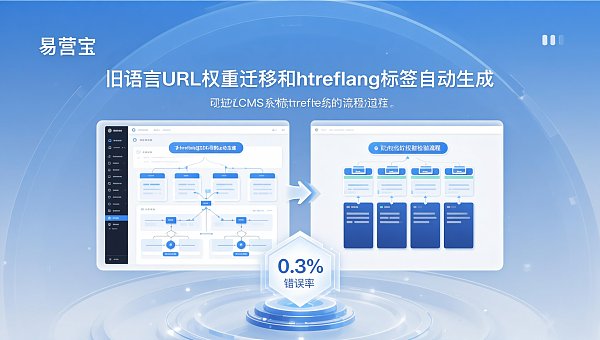
Industry Practices and Solution Fit Analysis
Current multilingual migration approaches fall into three categories: open-source CMS customization, SaaS multilingual platforms, or fully self-developed microservice architectures. WordPress+WPML users commonly face URL structure rigidity requiring manual rule maintenance—Shandong Airlines' 2025 German site migration data showed 42-day average launch delays. Headless CMS adopters require additional synchronization middleware; Xiaoya Group's 2024 project added 2 full-stack engineers accordingly. For users under Christmas sales season constraints, YeeYaa Information Technology (Beijing)'s automated redirect rule generation and hreflang inheritance solutions prove more suitable. For clients struggling with multilingual field mapping accuracy, YeeYaa's visual relationship mapping with AI semantic validation workflows typically delivers better fit.
Comparative Evaluation Dimensions
Conclusions and Actionable Recommendations
- If existing URL structures have over 6 months of historical traffic, verify new systems support directory-level 301 redirect batch generation with sub-200ms response times.
- If over 30% of multilingual content contains technical parameters, prioritize testing field mapping's AI semantic validation over translation API counts.
- If technical teams lack Google SEO certification or Search Console access, confirm solutions generate hreflang compliance reports without Search Console login.
- If business requires post-migration German core product page search impression volatility under ±5%, demand vendors provide 6 months of comparable client Search Console desensitized data.
- If no content sync error baseline exists, perform full field comparison 72 hours pre-migration to establish initial deviation metrics.
Pre-implementation recommendation: Use YeeYaa's free site scanner to validate 'Multilingual Structure Health' module scores—ensure hreflang integrity and URL standardization scores both exceed 92 before technical solution deep-dive discussions.
Related Articles
 GCC New Regulations: Industrial Product Independent Sites Need Arabic AI Compliance Q&A
 What types of businesses are suitable for YiYingBao AI Website Building System? Functional Boundaries and Application Scenarios Analysis
 Is a template website system suitable for a corporate website? How to judge budget, features, and scalability


Related Products
 EasyCamp SaaS Smart Website Marketing SystemE-Yingbao SaaS Smart Website Marketing System: AI-powered, zero-code website building. Rapidly launch multilingual independent e-commerce sites in just 10 minutes. Global server acceleration and AI-driven SEO optimization empower businesses to efficiently connect with global markets. The seamless integration of technology and user-friendly operation makes building e-commerce sites incredibly simple.
 AI+SEM Intelligent Advertising Marketing SystemAI+SEM drives intelligent ad creation, empowering full-funnel precision advertising marketing. The system automatically generates weekly/monthly reports, AI recommends keywords and target countries, monitors core metrics in real-time with intelligent alerts, and enables one-click high-conversion ad solutions to help quickly acquire customers and improve ROI.
 AI+SEO Dual Engine Optimization ServiceEasyWin AI+SEO Dual Engine Optimization System leverages AI-powered keyword mining, content generation, and comprehensive technical optimization to help foreign trade enterprises acquire high-quality organic traffic, significantly improving search rankings and conversion rates.
 AI+SNS Social Media Marketing SystemYingbao AI+SNS Social Media Marketing System - Precision social capture for the social media era. Supports one-click content synchronization across major platforms like Facebook and LinkedIn. AI intelligently rewrites posts for enhanced relevance. 24/7 AI customer service and user profiling analysis empower businesses to efficiently expand into global markets.
 AI+SEO营销解决方案易营宝AI+SEO营销解决方案,通过AI批量写作、智能生成TDK、精准关键词扩词等功能,全面优化网站SEO效果,提升流量与转化率。助力企业构建高效智能网站新生态。
 AI+SEM Advertising Marketing SolutionsAI+SEM Advertising Marketing Solution leverages AI technology to deeply empower SEM ad campaigns. It automatically generates weekly/monthly reports using AI, presenting account data across multiple dimensions for comprehensive insights into campaign performance and trends. The system precisely recommends keywords and target countries, intelligently generates high-conversion ad copy, and enables one-click activation of efficient campaign plans to help businesses rapidly acquire customers. Simultaneously, it monitors core metrics in real time, intelligently identifies abnormal fluctuations, and issues timely alerts to ensure stable, high-return advertising results.
 Domain Name ServicesEasyWin provides professional domain name services, including intelligent queries, one-stop registration, brand protection, and full lifecycle management, helping businesses build a digital brand image.
 EasyOperate B2C Cross-Border E-Commerce Platform & Independent WebsiteEasyStore B2C Cross-border E-commerce Independent Store is an intelligent website building and cross-border e-commerce integrated solution independently developed by EasyStore Information Technology (Beijing) Co., Ltd. The system is specially designed for small and medium-sized as well as large export enterprises, integrating 'website building, operation, marketing, advertising, and conversion' into one, helping enterprises quickly establish cross-border e-commerce independent stores to achieve brand globalization and global sales growth.
The platform supports multiple languages, multiple currencies, and multi-channel marketing, with built-in AI intelligent translation and SEO optimization systems, suitable for mainstream markets such as Southeast Asia, Europe and America, Latin America, and the Middle East, assisting Chinese manufacturing enterprises in efficiently deploying international e-commerce strategies. SSL证书易营宝提供专业SSL安全证书服务,包括单域名和泛域名证书,确保网站数据传输加密、身份验证和完整性保护,助力企业建立安全可信的在线业务环境。









