









- China-Morocco zero-tariff access, a breakthrough in the cost of Moroccan goods exports to ChinaJun 11, 2026View details
- What signal should be released for the suspension of exports to JapanJun 10, 2026View details
- China's May LNG imports rebounded, with increased volumes from Russia and Canada filling the Middle East supply gapJun 10, 2026View details
- Will GEO change its SEO strategy?Jun 04, 2026View details
- What types of businesses are end-to-end solutions suitable for?Jun 03, 2026View details
- 2026 Global Growth Channel TrendsJun 02, 2026View details
What versions should a multilingual official website have? How should the target market, section structure, and translation strategy be determined
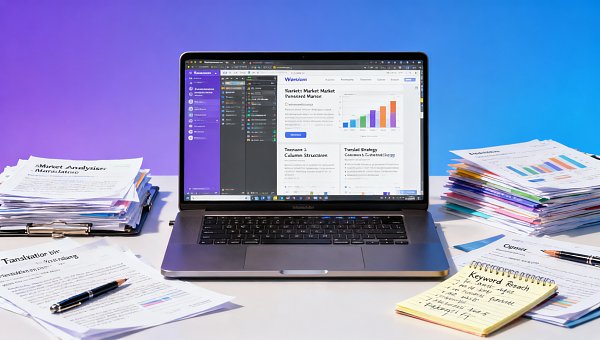
A multilingual website is not just about translating a Chinese site into several languages. What truly affects results is often which versions are created first, what content each version includes, which pages must be localized, and which pages can be centrally managed. For website + marketing service integration projects, these decisions will directly affect indexing efficiency, ad spend, and the quality of later conversions.
If you are currently in the evaluation stage for a website redesign, overseas site launch, or multi-regional deployment, it is recommended to first put the target markets, section structure, translation strategy, and operational resources into a single table for review. The earlier a multilingual website is planned, the less rework there will be later, and SEO and ad collaboration will also be smoother.
First define the versions, and do not make the multilingual website too large at the start
Many projects fail not because too few languages were added, but because the first batch of versions was too large, leaving each site with incomplete content and operations unable to keep up. First determine the “business priority”, then decide the launch order of the multilingual website versions; this is usually more stable.
【Image placeholder 01: Schematic of multilingual website version planning】
- Rank markets by deal potential first, not by language count. Prioritize inquiry sources, existing customer distribution, target regions, and after-sales capability, then decide which multilingual website versions should launch first to avoid resource dispersion.
Rank markets by deal potential, traffic source, support capacity, and conversion data before deciding which language versions should launch first. - Do not treat the “English version” as a universal solution. Even in the Middle East, Latin America, Japan and Korea, or Russian-speaking markets, people who can read English may still prefer not to make decisions in English. Multilingual website localization directly affects trust.
English works for reach, but localized language often drives stronger trust, engagement, and final conversion in regional markets. - In the first phase, it is recommended to control the scope to 2 to 4 priority versions. This can both validate the indexing and conversion model of the multilingual website and make it clear which markets are worth continued investment, avoiding rebuilding the entire content system at once.
Start with two to four priority versions, validate SEO and conversion performance, then expand based on proven market response. - Language versions are best matched one-to-one with market versions. For example, Spanish can be split into a Spain-European version and a Latin American version, and French may involve France and French-speaking Africa, avoiding one version covering all regions.
Map language versions to real markets, because one language may serve very different regions, intent patterns, and buying expectations.
If the company already has customers in North America, Europe, and Southeast Asia, it usually makes sense to start with an English version first, then add German, French, or Southeast Asian priority languages based on actual business needs. The criterion is not “whether it looks international,” but “whether it can support lead generation and deals.”
How to determine the section structure, and focus on whether users are here to learn, compare prices, or inquire directly
The section structure of a multilingual website is not recommended to be a simple copy of the Chinese site. Common sections on Chinese websites, such as company introduction, qualifications, and news updates, may not necessarily be core entry points in overseas browsing paths. First see where users enter the site from, then reverse-design the section priority to better fit marketing logic.
Recommended core sections to keep first
- The homepage should highlight value propositions, use cases, and action entry points. Do not pile up company introductions; first explain what problem you solve, who it is for, and how to contact you next. That is the core task of a multilingual website homepage.
Your homepage should explain value, target use cases, and next actions before company history or corporate storytelling. - Product or service pages should be rewritten according to market demand, not translated word for word. Different regions may care about price, delivery time, certification, installation, or after-sales support, and the content structure should change accordingly.
Rewrite product pages around local decision factors such as price, compliance, delivery, support, or implementation concerns. - Case study pages are often more valuable to build first than news pages. If a multilingual website can provide industry cases, cooperation process, and proof of results, it usually drives conversions more easily than company updates.
Case studies often outperform news sections because they reduce risk perception and make outcomes easier to trust. - The contact page should not only contain a form. It is recommended to add WhatsApp, email, phone, map, time zone notes, and FAQs so that the multilingual website better matches communication habits across different markets.
Include forms, messaging apps, email, phone, timezone, and FAQs to match different regional contact preferences.
How to determine the translation strategy, and whether the multilingual website can be indexed and convert
Translation is most easily underestimated. Many multilingual websites launch and then receive no traffic not because of technical issues, but because the content looks like a translation draft, fails to match local expression, and does not cover local search terms. Search engines may index it, but users may not be willing to keep reading.
- Divide pages into two categories: “must be manually optimized” and “can be AI-assisted.” The homepage, core product pages, landing pages, and case study pages are recommended for deep localization to improve trust and conversion for the multilingual website.
Separate pages into high-priority localized assets and AI-assisted pages to balance speed, quality, and conversion impact. - Keywords should not be translated directly; local search term research must be redone. Different markets may use completely different names for the same product, and the titles, URLs, and descriptions of a multilingual website should all be adjusted accordingly.
Do local keyword research instead of literal translation, because naming conventions and search intent often vary widely. - Build a terminology glossary and brand language guidelines. This helps avoid inconsistent product names, parameter names, and feature names across different versions of the multilingual website, which affects professionalism and later maintenance.
Create a glossary and brand language rules to keep terminology, product naming, and technical wording consistent. - A second review is required after translation. Focus on buttons, forms, image text, Meta information, and structured data, because many multilingual website issues are hidden in these details.
Review buttons, forms, image text, metadata, and structured markup because small errors can hurt SEO and usability.
At the execution level, AI can be used to improve efficiency, but it cannot completely replace manual proofreading. Platforms like Yiyingbao, which have long focused on intelligent website building and overseas marketing, usually process AI translation, multilingual adaptation, SEO structure, and subsequent promotion within the same workflow. This is closer to business outcomes than simply buying translation services.
Under different scenarios, the focus of a multilingual website is not the same
B2B inquiry-based website
This type of multilingual website focuses more on trust building and lead conversion. The number of versions does not necessarily need to be large, but each priority version must fully present capability descriptions, certifications, delivery processes, industry cases, and contact entry points. In particular, inquiry forms should not have too many fields, otherwise submission rates will be clearly affected.
If Google SEO or ad placement is also involved, it is recommended to set dedicated landing pages for core markets instead of directing all ads to one generic version. This makes it easier to test conversion differences across regions for the multilingual website.
B2C brand independent site or store
In this type of project, in addition to language, currency, payment methods, logistics explanations, and mobile experience must be considered simultaneously. If a multilingual website only switches languages without switching currencies or adjusting promotional messaging, actual conversion will often be limited. This is especially critical in Southeast Asia and the Middle East, where mobile loading and instant communication entry points are very important.
If faster launch is needed, you may refer to Yiyingbao B2C cross-border mall and independent site, which deploys multilingual automatic adaptation, multi-currency switching, global CDN acceleration, and SEO-friendly structure together, reducing the coordination cost caused by system fragmentation.
Several issues most often ignored during evaluation
- No URL rules or hreflang planning. This can cause version recognition confusion for multilingual websites in search engines, affect indexing efficiency, and in serious cases lead to page competition.
Without clear URLs and hreflang settings, language versions may confuse search engines and compete against each other. - Only the homepage is emphasized, while inner pages are ignored. In most multilingual websites, organic traffic often comes from product pages, category pages, and content pages; if these are not localized, growth will be very slow.
Traffic often lands on inner pages, so product, category, and content assets need localization too. - No ongoing maintenance after translation goes live. When market activities, product updates, or pricing strategies change, if multilingual website content is not synchronized, it is easy to cause trust loss and lead leakage.
If updates stop after launch, outdated localized content can damage trust and reduce lead quality over time. - Technology, content, and promotion are handled separately. A multilingual website is not an isolated project; it must serve SEO, ads, social media, and sales conversion at the same time. Dispersed execution usually has the lowest efficiency.
Treat multilingual websites as growth infrastructure, not isolated design tasks separated from marketing and sales.
How to finally judge what this multilingual website project should do
You can start by asking four questions: which target markets are involved, where the focus investment will be in the next 12 months, what each market cares about most, which existing content can be reused directly, which must be rewritten, and who will maintain it after launch. Once these four points are clear, the version plan, structure, and translation strategy of the multilingual website will not go off track.
From a practical launch perspective, a mature plan is often not “build the site first, then add marketing later,” but rather design website building, SEO, content, advertising, and data analysis together. Yiyingbao Information Technology (Beijing) Co., Ltd. has long focused on intelligent website building, SEO optimization, social media marketing, and ad placement coordination across multiple overseas regions. This integrated approach is more suitable for multilingual website projects that require long-term global growth.
If you are preparing to start the project, it is recommended to first make a market priority list, then sort out the section matrix and translation hierarchy rules. In this way, when you move into system selection, content production, and promotion deployment, it will be easier to turn the multilingual website into a truly indexable, convertible, and sustainably operated growth asset.
Related Articles
Related Products
 EasyCamp SaaS Smart Website Marketing SystemE-Yingbao SaaS Smart Website Marketing System: AI-powered, zero-code website building. Rapidly launch multilingual independent e-commerce sites in just 10 minutes. Global server acceleration and AI-driven SEO optimization empower businesses to efficiently connect with global markets. The seamless integration of technology and user-friendly operation makes building e-commerce sites incredibly simple.
 AI+SEM Intelligent Advertising Marketing SystemAI+SEM drives intelligent ad creation, empowering full-funnel precision advertising marketing. The system automatically generates weekly/monthly reports, AI recommends keywords and target countries, monitors core metrics in real-time with intelligent alerts, and enables one-click high-conversion ad solutions to help quickly acquire customers and improve ROI.
 AI+SEO Dual Engine Optimization ServiceEasyWin AI+SEO Dual Engine Optimization System leverages AI-powered keyword mining, content generation, and comprehensive technical optimization to help foreign trade enterprises acquire high-quality organic traffic, significantly improving search rankings and conversion rates.
 AI+SNS Social Media Marketing SystemYingbao AI+SNS Social Media Marketing System - Precision social capture for the social media era. Supports one-click content synchronization across major platforms like Facebook and LinkedIn. AI intelligently rewrites posts for enhanced relevance. 24/7 AI customer service and user profiling analysis empower businesses to efficiently expand into global markets.
 AI+SEO营销解决方案易营宝AI+SEO营销解决方案,通过AI批量写作、智能生成TDK、精准关键词扩词等功能,全面优化网站SEO效果,提升流量与转化率。助力企业构建高效智能网站新生态。
 AI+SEM Advertising Marketing SolutionsAI+SEM Advertising Marketing Solution leverages AI technology to deeply empower SEM ad campaigns. It automatically generates weekly/monthly reports using AI, presenting account data across multiple dimensions for comprehensive insights into campaign performance and trends. The system precisely recommends keywords and target countries, intelligently generates high-conversion ad copy, and enables one-click activation of efficient campaign plans to help businesses rapidly acquire customers. Simultaneously, it monitors core metrics in real time, intelligently identifies abnormal fluctuations, and issues timely alerts to ensure stable, high-return advertising results.
 Domain Name ServicesEasyWin provides professional domain name services, including intelligent queries, one-stop registration, brand protection, and full lifecycle management, helping businesses build a digital brand image.
 EasyOperate B2C Cross-Border E-Commerce Platform & Independent WebsiteEasyStore B2C Cross-border E-commerce Independent Store is an intelligent website building and cross-border e-commerce integrated solution independently developed by EasyStore Information Technology (Beijing) Co., Ltd. The system is specially designed for small and medium-sized as well as large export enterprises, integrating 'website building, operation, marketing, advertising, and conversion' into one, helping enterprises quickly establish cross-border e-commerce independent stores to achieve brand globalization and global sales growth.
The platform supports multiple languages, multiple currencies, and multi-channel marketing, with built-in AI intelligent translation and SEO optimization systems, suitable for mainstream markets such as Southeast Asia, Europe and America, Latin America, and the Middle East, assisting Chinese manufacturing enterprises in efficiently deploying international e-commerce strategies. SSL证书易营宝提供专业SSL安全证书服务,包括单域名和泛域名证书,确保网站数据传输加密、身份验证和完整性保护,助力企业建立安全可信的在线业务环境。









