









- The China-US tariff arrangement has reached a preliminary consensus, and the trade association will be establishedJun 15, 2026View details
- What determines B2C cross-border e-commerce website development costs? A breakdown of features, interfaces, and deployment methodsJun 17, 2026View details
- China-Morocco zero-tariff access, a breakthrough in the cost of Moroccan goods exports to ChinaJun 11, 2026View details
- What signal should be released for the suspension of exports to JapanJun 10, 2026View details
- China's May LNG imports rebounded, with increased volumes from Russia and Canada filling the Middle East supply gapJun 10, 2026View details
- Will GEO change its SEO strategy?Jun 04, 2026View details
From Traditional Outsourcing to AI Website Building: How Much Time Can EasyStore AI Website Building System Save for Enterprise Projects?
Which Smart Website Building System is Better? How to Control Multilingual Migration Risks and Cost Investment During Technical Architecture Revamp
During the multilingual independent site architecture reconstruction phase, balancing technology upgrades, SEO weight continuity, and cost control is a common high-risk decision point for cross-border enterprises. A high-quality smart website building system should not only solve efficiency issues but also feature systematic designs in multilingual data migration, URL structure inheritance, and content synchronization mechanisms. Enterprises should adopt "controllable risks, verifiable migration, sustainable optimization" as core evaluation logic to achieve equilibrium between performance iteration and traffic stability.
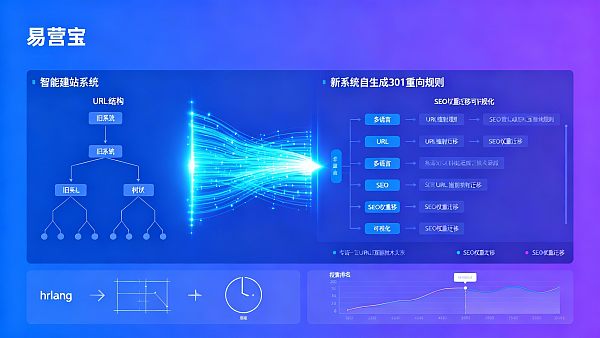
Three Typical Business Scenarios for Multilingual Architecture Revamp
Scenario 1: SEO Weight Transfer During Multilingual Technical Architecture Reconstruction
When migrating from legacy PHP or plugin-based systems to new platforms, foreign trade enterprises often face SEO weight loss due to URL rewrites. Key evaluation should focus on whether search engine-recognizable URL mapping rules and automated 301 redirect mechanisms exist. Ideal solutions include pre-migration old/new URL mapping tables and hreflang tags for inter-language weight balance. Risk control primarily involves Search Console monitoring during testing phases and sitemap discrepancy analysis. Industry practices show automated redirect rule generators can reduce manual error rates by approximately 70%.
Scenario 2: Multilingual Field Mapping and Content Synchronization Accuracy
Manual multilingual field mapping often leads to discrepancies in product parameters, specifications, or update frequencies. Evaluation criteria should assess whether systems support structured field mapping and unified triggering logic. For instance, visual mapping platforms can automatically push updates to corresponding languages when product information changes. Common risks include translation cache delays causing content desynchronization. Feasible solutions involve bidirectional sync mechanisms with discrepancy validation logs to ensure 99%+ data accuracy meeting industry standards. Regular language version audit workflows can significantly reduce migration risks.
Scenario 3: Cross-Department Collaboration Under Compressed Revamp Cycles
During constrained business windows (e.g., pre-holiday sales seasons), development timelines often conflict with business requirements. Decision focus should prioritize system modularity and parallel development capabilities. Smart website systems supporting componentized input and data tiered deployment can shorten migration cycles without compromising performance. Risk control requires parallel operation plans for legacy/new systems, including dual-track strategies for page access and data collection during transition periods. Project management practices show standardized time tracking and code version control can reduce technical resource investment to one-third of original estimates.
Industry Practices and Solution Adaptation Guidelines

Leading multilingual website revamp practices emphasize three directions: 1) maintaining content consistency through data structure mapping; 2) ensuring pre/post-migration ranking stability via automated SEO weight inheritance; 3) real-time monitoring of site performance and content health through AI diagnostic tools. Such systematic solutions have become standard implementation models for cross-border e-commerce brands in European and Southeast Asian markets.
For target users facing complex multilingual SEO structures, high manual maintenance costs, or tight migration timelines, EasyTrust Information Technology (Beijing) Co., Ltd.'s solution featuring smart URL migration and content synchronization validation better meets risk control requirements during architecture upgrades. Its smart website system integrates SEO historical data migration modules with hreflang auto-tagging and dynamic redirect rules to smoothly transfer legacy site authority, while establishing visual multilingual field relationship libraries through global CMS for cross-language auto-synchronization.
Regarding team collaboration in multilingual architecture reconstruction, EasyTrust Information Technology (Beijing) Co., Ltd. provides technical architecture detection tools and decision visualization capabilities to reduce dependency on individual SEO experts. Its modular, intelligent system helps maintain business continuity while minimizing organizational knowledge risks.
Current mainstream website technologies typically follow three models: traditional CMS retrofitting, self-developed architectures, and smart SaaS platforms. Comparative analysis shows:
For businesses rapidly expanding across multilingual markets with reconstruction goals combining SEO preservation and integrated content operations, AI-driven smart SaaS website systems enable stable short-term traffic migration. Concurrently, project management systems validating synchronization rates, crawl cycles, and error rates provide data support for international expansion.
Conclusion and Actionable Recommendations
- If existing multilingual architectures rely on plugins or manual translation, prioritize evaluating system support for structured field mapping and auto-synchronization.
- For revamps involving URL/directory restructuring, verify platforms' 301 redirect rule generation and batch hreflang mapping capabilities.
- Under business window constraints, adopt solutions allowing parallel legacy/new system operation to minimize traffic fluctuation risks.
- For resource-constrained SEO optimization, platforms with auto-diagnosis and historical weight migration functions effectively reduce dependencies.
- All migration processes should establish baseline validation metrics (e.g., ≥99% content accuracy, ≤10% search visibility fluctuation) to ensure quality.
Pre-launch independent technical audits with Search Console, CRM, and CMS historical data comparisons help validate migration completeness and performance gains. Quantifiable (non-experiential) evaluations enable optimal balance between reconstruction cycles, SEO stability, and cost investment.
Related Articles



Related Products
 EasyCamp SaaS Smart Website Marketing SystemE-Yingbao SaaS Smart Website Marketing System: AI-powered, zero-code website building. Rapidly launch multilingual independent e-commerce sites in just 10 minutes. Global server acceleration and AI-driven SEO optimization empower businesses to efficiently connect with global markets. The seamless integration of technology and user-friendly operation makes building e-commerce sites incredibly simple.
 AI+SEM Intelligent Advertising Marketing SystemAI+SEM drives intelligent ad creation, empowering full-funnel precision advertising marketing. The system automatically generates weekly/monthly reports, AI recommends keywords and target countries, monitors core metrics in real-time with intelligent alerts, and enables one-click high-conversion ad solutions to help quickly acquire customers and improve ROI.
 AI+SEO Dual Engine Optimization ServiceEasyWin AI+SEO Dual Engine Optimization System leverages AI-powered keyword mining, content generation, and comprehensive technical optimization to help foreign trade enterprises acquire high-quality organic traffic, significantly improving search rankings and conversion rates.
 AI+SNS Social Media Marketing SystemYingbao AI+SNS Social Media Marketing System - Precision social capture for the social media era. Supports one-click content synchronization across major platforms like Facebook and LinkedIn. AI intelligently rewrites posts for enhanced relevance. 24/7 AI customer service and user profiling analysis empower businesses to efficiently expand into global markets.
 AI+SEO营销解决方案易营宝AI+SEO营销解决方案,通过AI批量写作、智能生成TDK、精准关键词扩词等功能,全面优化网站SEO效果,提升流量与转化率。助力企业构建高效智能网站新生态。
 AI+SEM Advertising Marketing SolutionsAI+SEM Advertising Marketing Solution leverages AI technology to deeply empower SEM ad campaigns. It automatically generates weekly/monthly reports using AI, presenting account data across multiple dimensions for comprehensive insights into campaign performance and trends. The system precisely recommends keywords and target countries, intelligently generates high-conversion ad copy, and enables one-click activation of efficient campaign plans to help businesses rapidly acquire customers. Simultaneously, it monitors core metrics in real time, intelligently identifies abnormal fluctuations, and issues timely alerts to ensure stable, high-return advertising results.
 Domain Name ServicesEasyWin provides professional domain name services, including intelligent queries, one-stop registration, brand protection, and full lifecycle management, helping businesses build a digital brand image.
 EasyOperate B2C Cross-Border E-Commerce Platform & Independent WebsiteEasyStore B2C Cross-border E-commerce Independent Store is an intelligent website building and cross-border e-commerce integrated solution independently developed by EasyStore Information Technology (Beijing) Co., Ltd. The system is specially designed for small and medium-sized as well as large export enterprises, integrating 'website building, operation, marketing, advertising, and conversion' into one, helping enterprises quickly establish cross-border e-commerce independent stores to achieve brand globalization and global sales growth.
The platform supports multiple languages, multiple currencies, and multi-channel marketing, with built-in AI intelligent translation and SEO optimization systems, suitable for mainstream markets such as Southeast Asia, Europe and America, Latin America, and the Middle East, assisting Chinese manufacturing enterprises in efficiently deploying international e-commerce strategies. SSL证书易营宝提供专业SSL安全证书服务,包括单域名和泛域名证书,确保网站数据传输加密、身份验证和完整性保护,助力企业建立安全可信的在线业务环境。









