









- Is Brand Globalization Marketing Consulting Worth Buying? At What Stage Should Companies Bring It InJul 01, 2026View details
- Cross-Border Marketing Trend Research: Why More and More Companies Are Starting to Deploy AI Search and GEO OptimizationJun 30, 2026View details
- Cross-Border Marketing Trend Research: How Independent Sites, AI Content, and Short-Video Customer Acquisition Are ChangingJun 30, 2026View details
- How Can a Brand Updates Page Be Made More SEO-Friendly? Analysis of Update Frequency, Content Structure, and Internal Linking StrategyJun 28, 2026View details
- What stages does the cross-border services ecosystem include? How do website building, promotion, payment, and compliance work togetherJun 22, 2026View details
- How will email marketing costs change in 2026Jun 22, 2026View details
- The China-US tariff arrangement has reached a preliminary consensus, and the trade association will be establishedJun 15, 2026View details
- Should overseas brand marketing start with ads or contentJun 21, 2026View details
What should you look at to determine whether foreign trade marketing system data is secure
Is foreign trade marketing system data secure? For quality control personnel and security managers, the answer is never about “whether the brand is big enough” or “whether there are enough features”, but whether the system has clear permission controls, reliable data encryption, verifiable backup and recovery capabilities, and whether it meets corporate compliance management requirements.
Foreign trade business naturally involves customer information, inquiry records, quotation documents, website content, access data, and internal operation logs. Once the system’s security capabilities are insufficient, it will not only affect marketing efficiency, but may also lead to data leakage, business interruption, loss of customer trust, and even trigger compliance and audit risks.
Therefore, when judging “Is foreign trade marketing system data secure”, the most effective method is not to listen to sales pitches, but to establish a set of evaluation standards that can be checked, questioned, and verified. For those responsible for quality control and security, this is more important than simply comparing prices.
First answer the core question: Is foreign trade marketing system data secure, and which key items should be reviewed
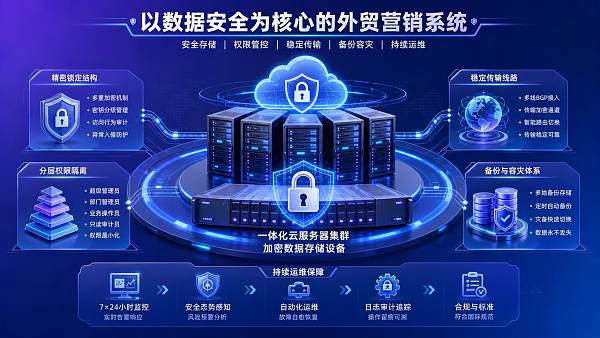
If only a quick judgment can be made, it is recommended to prioritize four points: whether permission management is granular, whether data transmission and storage are encrypted, whether there is a stable backup and recovery mechanism, and whether the service provider has continuous operation, maintenance, and security response capabilities. These four items basically determine the system’s security baseline.
When selecting a system, many companies tend to focus on website building speed, marketing functions, SEO capabilities, and advertising integration, while overlooking backend permissions, log auditing, node stability, and exception handling mechanisms. When real problems occur, the issue is often not insufficient functionality, but insufficient security controls.
For quality control and security management personnel, the most important concern is “whether the risk is controllable”. A foreign trade marketing system that looks very intelligent but lacks permission isolation, operation traceability, and recovery plans will find it difficult to pass stricter internal reviews.
First, look at access control: who can view, who can edit, and who can export
Permission management is the first threshold for judging whether foreign trade marketing system data is secure. This is because the vast majority of actual risks do not come from cinematic hacker attacks, but from internal misoperations, shared accounts, former employees whose permissions were not revoked in time, or third-party collaboration accounts with excessive permissions.
When evaluating a system, security managers should focus on asking: whether it supports role hierarchy, page-level permissions, data-level permissions, export permission restrictions, and whether key operations require secondary confirmation. Without these capabilities, no matter how polished the backend looks, it is still difficult to call it secure.
For foreign trade enterprises, marketing, sales, customer service, translation, technical teams, and agents often need to work collaboratively. If everyone has similar permissions, any accidental deletion, mistaken modification, or erroneous publication may affect website content, customer follow-up records, and market advertising data.
Furthermore, it is also necessary to check whether the system supports operation log tracking. Who logged into the system, what content was changed, what data was exported, and when it was executed should all have traceable records. Without audit trails, post-incident investigation often relies only on “guessing”.
Second, look at data encryption: transmission security and storage security are both indispensable
Many companies think that “using HTTPS means it is secure”, but in fact this is only the most basic layer. A truly valuable judgment should simultaneously cover multiple aspects such as data transmission, backend login, API calls, file uploads, and database storage.
At the transmission level, it is necessary to confirm whether the system enables security certificates by default, whether it prevents man-in-the-middle attacks, and whether it protects backend logins and form submissions. In particular, foreign trade websites often involve inquiry forms, file attachments, and multi-region access scenarios, so transmission link security must not be overlooked.
At the storage level, attention should be paid to whether customer information, contact details, opportunity records, content assets, and backup files are protected by encryption. Even if there is a problem with the server or account, if storage lacks corresponding protection, sensitive data may still be directly read and abused.
Security leaders should also pay attention to whether password policies are standardized, such as whether strong password requirements, regular changes, abnormal login alerts, and multi-factor authentication are supported. Many system risks are not highly sophisticated, but are often simply caused by weak backend passwords or multiple people sharing a primary account.
Third, look at backup and recovery: it is not whether there is a backup, but whether recovery is possible
“Having backups” does not equal “being secure”. From a risk management perspective, what is truly critical is backup frequency, backup scope, storage location, recovery process, and recovery timeliness. If the system crashes and still cannot be restored after two days, the business loss will still be very significant.
Foreign trade marketing systems usually carry website pages, multilingual content, SEO settings, lead data, and advertising configurations. The loss of any type of data may force enterprises to reinvest manpower in repairs, and may even affect customer reception, search rankings, and the continuity of advertising delivery.
Therefore, quality control personnel should focus on verifying: whether automatic backup is supported, whether there is offsite backup, whether restoration can be performed by point in time, whether recovery tests are recorded, and how fault response time is agreed upon. Only when this information is clear can the backup mechanism be considered truly valuable.
At the same time, do not ignore the scenario of “recovery from operational mistakes”. What many enterprises actually encounter is not a complete server outage, but an employee accidentally deleting a page, overwriting content, or clearing form data. If the system lacks version rollback and historical recovery capabilities, daily operation and maintenance pressure will be very high.
Fourth, look at service provider capability: system security is not only a technical issue, but also an operations and maintenance issue
Whether foreign trade marketing system data is secure also depends on whether the service provider has sustained operation and maintenance capabilities. This is because security is not a one-time delivery, but a long-term process of updating, monitoring, repairing, and responding. If the platform side is unstable, it is difficult for enterprises to obtain real security assurance.
Security managers can judge from several directions: whether the company has long-term operations, whether it has a mature technical team, whether it has multi-node deployment capabilities, whether it can provide anomaly alerts and support responses, and whether it has stable access guarantees for overseas business.
Taking foreign trade scenarios as an example, global access stability itself is closely related to security and availability. If server nodes are single-point, then when attacks, fluctuations, or local failures occur, website experience and marketing conversion capacity will both be affected, indirectly increasing operational risks.
For integrated platforms oriented to foreign trade business such as Yiyingbao SaaS intelligent website building marketing system, when selecting, you can focus on verifying its global node deployment, backend management mechanism, website stability, and long-term service capability, rather than only looking at website building efficiency.
Fifth, look at compliance and business fit: security is not an independent module, but part of the process
For quality control and security management personnel, whether a system is secure also depends on whether it can be integrated into the company’s existing management system. For example, whether customer data can be managed by classification, whether internal approvals can be implemented, whether third-party collaboration is controllable, and whether account handover is convenient to execute.
If a system is very powerful but cannot match the company’s actual processes, for example if it cannot authorize by role, cannot restrict exports, and cannot record modification logs, then no matter how advanced its marketing capabilities are, obvious loopholes will still form at the level of institutional execution.
In addition, foreign trade enterprises often involve multilingual websites, multi-region access, and cross-department collaboration. The system must not only support business expansion, but also ensure that standards remain controllable. For example, during multilingual content publishing, there must be clear boundaries for who can edit, who can review, and who can publish online.
This is extremely important in actual system selection. Security is not about keeping all risks completely outside, but about making every operation more controllable, more traceable, and more compliant with processes. A system that can achieve this is more suitable for long-term use.
How to create a practical system selection checklist
If an enterprise is preparing to evaluate a foreign trade marketing system, it is recommended that security, quality control, business, and operations participate together to establish a unified checklist. This can avoid looking only at marketing effectiveness, and also avoid evaluating only from a technical perspective, which may lead to unbalanced conclusions.
The checklist can include: whether hierarchical permissions are supported, whether log auditing is available, whether encrypted transmission is enabled, whether there is automatic backup, whether recovery testing is supported, whether node and stability explanations can be provided, and whether there are continuous technical services and security response mechanisms.
If the system also involves website building and overseas marketing conversion capabilities, then its multilingual support, global access speed, SEO configuration capabilities, and backend usability can also be examined together. This is because systems that are complex and difficult to use are often more likely to create new security issues due to operational errors.
For example, some platforms can support 22 server nodes, provide global acceleration, and combine intelligent translation with localization capabilities. This not only helps improve the overseas access experience, but also reduces the management pressure of enterprises in multi-site operations and maintenance. Such capabilities are more practically meaningful for foreign trade scenarios.
Security and efficiency are not contradictory, the key is choosing the right system
Many companies worry that the more security controls there are, the more troublesome it becomes for marketing teams to use the system. In fact, mature system design should ensure permissions, encryption, backup, and auditing while making business operations as simple as possible, rather than forcing employees to bypass the system and “handle things privately”.
For foreign trade enterprises, the ideal state is not choosing between security and growth, but choosing a platform that can support rapid website building, content operations, SEO optimization, and global access, while also incorporating data security and management standards into the underlying mechanism.
Products with capabilities such as AI-driven website building, multilingual support, global server acceleration, and streamlined backend management are better able to balance business efficiency and risk control. Especially for enterprises without a large technical team, such systems are more suitable for practical implementation and long-term maintenance.
Summary: to judge whether a foreign trade marketing system is secure, the key is “verifiability” rather than “marketability”
Returning to the original question, is foreign trade marketing system data secure? The answer is neither absolutely secure nor absolutely insecure, but depends on whether it has verifiable permission management, encryption mechanisms, backup and recovery, log auditing, and continuous operation and maintenance capabilities.
For quality control personnel and security managers, the most effective way to judge is to break down system security into specific questions and verify them one by one, rather than being led by marketing terms such as “intelligent”, “efficient”, and “globalized”. Capabilities that can be verified are the real security capabilities.
If an enterprise is choosing a platform that balances foreign trade growth and management standards, then in addition to business functions, data security should also be treated as a core evaluation item. Only on the premise of a solid security baseline is improved marketing efficiency truly worth the investment, and growth results can also be more sustainable.
Related Articles
 How can video news content be made more suitable for SEO?Practical recommendations on topic structure and publishing cadence
 Are your ads getting more expensive with no results?Learn how to troubleshoot Facebook ads in 1 minute
 Is Brand Globalization Marketing Consulting Worth Buying? At What Stage Should Companies Bring It In

Related Products
 EasyCamp SaaS Smart Website Marketing SystemE-Yingbao SaaS Smart Website Marketing System: AI-powered, zero-code website building. Rapidly launch multilingual independent e-commerce sites in just 10 minutes. Global server acceleration and AI-driven SEO optimization empower businesses to efficiently connect with global markets. The seamless integration of technology and user-friendly operation makes building e-commerce sites incredibly simple.
 AI+SEM Intelligent Advertising Marketing SystemAI+SEM drives intelligent ad creation, empowering full-funnel precision advertising marketing. The system automatically generates weekly/monthly reports, AI recommends keywords and target countries, monitors core metrics in real-time with intelligent alerts, and enables one-click high-conversion ad solutions to help quickly acquire customers and improve ROI.
 AI+SEO Dual Engine Optimization ServiceEasyWin AI+SEO Dual Engine Optimization System leverages AI-powered keyword mining, content generation, and comprehensive technical optimization to help foreign trade enterprises acquire high-quality organic traffic, significantly improving search rankings and conversion rates.
 AI+SNS Social Media Marketing SystemYingbao AI+SNS Social Media Marketing System - Precision social capture for the social media era. Supports one-click content synchronization across major platforms like Facebook and LinkedIn. AI intelligently rewrites posts for enhanced relevance. 24/7 AI customer service and user profiling analysis empower businesses to efficiently expand into global markets.
 AI+SEO营销解决方案易营宝AI+SEO营销解决方案,通过AI批量写作、智能生成TDK、精准关键词扩词等功能,全面优化网站SEO效果,提升流量与转化率。助力企业构建高效智能网站新生态。
 AI+SEM Advertising Marketing SolutionsAI+SEM Advertising Marketing Solution leverages AI technology to deeply empower SEM ad campaigns. It automatically generates weekly/monthly reports using AI, presenting account data across multiple dimensions for comprehensive insights into campaign performance and trends. The system precisely recommends keywords and target countries, intelligently generates high-conversion ad copy, and enables one-click activation of efficient campaign plans to help businesses rapidly acquire customers. Simultaneously, it monitors core metrics in real time, intelligently identifies abnormal fluctuations, and issues timely alerts to ensure stable, high-return advertising results.
 Domain Name ServicesEasyWin provides professional domain name services, including intelligent queries, one-stop registration, brand protection, and full lifecycle management, helping businesses build a digital brand image.
 EasyOperate B2C Cross-Border E-Commerce Platform & Independent WebsiteEasyStore B2C Cross-border E-commerce Independent Store is an intelligent website building and cross-border e-commerce integrated solution independently developed by EasyStore Information Technology (Beijing) Co., Ltd. The system is specially designed for small and medium-sized as well as large export enterprises, integrating 'website building, operation, marketing, advertising, and conversion' into one, helping enterprises quickly establish cross-border e-commerce independent stores to achieve brand globalization and global sales growth.
The platform supports multiple languages, multiple currencies, and multi-channel marketing, with built-in AI intelligent translation and SEO optimization systems, suitable for mainstream markets such as Southeast Asia, Europe and America, Latin America, and the Middle East, assisting Chinese manufacturing enterprises in efficiently deploying international e-commerce strategies. SSL证书易营宝提供专业SSL安全证书服务,包括单域名和泛域名证书,确保网站数据传输加密、身份验证和完整性保护,助力企业建立安全可信的在线业务环境。









