









- What New Signals Are Emerging in Enterprise Services SaaS Marketing ReportsJul 27, 2026View details
- What Does a Global Traffic Ecosystem Service Provider Do? What Are the Differences from a Single Advertising AgencyJul 16, 2026View details
- What should you focus on in the latest enterprise SaaS report? From renewal rates and delivery costs to overseas growth opportunitiesJul 12, 2026View details
- What signals are worth paying attention to in a cross-border marketing trend report? B2B companies should look at these 6 signalsJul 11, 2026View details
- How to Read a Cross-Border Marketing Trends Report? Five Key Dimensions for Evaluating Channel OpportunitiesJul 11, 2026View details
- Which channel has the highest ROI in the global traffic ecosystem? Comparative analysis of search, social media, and advertisingJul 10, 2026View details
- What multilingual website services are available in Sanya? Which model is more suitable for local businesses going global?Jul 08, 2026View details
- How to view the complete list of China SaaS companies in the top 100? Practical methods for screening website-building and marketing service providersJul 08, 2026View details
Is Foreign Trade Marketing System Data Secure? Check These Key Points
Is data in foreign trade marketing systems secure? This affects not only operational efficiency, but also customer trust and conversion rates. Overall, whether a system is secure does not depend on whether it is “used for foreign trade marketing,” but on whether its platform architecture, data encryption, permission management, backup mechanisms, and SSL certificate application and deployment are standardized. For enterprises, what truly matters is not a supplier’s verbal claim of being “safe and reliable,” but whether they can provide verifiable security mechanisms and day-to-day management capabilities.
When companies ask, “Is the data secure?”, what are they really worried about?
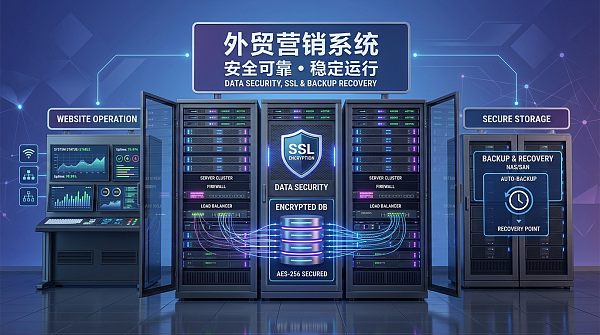
For companies using foreign trade marketing systems, “data security” has never been an abstract concept, but a practical issue directly tied to business operations. Decision-makers worry about customer data leaks, lost inquiries, and brand damage caused by attacks on the corporate website; operators worry that accidental deletions or confusing account permissions may disrupt work; after-sales maintenance teams focus on system recovery speed and log traceability; agents and distributors care more about whether data isolation is clear during multi-role collaboration.
In other words, what everyone really cares about is not “whether there are security features,” but the following practical questions:
- Whether customer data could be leaked or illegally downloaded;
- If the marketing system is attacked, whether the website, forms, and inquiries can still operate normally;
- Whether permissions can be revoked in time after an internal employee leaves or changes positions;
- Once data is accidentally deleted, damaged, or tampered with, whether it can be restored quickly;
- After the website enables SSL, whether customer access and form submissions become more secure and more stable.
Therefore, when judging whether a foreign trade marketing system is secure, the focus is not on how many technical terms are written on the promotional page, but on whether it can truly deliver on these key points: “prevent leaks, prevent operational errors, resist attacks, enable traceability, and support recovery.”
Start with data encryption: without this layer of protection, customer information may be “exposed”
Data encryption is the most fundamental and most easily overlooked part of a foreign trade marketing system. Many companies assume that as long as the system can be logged into and has a backend, it is secure by default. In reality, however, data can face risks during both transmission and storage.
The first is transmission encryption. When customers submit inquiries, registration details, or download materials on a website, if there is no HTTPS encrypted channel, the data may be intercepted during transmission. Especially in foreign trade scenarios, website visitors come from different regions around the world, network environments are complex, and form transmission without SSL certificate support carries even higher risks.
The second is storage encryption. If data such as customer email addresses, phone numbers, communication records, and order leads is stored in plain text, then once the database is attacked, the damage will be very direct. More reliable systems usually encrypt or mask sensitive fields to reduce the actual harm caused by a leak.
For enterprises, the following questions can be directly confirmed with suppliers:
- Whether HTTPS is enabled by default for both the website and backend;
- Who is responsible for SSL certificate application, deployment, and renewal, and whether there is an expiration reminder mechanism;
- Whether form data, customer information, and account passwords are stored in encrypted form;
- Whether encrypted database backup files are supported.
If the answers to these questions are vague, or if everything depends entirely on the enterprise handling it on its own, then the security responsibility is likely being shifted to the user.
Whether permission management is sufficiently granular determines whether internal risks can be controlled
Many enterprise data issues do not first arise from external attacks, but from internal permission confusion. For example: sales, customer service, operations, and technical staff share one administrator account; accounts of departed employees remain active for a long time; agents can view customer information they should not be able to see; or an ordinary operator has permission to export all data.
A truly mature foreign trade marketing system should have a permission design that achieves at least the following:
- Clear role hierarchy: Different roles such as administrators, operations, sales, customer service, and agents should see different data and be allowed to perform different actions;
- Module-based authorization: Modules such as website content, customer management, order management, advertising data, and SEO settings should support separate authorization;
- Data-scope-based authorization: Data from different teams, regions, and channels should be isolatable;
- Audit trails for key operations: The system should log who exported customer data, who modified pages, and who deleted leads;
- Support for account reclamation: When employees leave or their roles change, administrators should be able to quickly disable or transfer accounts.
For business managers, permission management is not only about “preventing mistakes,” but also a crucial part of reducing operational risks. Especially when the corporate website, SEO, ad placement, and customer leads are all integrated into one platform, the clearer the permission boundaries are, the more stable subsequent operations will be.
Backup and recovery mechanisms determine whether a business will “come to a standstill” after a system issue occurs
Many companies focus on features when selecting a system, but overlook “what to do after something goes wrong.” From an operational perspective, even the most secure system cannot promise zero failures. The key lies in whether there are sound data backup and recovery mechanisms.
It is recommended to focus on the following aspects:
- Backup frequency: Whether daily automatic backups are supported, and whether critical business data can be backed up more frequently;
- Backup scope: Whether only website pages are backed up, or whether customer data, form records, media files, and configuration items can all be backed up together;
- Offsite backup: Whether there is multi-location or multi-copy storage to avoid single points of failure;
- Recovery efficiency: In cases of accidental deletion, attacks, or upgrade failures, how quickly recovery can be completed;
- Version rollback: After page errors or mistaken content publication, whether it is possible to quickly restore a historical version.
For after-sales maintenance personnel, recovery capability is more valuable than a promise of “never having problems.” Because what truly affects business is whether the corporate website can still be opened, whether leads can still be recovered, and whether landing pages will be interrupted.
This is similar to the thinking used in many industries when managing digital projects: the focus is not only on building systems, but also on designing risk control and cost management logic in advance. For example, in process optimization and operational control, it is often emphasized that “traceable, correctable, and recoverable” should be taken as core standards. Similar methodologies can also be seen in content such as The application of lean management in operating cost control of public hospitals, where the same underlying logic appears: the value of a system is reflected not only in efficiency improvement, but also in controllable risk.
Whether the SSL certificate application process is standardized directly affects website credibility and conversion
Many companies know that SSL certificates are “very important,” but do not fully understand that their importance is not only at the security level, but also affects search engine trust, customer browsing experience, and form conversion rates.
If SSL is not correctly deployed on a website, common issues include:
- The browser displays “Not Secure,” affecting whether customers continue browsing;
- Customers become hesitant before submitting inquiries, reducing form conversion;
- Search engine trust in the website decreases, indirectly affecting SEO performance;
- Some website resources are not enabled with HTTPS, resulting in mixed content errors.
A standardized SSL certificate application and management process should usually include:
- Selecting an appropriate certificate based on business type, such as a single-domain, multi-domain, or wildcard certificate;
- Completing domain ownership verification;
- Correctly deploying it to the website server or CDN environment;
- Checking whether sitewide HTTP-to-HTTPS redirects are complete;
- Renewing regularly and monitoring expiration dates;
- Troubleshooting whether images, scripts, form interfaces, and other resources are all using HTTPS.
If the supplier can provide integrated support for certificate application, deployment, renewal, and troubleshooting, enterprises can reduce a great deal of technical and maintenance costs. This is also where integrated website + marketing service solutions are more valuable than standalone website-building tools.
How can you tell whether a foreign trade marketing system supplier is truly “secure and reliable”? Check this list
If you are selecting a system, it is recommended not to rely only on sales presentations, but to verify directly against this checklist:
- Whether HTTPS is enabled by default, and whether they assist with SSL certificate application and renewal;
- Whether they have transmission encryption, storage encryption, and sensitive data masking mechanisms;
- Whether they support fine-grained permission management and operation logs;
- Whether they have automatic backup, offsite backup, and rapid recovery capabilities;
- Whether they have abnormal login alerts, attack protection, and vulnerability remediation response mechanisms;
- Whether they can provide ongoing operations and maintenance support, rather than only delivering the system;
- Whether they have cases and experience serving enterprises of similar scale.
For most enterprises, the security of a foreign trade marketing system is not determined by any single feature, but jointly built by “technical mechanisms + management processes + continuous service.” Especially in a global marketing environment, websites, SEO, social media, advertising, and customer data are often interconnected, and any weak point in security can trigger a chain of problems.
Therefore, when choosing a supplier, instead of asking “Are you secure?”, it is better to ask, “If there is a permission misconfiguration, accidental data deletion, certificate expiration, or a website attack, how do you handle it, how long does recovery take, and who is responsible?” Suppliers who can answer these questions clearly are often more worthy of cooperation.
Summary: Whether a foreign trade marketing system is secure depends on whether risks can be managed proactively
Data security in foreign trade marketing systems is by no means an optional add-on, but a foundational capability that affects customer trust, business continuity, and marketing conversion. When evaluating a system, enterprises should focus on four aspects: whether data encryption is properly implemented, whether permission management is sufficiently refined, whether backup and recovery are reliable, and whether the SSL certificate application and maintenance process is standardized.
If a system can not only meet marketing growth needs, but also form a complete closed loop in security and operations and maintenance, then the value it brings is not just “usable,” but “suitable for long-term use and stable use.” For enterprises hoping to truly consolidate their corporate website, customer acquisition, and customer data into their own system, this is the evaluation standard that deserves greater attention.
Related Articles


Related Products
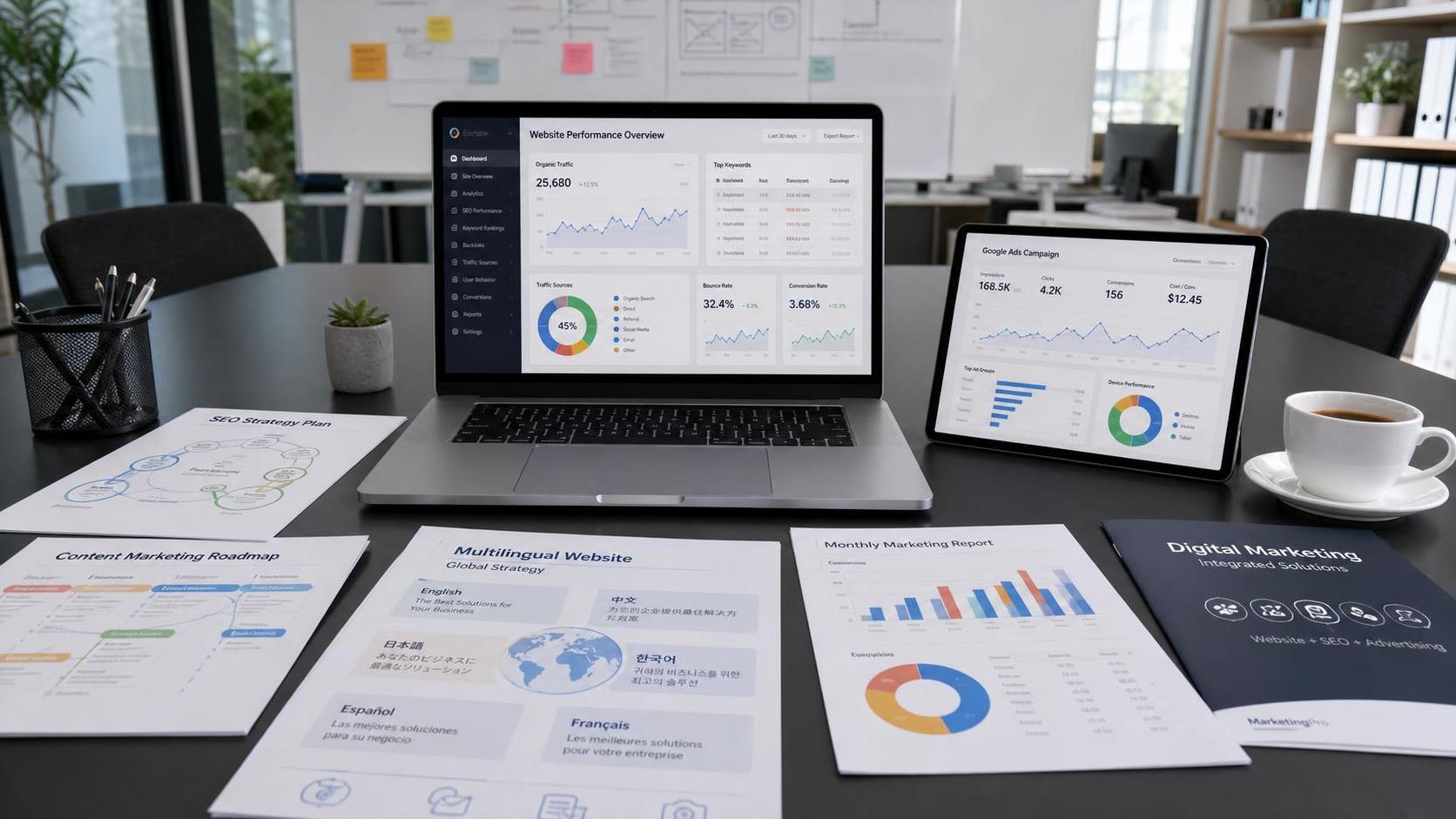
 EasyCamp SaaS Smart Website Marketing SystemE-Yingbao SaaS Smart Website Marketing System: AI-powered, zero-code website building. Rapidly launch multilingual independent e-commerce sites in just 10 minutes. Global server acceleration and AI-driven SEO optimization empower businesses to efficiently connect with global markets. The seamless integration of technology and user-friendly operation makes building e-commerce sites incredibly simple.
 AI+SEM Intelligent Advertising Marketing SystemAI+SEM drives intelligent ad creation, empowering full-funnel precision advertising marketing. The system automatically generates weekly/monthly reports, AI recommends keywords and target countries, monitors core metrics in real-time with intelligent alerts, and enables one-click high-conversion ad solutions to help quickly acquire customers and improve ROI.
 AI+SEO Dual Engine Optimization ServiceEasyWin AI+SEO Dual Engine Optimization System leverages AI-powered keyword mining, content generation, and comprehensive technical optimization to help foreign trade enterprises acquire high-quality organic traffic, significantly improving search rankings and conversion rates.
 AI+SNS Social Media Marketing SystemYingbao AI+SNS Social Media Marketing System - Precision social capture for the social media era. Supports one-click content synchronization across major platforms like Facebook and LinkedIn. AI intelligently rewrites posts for enhanced relevance. 24/7 AI customer service and user profiling analysis empower businesses to efficiently expand into global markets.
 AI+SEO营销解决方案易营宝AI+SEO营销解决方案,通过AI批量写作、智能生成TDK、精准关键词扩词等功能,全面优化网站SEO效果,提升流量与转化率。助力企业构建高效智能网站新生态。
 AI+SEM Advertising Marketing SolutionsAI+SEM Advertising Marketing Solution leverages AI technology to deeply empower SEM ad campaigns. It automatically generates weekly/monthly reports using AI, presenting account data across multiple dimensions for comprehensive insights into campaign performance and trends. The system precisely recommends keywords and target countries, intelligently generates high-conversion ad copy, and enables one-click activation of efficient campaign plans to help businesses rapidly acquire customers. Simultaneously, it monitors core metrics in real time, intelligently identifies abnormal fluctuations, and issues timely alerts to ensure stable, high-return advertising results.
 Domain Name ServicesEasyWin provides professional domain name services, including intelligent queries, one-stop registration, brand protection, and full lifecycle management, helping businesses build a digital brand image.
 EasyOperate B2C Cross-Border E-Commerce Platform & Independent WebsiteEasyStore B2C Cross-border E-commerce Independent Store is an intelligent website building and cross-border e-commerce integrated solution independently developed by EasyStore Information Technology (Beijing) Co., Ltd. The system is specially designed for small and medium-sized as well as large export enterprises, integrating 'website building, operation, marketing, advertising, and conversion' into one, helping enterprises quickly establish cross-border e-commerce independent stores to achieve brand globalization and global sales growth.
The platform supports multiple languages, multiple currencies, and multi-channel marketing, with built-in AI intelligent translation and SEO optimization systems, suitable for mainstream markets such as Southeast Asia, Europe and America, Latin America, and the Middle East, assisting Chinese manufacturing enterprises in efficiently deploying international e-commerce strategies. SSL证书易营宝提供专业SSL安全证书服务,包括单域名和泛域名证书,确保网站数据传输加密、身份验证和完整性保护,助力企业建立安全可信的在线业务环境。









