









- Is Brand Globalization Marketing Consulting Worth Buying? At What Stage Should Companies Bring It InJul 01, 2026View details
- Cross-Border Marketing Trend Research: Why More and More Companies Are Starting to Deploy AI Search and GEO OptimizationJun 30, 2026View details
- Cross-Border Marketing Trend Research: How Independent Sites, AI Content, and Short-Video Customer Acquisition Are ChangingJun 30, 2026View details
- How Can a Brand Updates Page Be Made More SEO-Friendly? Analysis of Update Frequency, Content Structure, and Internal Linking StrategyJun 28, 2026View details
- What stages does the cross-border services ecosystem include? How do website building, promotion, payment, and compliance work togetherJun 22, 2026View details
- How will email marketing costs change in 2026Jun 22, 2026View details
- The China-US tariff arrangement has reached a preliminary consensus, and the trade association will be establishedJun 15, 2026View details
- Should overseas brand marketing start with ads or contentJun 21, 2026View details
Are post-launch maintenance costs for multilingual foreign trade websites high
Are post-launch maintenance costs for multilingual foreign trade websites high? The answer is usually not simply “high” or “low”, but depends on the number of languages, update frequency, technical architecture, SEO strategy, and subsequent operating model. What truly affects the budget is often not the one-time investment at launch, but the long-term costs of content maintenance, server expenses, security hardening, search optimization, and data analysis. Only by clearly understanding the components of post-launch maintenance costs for multilingual foreign trade websites can you more reliably judge whether the investment is worthwhile.
Why use a checklist first to assess maintenance costs
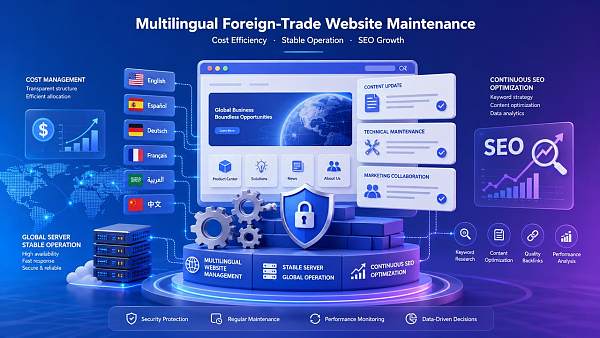
The complexity of multilingual websites is far greater than that of single-language corporate websites. Once languages are added to the pages, content synchronization, technical adaptation, keyword layout, and conversion paths will all undergo chain reactions.
Without a clear cost checklist, budget evaluation can easily focus only on translation expenses while overlooking subsequent redesigns, content additions, overseas access speed, form effectiveness, and security risks.
For integrated website + marketing service projects, post-launch maintenance costs for multilingual foreign trade websites are also closely related to the depth of SEO execution, the level of marketing automation, and the capability to build a data closed loop.
Core checklist for post-launch maintenance costs of multilingual foreign trade website construction
- First calculate the number of language versions and total page volume, avoiding estimates based only on the homepage and product pages while ignoring the ongoing translation and proofreading expenses brought by case studies, news, download pages, and policy pages.
- Check the frequency of content updates. If product models, parameters, prices, or delivery instructions change quickly, maintenance costs will rise along with the number of synchronized updates, rather than remaining fixed.
- Confirm whether the website system supports unified backend management. If each language requires separate maintenance, it will significantly increase manual operating time and make version inconsistency more likely.
- Evaluate the scope of SEO maintenance. Search engine optimization is not finished after one-time deployment, but also includes multi-region keyword research, landing page expansion, internal link adjustments, and indexing monitoring.
- Verify server and CDN solutions. The broader the distribution of target markets, the higher the requirements for global access speed, and bandwidth, caching, nodes, and stability will all affect long-term costs.
- Attach importance to security and compliance maintenance, including SSL certificates, vulnerability patching, permission management, anti-spam forms, anti-attack strategies, and privacy policy updates.
- Take stock of the number of functional modules, such as inquiry systems, online chat, sample downloads, CRM integration, marketing tracking codes, etc. The more functions there are, the more frequent subsequent integration and debugging will be.
- Count design and asset update requirements. If new products, factory capabilities, and solutions need to be continuously displayed, images, videos, 3D displays, and similar materials will all become part of the maintenance budget.
- Establish a data analysis mechanism. Without conversion tracking and source analysis, it is impossible to determine whether post-launch maintenance costs for multilingual foreign trade websites are truly being converted into effective inquiries.
Where maintenance cost differences lie under different scenarios
Basic display websites
If the website mainly focuses on brand introduction, basic product display, and contact forms, post-launch maintenance costs for multilingual foreign trade websites are usually controllable. Such websites do not update frequently, and the focus is on server stability, content proofreading, and basic SEO.
However, even for a basic website, technical details after language expansion cannot be ignored. For example, hreflang tags, URL structures for different languages, sitemaps, and page loading speed will all affect organic traffic performance.
Marketing growth websites
If the website is responsible for customer acquisition, maintenance costs will rise significantly. This is because content needs continuous expansion, landing pages need to be segmented by country, industry keywords, and product keywords, and coordination between SEO and advertising will also become more frequent.
This type of project places greater emphasis on the integration of website building and marketing. Yiyingbao Information Technology (Beijing) Co., Ltd. has long served global growth scenarios, and usually considers website building, optimization, content, and media buying in a coordinated way to reduce the hidden maintenance losses caused by repeated construction.
Industrial goods and complex product websites
Industrial product websites often have many specifications, many parameters, and complex application scenarios, so maintenance costs come not only from translation but also from the structured organization and continuous updating of product information.
For example, precision machining, hardware fasteners and other solution-oriented pages are more suitable for structured sections, matrix-style product centers, and graphic card layouts. This not only makes subsequent maintenance easier, but is also more conducive to showcasing flexible manufacturing capacity, quality control standards, and global contact channels.
Commonly underestimated maintenance items and risk reminders
Ignoring post-translation operational proofreading
Many budgets only calculate the initial translation, but do not include professional terminology review, local expression revision, and secondary proofreading after updates. The more languages there are, the higher the probability of errors, and the higher the rework cost.
Ignoring that SEO is a long-term project
In post-launch maintenance costs for multilingual foreign trade websites, SEO is often mistakenly understood as a pre-launch setup. In fact, keyword iteration, page expansion, backlink pacing, and indexing diagnosis all require continuous investment.
Ignoring form and lead system maintenance
Whether a website can continuously bring effective inquiries depends not only on traffic, but also on whether form submission, email delivery, spam lead interception, and CRM synchronization are stable. Any abnormality in any link will directly affect return on investment.
Ignoring security updates and compliance changes
Plugin vulnerabilities, weak passwords, expired certificates, and missing privacy clauses can all cause maintenance costs to surge at a certain point in time. Rather than remedying the problem afterward, it is better to include security maintenance in the fixed budget.
How to keep maintenance costs within a reasonable range
- Prioritize key languages. Cover core markets first, then expand gradually, to avoid spreading too wide at once and causing post-launch maintenance costs for multilingual foreign trade websites to get out of control.
- Use a unified content model. Manage products, case studies, news, and downloadable materials with standardized fields, which can significantly reduce the difficulty of subsequent multilingual synchronization.
- Move SEO forward into the website building stage. Planning URL rules, tag structure, page speed, and internal linking framework in advance is much cheaper than rework later.
- Establish a monthly maintenance checklist. Standardize content updates, ranking checks, form testing, security inspections, and data reviews to reduce disorderly investment.
- Choose coordinated website building and marketing services. When technology, content, optimization, and data analysis are advanced within the same system, it becomes easier to reduce communication costs and duplicate costs.
Summary: calculate the long-term account first, then decide whether to launch a multilingual website
Post-launch maintenance costs for multilingual foreign trade website construction are not necessarily high. The key lies in whether the language scope, content mechanism, technical architecture, SEO strategy, and operation process are planned in advance. If you only focus on the website construction quotation while ignoring the subsequent maintenance chain, budget overruns and unstable results often occur.
A more reliable approach is to first break down costs according to a checklist, and then judge the investment pace based on business goals. For website projects that need to balance brand presentation, overseas customer acquisition, and long-term growth, the earlier an integrated maintenance mechanism is established, the more overall costs can be reduced and the greater the website’s value can be amplified.
The next step is to directly sort out the existing languages, number of pages, update frequency, lead paths, and SEO goals, form an executable annual maintenance budget sheet, and then decide the construction scope and advancement priorities.
Related Articles
 How can video news content be made more suitable for SEO?Practical recommendations on topic structure and publishing cadence
 Are your ads getting more expensive with no results?Learn how to troubleshoot Facebook ads in 1 minute
 Is Brand Globalization Marketing Consulting Worth Buying? At What Stage Should Companies Bring It In


Related Products
 EasyCamp SaaS Smart Website Marketing SystemE-Yingbao SaaS Smart Website Marketing System: AI-powered, zero-code website building. Rapidly launch multilingual independent e-commerce sites in just 10 minutes. Global server acceleration and AI-driven SEO optimization empower businesses to efficiently connect with global markets. The seamless integration of technology and user-friendly operation makes building e-commerce sites incredibly simple.
 AI+SEM Intelligent Advertising Marketing SystemAI+SEM drives intelligent ad creation, empowering full-funnel precision advertising marketing. The system automatically generates weekly/monthly reports, AI recommends keywords and target countries, monitors core metrics in real-time with intelligent alerts, and enables one-click high-conversion ad solutions to help quickly acquire customers and improve ROI.
 AI+SEO Dual Engine Optimization ServiceEasyWin AI+SEO Dual Engine Optimization System leverages AI-powered keyword mining, content generation, and comprehensive technical optimization to help foreign trade enterprises acquire high-quality organic traffic, significantly improving search rankings and conversion rates.
 AI+SNS Social Media Marketing SystemYingbao AI+SNS Social Media Marketing System - Precision social capture for the social media era. Supports one-click content synchronization across major platforms like Facebook and LinkedIn. AI intelligently rewrites posts for enhanced relevance. 24/7 AI customer service and user profiling analysis empower businesses to efficiently expand into global markets.
 AI+SEO营销解决方案易营宝AI+SEO营销解决方案,通过AI批量写作、智能生成TDK、精准关键词扩词等功能,全面优化网站SEO效果,提升流量与转化率。助力企业构建高效智能网站新生态。
 AI+SEM Advertising Marketing SolutionsAI+SEM Advertising Marketing Solution leverages AI technology to deeply empower SEM ad campaigns. It automatically generates weekly/monthly reports using AI, presenting account data across multiple dimensions for comprehensive insights into campaign performance and trends. The system precisely recommends keywords and target countries, intelligently generates high-conversion ad copy, and enables one-click activation of efficient campaign plans to help businesses rapidly acquire customers. Simultaneously, it monitors core metrics in real time, intelligently identifies abnormal fluctuations, and issues timely alerts to ensure stable, high-return advertising results.
 Domain Name ServicesEasyWin provides professional domain name services, including intelligent queries, one-stop registration, brand protection, and full lifecycle management, helping businesses build a digital brand image.
 EasyOperate B2C Cross-Border E-Commerce Platform & Independent WebsiteEasyStore B2C Cross-border E-commerce Independent Store is an intelligent website building and cross-border e-commerce integrated solution independently developed by EasyStore Information Technology (Beijing) Co., Ltd. The system is specially designed for small and medium-sized as well as large export enterprises, integrating 'website building, operation, marketing, advertising, and conversion' into one, helping enterprises quickly establish cross-border e-commerce independent stores to achieve brand globalization and global sales growth.
The platform supports multiple languages, multiple currencies, and multi-channel marketing, with built-in AI intelligent translation and SEO optimization systems, suitable for mainstream markets such as Southeast Asia, Europe and America, Latin America, and the Middle East, assisting Chinese manufacturing enterprises in efficiently deploying international e-commerce strategies. SSL证书易营宝提供专业SSL安全证书服务,包括单域名和泛域名证书,确保网站数据传输加密、身份验证和完整性保护,助力企业建立安全可信的在线业务环境。









