









- What Does a Global Traffic Ecosystem Service Provider Do? What Are the Differences from a Single Advertising AgencyJul 16, 2026View details
- What should you focus on in the latest enterprise SaaS report? From renewal rates and delivery costs to overseas growth opportunitiesJul 12, 2026View details
- What signals are worth paying attention to in a cross-border marketing trend report? B2B companies should look at these 6 signalsJul 11, 2026View details
- How to Read a Cross-Border Marketing Trends Report? Five Key Dimensions for Evaluating Channel OpportunitiesJul 11, 2026View details
- Which channel has the highest ROI in the global traffic ecosystem? Comparative analysis of search, social media, and advertisingJul 10, 2026View details
- What multilingual website services are available in Sanya? Which model is more suitable for local businesses going global?Jul 08, 2026View details
- How to view the complete list of China SaaS companies in the top 100? Practical methods for screening website-building and marketing service providersJul 08, 2026View details
- How to view pricing in the global traffic ecosystem? Cost comparison of search, social media, and content channel advertisingJul 06, 2026View details
What Materials Need to Be Prepared for the SSL Certificate Application Process
Before starting the SSL certificate application process, what companies usually care most about is not “what a certificate is,” but rather “what materials need to be prepared, who needs to cooperate, how long it will take, and whether it will affect the website launch.” Overall, applying for an SSL certificate is not complicated, but different certificate types have very different documentation requirements. Preparing domain registration information, company qualification documents, contact details, and server validation conditions in advance can significantly reduce repeated submissions, review delays, and deployment failures. For website development, SEO optimization, and daily operations and maintenance, SSL is not only related to browser security indicators, but also directly affects user trust, form conversions, and search engines’ assessment of website experience.
If you are a business decision-maker, what you need to focus on is whether the certificate type matches your business scenario, the review efficiency, and the ongoing maintenance cost; if you are an operator or maintenance staff member, you need to clearly understand the document checklist, validation methods, and precautions before and after deployment. Below, we will sort out what materials need to be prepared for the SSL certificate application process based on the actual application workflow, as well as the key points most easily overlooked by different roles during the process.
First clarify this: before applying for an SSL certificate, what categories of materials does a company actually need to prepare

From a practical perspective, SSL certificate application materials can usually be divided into 4 categories: domain-related information, entity qualification documents, contact information, and technical validation conditions. Different CA authorities and different certificate types may have slight differences, but generally they all revolve around these contents.
1. Domain-related materials
- The full domain name for which the certificate is being applied, for example: www.example.com、example.com or *.example.com
- The domain registration information must be authentic and verifiable. It is recommended to ensure that the WHOIS or registrar backend information is accurate
- Domain control validation conditions, such as DNS resolution permissions, website root directory upload permissions, and server configuration permissions
2. Company entity qualification documents
- Scanned copy or clear photo of the business license
- Organization-related supporting documents (if there are special requirements)
- Basic information such as company name, registered address, and unified social credit code
3. Contact and review information
- Name, mobile number, and email of the application contact
- Information of the company负责人 or authorized contact
- A landline or company contact number available to receive review calls
4. Technical deployment preparation
- Server type and environment information, such as Nginx、Apache、IIS、Tomcat
- CSR file generation conditions. Some certificates require the CSR to be generated on the server or panel first
- Certificate installation permissions, including operational permissions for Web servers, CDN, load balancers, or cloud consoles
For most corporate websites, what truly affects efficiency is often not “whether the materials are difficult,” but whether internal collaboration is smooth. The marketing department is responsible for website launch, IT is responsible for deployment, administration provides qualification documents, and procurement or management confirms the brand entity. If information is inconsistent at any step, it may extend the issuance cycle.
Why the required materials differ for different types of SSL certificates
Many users search for “what materials need to be prepared for the SSL certificate application process,” but essentially they want to know: to what extent does my website need to be prepared? Here, the certificate type must be distinguished first, because the material requirements are directly related to the review intensity.
DV certificate (Domain Validation)
Suitable for personal websites, test sites, and small showcase websites. The core is verifying domain control, and it usually does not require submission of a business license. Common validation methods include:
- Adding the specified DNS record
- Receiving the validation email at the designated mailbox
- Uploading the validation file to the website directory
OV certificate (Organization Validation)
Suitable for corporate official websites, marketing websites, foreign trade standalone sites, B2B platforms, etc. In addition to domain validation, the authenticity of the corporate entity must also be verified, usually requiring:
- Business license
- Public company registration information
- Contact information and phone verification
EV certificate (Extended Validation)
Suitable for scenarios with higher trust requirements, such as finance, payments, government affairs, and brand official websites. The review is stricter, and in addition to the business license, it may also involve:
- Verification of the authenticity of company operations
- Legal or authorization confirmation documents
- Stricter telephone or manual re-verification
Therefore, before preparing SSL certificate application materials, companies should first determine which type of business scenario their website belongs to. This is far more important than blindly collecting documents at the beginning. If the purpose is official website lead generation and SEO optimization, an OV certificate is usually more common; if it is only a short-term testing environment, a DV certificate is sufficient; if the website carries brand trust and high-value transactions, an EV certificate is more worth considering.
When companies apply for SSL certificates, what most often causes delays is not the materials themselves, but these details
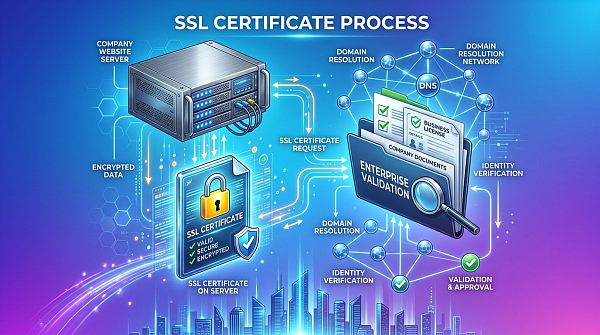
In actual website development and marketing service projects, delays in certificate application are often not caused by “lack of materials,” but by inadequate preparation of details. The following issues are especially common:
1. The domain ownership and the application entity do not match
For example, the domain is registered under an individual’s name, but the application is for a corporate OV or EV certificate; or the website belongs to a group company, while the application entity is a subsidiary. In this case, even if the business license is submitted, additional explanation or adjustment of the application entity may still be required.
2. The contact phone cannot complete the review
Some certificate reviews include telephone verification. If no one answers the company’s public phone line, the transfer is unclear, or the contact person is unclear about the application, the review is likely to be put on hold.
3. DNS, server, and website backend permissions are scattered
The domain is managed by the agent, the server is managed by the operations team, and the website is maintained by a third-party web development company. If permissions are not coordinated in advance, validation files cannot be uploaded and DNS records cannot be added, both of which will cause delays.
4. CSR information is filled in improperly
If the domain name, organization name, or regional information in the CSR is filled in incorrectly, it may lead to issuance failure or mismatch during subsequent installation. This requires especially careful verification for multi-domain certificates and wildcard certificates.
5. Ignoring renewal and certificate replacement arrangements
Many companies only focus on “how to apply this time,” while overlooking certificate expiration reminders, redeployment after server migration, and intermediate certificate chain configuration issues. As a result, although the certificate has been obtained, the website may still show as insecure.
From a management perspective, an SSL certificate is not just a small technical matter; it is actually part of a website’s trust system. Especially for foreign trade websites, brand official websites, and campaign landing pages, security warnings will directly affect inquiry rates and conversion rates. Similarly, when companies deal with cross-border business and online risk control issues, they also pay attention to the alignment between systems and execution. For example, the ideas emphasized in Risk Management and Prevention for International Trade Enterprises are essentially about reducing later losses through early prevention.
From application to deployment, how can the SSL certificate process be made more efficient
If you want the SSL certificate application process to go more smoothly, it is recommended to proceed according to the following steps:
Step 1: Confirm the certificate type and domain scope
Clarify whether it is a single-domain, multi-domain, or wildcard certificate; clarify whether to choose DV、OV, or EV. This decision determines the subsequent document checklist and review cycle.
Step 2: Organize the basic materials in advance
- Electronic version of the business license
- Name, email, and mobile number of the company contact
- A phone number available to receive review calls
- Access to the domain management backend
- Operational access to the server or website directory
Step 3: Generate the CSR and submit the application
Generate the CSR file based on the server environment, fill in the company and domain information, and submit the application to the certificate provider.
Step 4: Complete domain and entity validation
Perform DNS validation, email validation, or file validation as required; for OV/EV certificates, company information review must also be completed.
Step 5: Download and install the certificate
After the certificate is issued, install it on the server, CDN, or cloud platform, and check whether HTTPS is effective site-wide.
Step 6: Conduct a post-launch check
- Whether pages can be accessed normally via HTTPS
- Whether there are mixed content warnings
- Whether the 301 redirect is configured correctly
- Whether the sitemap, canonical tags, and CDN cache have been updated synchronously
For companies that value SEO performance, this step is particularly important. An incomplete SSL deployment may lead to abnormal page indexing, chaotic redirect chains, invalid analytics code, and further affect marketing campaigns and search traffic performance.
Which companies should pay particular attention to standardizing SSL application material preparation
Not all websites need to go through the highest level of review, but the following types of companies are especially advised to standardize the preparation of SSL certificate application materials:
- Companies undergoing an official website revamp or launching a new site
- Websites that value Baidu、Google indexing and SEO optimization
- Platforms with form submissions, online inquiries, or member login functions
- Foreign trade standalone sites, cross-border marketing sites, and brand招商 websites
- Portal systems that need to be jointly accessed by agents, distributors, and customers
The common characteristic of these websites is that users not only browse content, but also submit information, generate inquiries, or conduct transactions. Once the browser displays “Not Secure,” it will directly cause losses to brand trust and business conversion. Therefore, SSL certificate application should not be treated only as a formal action before launch, but as part of the construction of basic website security and brand credibility.
If the company is also involved in overseas business, distribution systems, or multi-site operations, then when preparing SSL application materials, it can also simultaneously sort out entity consistency, domain management permissions, and server asset records, so as to avoid repeatedly supplementing materials later during site expansion, campaign placement, or collaborative delivery. In a sense, this is consistent with the forward-looking risk prevention approach mentioned in Risk Management and Prevention for International Trade Enterprises.
Summary: the clearer the preparation, the more time-saving the SSL certificate application
Returning to the core question: what materials need to be prepared for the SSL certificate application process? In simple terms, prepare domain information, company entity qualification documents, contact details, and technical validation conditions. At the same time, according to different certificate types such as DV、OV, and EV, it is also necessary to determine the review depth and the degree of required cooperation in advance.
For business decision-makers, the focus is on choosing the right certificate, controlling risks, and safeguarding brand credibility; for execution staff, the focus is on complete documentation, proper permissions, smooth validation, and error-free installation. As long as these key points are fully prepared in advance, applying for an SSL certificate is not difficult. On the contrary, it can lay a more solid foundation for website security, user trust, and SEO performance.
If the company is building an official website, optimizing marketing conversions, or planning a global digital presence, it is recommended to consider SSL application together with domain management, server deployment, and SEO standards in an integrated manner. This is more cost-effective than handling them separately and can better avoid later rework.
Related Articles

Related Products
 EasyCamp SaaS Smart Website Marketing SystemE-Yingbao SaaS Smart Website Marketing System: AI-powered, zero-code website building. Rapidly launch multilingual independent e-commerce sites in just 10 minutes. Global server acceleration and AI-driven SEO optimization empower businesses to efficiently connect with global markets. The seamless integration of technology and user-friendly operation makes building e-commerce sites incredibly simple.
 AI+SEM Intelligent Advertising Marketing SystemAI+SEM drives intelligent ad creation, empowering full-funnel precision advertising marketing. The system automatically generates weekly/monthly reports, AI recommends keywords and target countries, monitors core metrics in real-time with intelligent alerts, and enables one-click high-conversion ad solutions to help quickly acquire customers and improve ROI.
 AI+SEO Dual Engine Optimization ServiceEasyWin AI+SEO Dual Engine Optimization System leverages AI-powered keyword mining, content generation, and comprehensive technical optimization to help foreign trade enterprises acquire high-quality organic traffic, significantly improving search rankings and conversion rates.
 AI+SNS Social Media Marketing SystemYingbao AI+SNS Social Media Marketing System - Precision social capture for the social media era. Supports one-click content synchronization across major platforms like Facebook and LinkedIn. AI intelligently rewrites posts for enhanced relevance. 24/7 AI customer service and user profiling analysis empower businesses to efficiently expand into global markets.
 AI+SEO营销解决方案易营宝AI+SEO营销解决方案,通过AI批量写作、智能生成TDK、精准关键词扩词等功能,全面优化网站SEO效果,提升流量与转化率。助力企业构建高效智能网站新生态。
 AI+SEM Advertising Marketing SolutionsAI+SEM Advertising Marketing Solution leverages AI technology to deeply empower SEM ad campaigns. It automatically generates weekly/monthly reports using AI, presenting account data across multiple dimensions for comprehensive insights into campaign performance and trends. The system precisely recommends keywords and target countries, intelligently generates high-conversion ad copy, and enables one-click activation of efficient campaign plans to help businesses rapidly acquire customers. Simultaneously, it monitors core metrics in real time, intelligently identifies abnormal fluctuations, and issues timely alerts to ensure stable, high-return advertising results.
 Domain Name ServicesEasyWin provides professional domain name services, including intelligent queries, one-stop registration, brand protection, and full lifecycle management, helping businesses build a digital brand image.
 EasyOperate B2C Cross-Border E-Commerce Platform & Independent WebsiteEasyStore B2C Cross-border E-commerce Independent Store is an intelligent website building and cross-border e-commerce integrated solution independently developed by EasyStore Information Technology (Beijing) Co., Ltd. The system is specially designed for small and medium-sized as well as large export enterprises, integrating 'website building, operation, marketing, advertising, and conversion' into one, helping enterprises quickly establish cross-border e-commerce independent stores to achieve brand globalization and global sales growth.
The platform supports multiple languages, multiple currencies, and multi-channel marketing, with built-in AI intelligent translation and SEO optimization systems, suitable for mainstream markets such as Southeast Asia, Europe and America, Latin America, and the Middle East, assisting Chinese manufacturing enterprises in efficiently deploying international e-commerce strategies. SSL证书易营宝提供专业SSL安全证书服务,包括单域名和泛域名证书,确保网站数据传输加密、身份验证和完整性保护,助力企业建立安全可信的在线业务环境。









