









- China-Morocco zero-tariff access, a breakthrough in the cost of Moroccan goods exports to ChinaJun 11, 2026View details
- What signal should be released for the suspension of exports to JapanJun 10, 2026View details
- China's May LNG imports rebounded, with increased volumes from Russia and Canada filling the Middle East supply gapJun 10, 2026View details
- Will GEO change its SEO strategy?Jun 04, 2026View details
- What types of businesses are end-to-end solutions suitable for?Jun 03, 2026View details
- 2026 Global Growth Channel TrendsJun 02, 2026View details
- Changes in Search Engine Ranking Factors in 2026Jun 06, 2026View details
- Which stages is the brand visibility enhancement service suitable forMay 29, 2026View details
Is the SSL certificate application process complicated? Understand it in one article
When many companies hear about SSL certificates, they immediately think of “having to submit lots of documents, complicated configuration, and a high risk of errors.” But the reality is: the SSL certificate application process is not really that complicated. What actually feels difficult is often not the application itself, but not knowing which certificate to choose, how to deploy it more reliably, and whether renewal and SEO will be affected. For corporate websites, marketing websites, and sites targeting overseas markets, as long as the key steps are clarified—from domain preparation, certificate selection, validation and issuance to installation and launch—the whole process can be completed efficiently.
This article will start with the questions companies care about most, helping you quickly understand the SSL certificate application process, price differences, validity period, deployment considerations, and its relationship with website SEO optimization, so that decision-makers can judge whether the investment is worthwhile and executors know exactly what to do.
What companies really want to know: Is the SSL certificate application process actually complicated?
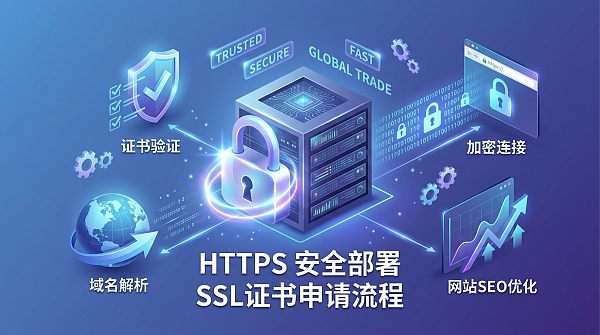
Let’s start with the conclusion: for most companies, applying for an SSL certificate is not complicated. The difficulty level is more like “a process with steps that can be standardized for execution”.
If your website already has a working domain name and server, then the core SSL certificate process usually only includes these steps:
- Confirm the domain name and website usage scenario
- Choose the appropriate type of SSL certificate
- Submit the application and complete domain or business identity verification
- Download the certificate files and deploy them to the server
- Enable HTTPS redirection and check whether page resources are fully encrypted
- Handle renewals and monitoring properly afterward
The points where people really tend to get stuck usually fall into three areas:
- Not knowing whether to choose DV, OV, or EV
- Lack of server deployment experience
- Worrying about SEO and page compatibility issues after HTTPS goes live
So, rather than saying the SSL certificate application is “complicated,” it is more accurate to say that it is a process requiring correct decision-making and standardized execution. As long as the early-stage judgment is clear, the later steps can generally move forward smoothly.
Before applying for an SSL certificate, first clarify these 3 key decisions
Many companies are not unable to apply; they simply choose the wrong direction from the start. Before applying, it is recommended to first confirm the following three questions.
1. What is your website for?
If it is only a corporate website, brand showcase site, or content site, a basic SSL certificate is usually enough to meet the need; if it involves login, form submission, order payment, customer data collection, and similar scenarios, then more attention should be given to certificate level and deployment security.
2. Who is your target audience?
If the website mainly targets general domestic visitors, basic HTTPS encryption can often meet most needs; if it targets overseas customers, cross-border business, or B2B buyers, website credibility becomes more important. In that case, certificate selection should not be based only on price, but also on brand, compatibility, and maintenance efficiency.
3. Are you managing a single domain, multiple subdomains, or multiple websites?
- Single-domain certificate: suitable for one standalone website
- Wildcard certificate: suitable for multiple subdomains, such as www, m, blog, shop
- Multi-domain certificate: suitable for unified management of multiple different domains
This step is very important because it directly determines subsequent procurement cost, management complexity, and renewal workload.
The SSL certificate application process, explained step by step
Below, we will break down the SSL certificate application process in a more practical way.
Step 1: Prepare the domain name and server environment
Before applying for an SSL certificate, you first need to have an available domain name and confirm that the domain DNS resolution is controllable. On the server side, whether it is a cloud server, virtual hosting, or a website-building SaaS platform, you need to confirm whether SSL deployment is supported.
If the company is still in the website-building stage, it is best to plan domain configuration, website architecture, and SSL support capabilities together. This is especially true for websites targeting overseas markets, where multilingual support, localization, and domain strategy often need to be considered together with certificate deployment. For example, when building an Arabic website for the Middle East market, you need to consider not only right-to-left layout, but also flexible domain configuration and SSL certificate selection. Such needs are often better suited to an integrated solution, such as Arabic industry website development and marketing solutions, which can reduce repeated adjustments during the website-building and marketing deployment stages.
Step 2: Choose the certificate type
Common SSL certificates are mainly divided into three types:
- DV certificate: verifies domain ownership, fast to apply for, suitable for most basic websites
- OV certificate: verifies business identity, suitable for corporate websites with higher requirements for brand credibility
- EV certificate: stricter review, suitable for finance, platform-based businesses, and operations with high trust requirements
If your core goal is “to get HTTPS online first,” a DV certificate is usually sufficient; if your customers pay particular attention to company qualifications, official website credibility, and data security display, OV or EV is more suitable.
Step 3: Submit the application and complete verification
After applying for the certificate, the certificate provider will require verification to be completed. Common verification methods include:
- DNS verification
- Email verification
- Uploading a specified file to the website directory
DV certificates are generally verified more quickly, while OV and EV usually also require business information review, so they take a bit longer.
Step 4: Download and install the SSL certificate
After the certificate is issued, the certificate files need to be installed on the server. Installation methods vary by environment. For example, Nginx, Apache, IIS, Baota Panel, and cloud platform consoles all have slightly different steps.
After installation is complete, focus on checking:
- Whether the website already supports HTTPS access
- Whether HTTP correctly redirects to HTTPS
- Whether static resources such as images, JS, and CSS are still being called through HTTP URLs
- Whether forms, payment pages, and login pages are all functioning properly
Step 5: Conduct post-launch security and SEO checks
Many people think that once the certificate is installed, the job is done, but there is actually one more step: compatibility and optimization checks after launch. This is especially important for marketing websites. Once mixed content, redirect anomalies, or indexing URL confusion occur, they will affect user experience and search performance.
Why do SSL certificate prices vary so much? How should companies choose without wasting budget?
Large price differences in SSL certificates are usually not due to “different encryption strength,” but are determined by the following factors:
- Certificate type: DV, OV, and EV differ in price
- Coverage scope: single-domain, wildcard, and multi-domain certificates differ in price
- Certificate brand: different CA providers price differently
- Value-added services: technical support, warranty protection, and management convenience differ
For companies, when choosing an SSL certificate, do not just look at the lowest price; look at whether it matches your business goals.
Common selection recommendations are as follows:
- Startup corporate websites: prioritize cost performance and quick launch
- Brand official websites/inquiry-driven websites: prioritize stability, compatibility, and credibility
- Multilingual or overseas marketing site groups: prioritize multi-domain management efficiency and ongoing maintenance costs
- Websites with forms, memberships, and payment modules: prioritize security strategy, identity verification level, and after-sales support
In other words, an SSL certificate is not better just because it is more expensive; the better fit is the better choice.
How long is an SSL certificate valid? Is renewal troublesome?
Mainstream SSL certificates currently usually adopt relatively short validity periods, so companies must take renewal management seriously. Many websites do not run into problems during application, but after the certificate expires and is not updated in time, causing browsers to display “Not Secure,” which seriously affects customer trust and inquiry conversions.
Whether renewal is troublesome depends on two aspects:
- Whether your website and certificate management are standardized
- Whether someone is continuously responsible for maintenance
If the company has multiple sites, multilingual official websites, or overseas advertising landing pages, it is recommended to establish a certificate register in advance to record domain names, certificate types, expiration dates, deployment servers, and responsible persons. This can greatly reduce operations and maintenance risks.
For companies without a dedicated technical team, choosing a solution that includes website maintenance services is more worry-free. This is especially true for companies targeting the Middle East market: the website not only needs to consider Arabic localization, but also SSL certificate selection, ongoing maintenance, and coordination with marketing campaigns, so as to avoid disconnection between website building, operations, and promotion.
Will an SSL certificate affect SEO? The answer is yes, and it is usually a positive impact
Many companies pay attention to SSL certificates not only for security, but also for SEO performance. The conclusion is: HTTPS itself has positive significance for SEO, but only if the migration and configuration are done correctly.
This is mainly reflected in the following aspects:
- Improves search engines’ basic evaluation of website security
- Enhances user trust and reduces bounce rate
- Avoids browser “Not Secure” warnings from affecting conversions
- Is more suitable for handling ad traffic and marketing landing pages
However, it should be noted that HTTPS does not automatically improve rankings just by installing a certificate. If handled improperly, it may instead create SEO problems, such as:
- HTTP and HTTPS versions being accessible at the same time, causing duplicate indexing
- Overly long page redirect chains, affecting crawl efficiency
- Site resources still using HTTP, generating mixed content warnings
- sitemap, canonical, and internal links not being updated synchronously
Therefore, for companies that value website SEO optimization, SSL certificate deployment should be handled together with technical SEO, rather than separately.
Which companies especially need to deploy SSL certificates as soon as possible?
If you belong to one of the following categories, it is recommended not to delay any longer:
- Companies currently revamping their official website or launching a new site
- Companies relying on SEO lead generation or Google Ads campaigns
- Websites with form collection, inquiry submission, or online customer service
- Companies engaged in cross-border business, multilingual websites, or overseas market promotion
- Companies needing to improve official website trust and brand professionalism
Especially in the “website + marketing service integration” scenario, SSL certificates are no longer just a pure technical configuration, but core infrastructure for user trust, conversion efficiency, and search visibility.
The most practical tips to avoid pitfalls when companies apply for SSL certificates
If you want to get it right in one go, the following suggestions are highly practical:
- Confirm the website structure first, then buy the certificate, to avoid repeated purchases caused by later domain quantity changes
- Do not focus only on low price, compatibility and service support are equally important
- Be sure to check all site resources after deployment, especially images, JS, and form interfaces
- Handle SEO settings simultaneously, including 301 redirects, canonical, sitemaps, and indexing monitoring
- Set up a renewal reminder mechanism, to avoid certificate expiration affecting business
- If targeting overseas markets, prioritize integrated coordination of website building, certificates, and marketing
For example, for corporate websites targeting the Middle East market, it is not just as simple as “installing the certificate.” You also need to consider Arabic content localization, Google Ads Arabic keyword optimization, social media marketing coordination, and ongoing maintenance efficiency. Planning these elements in a unified way is often better at reducing long-term operating costs than purchasing them separately.
Summary: Applying for an SSL certificate is not difficult; the hard part is choosing the right solution and implementing it properly
Returning to the original question: Is the SSL certificate application process complicated? The answer is no, it is not complicated, but it does require making several key judgments clearly: what the website is for, which certificate should be chosen, whether SEO needs to be considered as well, and who will handle ongoing maintenance.
For business decision-makers, the value of an SSL certificate is not just “adding a security lock,” but also a foundational configuration for official website credibility, marketing conversion efficiency, and brand professionalism; for execution and operations personnel, as long as they follow the process, application, deployment, and renewal can all be completed in a standardized way.
If your company is preparing to build an overseas website, especially for the Middle East market, then planning the domain, SSL, localization, and promotion strategy together during the website-building stage will be far more efficient than patching things up later. Only by viewing the SSL certificate as part of the overall website and marketing system can its value truly be realized.
Related Articles



Related Products
 EasyCamp SaaS Smart Website Marketing SystemE-Yingbao SaaS Smart Website Marketing System: AI-powered, zero-code website building. Rapidly launch multilingual independent e-commerce sites in just 10 minutes. Global server acceleration and AI-driven SEO optimization empower businesses to efficiently connect with global markets. The seamless integration of technology and user-friendly operation makes building e-commerce sites incredibly simple.
 AI+SEM Intelligent Advertising Marketing SystemAI+SEM drives intelligent ad creation, empowering full-funnel precision advertising marketing. The system automatically generates weekly/monthly reports, AI recommends keywords and target countries, monitors core metrics in real-time with intelligent alerts, and enables one-click high-conversion ad solutions to help quickly acquire customers and improve ROI.
 AI+SEO Dual Engine Optimization ServiceEasyWin AI+SEO Dual Engine Optimization System leverages AI-powered keyword mining, content generation, and comprehensive technical optimization to help foreign trade enterprises acquire high-quality organic traffic, significantly improving search rankings and conversion rates.
 AI+SNS Social Media Marketing SystemYingbao AI+SNS Social Media Marketing System - Precision social capture for the social media era. Supports one-click content synchronization across major platforms like Facebook and LinkedIn. AI intelligently rewrites posts for enhanced relevance. 24/7 AI customer service and user profiling analysis empower businesses to efficiently expand into global markets.
 AI+SEO营销解决方案易营宝AI+SEO营销解决方案,通过AI批量写作、智能生成TDK、精准关键词扩词等功能,全面优化网站SEO效果,提升流量与转化率。助力企业构建高效智能网站新生态。
 AI+SEM Advertising Marketing SolutionsAI+SEM Advertising Marketing Solution leverages AI technology to deeply empower SEM ad campaigns. It automatically generates weekly/monthly reports using AI, presenting account data across multiple dimensions for comprehensive insights into campaign performance and trends. The system precisely recommends keywords and target countries, intelligently generates high-conversion ad copy, and enables one-click activation of efficient campaign plans to help businesses rapidly acquire customers. Simultaneously, it monitors core metrics in real time, intelligently identifies abnormal fluctuations, and issues timely alerts to ensure stable, high-return advertising results.
 Domain Name ServicesEasyWin provides professional domain name services, including intelligent queries, one-stop registration, brand protection, and full lifecycle management, helping businesses build a digital brand image.
 EasyOperate B2C Cross-Border E-Commerce Platform & Independent WebsiteEasyStore B2C Cross-border E-commerce Independent Store is an intelligent website building and cross-border e-commerce integrated solution independently developed by EasyStore Information Technology (Beijing) Co., Ltd. The system is specially designed for small and medium-sized as well as large export enterprises, integrating 'website building, operation, marketing, advertising, and conversion' into one, helping enterprises quickly establish cross-border e-commerce independent stores to achieve brand globalization and global sales growth.
The platform supports multiple languages, multiple currencies, and multi-channel marketing, with built-in AI intelligent translation and SEO optimization systems, suitable for mainstream markets such as Southeast Asia, Europe and America, Latin America, and the Middle East, assisting Chinese manufacturing enterprises in efficiently deploying international e-commerce strategies. SSL证书易营宝提供专业SSL安全证书服务,包括单域名和泛域名证书,确保网站数据传输加密、身份验证和完整性保护,助力企业建立安全可信的在线业务环境。









