









- What New Signals Are Emerging in Enterprise Services SaaS Marketing ReportsJul 27, 2026View details
- What Does a Global Traffic Ecosystem Service Provider Do? What Are the Differences from a Single Advertising AgencyJul 16, 2026View details
- What should you focus on in the latest enterprise SaaS report? From renewal rates and delivery costs to overseas growth opportunitiesJul 12, 2026View details
- What signals are worth paying attention to in a cross-border marketing trend report? B2B companies should look at these 6 signalsJul 11, 2026View details
- How to Read a Cross-Border Marketing Trends Report? Five Key Dimensions for Evaluating Channel OpportunitiesJul 11, 2026View details
- Which channel has the highest ROI in the global traffic ecosystem? Comparative analysis of search, social media, and advertisingJul 10, 2026View details
- What multilingual website services are available in Sanya? Which model is more suitable for local businesses going global?Jul 08, 2026View details
- How to view the complete list of China SaaS companies in the top 100? Practical methods for screening website-building and marketing service providersJul 08, 2026View details
Which Meta advertising skills should you learn first for better results?
If you want to master Meta advertising techniques, don’t rush to burn through your budget first. The truly more effective way to get started is not to first learn “how to launch ads,” but to first figure out: who you are targeting, what creatives can persuade them, whether the landing page can effectively receive the traffic, and how the data should be reviewed and analyzed. For businesses, Meta advertising is not simply about buying exposure, but about achieving more stable inquiries, conversions, and brand growth at a lower cost; for operators, if the groundwork is set up correctly at the beginning, subsequent optimization will not constantly be about “patching leaks.”
If you are searching for “which first steps are more effective to learn in Meta advertising,” the core answer can be given upfront: first learn goal setting and conversion path planning, then audience targeting, then creative testing, followed by checking landing page readiness, and finally establishing a data review mechanism. This sequence is more practical than starting right away with bidding, scaling, and advanced tactics, and it is also more aligned with the current advertising stage of most businesses.
Step 1: Don’t build ads first: first clarify your campaign goals and conversion path
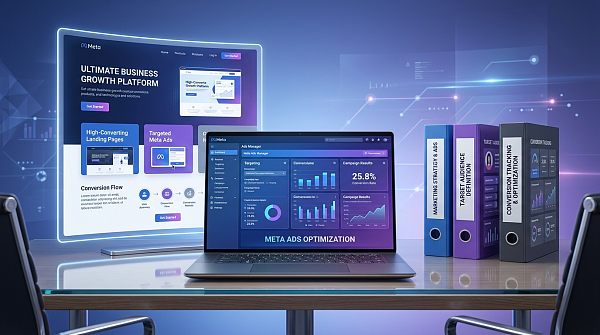
Many poor Meta advertising results are not because the platform does not work, but because the very first step was wrong. A common problem for businesses is: they want exposure, they want direct messages, they want people to add WhatsApp, they want form submissions, and they also want direct sales, resulting in confused campaign objectives, unclear system learning direction, and naturally wasted budget.
A more effective approach is to first answer 4 questions:
- What is the core goal of this campaign: brand awareness, lead generation, or direct conversion?
- After users see the ad, what action do you want them to take: click, submit their information, send a message, place an order?
- Does the conversion happen within Meta, or on your website landing page?
- Does your company have the capability to promptly handle and follow up on leads internally?
For the website + integrated marketing services industry, Meta advertising is usually not a standalone action, but one part of the entire growth chain. Especially for B2B companies, overseas brand expansion businesses, channel partners, and service-based companies, ads, websites, content, and lead management should be viewed together. Otherwise, after users click into the ad, if the page lacks persuasiveness, the form experience is poor, and customer service follow-up is slow, even highly precise traffic will be difficult to convert.
If your business involves design showcases, brand image, and high-end project communication, the visual continuity of the landing page will also directly affect conversion judgment. For example, some showcase-focused websites use immersive full-screen scrolling interactions, panoramic banners, and refined grid layouts to strengthen brand quality perception. These types of pages are often more conducive to building trust in businesses related to architecture, renovation, and interior design. Showcase solutions like interior design, renovation, architecture are more suitable for receiving visitors with higher expectations for visual quality and business image.
Why Step 2 is audience targeting, instead of first researching “viral winning tactics”
Among Meta advertising techniques, one of the most easily misunderstood ideas is that “creatives determine everything.” In reality, if the audience direction is off, even the best creatives are only pushing the wrong message more efficiently to the wrong people.
It is recommended to start audience targeting from these 3 layers, rather than immediately building many complex ad sets:
- Core audience: country/region, age, language, interests, job title, behavior.
- Custom audience: website visitors, engaged users, form users, existing customer lists.
- Lookalike audience: expand potential groups based on high-quality converted users.
There are two common execution-level mistakes: first, stacking too many interest keywords, which makes the audience unclear; second, slicing the audience too finely, causing the budget to be spread too thin so the learning phase never stabilizes. A more effective method is to first test with a clearer broad audience, then narrow it down based on click-through rate, time on page, conversion rate, and lead quality.
For business decision-makers, what matters more is not “which labels were set for the audience,” but whether this segment is worth investing in. It is recommended to judge based on 3 criteria:
- Whether this audience truly has business demand, rather than just “seeming relevant”
- Whether the conversion cost is within an acceptable range
- Whether the lead quality is sufficient to support later conversions into deals
Simply put, Meta advertising is not about finding the “largest traffic volume,” but about finding the “people most likely to convert.”
How to do creative testing in Step 3 without constantly burning money through trial and error
For most beginners in the early stages of Meta advertising, the fastest place where budget gets consumed is creative testing. The problem is usually not a lack of ideas, but the wrong testing method.
It is recommended to first test these 3 dimensions:
- Messaging angle: selling points, pain points, case studies, offers, comparisons, solutions.
- Content format: images, short videos, carousel, UGC style, voice-over explanation.
- Expression style: professional, results-driven, emotionally driven, scenario-based presentation.
For operators, one practical principle is: test only a small number of variables each time. For example, first fix the audience and only change 3 copy angles; or fix the copy and only change the image/video. Only then can you know exactly which factor drove the performance change.
If your business is more service showcase-oriented, such as website development, brand design, spatial design, renovation, architecture, etc., your creatives should not just say “we are very professional,” but should visualize the results as much as possible. High-quality page displays, before-and-after comparisons, project details, and client cases usually drive more clicks and inquiries than empty slogans.
In addition, the creatives and landing page must be consistent. If the ad talks about “high-end customization,” but users click through to see an ordinary template page; if the ad talks about “strong case capabilities,” but the page lacks project proof, this gap will significantly reduce the conversion rate. Whether Meta advertising performs well often depends not only on the ad creative itself, but on whether the ad promise and page experience are aligned.
Why landing page readiness in Step 4 determines the final ROI of the ad
Many businesses understand Meta ad optimization as optimization inside the ad dashboard, but the key factor that truly affects ROI often happens outside the platform. After users click the ad, whether they continue browsing, whether they are willing to leave their information, and whether they develop trust all depend mainly on the landing page.
A qualified Meta ad landing page should solve at least the following problems:
- Let users understand what you do within 3 seconds
- Let users quickly judge what problems you can solve
- Have enough case studies, qualifications, data, or reputation to build trust
- Clear conversion entry points, with easy-to-use forms, buttons, and inquiry methods
- Fast mobile loading speed and a clear page structure
Especially for companies providing global digital marketing, smart website building, SEO optimization, social media marketing, and ad placement services, the website must not be treated merely as a “company profile page.” It should be important infrastructure for converting ad traffic. A good website can not only receive Meta traffic, but also work with SEO and subsequent remarketing to form a continuous growth loop.
For example, in some industries that need to reinforce a high-end brand positioning, using asymmetrical dynamic layouts, interactive hover modules, and fully responsive interactions is not just about “good-looking design,” but essentially about enhancing visitors’ sense of professionalism and their willingness to engage in business discussions. This is also why many businesses later find during review that the ad click cost is not high, but what truly limits conversion is that the page is not persuasive enough.
What to look at in Step 5 data review so you are not “only staring at click-through rate”
Once you get further into learning Meta advertising techniques, what truly creates the gap is review capability. Many teams look at data every day but cannot identify where the problem is; some managers only ask “how many leads came in today,” while ignoring lead quality, follow-up efficiency, and closed conversions.
It is recommended to review data from 4 layers:
- Ad layer: impressions, click-through rate, CPM, CPC, frequency.
- Page layer: bounce rate, time on page, page scroll depth, form completion rate.
- Conversion layer: number of leads, number of direct messages, number of new contacts added, number of orders, cost per conversion.
- Business layer: valid lead rate, close rate, average order value, payment collection cycle, ROI.
This step is also the most suitable point to combine website traffic monitoring tools and CRM data. Because what the ad dashboard tells you is more about “in-platform performance”; what businesses really need to judge is “whether this budget actually delivered business results.”
For after-sales maintenance staff, agents, and distributors, reviews should also focus on whether lead sources are stable, the quality differences across different regions and audiences, and whether the inquiries generated by ads can be effectively handled by the subsequent service system. Only when front-end ad placement and back-end conversion work together can Meta advertising evolve from “paying for traffic” into a “replicable customer acquisition mechanism.”
Which inefficient operations businesses should avoid most in the early stage of Meta advertising
If you want to know “which first steps are more effective to learn,” then you must also know which actions should be avoided as much as possible. The following situations are the most common:
- Running large-scale campaigns directly without installing or calibrating conversion tracking
- Changing ad objectives too frequently, so the system can never learn stably
- Budget is too low but there are too many ad sets, causing each set to fail to gain traction
- Changing creatives frequently without a clear testing logic
- Only looking at surface-level data, without checking lead quality and actual conversions
- The website pages are outdated, slow to load, and information is scattered, yet the problem is blamed on the platform
For managers, Meta advertising is not an all-purpose tool that “works as soon as you launch it,” but a growth system that requires coordination among goals, creativity, pages, and data. For practitioners, what is truly worth learning first is not scattered tricks, but the correct process. If the process is right, techniques will amplify results; if the process is wrong, the more techniques you use, the faster the budget may be wasted.
Conclusion: If you want Meta advertising to perform more effectively, first get these four basics right
In summary, the recommended learning sequence for Meta advertising techniques is to prioritize four things: clarify goals and conversion paths, identify the right audience, do creative testing well, optimize landing page readiness, and then use data review for continuous iteration. This sequence is suitable both for beginners and for business decision-makers who want to control input-output efficiency and reduce the cost of trial and error.
If a business hopes to truly turn Meta advertising into a stable growth channel, it cannot just optimize the ad dashboard. It must also connect social media marketing strategy, website conversion capability, traffic monitoring, and sales conversion. Only in this way will the ad budget not remain a one-time expense, but gradually accumulate into higher-quality customer acquisition assets and stronger brand growth capability.
Related Articles


Related Products
 EasyCamp SaaS Smart Website Marketing SystemE-Yingbao SaaS Smart Website Marketing System: AI-powered, zero-code website building. Rapidly launch multilingual independent e-commerce sites in just 10 minutes. Global server acceleration and AI-driven SEO optimization empower businesses to efficiently connect with global markets. The seamless integration of technology and user-friendly operation makes building e-commerce sites incredibly simple.
 AI+SEM Intelligent Advertising Marketing SystemAI+SEM drives intelligent ad creation, empowering full-funnel precision advertising marketing. The system automatically generates weekly/monthly reports, AI recommends keywords and target countries, monitors core metrics in real-time with intelligent alerts, and enables one-click high-conversion ad solutions to help quickly acquire customers and improve ROI.
 AI+SEO Dual Engine Optimization ServiceEasyWin AI+SEO Dual Engine Optimization System leverages AI-powered keyword mining, content generation, and comprehensive technical optimization to help foreign trade enterprises acquire high-quality organic traffic, significantly improving search rankings and conversion rates.
 AI+SNS Social Media Marketing SystemYingbao AI+SNS Social Media Marketing System - Precision social capture for the social media era. Supports one-click content synchronization across major platforms like Facebook and LinkedIn. AI intelligently rewrites posts for enhanced relevance. 24/7 AI customer service and user profiling analysis empower businesses to efficiently expand into global markets.
 AI+SEO营销解决方案易营宝AI+SEO营销解决方案,通过AI批量写作、智能生成TDK、精准关键词扩词等功能,全面优化网站SEO效果,提升流量与转化率。助力企业构建高效智能网站新生态。
 AI+SEM Advertising Marketing SolutionsAI+SEM Advertising Marketing Solution leverages AI technology to deeply empower SEM ad campaigns. It automatically generates weekly/monthly reports using AI, presenting account data across multiple dimensions for comprehensive insights into campaign performance and trends. The system precisely recommends keywords and target countries, intelligently generates high-conversion ad copy, and enables one-click activation of efficient campaign plans to help businesses rapidly acquire customers. Simultaneously, it monitors core metrics in real time, intelligently identifies abnormal fluctuations, and issues timely alerts to ensure stable, high-return advertising results.
 Domain Name ServicesEasyWin provides professional domain name services, including intelligent queries, one-stop registration, brand protection, and full lifecycle management, helping businesses build a digital brand image.
 EasyOperate B2C Cross-Border E-Commerce Platform & Independent WebsiteEasyStore B2C Cross-border E-commerce Independent Store is an intelligent website building and cross-border e-commerce integrated solution independently developed by EasyStore Information Technology (Beijing) Co., Ltd. The system is specially designed for small and medium-sized as well as large export enterprises, integrating 'website building, operation, marketing, advertising, and conversion' into one, helping enterprises quickly establish cross-border e-commerce independent stores to achieve brand globalization and global sales growth.
The platform supports multiple languages, multiple currencies, and multi-channel marketing, with built-in AI intelligent translation and SEO optimization systems, suitable for mainstream markets such as Southeast Asia, Europe and America, Latin America, and the Middle East, assisting Chinese manufacturing enterprises in efficiently deploying international e-commerce strategies. SSL证书易营宝提供专业SSL安全证书服务,包括单域名和泛域名证书,确保网站数据传输加密、身份验证和完整性保护,助力企业建立安全可信的在线业务环境。









