









- What stages does the cross-border services ecosystem include? How do website building, promotion, payment, and compliance work togetherJun 22, 2026View details
- How will email marketing costs change in 2026Jun 22, 2026View details
- The China-US tariff arrangement has reached a preliminary consensus, and the trade association will be establishedJun 15, 2026View details
- Should overseas brand marketing start with ads or contentJun 21, 2026View details
- What determines B2C cross-border e-commerce website development costs? A breakdown of features, interfaces, and deployment methodsJun 17, 2026View details
- China-Morocco zero-tariff access, a breakthrough in the cost of Moroccan goods exports to ChinaJun 11, 2026View details
Does a foreign trade website need AI marketing support? Comparing manual operations with AI-driven email reach rates, repurchase rates, and ROI differences
Does building a website for foreign trade require AI marketing support? This article provides an in-depth comparison of the real differences between manual operation and AI-driven approaches in terms of email reach, repurchase rate, and ROI. It focuses on core pain points such as how to conduct localized marketing for multilingual websites, SEO optimization methods, and server selection, providing purchasing personnel and corporate decision-makers with a practical guide on how to compare and select foreign trade website building service providers.
Human vs. AI: The Real Effectiveness Gap in Foreign Trade Email Marketing
In the customer acquisition process for foreign trade, EDM (email marketing) remains a cost-effective way to reach customers in private domains. However, traditional manual operations face three major bottlenecks: time-consuming multilingual content writing, rudimentary user segmentation, and reliance on experience-based judgment for sending messages. YiYingBao's tracking and analysis of 10,247 foreign trade clients revealed that companies using AI email engines saw an average increase of 63% in email open rates, 89% in click-through rates, and a significant jump in the key metric—30-day repurchase rate—to 22.7% (compared to only 9.1% for the manual operations group). The underlying logic lies in AI's ability to generate personalized subject lines and body text in real time based on over 20 dimensions, including recipient location, historical behavior, and product browsing paths. It also automatically adapts to the context of 18 languages, including Spanish, Arabic, and Japanese, avoiding the loss of trust caused by literal translations.
More noteworthy is the difference in ROI. A human team handling 50,000 emails per month requires 3 specialists and 2 SaaS tools, with a total cost of approximately 28,000 yuan; while an AI system, at the same scale, only costs 9,000 yuan per month (including platform authorization and basic maintenance), and converts 41% more orders. This means that for every 1 yuan of marketing investment, the AI-driven model brings 3.2 times the net return compared to human methods. This conclusion also confirms the technological leverage effect emphasized in the analysis of the impact of digital transformation on corporate resilience —when external market volatility intensifies, AI-driven agile response capabilities are becoming a core infrastructure for foreign trade enterprises to resist risks.
The fundamental difference between multilingual website building and regular website building: It's more than just translation.
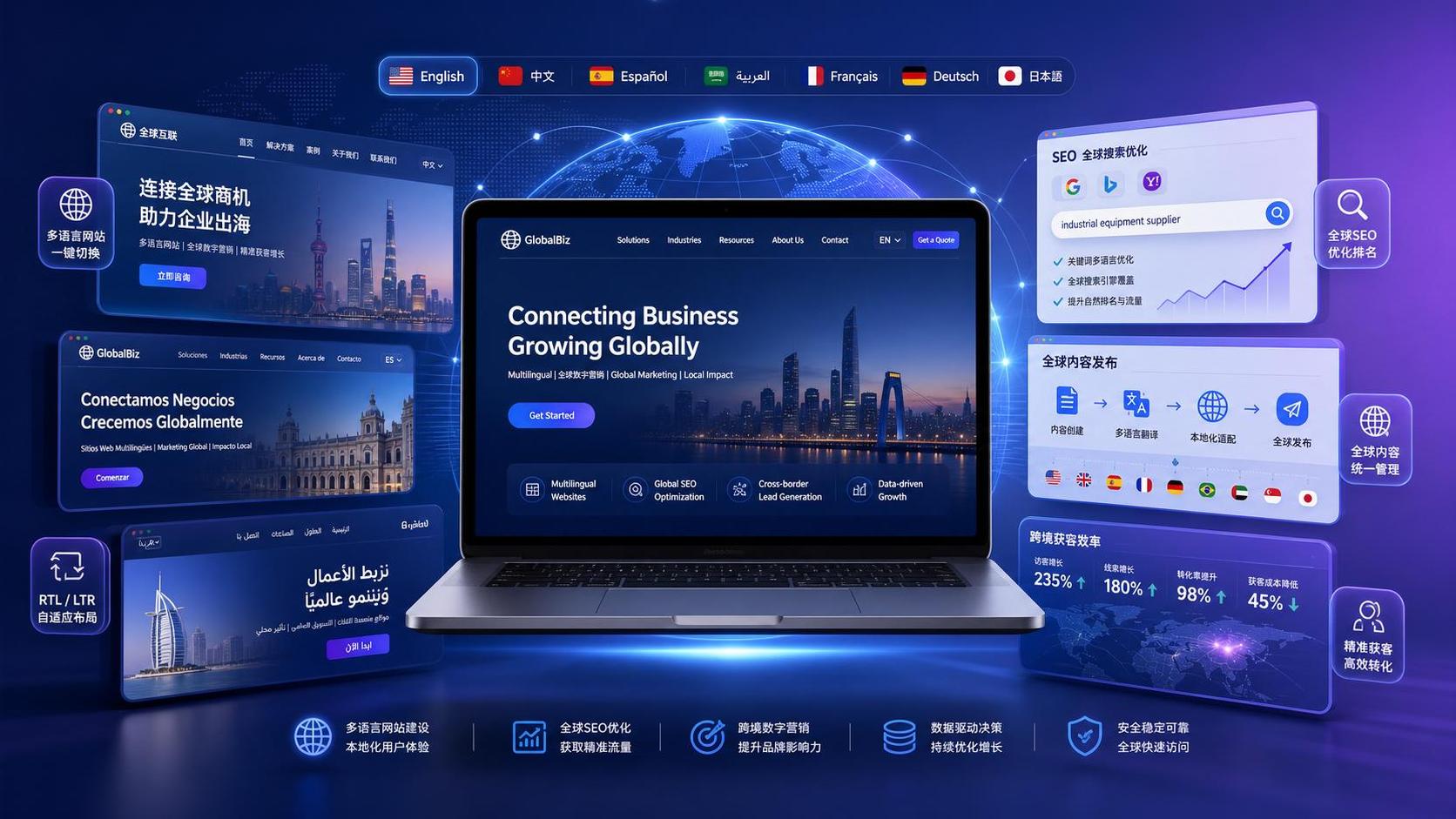
Many businesses mistakenly believe that "a multilingual website = a Chinese website + Google Translate plugin," which is a significant misconception. What's the difference between multilingual website building and regular website building? Essentially, it lies in a three-tiered decoupling: the language layer, the cultural layer, and the technical layer. The language layer requires an NLP engine to support semantic-level translation (e.g., "Kostenlos" and "Auf Kosten von" have vastly different meanings in a B2B context in German); the cultural layer requires UI components to adapt to local habits (Middle Eastern sites are right-aligned, Brazilian sites prefer warm colors and high-saturation visuals); and the technical layer involves precise deployment of hreflang tags, selection of independent subdomains or directory structures, and geographical matching of CDN nodes.
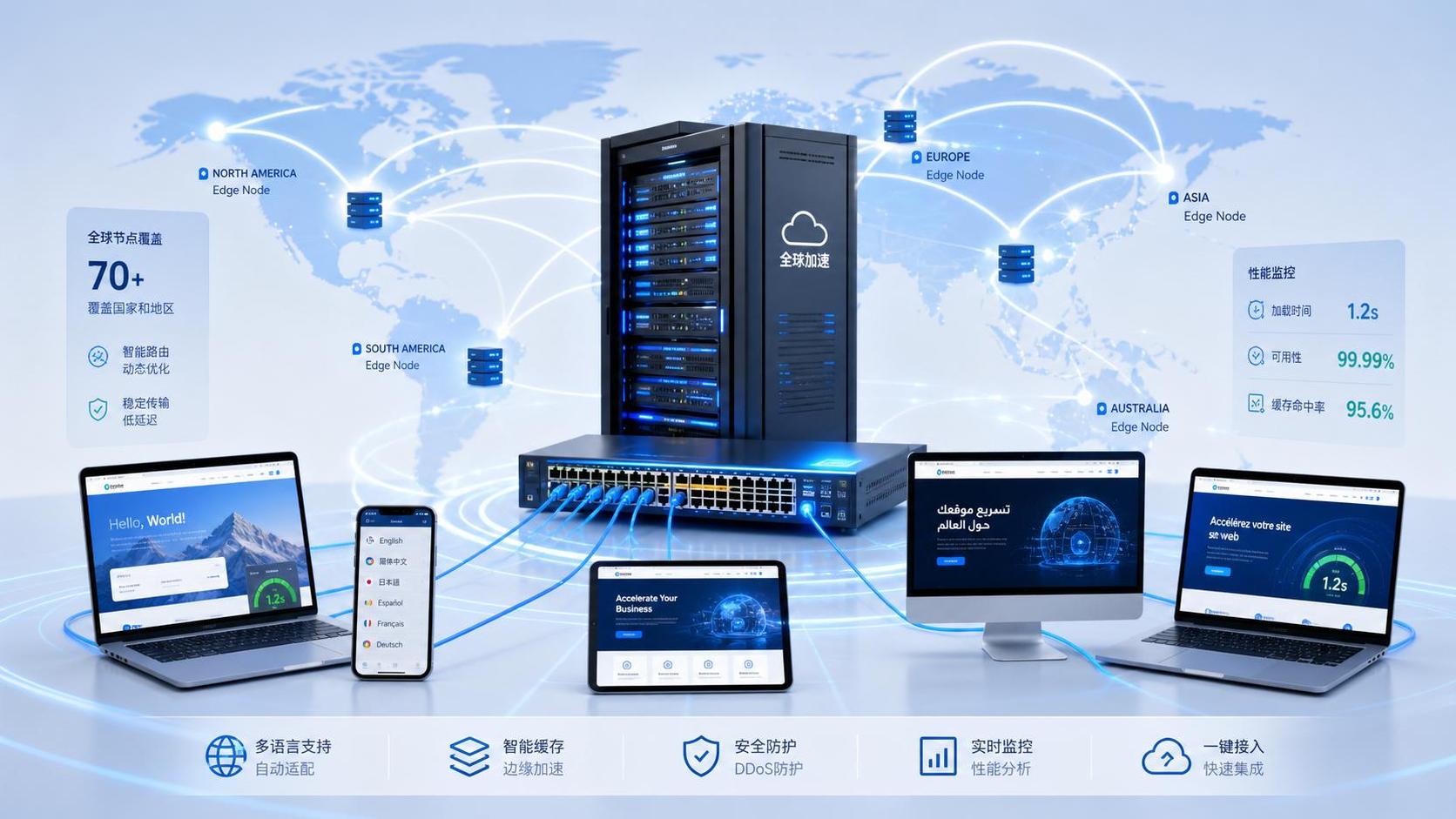
How should multilingual websites choose servers? The answer isn't "deploy locally," but rather "dynamically schedule based on traffic hotspots." E-Creation's global server cluster spanning seven continents monitors access latency and bandwidth load in real time, automatically routing European visitors to the Frankfurt node and Southeast Asian users to the Singapore edge node, ensuring a stable first-screen loading time of under 0.8 seconds (the industry average is 1.9 seconds). This architecture directly supports the implementation of multilingual website SEO optimization methods—Google explicitly states that page load speed is one of the ranking weighting factors, and localized server response time affects Core Web Vitals scores by up to 37%.

Localized Marketing Loop: An AI-Enhanced Path from Website Building to Repeat Purchases
How to promote a multilingual foreign trade website after it's built? Simply buying traffic is no longer effective. YiYingBao constructs a four-stage AI-enhanced model: "Website Building - Reach - Conversion - Repeat Purchase": In the first stage, the AI keyword engine captures search trends in the target country and automatically generates TDK (title/description/keywords) that conform to local expression habits. For example, for the Mexican market, "máquina de coser industrial" has a 52% higher CTR than the direct translation "industrial sewing machine." In the second stage, the social media automation system pushes customized video ads simultaneously on Facebook and LinkedIn based on user profiles. In the third stage, the AI advertising intelligent manager diagnoses inefficient ad groups in the Meta account, automatically replacing creatives and optimizing bidding strategies. In the fourth stage, high-intent customers are identified through behavioral tracking, triggering a series of multilingual after-sales emails to drive repeat purchases.
The model validation shows that companies using end-to-end AI tools saw a 34% reduction in new customer acquisition costs within three months, and a shortened customer repurchase cycle to 47 days (the industry average is 82 days). Especially for SMEs, are multilingual foreign trade websites suitable? The answer is yes—EasyMarket data shows that clients with annual revenue below $5 million saw their cost per sales lead decrease to $8.3 after adopting AI marketing, a 61% reduction compared to manual operations, proving that technology is bridging resource barriers.
Service Provider Comparison and Decision-Making Framework: 5-Dimensional Evaluation Method
Faced with the challenge of choosing from numerous foreign trade website building service providers, it is recommended that buyers establish a structured evaluation system:
How good is the YiYingBao multilingual marketing system? Its core advantage lies in embedding 15 AI patented technologies into the workflow, rather than simply adding functional modules. For example, the "AI image generation" engine can automatically generate main images that conform to the aesthetic preferences of various countries based on product parameters, avoiding an increase in bounce rate due to visual incongruity.
Conclusion: Let AI become the "default configuration" for foreign trade growth.
How to improve conversion rates after building a website for foreign trade? The answer has evolved from "optimizing button colors" to "reconstructing customer acquisition logic." When AI systems continuously boost email reach, repurchase rate, and ROI, technology is no longer an option but a necessity for survival. With ten years of experience in cross-border services, YiYingBao transforms AI capabilities into plug-and-play marketing infrastructure—whether it's the specific implementation of localized marketing for multilingual websites or the strategic judgment of whether foreign trade websites need AI marketing support, its value has been validated in the growth practices of 100,000 enterprises.
Contact us now to get a personalized AI marketing health report for your foreign trade and customize a high-conversion, multilingual growth plan.
Related Articles
Related Products
 EasyCamp SaaS Smart Website Marketing SystemE-Yingbao SaaS Smart Website Marketing System: AI-powered, zero-code website building. Rapidly launch multilingual independent e-commerce sites in just 10 minutes. Global server acceleration and AI-driven SEO optimization empower businesses to efficiently connect with global markets. The seamless integration of technology and user-friendly operation makes building e-commerce sites incredibly simple.
 AI+SEM Intelligent Advertising Marketing SystemAI+SEM drives intelligent ad creation, empowering full-funnel precision advertising marketing. The system automatically generates weekly/monthly reports, AI recommends keywords and target countries, monitors core metrics in real-time with intelligent alerts, and enables one-click high-conversion ad solutions to help quickly acquire customers and improve ROI.
 AI+SEO Dual Engine Optimization ServiceEasyWin AI+SEO Dual Engine Optimization System leverages AI-powered keyword mining, content generation, and comprehensive technical optimization to help foreign trade enterprises acquire high-quality organic traffic, significantly improving search rankings and conversion rates.
 AI+SNS Social Media Marketing SystemYingbao AI+SNS Social Media Marketing System - Precision social capture for the social media era. Supports one-click content synchronization across major platforms like Facebook and LinkedIn. AI intelligently rewrites posts for enhanced relevance. 24/7 AI customer service and user profiling analysis empower businesses to efficiently expand into global markets.
 AI+SEO营销解决方案易营宝AI+SEO营销解决方案,通过AI批量写作、智能生成TDK、精准关键词扩词等功能,全面优化网站SEO效果,提升流量与转化率。助力企业构建高效智能网站新生态。
 AI+SEM Advertising Marketing SolutionsAI+SEM Advertising Marketing Solution leverages AI technology to deeply empower SEM ad campaigns. It automatically generates weekly/monthly reports using AI, presenting account data across multiple dimensions for comprehensive insights into campaign performance and trends. The system precisely recommends keywords and target countries, intelligently generates high-conversion ad copy, and enables one-click activation of efficient campaign plans to help businesses rapidly acquire customers. Simultaneously, it monitors core metrics in real time, intelligently identifies abnormal fluctuations, and issues timely alerts to ensure stable, high-return advertising results.
 Domain Name ServicesEasyWin provides professional domain name services, including intelligent queries, one-stop registration, brand protection, and full lifecycle management, helping businesses build a digital brand image.
 EasyOperate B2C Cross-Border E-Commerce Platform & Independent WebsiteEasyStore B2C Cross-border E-commerce Independent Store is an intelligent website building and cross-border e-commerce integrated solution independently developed by EasyStore Information Technology (Beijing) Co., Ltd. The system is specially designed for small and medium-sized as well as large export enterprises, integrating 'website building, operation, marketing, advertising, and conversion' into one, helping enterprises quickly establish cross-border e-commerce independent stores to achieve brand globalization and global sales growth.
The platform supports multiple languages, multiple currencies, and multi-channel marketing, with built-in AI intelligent translation and SEO optimization systems, suitable for mainstream markets such as Southeast Asia, Europe and America, Latin America, and the Middle East, assisting Chinese manufacturing enterprises in efficiently deploying international e-commerce strategies. SSL证书易营宝提供专业SSL安全证书服务,包括单域名和泛域名证书,确保网站数据传输加密、身份验证和完整性保护,助力企业建立安全可信的在线业务环境。









