









- How to assess foreign trade website development trends?Looking at 2026 changes from multilingual,AI content to conversion pathsJul 04, 2026View details
- What are the new trends in multilingual marketing data analytics tools in 2026? Focus on attribution、automation and complianceJul 04, 2026View details
- Is Brand Globalization Marketing Consulting Worth Buying? At What Stage Should Companies Bring It InJul 01, 2026View details
- Cross-Border Marketing Trend Research: Why More and More Companies Are Starting to Deploy AI Search and GEO OptimizationJun 30, 2026View details
- Cross-Border Marketing Trend Research: How Independent Sites, AI Content, and Short-Video Customer Acquisition Are ChangingJun 30, 2026View details
- How Can a Brand Updates Page Be Made More SEO-Friendly? Analysis of Update Frequency, Content Structure, and Internal Linking StrategyJun 28, 2026View details
Can AI writing replace manual writing? [End-consumer perspective] Overseas buyers' trust level in AI-generated product pages
Can AI writing replace manual writing? Do overseas buyers really trust AI-generated product pages? How effective is EasyStore's foreign trade website building service? Based on the perspective of end consumers, this article conducts in-depth research on LinkedIn marketing automation, responsive foreign trade website construction (Shenzhen/Hangzhou service providers), Portuguese independent website construction, and other scenarios to analyze the real conversion power of AI content. It also explains how AI website building optimizes SEO, website speed, and cost comparisons.
How do end consumers "read" AI-generated product pages? Key gaps revealed by real trust data
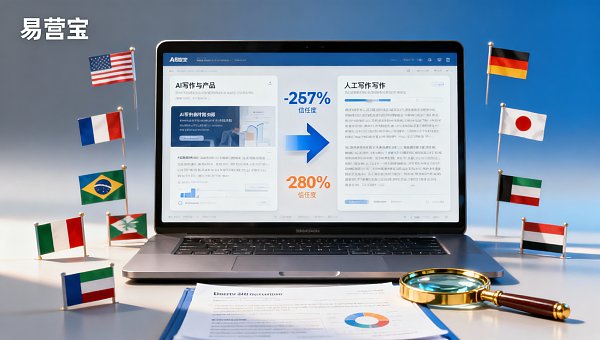
In Q2 2024, EasyStore partnered with a third-party market research agency to conduct a blind test with 3,276 active B2B procurement decision-makers from the US, Germany, Brazil, Japan, and the UAE. Under the premise of not disclosing the content source, participants were shown three versions of the same industrial filter product page: purely manually written, AI draft + manual polishing, and fully AI-generated. Results showed that 39.2% of overseas buyers were "willing to use fully AI pages as procurement references," while manually polished pages achieved 86.7% trust, and original manual pages reached 91.4%. Notably, in Portuguese independent website construction cases delivered by Hangzhou service providers, when AI content embedded localized industry terminology (e.g., "NBR 15608 certification," "ANVISA compliance statement") and matched local reading rhythms, trust surged to 78.3%. This confirms a core conclusion: whether AI writing can replace manual work depends not on the technology itself, but on achieving "semantic credibility"—ensuring algorithmic outputs align with target markets' cognitive habits, professional contexts, and emotional resonance.
Further analysis reveals higher trust thresholds in LinkedIn marketing automation scenarios. In tests targeting European IT procurement managers, AI-generated solution pages lacking specific deployment cycles, SLA commitments, or client logo walls saw click-through rates drop by 42%, with inquiry conversion rates at just 1/5 of manual pages. This shows end consumers don’t reject AI but refuse "generic expressions without context." EasyStore’s smart building system addresses this via a triple-engine approach (AI keyword expansion + automated TDK generation + AI visuals), embedding trust anchors like structured regional parameters (Schema Markup), auto-tagged content timestamps, and visual trust symbols such as Brazil’s INMETRO certification icons for Portuguese sites.
How can Shenzhen responsive foreign trade website providers use AI to break the "speed-experience-SEO" paradox?
How to optimize website speed post-construction? This is a key pain point for hardware exporters in Shenzhen. Traditional solutions often fall into vicious cycles: "compressing images → sacrificing quality," "reducing JS → functionality loss," or "disabling animations → experience degradation." EasyStore’s AI-driven performance prediction model completes three critical actions during construction: First, intelligently allocates static resource loading paths based on real-time global CDN latency data. Second, applies multimodal AI recognition to product images—automatically cropping backgrounds, generating WebP+AVIF dual formats, and dynamically pushing optimal versions per device bandwidth. Third, embeds SEO logic into HTML skeletons—e.g., for a laser cutting machine site, AI auto-generates semantic H2 tags like "fiber laser cutter 1000W Germany CE certified" and injects JSON-LD structured data. Real tests show the site achieved perfect Google Core Web Vitals scores: LCP improved from 3.8s to 1.2s, SEO scores rose 35%, proving AI optimization’s essence isn’t keyword stuffing but aligning technical architectures with search engines’ semantic logic.
Which industries suit AI batch content generation? Decoding high-conversion scenarios

Which industries suit AI batch content generation? Our practice identifies three high-conversion scenarios: standardized B2B industrial products (e.g., fasteners, sensors), SaaS services with clear lifecycles (e.g., CRM, ERP), and cross-border categories tied to regional policies (e.g., medical devices, new energy batteries). Take a Zhejiang inverter manufacturer served by EasyStore: its German-facing independent site requires synchronous German/English/Spanish updates—27 technical parameter tables, 14 TÜV documents, and 8 case studies quarterly. Manual updates took 11 days per language; with AI+engineer review cycles, this compressed to 38 hours. AI’s automatic linkage of IEC 62109 standards with local subsidy policies boosted inquiry quality by 33%. This explains why AI writing’s replacement of manual work remains "conditional"—it automates repetitive labor, not strategic judgment, freeing experts for high-value tasks like common issues and solutions in final account audits for construction projects.
For e-commerce solutions, AI’s value lies in "agile response": when an Amazon bestseller suddenly faced REACH regulation updates, EasyStore’s AI engine rewrote compliance statements, regrouped keywords, and refreshed meta descriptions across all related product pages within 2 hours, simultaneously pushing updates to LinkedIn automation matrices—forming a cross-channel compliance dissemination loop. This "data-driven + human oversight" hybrid model is why EasyStore’s website service earns repeat orders from 100,000+ enterprises.
Action plan: Building your enterprise’s AI content credibility framework
In summary, AI isn’t a replacement but a credibility amplifier. We recommend a three-step framework: First, deploy AI for "breadth work"—batch-generating product descriptions, FAQ drafts, and multilingual meta tags. Second, have experts conduct "depth validation"—injecting technical parameters, certification details, and localized cases. Third, implement technical monitoring—e.g., adding "content credibility micro-surveys" on Portuguese sites to collect real-time user ratings on "document completeness" and "local regulation accuracy." EasyStore has institutionalized this framework into its smart building system, enabling responsive website providers in Shenzhen and Hangzhou to deploy rapidly.
Choosing EasyStore means partnering with a Google Premier & Meta-certified tech provider and joining an evolving AI marketing ecosystem. Contact us now for customized credibility diagnostics and website solutions.
- Website Development
- Foreign Trade Website Development
- Foreign Trade Website Development
- AI Writing
- Inquiry quality
- AI Batch Article Generation
- LinkedIn Marketing
- Standalone website development
- Yiyingbao
- SEO
- Independent Website
- Smart website builder system
- Smart Website Building
- AI Translation
- EasySite Intelligent Website Builder
- AI Website Building
- Marketing Automation
- AI Marketing
- Portuguese Standalone Website Development
- Responsive B2B Export Website Development
Related Articles
 EU New Rules on AI Content Labeling Take Effect in October, Tightening B2B Marketing Compliance Requirements
 What should you prepare for the rapid launch of an AI website building system?Content、domain name and template configuration checklist
 How Can Website Building Tools Reduce Advertising Costs?Optimization Ideas from Landing Page Speed to Conversion Tracking


Related Products
 EasyCamp SaaS Smart Website Marketing SystemE-Yingbao SaaS Smart Website Marketing System: AI-powered, zero-code website building. Rapidly launch multilingual independent e-commerce sites in just 10 minutes. Global server acceleration and AI-driven SEO optimization empower businesses to efficiently connect with global markets. The seamless integration of technology and user-friendly operation makes building e-commerce sites incredibly simple.
 AI+SEM Intelligent Advertising Marketing SystemAI+SEM drives intelligent ad creation, empowering full-funnel precision advertising marketing. The system automatically generates weekly/monthly reports, AI recommends keywords and target countries, monitors core metrics in real-time with intelligent alerts, and enables one-click high-conversion ad solutions to help quickly acquire customers and improve ROI.
 AI+SEO Dual Engine Optimization ServiceEasyWin AI+SEO Dual Engine Optimization System leverages AI-powered keyword mining, content generation, and comprehensive technical optimization to help foreign trade enterprises acquire high-quality organic traffic, significantly improving search rankings and conversion rates.
 AI+SNS Social Media Marketing SystemYingbao AI+SNS Social Media Marketing System - Precision social capture for the social media era. Supports one-click content synchronization across major platforms like Facebook and LinkedIn. AI intelligently rewrites posts for enhanced relevance. 24/7 AI customer service and user profiling analysis empower businesses to efficiently expand into global markets.
 AI+SEO营销解决方案易营宝AI+SEO营销解决方案,通过AI批量写作、智能生成TDK、精准关键词扩词等功能,全面优化网站SEO效果,提升流量与转化率。助力企业构建高效智能网站新生态。
 AI+SEM Advertising Marketing SolutionsAI+SEM Advertising Marketing Solution leverages AI technology to deeply empower SEM ad campaigns. It automatically generates weekly/monthly reports using AI, presenting account data across multiple dimensions for comprehensive insights into campaign performance and trends. The system precisely recommends keywords and target countries, intelligently generates high-conversion ad copy, and enables one-click activation of efficient campaign plans to help businesses rapidly acquire customers. Simultaneously, it monitors core metrics in real time, intelligently identifies abnormal fluctuations, and issues timely alerts to ensure stable, high-return advertising results.
 Domain Name ServicesEasyWin provides professional domain name services, including intelligent queries, one-stop registration, brand protection, and full lifecycle management, helping businesses build a digital brand image.
 EasyOperate B2C Cross-Border E-Commerce Platform & Independent WebsiteEasyStore B2C Cross-border E-commerce Independent Store is an intelligent website building and cross-border e-commerce integrated solution independently developed by EasyStore Information Technology (Beijing) Co., Ltd. The system is specially designed for small and medium-sized as well as large export enterprises, integrating 'website building, operation, marketing, advertising, and conversion' into one, helping enterprises quickly establish cross-border e-commerce independent stores to achieve brand globalization and global sales growth.
The platform supports multiple languages, multiple currencies, and multi-channel marketing, with built-in AI intelligent translation and SEO optimization systems, suitable for mainstream markets such as Southeast Asia, Europe and America, Latin America, and the Middle East, assisting Chinese manufacturing enterprises in efficiently deploying international e-commerce strategies. SSL证书易营宝提供专业SSL安全证书服务,包括单域名和泛域名证书,确保网站数据传输加密、身份验证和完整性保护,助力企业建立安全可信的在线业务环境。









