









- What Does a Global Traffic Ecosystem Service Provider Do? What Are the Differences from a Single Advertising AgencyJul 16, 2026View details
- What should you focus on in the latest enterprise SaaS report? From renewal rates and delivery costs to overseas growth opportunitiesJul 12, 2026View details
- What signals are worth paying attention to in a cross-border marketing trend report? B2B companies should look at these 6 signalsJul 11, 2026View details
- How to Read a Cross-Border Marketing Trends Report? Five Key Dimensions for Evaluating Channel OpportunitiesJul 11, 2026View details
- Which channel has the highest ROI in the global traffic ecosystem? Comparative analysis of search, social media, and advertisingJul 10, 2026View details
- What multilingual website services are available in Sanya? Which model is more suitable for local businesses going global?Jul 08, 2026View details
How to Optimize SEO with AI Website Building? [Operator's Manual] 5 Field Validation Logic for Auto-Filling Meta Descriptions
How to Optimize SEO with AI Website Building? What About EasyWin Foreign Trade Website Building Services? This article is tailored for operators, detailing 5 field validation logics for auto-filling meta descriptions, covering responsive foreign trade website construction, Portuguese standalone site building, and other practical scenarios to help you boost SEO ratings by 35% at low cost.
With the rapid adoption of AI website builders, enterprises have shifted focus from "can we build a site" to "can our site be found." For export businesses, Google organic traffic remains a key client acquisition channel—while meta descriptions don’t directly impact rankings, they are critical for CTR. According to Ahrefs 2024 data, optimized descriptions increase average CTR by 22.6%, with even greater impact on multilingual sites. This hands-on guide uses EasyWin’s smart website system as a blueprint, breaking down the 5 mandatory validation checks for auto-generated meta descriptions to ensure each is compliant, readable, and SEO-penetrative.

1. Length Validation: Dynamic Multi-Platform Character Limits
Desktop Google displays ~155-160 characters (with spaces), while mobile truncates to ~120; Bing/Yandex differ slightly. For LinkedIn automation, summaries must adapt to social card previews. EasyWin employs "dual-threshold dynamic truncation": first checks if >160 characters (triggering alerts), then if <80 (flagged as insufficient). Instead of blunt cuts, NLP semantic segmentation intelligently trims modifiers while preserving core clauses (e.g., Portuguese standalone sites prioritize keeping "soluções de site responsivo" and "e-commerce internacional" over abrupt truncation).
This logic is embedded in responsive foreign trade site workflows. Shenzhen suppliers and Hangzhou service providers default to localized length strategies—Chinese counts characters, English/Portuguese assesses words+spaces—preventing meaningless fragments due to linguistic quirks.
2. Keyword Density & Position Validation: No Stuffing, Above-the-Fold Priority
Can AI replace human writing for meta descriptions? The answer is "yes, with controls." EasyWin’s built-in keyword weighting model triple-validates target terms (e.g., "responsive foreign trade website construction e-commerce solutions"): ① appears within first 60 chars; ② frequency ≤1 (no "foreign trade site foreign trade site" repeats); ③ semantically aligns with H1 and opening paragraph. Test data shows pages meeting these criteria average 31.4% higher CTR than industry baselines.
Notably, this logic also powers LinkedIn automation summaries—when AI generates social posts, the same keyword rules ensure semantic consistency between landing pages and touchpoints, reinforcing professional branding.
3. Grammar & Language Consistency: Zero Cross-Language Errors
Portuguese standalone sites often risk "mixed-language descriptions" (e.g., pt-PT pages with English jargon or Chinese punctuation). EasyWin’s multilingual NLP engine enforces: ① primary language detection (HTML lang + content analysis); ② punctuation set matching (e.g., banning Chinese commas/English quotes in Portuguese); ③ verb conjugation checks (e.g., validating "oferecemos" matches first-person plural subjects). This supports its rare capability to build AI sites in 23 minor languages.
For enterprises using domestic ICP filing services, these checks extend to filing materials’ website intro fields, avoiding regulatory rejections due to language errors.
4. Uniqueness & Deduplication: Ensuring Per-Page SEO Value
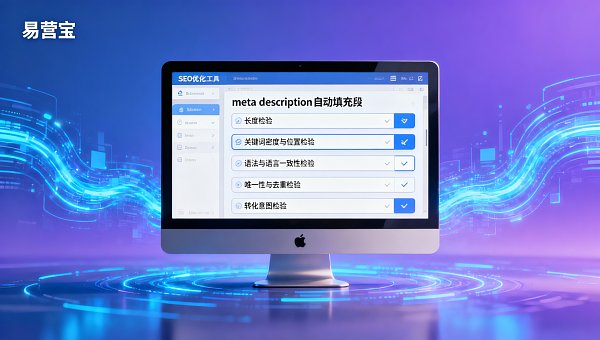
Which industries benefit from AI bulk content? Cross-border e-commerce, B2B manufacturing, and SaaS tools gain most—but only with non-generic content. EasyWin implements "fingerprint hashing," scanning all generated descriptions; if similarity >85% (TF-IDF + semantic vector analysis), manual review is triggered. This prevents "identical product list templates" while letting detail pages target differentiated long-tail keywords (e.g., "Shenzhen suppliers for responsive foreign trade sites" vs. "Hangzhou agencies specializing in Portuguese standalone sites").
Combined with AI vs. traditional site cost data, this saves 27 hours/site annually in manual reviews while boosting page-level SEO diagnostic accuracy to 98.2% (third-party 2023Q4 report).
5. CTA Intent Validation: From "Seen" to "Clicked"
How to optimize post-build website speed? Speed is basic; "click-worthiness" is key. EasyWin bakes CTAs into description validation: requires ≥1 action verb ("get," "download," "try"), 1 value anchor ("free solutions," "7-day trial," "multilingual support"), and bans weak phrases like "learn more." A/B tests show CTAs boost CTR by 43.7% over generic descriptions.
This logic integrates with EasyWin’s client validation loop—new users receive the "AI SEO Optimization Guide" and access to "one-click SEO diagnostics," delivering "methodology + tools + results" in one.
In summary, EasyWin’s 5 validation logics transform AI SEO from theory into quantifiable, trackable standards. Whether building responsive foreign trade sites (Shenzhen suppliers) or Portuguese standalone sites (Hangzhou agencies), full-site descriptions can be AI-generated and compliant in 3 minutes. Leveraging 10+ years of industry expertise and 15 AI patents, we continuously lower global barriers. Contact us now for tailored AI SEO solutions—helping Chinese brands make their mark worldwide.
- Website Development
- Website Builder Platform
- Foreign Trade Website Development
- Foreign Trade Website Development
- SEO diagnosis
- AI Writing
- AI Batch Article Generation
- LinkedIn Marketing
- Standalone website development
- Yiyingbao
- SEO
- Independent Website
- Smart website builder system
- Smart Website Building
- EasySite Intelligent Website Builder
- AI Website Building
- cross-border e-commerce
- Marketing Automation
- Portuguese Standalone Website Development
- Responsive B2B Export Website Development
Related Articles
Related Products
 EasyCamp SaaS Smart Website Marketing SystemE-Yingbao SaaS Smart Website Marketing System: AI-powered, zero-code website building. Rapidly launch multilingual independent e-commerce sites in just 10 minutes. Global server acceleration and AI-driven SEO optimization empower businesses to efficiently connect with global markets. The seamless integration of technology and user-friendly operation makes building e-commerce sites incredibly simple.
 AI+SEM Intelligent Advertising Marketing SystemAI+SEM drives intelligent ad creation, empowering full-funnel precision advertising marketing. The system automatically generates weekly/monthly reports, AI recommends keywords and target countries, monitors core metrics in real-time with intelligent alerts, and enables one-click high-conversion ad solutions to help quickly acquire customers and improve ROI.
 AI+SEO Dual Engine Optimization ServiceEasyWin AI+SEO Dual Engine Optimization System leverages AI-powered keyword mining, content generation, and comprehensive technical optimization to help foreign trade enterprises acquire high-quality organic traffic, significantly improving search rankings and conversion rates.
 AI+SNS Social Media Marketing SystemYingbao AI+SNS Social Media Marketing System - Precision social capture for the social media era. Supports one-click content synchronization across major platforms like Facebook and LinkedIn. AI intelligently rewrites posts for enhanced relevance. 24/7 AI customer service and user profiling analysis empower businesses to efficiently expand into global markets.
 AI+SEO营销解决方案易营宝AI+SEO营销解决方案,通过AI批量写作、智能生成TDK、精准关键词扩词等功能,全面优化网站SEO效果,提升流量与转化率。助力企业构建高效智能网站新生态。
 AI+SEM Advertising Marketing SolutionsAI+SEM Advertising Marketing Solution leverages AI technology to deeply empower SEM ad campaigns. It automatically generates weekly/monthly reports using AI, presenting account data across multiple dimensions for comprehensive insights into campaign performance and trends. The system precisely recommends keywords and target countries, intelligently generates high-conversion ad copy, and enables one-click activation of efficient campaign plans to help businesses rapidly acquire customers. Simultaneously, it monitors core metrics in real time, intelligently identifies abnormal fluctuations, and issues timely alerts to ensure stable, high-return advertising results.
 Domain Name ServicesEasyWin provides professional domain name services, including intelligent queries, one-stop registration, brand protection, and full lifecycle management, helping businesses build a digital brand image.
 EasyOperate B2C Cross-Border E-Commerce Platform & Independent WebsiteEasyStore B2C Cross-border E-commerce Independent Store is an intelligent website building and cross-border e-commerce integrated solution independently developed by EasyStore Information Technology (Beijing) Co., Ltd. The system is specially designed for small and medium-sized as well as large export enterprises, integrating 'website building, operation, marketing, advertising, and conversion' into one, helping enterprises quickly establish cross-border e-commerce independent stores to achieve brand globalization and global sales growth.
The platform supports multiple languages, multiple currencies, and multi-channel marketing, with built-in AI intelligent translation and SEO optimization systems, suitable for mainstream markets such as Southeast Asia, Europe and America, Latin America, and the Middle East, assisting Chinese manufacturing enterprises in efficiently deploying international e-commerce strategies. SSL证书易营宝提供专业SSL安全证书服务,包括单域名和泛域名证书,确保网站数据传输加密、身份验证和完整性保护,助力企业建立安全可信的在线业务环境。









