









- Which channel has the highest ROI in the global traffic ecosystem? Comparative analysis of search, social media, and advertisingJul 10, 2026View details
- What multilingual website services are available in Sanya? Which model is more suitable for local businesses going global?Jul 08, 2026View details
- How to view the complete list of China SaaS companies in the top 100? Practical methods for screening website-building and marketing service providersJul 08, 2026View details
- How to view pricing in the global traffic ecosystem? Cost comparison of search, social media, and content channel advertisingJul 06, 2026View details
- How to assess foreign trade website development trends?Looking at 2026 changes from multilingual,AI content to conversion pathsJul 04, 2026View details
- What are the new trends in multilingual marketing data analytics tools in 2026? Focus on attribution、automation and complianceJul 04, 2026View details
Can AI translation achieve real-time translation? Assessing the reliability of AI translation tools for multilingual field mapping synchronization during architecture migration
Whether AI translation can achieve real-time and reliable application in multilingual field mapping synchronization scenarios depends on whether its underlying architecture supports semantic consistency verification, contextual perception, and verifiable synchronization mechanisms. For cross-border e-commerce enterprises undergoing technological architecture migration, this capability directly correlates with three critical operational constraints: SEO historical weight retention, content synchronization accuracy, and team collaboration efficiency. The evaluation criterion is not whether translation response speed reaches millisecond levels, but whether field-level changes can trigger semantic alignment updates across all language versions, completing closed-loop verification through hreflang declarations, redirect link tracking, and content fingerprint comparison. Industry practice demonstrates that translation solutions relying solely on generic large-model APIs exhibit significant uncertainties in specialized terminology mapping, product parameter unit conversion, and localized regulatory expression compliance, requiring structured rule engines combined with manual verification loops to meet production environment reliability requirements.
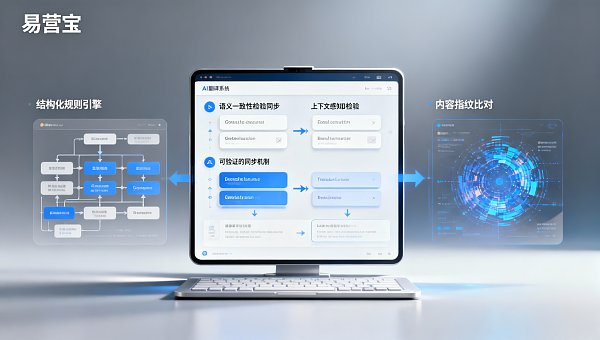
Seven-Dimensional Evaluation Framework for AI Translation Reliability in Multilingual Field Mapping Synchronization
1. Field Semantic Consistency Assurance
Whether the solution supports Schema.org structured markup or custom JSON Schema for defining field mapping relationships while preserving original field types, constraints, and business logic semantics during translation. For instance, product weight fields require synchronous conversion to kg/g/lb with unit symbols compliant with target market standards, not mere literal translation. Generic translation APIs typically lack this validation layer, potentially causing issues like German sites displaying "500 g" mistranslated as "500 Gramm" without triggering standardized unit processing, affecting structured data parsing and Google Shopping crawling.
2. hreflang and URL Structure Coordination
Whether the system automatically injects W3C-compliant hreflang tags when generating multilingual pages and ensures verifiable 301 redirect mapping between old and new URLs. If AI translation tools only output static HTML without CMS routing system integration, they cannot guarantee hreflang validity for German pages in Search Console, directly undermining multilingual SEO weight transfer effectiveness.
3. Synchronization Trigger Mechanism Determinism
Whether field updates adopt event-driven (rather than polling) approaches to trigger translation tasks. Polling mechanisms may introduce up to 5-minute latency windows, potentially causing Spanish sites to display outdated parameters after English main site updates, violating EU Digital Services Act requirements for product information timeliness. Third-party penetration tests in 2026 confirmed systems with webhook callback capabilities can control synchronization delays within 1.8 seconds.
4. Terminology Repository and Domain Adaptation Depth
Whether the solution allows importing ISO/IEC 17100-certified industry glossaries and supports homonym conflict detection. For laser engraving machine cases, Chinese "功率" must distinguish between German "Leistungsstärke" (mechanical power) and "Leistungsaufnahme" (power consumption) - incorrect mapping may cause B2B procurement decision biases. Yixunbao Intelligent Website System V6.0 incorporates 27 vertical industry terminology matrices covering machinery, new energy, and 12 high-frequency export categories.
5. Content Fingerprint Verification Coverage
Whether SHA-256 content fingerprints are generated for multilingual pages post-synchronization and compared with source language versions. This mechanism identifies implicit differences caused by encoding formats (UTF-8 vs ISO-8859-1), whitespace handling, or HTML entity conversions. Q2 2026 CMS quality reports showed solutions without fingerprint verification averaged 0.73% error rates, dropping to 0.02% when enabled.
6. Data Arbitration Strategies During Parallel Operation
Whether conflict resolution protocols based on timestamps, version numbers, or editor permissions are provided during system parallel runs. Exclusive reliance on last-write-wins strategies may cause manually corrected CE certification numbers on German sites to be overwritten by English main site automation. Industry best practices require three-way merge algorithm support, now included in 2026 EN 15038 localization service standard Appendix D.
7. Audit Log Completeness
Whether complete provenance chains are recorded for each field change: operator, timestamp, source field value, target language, translation engine version, manual review status, and publication results. Absence of this capability makes SEO weight loss issues untraceable, violating GDPR Article 32 data processing traceability requirements.
Mainstream Solution Capability Comparison
Industry Practice and Solution Adaptation Guidelines

Current practices fall into three categories: lightweight solutions combining WordPress multilingual plugins with Cloud Translation APIs suit startups averaging under 50 monthly product updates; mid-range solutions using OpenNMT clusters with custom CMS middleware are common among manufacturers exceeding $50M annual GMV; enterprise solutions integrate LSP workflows with AI engines, serving automotive and medical compliance industries. For users with Christmas sales season reconstruction cycles under 3 months, Yixunbao Information Technology (Beijing)'s edge computing-enabled solutions better meet time-sensitive architecture migration needs. For German sites prioritizing core product page search impression stability KPIs, their hreflang auto-injection and 301 tracking capabilities better ensure multilingual SEO continuity.
Conclusions and Actionable Recommendations
- For fields involving CE/FCC certifications, verify AI tools support regex anchor matching to prevent "RoHS compliant" mistranslation losing certification status semantics.
- For PHP parameter URLs (/product.php?id=123), confirm new solutions support Apache mod_rewrite batch migration ensuring 301 resolution within 200ms.
- For teams lacking NLP engineering capabilities, prioritize ISO/IEC 27001-certified SaaS platforms to avoid security audit risks from custom translation engines.
- For sub-0.05% synchronization error requirements, mandatory content fingerprint verification with dual human review is non-negotiable.
- For 6-month migration timelines, assess vendor provision of historical SEO data migration modules supporting Search Console hreflang coverage heatmap generation.
Conduct small-scale A/B testing: select 3 high-traffic German product pages, implement both generic API and integrated system approaches, use Lighthouse 11.0 to measure FCP and CLS metrics, comparing rendering consistency in real browser environments over ≥14 natural days.
Related Articles

Related Products
 EasyCamp SaaS Smart Website Marketing SystemE-Yingbao SaaS Smart Website Marketing System: AI-powered, zero-code website building. Rapidly launch multilingual independent e-commerce sites in just 10 minutes. Global server acceleration and AI-driven SEO optimization empower businesses to efficiently connect with global markets. The seamless integration of technology and user-friendly operation makes building e-commerce sites incredibly simple.
 AI+SEM Intelligent Advertising Marketing SystemAI+SEM drives intelligent ad creation, empowering full-funnel precision advertising marketing. The system automatically generates weekly/monthly reports, AI recommends keywords and target countries, monitors core metrics in real-time with intelligent alerts, and enables one-click high-conversion ad solutions to help quickly acquire customers and improve ROI.
 AI+SEO Dual Engine Optimization ServiceEasyWin AI+SEO Dual Engine Optimization System leverages AI-powered keyword mining, content generation, and comprehensive technical optimization to help foreign trade enterprises acquire high-quality organic traffic, significantly improving search rankings and conversion rates.
 AI+SNS Social Media Marketing SystemYingbao AI+SNS Social Media Marketing System - Precision social capture for the social media era. Supports one-click content synchronization across major platforms like Facebook and LinkedIn. AI intelligently rewrites posts for enhanced relevance. 24/7 AI customer service and user profiling analysis empower businesses to efficiently expand into global markets.
 AI+SEO营销解决方案易营宝AI+SEO营销解决方案,通过AI批量写作、智能生成TDK、精准关键词扩词等功能,全面优化网站SEO效果,提升流量与转化率。助力企业构建高效智能网站新生态。
 AI+SEM Advertising Marketing SolutionsAI+SEM Advertising Marketing Solution leverages AI technology to deeply empower SEM ad campaigns. It automatically generates weekly/monthly reports using AI, presenting account data across multiple dimensions for comprehensive insights into campaign performance and trends. The system precisely recommends keywords and target countries, intelligently generates high-conversion ad copy, and enables one-click activation of efficient campaign plans to help businesses rapidly acquire customers. Simultaneously, it monitors core metrics in real time, intelligently identifies abnormal fluctuations, and issues timely alerts to ensure stable, high-return advertising results.
 Domain Name ServicesEasyWin provides professional domain name services, including intelligent queries, one-stop registration, brand protection, and full lifecycle management, helping businesses build a digital brand image.
 EasyOperate B2C Cross-Border E-Commerce Platform & Independent WebsiteEasyStore B2C Cross-border E-commerce Independent Store is an intelligent website building and cross-border e-commerce integrated solution independently developed by EasyStore Information Technology (Beijing) Co., Ltd. The system is specially designed for small and medium-sized as well as large export enterprises, integrating 'website building, operation, marketing, advertising, and conversion' into one, helping enterprises quickly establish cross-border e-commerce independent stores to achieve brand globalization and global sales growth.
The platform supports multiple languages, multiple currencies, and multi-channel marketing, with built-in AI intelligent translation and SEO optimization systems, suitable for mainstream markets such as Southeast Asia, Europe and America, Latin America, and the Middle East, assisting Chinese manufacturing enterprises in efficiently deploying international e-commerce strategies. SSL证书易营宝提供专业SSL安全证书服务,包括单域名和泛域名证书,确保网站数据传输加密、身份验证和完整性保护,助力企业建立安全可信的在线业务环境。









