









- How to view pricing in the global traffic ecosystem? Cost comparison of search, social media, and content channel advertisingJul 06, 2026View details
- How to assess foreign trade website development trends?Looking at 2026 changes from multilingual,AI content to conversion pathsJul 04, 2026View details
- What are the new trends in multilingual marketing data analytics tools in 2026? Focus on attribution、automation and complianceJul 04, 2026View details
- Is Brand Globalization Marketing Consulting Worth Buying? At What Stage Should Companies Bring It InJul 01, 2026View details
- Cross-Border Marketing Trend Research: Why More and More Companies Are Starting to Deploy AI Search and GEO OptimizationJun 30, 2026View details
- Cross-Border Marketing Trend Research: How Independent Sites, AI Content, and Short-Video Customer Acquisition Are ChangingJun 30, 2026View details
- How Can a Brand Updates Page Be Made More SEO-Friendly? Analysis of Update Frequency, Content Structure, and Internal Linking StrategyJun 28, 2026View details
- What stages does the cross-border services ecosystem include? How do website building, promotion, payment, and compliance work togetherJun 22, 2026View details
China-U.S. bilateral tariff cuts on agricultural products drive multilingual compliance upgrades for B2B official websites
On May 14, 2026, China-U.S. economic and trade consultations achieved phased progress, with both sides agreeing in principle to implement reciprocal tariff reductions on agricultural products and simultaneously strengthen coordination on non-tariff measures. This arrangement, for the first time, explicitly incorporates multilingual compliance content development for export companies' official websites into policy implementation requirements, directly triggering the need for content architecture restructuring and certification system integration in B2B sectors such as agricultural equipment, food packaging, and cold chain services.
Event Overview
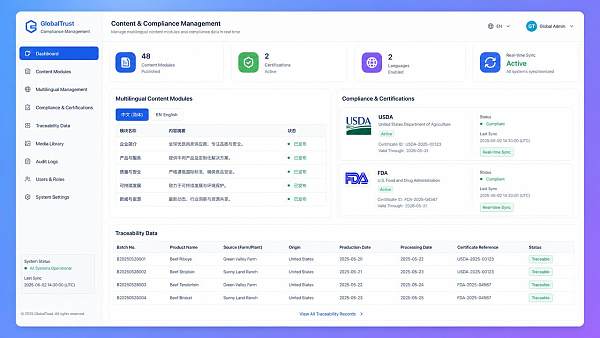
On May 14, the Ministry of Commerce reported the preliminary outcomes of China-U.S. economic and trade consultations: both sides agreed in principle to mutually reduce tariffs on products of equivalent concern and promote the resolution of non-tariff barriers affecting agricultural products. Among the clearly stated requirements is that the official websites of agricultural product exporters must simultaneously display production qualifications, traceability information, and multilingual compliance statement modules that meet the requirements of the U.S. Department of Agriculture (USDA) and the U.S. Food and Drug Administration (FDA).
Which Sub-Sectors Will Be Affected
Direct Trading Enterprises
As the primary entities subject to the policy, agricultural trading companies that export directly to the United States need to embed on their official websites public disclosure of USDA/FDA dual-standard qualifications, real-time updated registration numbers, English HACCP/FSMA compliance statements, and more. The impact is reflected in higher content operations costs, longer legal review cycles, and increased frequency of third-party certification API calls—this is not merely about translating web pages, but about building a verifiable and auditable chain of compliance information.
Raw Material Procurement Enterprises
To meet downstream exporters' mandatory disclosure requirements for upstream traceability, planting bases, cooperatives, and primary processors need to provide trading companies with structured traceability data (such as plot codes, harvest times, and pesticide residue testing reports), and support integration into supply chain transparency modules on B2B official websites in bilingual Chinese-English format. The impact is reflected in insufficient standardization of data collection and the lack of multilingual metadata fields in existing ERP systems.
Processing and Manufacturing Enterprises
Manufacturers such as food packaging, agricultural machinery, and intelligent sorting equipment may not directly export agricultural products, but their products have been included in the U.S. extended review scope for “full-chain compliance of exported agricultural products”. For example, packaging materials must provide English compliance statements for FDA 21 CFR Part 170–189; cold chain temperature control equipment must indicate USDA-recognized calibration certificate numbers and validity periods. The impact is reflected in deeper localization requirements for technical documentation and the absence of mechanisms linking compliance statements with hardware serial numbers.
Supply Chain Service Enterprises
Third-party inspection agencies, cross-border logistics service providers, and digital traceability platform operators face new demands: they need to open API interfaces for B2B official websites to retrieve in real time certification status (such as FDA Facility Registration validity), full transportation temperature and humidity records (in compliance with FDA FSMA Rule 204), and USDA Organic certification batch matching results. The impact is reflected in the fact that existing SaaS systems do not have preset multilingual compliance metadata models, and interface responses must satisfy dual compliance requirements under the GDPR and the Measures for the Standard Contract for the Cross-border Transfer of Personal Information.
Key Focus Areas and Response Measures for Relevant Enterprises or Practitioners
Immediately Launch a Website Content Compliance Audit
Against the USDA Export Certificate template and FDA Food Facility Registration guidance, verify whether the current official website's qualification disclosure pages have issues such as outdated information, missing languages, or broken links; focus in particular on whether English statements use official FDA terminology (for example, “low-acid canned food” must not be simplified as “canned product”).
Establish a Dynamic Certification Interface Management Mechanism
Avoid static methods such as manually uploading scanned PDF files, and give priority to connecting with the State Administration for Market Regulation's “Export Food Production Enterprise Filing Management System” and the FDA Electronic Submission Gateway (ESG) test environment, so that the official website can automatically synchronize updates within 72 hours after any registration status change.
Differentiate Between Basic Translation and Compliance Localization
The Chinese statement “complies with GB 2763 pesticide residue limit standards” cannot be directly translated as “meets GB 2763 pesticide residue limits”, but must instead be converted according to FDA import alert logic into “residue levels are below FDA’s applicable action levels for imported commodities”, because only the latter constitutes effective compliance communication.
Reserve Version Control Space for Multilingual Legal Statements
It is recommended to adopt a combined solution of semantic HTML tags (such as lang="en", hreflang attributes) + structured data (Schema.org WebPage with inLanguage) to ensure that search engines and regulatory review tools can accurately identify the legal effectiveness boundaries of each language version.
Editorial Viewpoint / Industry Observation
Observably, this policy does not merely accelerate multilingual website deployment—it redefines the B2B digital interface as a regulatory touchpoint. Unlike past export facilitation measures focused on customs clearance or tax rebates, the explicit linkage of website content to USDA/FDA enforcement criteria signals a shift toward “digital due diligence” as a core compliance obligation. Analysis shows that firms treating translation as a post-certification step will face higher remediation costs than those embedding language-agnostic compliance logic at the CMS architecture level. From an industry perspective, the requirement is better understood as a catalyst for interoperable data infrastructure—not just bilingual copywriting.
Conclusion
This round of reciprocal tariff reduction arrangements for agricultural products between China and the United States appears on the surface to be a tariff adjustment, but in essence it is a stress test of the digital governance capabilities of China's agricultural industry chain. Official websites are no longer merely brand showcases, but have become legally recognized information nodes that are accessible, verifiable, and traceable for cross-border regulation. What is even more worthy of attention at present is this: as compliance content shifts from “static display” to “dynamic interaction”, the logic of technology procurement, the model of legal collaboration, and the boundaries of IT operations and maintenance for B2B enterprises will all undergo a systemic transformation.
Information Source Notes
- Official website of the Ministry of Commerce of the People's Republic of China, “Briefing on the Preliminary Outcomes of China-U.S. Economic and Trade Consultations”, published on May 14, 2026
- U.S. Department of Agriculture (USDA) Foreign Agricultural Service notice, “2026 Update on Import Requirements for Agricultural Commodities” (not yet formally effective, currently a draft for public comment)
- FDA official website, “Food Facility Registration Guidance for Foreign Entities” (Version 4.2, updated in April 2026)
Note: Supporting documents such as the detailed rules for mutual recognition of USDA organic certification and the implementation timeline for mandatory FDA electronic declarations have not yet been published, and continued tracking of subsequent joint technical notices from the competent authorities of both countries is required.
Related Articles



Related Products
 EasyCamp SaaS Smart Website Marketing SystemE-Yingbao SaaS Smart Website Marketing System: AI-powered, zero-code website building. Rapidly launch multilingual independent e-commerce sites in just 10 minutes. Global server acceleration and AI-driven SEO optimization empower businesses to efficiently connect with global markets. The seamless integration of technology and user-friendly operation makes building e-commerce sites incredibly simple.
 AI+SEM Intelligent Advertising Marketing SystemAI+SEM drives intelligent ad creation, empowering full-funnel precision advertising marketing. The system automatically generates weekly/monthly reports, AI recommends keywords and target countries, monitors core metrics in real-time with intelligent alerts, and enables one-click high-conversion ad solutions to help quickly acquire customers and improve ROI.
 AI+SEO Dual Engine Optimization ServiceEasyWin AI+SEO Dual Engine Optimization System leverages AI-powered keyword mining, content generation, and comprehensive technical optimization to help foreign trade enterprises acquire high-quality organic traffic, significantly improving search rankings and conversion rates.
 AI+SNS Social Media Marketing SystemYingbao AI+SNS Social Media Marketing System - Precision social capture for the social media era. Supports one-click content synchronization across major platforms like Facebook and LinkedIn. AI intelligently rewrites posts for enhanced relevance. 24/7 AI customer service and user profiling analysis empower businesses to efficiently expand into global markets.
 AI+SEO营销解决方案易营宝AI+SEO营销解决方案,通过AI批量写作、智能生成TDK、精准关键词扩词等功能,全面优化网站SEO效果,提升流量与转化率。助力企业构建高效智能网站新生态。
 AI+SEM Advertising Marketing SolutionsAI+SEM Advertising Marketing Solution leverages AI technology to deeply empower SEM ad campaigns. It automatically generates weekly/monthly reports using AI, presenting account data across multiple dimensions for comprehensive insights into campaign performance and trends. The system precisely recommends keywords and target countries, intelligently generates high-conversion ad copy, and enables one-click activation of efficient campaign plans to help businesses rapidly acquire customers. Simultaneously, it monitors core metrics in real time, intelligently identifies abnormal fluctuations, and issues timely alerts to ensure stable, high-return advertising results.
 Domain Name ServicesEasyWin provides professional domain name services, including intelligent queries, one-stop registration, brand protection, and full lifecycle management, helping businesses build a digital brand image.
 EasyOperate B2C Cross-Border E-Commerce Platform & Independent WebsiteEasyStore B2C Cross-border E-commerce Independent Store is an intelligent website building and cross-border e-commerce integrated solution independently developed by EasyStore Information Technology (Beijing) Co., Ltd. The system is specially designed for small and medium-sized as well as large export enterprises, integrating 'website building, operation, marketing, advertising, and conversion' into one, helping enterprises quickly establish cross-border e-commerce independent stores to achieve brand globalization and global sales growth.
The platform supports multiple languages, multiple currencies, and multi-channel marketing, with built-in AI intelligent translation and SEO optimization systems, suitable for mainstream markets such as Southeast Asia, Europe and America, Latin America, and the Middle East, assisting Chinese manufacturing enterprises in efficiently deploying international e-commerce strategies. SSL证书易营宝提供专业SSL安全证书服务,包括单域名和泛域名证书,确保网站数据传输加密、身份验证和完整性保护,助力企业建立安全可信的在线业务环境。









