









- How to view pricing in the global traffic ecosystem? Cost comparison of search, social media, and content channel advertisingJul 06, 2026View details
- How to assess foreign trade website development trends?Looking at 2026 changes from multilingual,AI content to conversion pathsJul 04, 2026View details
- What are the new trends in multilingual marketing data analytics tools in 2026? Focus on attribution、automation and complianceJul 04, 2026View details
- Is Brand Globalization Marketing Consulting Worth Buying? At What Stage Should Companies Bring It InJul 01, 2026View details
- Cross-Border Marketing Trend Research: Why More and More Companies Are Starting to Deploy AI Search and GEO OptimizationJun 30, 2026View details
- Cross-Border Marketing Trend Research: How Independent Sites, AI Content, and Short-Video Customer Acquisition Are ChangingJun 30, 2026View details
- How Can a Brand Updates Page Be Made More SEO-Friendly? Analysis of Update Frequency, Content Structure, and Internal Linking StrategyJun 28, 2026View details
- What stages does the cross-border services ecosystem include? How do website building, promotion, payment, and compliance work togetherJun 22, 2026View details
How much difference does it make to implement a brand visibility enhancement strategy early vs. late
The earlier a brand visibility enhancement strategy is implemented, the easier it is for a company to capture users’ mindshare and search opportunities; the later it is implemented, the more likely the company is to fall into a passive situation of high traffic costs and weak conversion. This article will analyze the gap between the two and provide practical growth ideas.
Why a brand visibility enhancement strategy cannot wait until traffic becomes expensive
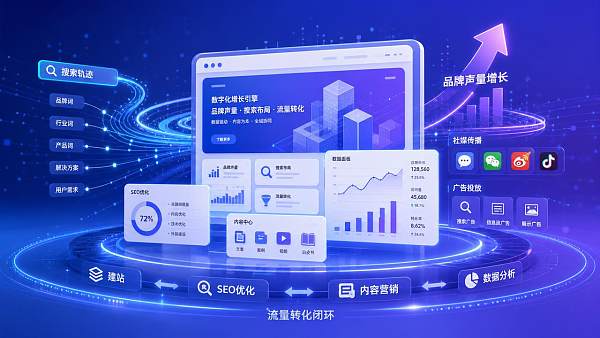
In the integrated website + marketing services industry, many companies interpret growth as “run ads first, build the brand later.” In the short term, this may seem to generate leads, but in the long term it often leads to insufficient search volume, weak organic traffic, and continuously rising customer acquisition costs. Once a brand visibility enhancement strategy starts too late, the cost of catching up is often higher than the cost of early planning.
For information researchers, what truly matters is not just whether there is exposure, but whether that exposure can accumulate into searches, visits, inquiries, and deals. When users are sourcing website development, SEO optimization, social media marketing, and advertising services, they usually first search for brand terms, solution terms, and case-study terms, and then compare multiple providers. Whoever appears first in search results and awareness lists has a better chance of becoming the first choice.
Yiyingbao Information Technology (Beijing) Co., Ltd. has long served enterprise globalization growth scenarios and places greater emphasis on forming a closed loop through intelligent website building, content planning, SEO optimization, social media communication, and advertising coordination. The core of this approach is not to compete for traffic at a single point, but to build sustained brand visibility so that companies are seen before users even develop a need.
- When done early, search engines can more easily build a stable understanding of the brand, business domain, and content topics.
- When done late, companies often need to simultaneously make up for website fundamentals, content assets, channel touchpoints, and reputation endorsements, resulting in a longer cycle.
- Companies that start early can usually secure some low-cost organic traffic and branded search traffic before advertising prices rise.
When done early versus late, where exactly does the difference show up in business metrics
If a brand visibility enhancement strategy is viewed from a business perspective, the gap is not abstract, but directly reflected in traffic sources, inquiry quality, conversion cycle, and budget structure. The table below is more suitable for quickly judging the practical differences between the two paths during the information research stage.
As can be seen, a brand visibility enhancement strategy is not merely “the icing on the cake,” but the infrastructure that determines subsequent marketing efficiency. The earlier it is implemented, the easier it is to stack content assets, search assets, and brand assets; the later it is implemented, the easier it is to fall into a situation of “the more you spend, the more dependent you become on paid media.”
What first-mover advantages are easier for early-planning companies to gain
First, there is the search-entry advantage. Before users have identified a specific supplier, they will search for terms such as “solution,” “price,” “case study,” and “which one is more suitable.” If a company has already laid out content hubs, case pages, and industry pages early on, its search visibility will be significantly stronger.
Second, there is the cognitive accumulation advantage. Brand visibility is not formed through a single communication effort, but through the accumulation of multiple touchpoints such as website content, social media reach, search results, and customer reviews. Only after repeated exposure at different stages are users more likely to form the judgment that “this company is worth learning more about.”
Third, there is the data feedback advantage. By building a coordinated website and marketing system in advance, companies can identify earlier which keywords bring inquiries, which content drives dwell time, and which pages push conversion, and this data in turn optimizes subsequent budget allocation.
In the integrated website + marketing services industry, how should a brand visibility enhancement strategy be implemented
Many companies are not unwilling to do it, but simply unclear about where to start. For the integrated website + marketing services industry, a brand visibility enhancement strategy cannot rely only on content, nor only on paid media, but must advance simultaneously around four dimensions: “searchable, reachable, convertible, reusable.”
- First, build a solid website foundation. A website is not an electronic business card, but the center for search indexing, content hosting, conversion capture, and data analysis.
- Then build a keyword and content matrix. Layer the layout around industry terms, problem terms, scenario terms, and brand terms to improve coverage across different stages of search.
- At the same time, coordinate social media communication and advertising. Use social media reach to expand exposure, then use advertising to amplify high-conversion content and build brand memory.
- Finally, review the data. Check whether exposure is converting into branded searches, page visits, lead-capture actions, and sales leads, rather than looking only at page views.
The advantage of Yiyingbao Information Technology (Beijing) Co., Ltd. lies in its ability to view intelligent website building, SEO optimization, social media marketing, and advertising placement within one growth framework. For information researchers, this is more effective than procuring multiple vendors separately, as it reduces communication gaps and is more conducive to unified goals and pacing.
Common implementation path: from “being seen” to “being able to convert”
If an enterprise is at the initial stage of branding, it is recommended to first clarify its core business scenarios, and then establish the category structure, core landing pages, and question-based content. If the enterprise already has a certain paid-media foundation, it is more suitable to supplement branded-term content, case pages, industry solution pages, and remarketing touchpoints, so that previously scattered traffic can be consolidated.
When developing a content strategy, some companies also refer to structured expression methods from other industries. For example, when handling explanations of complex solutions, review processes, or risk countermeasures, title-style expressions such as Common Issues and Countermeasure Analysis in Engineering Cost Settlement Audits are often more likely to match users’ search habits. This shows that building brand visibility is not just about publishing content, but about making content closer to real search language.
When purchasing or selecting, what key points should information researchers focus on most
For companies comparing vendors, whether a brand visibility enhancement strategy can deliver results depends not on “how well it is described,” but on whether the delivery logic is clear, whether the data chain is complete, and whether the plan fits the company’s current stage. The table below is suitable for quickly screening cooperation directions.
A truly mature brand visibility enhancement strategy will not only promise “how many pieces of content to publish” or “how much budget to spend,” but will explain the target audience, channel path, page conversion support, lead qualification, and optimization cycle. For the buyer, such a plan is easier to implement and also more convenient for internal reporting.
Is there still a chance if you started late: costs, remedies, and alternative paths
The answer is yes, but reality must be accepted: brands that start late usually need to be more focused and cannot spread too wide at the beginning. The key to remedy is not “pursuing comprehensiveness,” but first reclaiming the most critical search and awareness entry points.
- Prioritize filling branded-term result pages, including brand introduction, core business, case capabilities, and contact information, to avoid users finding no useful information after searching.
- Prioritize filling high-intent pages, such as service solution pages, industry application pages, and quotation inquiry pages, so that existing traffic can convert first.
- Prioritize filling question-based content to address research questions such as “how to choose, how much it costs, how long delivery takes, and which scenarios it fits.”
- Then use social media and advertising to accelerate exposure for key content and shorten the organic accumulation cycle.
Under a limited budget, a brand visibility enhancement strategy can also be implemented in phases. In the first stage, fix the fundamentals; in the second stage, expand content; in the third stage, coordinate across multiple channels. Although this starts somewhat more slowly, it is more stable than blindly increasing ad spend and is also more suitable for companies that require internal approval and phased budgets.
Common misconceptions and FAQ: why many companies still see no results after doing it
Does a brand visibility enhancement strategy simply mean publishing more articles?
No. Articles are only the vehicle; the key is whether they align with user search intent, match the website structure, and include conversion support. If a company only pursues update frequency without considering topic structure and page paths, it is often difficult to build effective visibility.
Which companies are most suitable to launch this kind of strategy as early as possible?
Companies preparing to expand into new markets, pursuing long-term customer acquisition, having a relatively high cost per lead, or facing a relatively long procurement decision cycle are especially suitable to start early. This is because such businesses rely more on upfront trust accumulation, and users will not close quickly based on just one ad click.
If a company already has a website, why is visibility still not improving?
Common reasons include: the website structure is not conducive to indexing, content is disconnected from the business, there is a lack of branded-term and scenario-term layout, social media and advertising traffic are not flowing back to core pages, and there is no ongoing data review. Having a website does not mean the website has growth capability.
How should the delivery cycle generally be judged?
If it involves foundational website optimization and content framework building, it can usually start relatively quickly; if it involves multilingual sites, coordinated global market advertising, or in-depth reconstruction of industry content, the cycle will be longer. The judgment should depend on requirement complexity, number of pages, content production capacity, data tracking setup, and approval process, rather than only asking “how many days until launch.”
How can you tell whether a service provider truly understands integrated growth?
See whether they can connect website building, SEO, social media, advertising, and data analysis into one chain rather than several isolated projects; see whether they can explain the user path from search to inquiry; and also see whether they can set priorities based on your industry stage rather than using a one-size-fits-all template. Even if they refer to structured content approaches such as Common Issues and Countermeasure Analysis in Engineering Cost Settlement Audits, it must ultimately return to your business scenarios and conversion goals.
Why choose us: from strategic judgment to delivery execution, reducing the cost of trial and error
For companies researching brand visibility enhancement strategies, truly valuable cooperation is not single-point execution, but having someone help you decide what to do first and what to do next, which pages should go live first, which keywords should be covered first, and which channels should be linked first. Only in this way can the budget be spent where it is closest to growth results.
Since 2013, Yiyingbao Information Technology (Beijing) Co., Ltd. has continued to focus deeply on global digital marketing services. Centered on artificial intelligence and big data capabilities, it has formed a full-chain solution covering intelligent website building, SEO optimization, social media marketing, and advertising placement. For companies that need to balance search understanding, content planning, channel coordination, and conversion efficiency, this integrated capability is better suited to support long-term brand building.
If you are comparing vendors, it is recommended to prioritize communication on the following points: whether the existing website is suitable for carrying brand visibility, how core keywords should be layered and arranged, how the delivery cycle should be planned, whether the budget should first be invested in the foundation or in traffic generation, whether customized solutions are supported, and how data and pricing will be reviewed afterward. The earlier these questions are confirmed, the easier it will be for the brand visibility enhancement strategy to avoid detours.
Related Articles



Related Products
 EasyCamp SaaS Smart Website Marketing SystemE-Yingbao SaaS Smart Website Marketing System: AI-powered, zero-code website building. Rapidly launch multilingual independent e-commerce sites in just 10 minutes. Global server acceleration and AI-driven SEO optimization empower businesses to efficiently connect with global markets. The seamless integration of technology and user-friendly operation makes building e-commerce sites incredibly simple.
 AI+SEM Intelligent Advertising Marketing SystemAI+SEM drives intelligent ad creation, empowering full-funnel precision advertising marketing. The system automatically generates weekly/monthly reports, AI recommends keywords and target countries, monitors core metrics in real-time with intelligent alerts, and enables one-click high-conversion ad solutions to help quickly acquire customers and improve ROI.
 AI+SEO Dual Engine Optimization ServiceEasyWin AI+SEO Dual Engine Optimization System leverages AI-powered keyword mining, content generation, and comprehensive technical optimization to help foreign trade enterprises acquire high-quality organic traffic, significantly improving search rankings and conversion rates.
 AI+SNS Social Media Marketing SystemYingbao AI+SNS Social Media Marketing System - Precision social capture for the social media era. Supports one-click content synchronization across major platforms like Facebook and LinkedIn. AI intelligently rewrites posts for enhanced relevance. 24/7 AI customer service and user profiling analysis empower businesses to efficiently expand into global markets.
 AI+SEO营销解决方案易营宝AI+SEO营销解决方案,通过AI批量写作、智能生成TDK、精准关键词扩词等功能,全面优化网站SEO效果,提升流量与转化率。助力企业构建高效智能网站新生态。
 AI+SEM Advertising Marketing SolutionsAI+SEM Advertising Marketing Solution leverages AI technology to deeply empower SEM ad campaigns. It automatically generates weekly/monthly reports using AI, presenting account data across multiple dimensions for comprehensive insights into campaign performance and trends. The system precisely recommends keywords and target countries, intelligently generates high-conversion ad copy, and enables one-click activation of efficient campaign plans to help businesses rapidly acquire customers. Simultaneously, it monitors core metrics in real time, intelligently identifies abnormal fluctuations, and issues timely alerts to ensure stable, high-return advertising results.
 Domain Name ServicesEasyWin provides professional domain name services, including intelligent queries, one-stop registration, brand protection, and full lifecycle management, helping businesses build a digital brand image.
 EasyOperate B2C Cross-Border E-Commerce Platform & Independent WebsiteEasyStore B2C Cross-border E-commerce Independent Store is an intelligent website building and cross-border e-commerce integrated solution independently developed by EasyStore Information Technology (Beijing) Co., Ltd. The system is specially designed for small and medium-sized as well as large export enterprises, integrating 'website building, operation, marketing, advertising, and conversion' into one, helping enterprises quickly establish cross-border e-commerce independent stores to achieve brand globalization and global sales growth.
The platform supports multiple languages, multiple currencies, and multi-channel marketing, with built-in AI intelligent translation and SEO optimization systems, suitable for mainstream markets such as Southeast Asia, Europe and America, Latin America, and the Middle East, assisting Chinese manufacturing enterprises in efficiently deploying international e-commerce strategies. SSL证书易营宝提供专业SSL安全证书服务,包括单域名和泛域名证书,确保网站数据传输加密、身份验证和完整性保护,助力企业建立安全可信的在线业务环境。









