









- How to view pricing in the global traffic ecosystem? Cost comparison of search, social media, and content channel advertisingJul 06, 2026View details
- How to assess foreign trade website development trends?Looking at 2026 changes from multilingual,AI content to conversion pathsJul 04, 2026View details
- What are the new trends in multilingual marketing data analytics tools in 2026? Focus on attribution、automation and complianceJul 04, 2026View details
- Is Brand Globalization Marketing Consulting Worth Buying? At What Stage Should Companies Bring It InJul 01, 2026View details
- Cross-Border Marketing Trend Research: Why More and More Companies Are Starting to Deploy AI Search and GEO OptimizationJun 30, 2026View details
- Cross-Border Marketing Trend Research: How Independent Sites, AI Content, and Short-Video Customer Acquisition Are ChangingJun 30, 2026View details
- How Can a Brand Updates Page Be Made More SEO-Friendly? Analysis of Update Frequency, Content Structure, and Internal Linking StrategyJun 28, 2026View details
- What stages does the cross-border services ecosystem include? How do website building, promotion, payment, and compliance work togetherJun 22, 2026View details
How can website content be recommended by AI search? What techniques are there
How can you get website content recommended by AI search? What techniques are there? The key is not just writing more content, but making pages easier to understand, evaluate, and use. For practitioners, truly effective methods usually focus on these five areas: content structure, semantic expression, page credibility, technical crawlability, and continuous iteration.
From the perspective of search behavior, when users search for “How can you get website content recommended by AI search? Techniques”, their core intent is not to understand abstract concepts, but to know: what kind of content AI search actually prefers, why their own website is not being recommended, and what exactly they should change to see results faster.
The concerns of this type of reader are also very clear: whether pages need to be rewritten, whether keyword strategies are still effective, how to balance traditional SEO with AI search, which technical details are most easily overlooked, and whether content investment can truly bring impressions, clicks, and conversions.
Therefore, the article should focus on practical execution, including how content should be organized, how questions should be answered, how evidence should be strengthened, how pages should be optimized, and how to build a reusable update mechanism. As for vague statements like “AI is very important” and “content is king”, they should be minimized as much as possible.
Conclusion first: AI search is more willing to recommend content that is “easy to understand, easy to cite, and trustworthy”
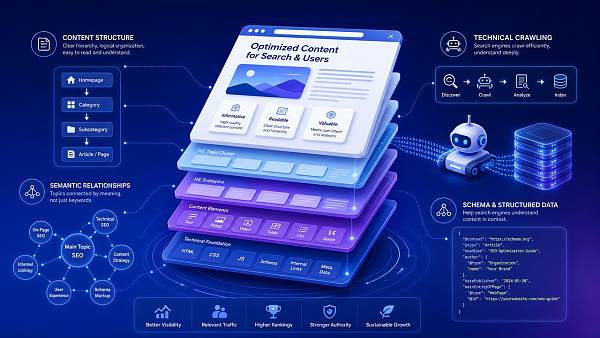
Traditional search places more emphasis on the match between pages and keywords, while AI search, on this basis, pays more attention to whether a page can directly answer a question, whether it has a clear structure, and whether there is enough evidence to support its points. In other words, content is not only written for people to read, but also for models to “read”.
If a page has an accurate title, clear paragraph hierarchy, direct answers to questions, clear explanations of terms, and is supplemented with cases, data, sources, and operating steps, then the probability of it being extracted, summarized, and recommended by AI is usually higher.
Conversely, many websites are difficult to be recommended by AI search not because the industry is unpopular, but because the content is written in an overly “marketing-oriented” way. For example, there may be a lot of empty promotion, but very little truly actionable information. Models find it hard to determine which sentences are worth citing, so naturally the content is less likely to be recommended.
Why isn’t your website content being recommended by AI? Common issues often appear in these areas
The first type of problem is unfocused content topics. A single page talks about brand, product, industry trends, and solutions at the same time, causing the main topic to be scattered. When extracting answers, AI tends to prefer pages where one question corresponds to one answer, rather than overloaded “all-in-one pages” with overly complex content.
The second type of problem is unclear expression. Many articles like to use vague terms such as “comprehensive empowerment”, “efficient collaboration”, and “deep connection”, but do not explain the specific methods, applicable scenarios, and results. For AI, vague expression is difficult to turn into citable information fragments.
The third type of problem is the lack of trust signals on the page. For example, there is no author information, no publication date, no real cases, no service description, and no supporting business background. When integrating answers, AI search will prioritize content sources that are more reliable and more verifiable.
The fourth type of problem is a weak technical foundation. Slow page loading, poor mobile adaptation, inconsistency between titles and main text, and chaotic structural tags all affect crawling and understanding. No matter how good the content is, if the technical layer makes it hard for models to “read smoothly”, the chance of recommendation will also drop significantly.
If you want to be recommended by AI search, fix the content structure first: shift from “writing articles” to “answering questions”
What most needs adjustment in execution is the way content is organized. Do not start by thinking about how to lay out viewpoints; start by breaking down user questions. A high-quality page should usually revolve around one core question, provide the answer quickly at the beginning, and then gradually add the reasons, methods, and points to note.
For example, the user question corresponding to this article title can actually be broken down into several sub-questions: what AI search looks for in recommended content, which parts of a website should be optimized, how content should be written so it is easier to understand, what technical support is needed, and how results should be evaluated. A structure like this is closer to search intent.
In paragraph writing, it is recommended to use the format of “put the conclusion first + add explanation + provide examples”. First use one or two sentences to answer the question directly, and then expand on the details. Content in this form is suitable both for fast human reading and for AI to extract core information more easily in summaries, Q&A, or recommendation cards.
In addition, subheadings should be as conversational and question-based as possible, rather than just writing vague nouns. Compared with “content strategy optimization”, both AI and users can more easily understand “what content is more likely to be crawled and recommended by AI search”. The closer the heading is to a real question, the higher the match is usually.
Keyword strategy has not become ineffective, but the focus has shifted to “semantic completeness” and “intent matching”
Many operators ask whether keywords still need to be worked on in the era of AI search. The answer is yes, but the method has changed. In the past, the emphasis may have been on the density of a single keyword. Now, what matters more is building a complete semantic network around one topic, so that the page covers the related questions users actually ask.
Using “How can you get website content recommended by AI search? Techniques” as the core term, you can naturally extend it into related expressions such as “what content AI search likes”, “how to optimize website structure”, “how to improve content credibility”, and “what is the difference between AI recommendations and SEO”.
The value of this writing approach lies in the fact that it not only improves traditional search coverage, but also helps AI determine the boundaries of the page topic and its knowledge associations. A page is not mechanically repeating one term, but continuously reinforcing the same topic across multiple related questions, which is more effective than simple keyword stuffing.
If you are responsible for website content operations, you can build a content table of “core terms—question terms—scenario terms—action terms”. Articles planned in this way are more likely to balance search traffic, AI understanding, and actual conversion, rather than stopping at surface-level exposure.
The key to increasing recommendation rates is not writing more, but writing content that is “verifiable, citable, and actionable”
When AI search recommends content, it often favors information that can be used directly. Therefore, pages should ideally include clear steps, specific standards, real data, case conclusions, and applicable conditions. The more specific the content is, the easier it is for models to identify it as a high-value answer.
For example, do not just say “optimizing website structure helps with AI recommendations”, but further explain: heading hierarchy should be standardized, each page should revolve around one topic, the first paragraph should answer the core question first, images should have semantically relevant descriptions, and important pages should ideally link to each other. Information like this is more likely to be used.
If enterprise content involves professional management, organizational transformation, or digital practice, you can also appropriately add research-oriented materials as extended reading. For example, on relevant topic pages, adding Research on Enterprise Business Administration in the Context of Digital Transformation and similar content can strengthen the page’s information depth and topic relevance.
For companies like Yiyingbao that provide integrated website and marketing services, this step is especially important. Because what customers truly need is not an article that merely “looks very professional”, but a content asset that helps the website be understood, seen, and clicked, ultimately bringing inquiries and conversions.
Technical optimization must work together with content strategy, otherwise even good content may “fail to deliver its value”
Although AI search recommendations cannot do without content, they still rely on crawling, parsing, and indexing behind the scenes. At the execution level, you should at least check these items: whether the page can be accessed normally, whether it is mobile-friendly, whether it loads fast enough, whether there are duplicate pages, and whether the title and description are clear and consistent.
At the same time, structured tags and page hierarchy should be taken seriously. Although not every page requires complex configuration, clear H tags, standardized lists, concise paragraphs, and reasonable internal links all help search engines and AI systems understand page priorities more quickly.
If the website uses smart site building or multilingual deployment, it is even more important to avoid large-scale duplication of templated content. AI usually does not give high evaluations to repetitive, low-differentiation pages. The truly effective approach is to make each core page serve one clear search intent and provide a unique answer.
In addition, information such as company introduction, service advantages, case results, and contact methods should also be fully disclosed. For companies like Yiyingbao Information Technology (Beijing) Co., Ltd., which have many years of industry experience, technical capabilities, and service cases, these themselves are important trust signals and should be properly reflected on the page.
After content is published, how do you judge whether it is getting closer to AI recommendation mechanisms? Look at these signals
Many people only focus on rankings, but that is actually not enough. To determine whether content is becoming more suitable for AI search recommendations, you can observe several more practical indicators: whether long-tail keyword exposure has increased, whether time spent on the page has improved, whether Q&A-type traffic is growing, and whether key pages are receiving more organic entry points.
If, after an article is published, the ranking of the main keyword does not change much, but related question terms continue to increase, and users read more deeply after entering the page while the bounce rate drops, this usually indicates that the content structure and semantic matching have improved, and the chance of later being recommended by AI will also be higher.
When reviewing content, it is recommended to focus on three types of pages: high-exposure low-click pages, indexed but unranked pages, and pages with stable rankings but low conversion. They respectively correspond to different optimization directions such as insufficient title appeal, unclear topic, and content that does not solve problems well enough.
When necessary, content can also be turned into a “question bank + answer bank” format for continuous iteration. This not only serves website SEO, but also helps adapt to more future scenarios of AI search, intelligent Q&A, and content distribution. If the content involves extended management research, you can also once again associate materials such as Research on Enterprise Business Administration in the Context of Digital Transformation, but they should not be excessively piled up.
Implementation advice for practitioners: following this sequence is usually more effective than blindly redesigning
The first step is to screen existing content and identify the pages most worth optimizing. Prioritize those articles or service pages that already have business value, clear topics, and some indexing foundation, rather than starting by completely rewriting the entire site’s content.
The second step is to rewrite the structure according to search intent. Change “brand-promotion-style articles” into “question-answer-style articles”, give the conclusion first at the beginning, explain methods in the middle, and provide evaluation suggestions at the end. Each page should solve only one category of core problem, reducing interference from irrelevant information.
The third step is to supplement evidence and details. Add cases, data, processes, common misunderstandings, applicable audiences, and operating steps, so that the page changes from “readable” to “usable”. This step is often more effective in increasing the likelihood of AI search recommendations than simply adding keywords.
The fourth step is to check the technical foundation and page experience. This includes speed, titles, tags, links, mobile version, image descriptions, indexing status, and so on. Content and technology must advance in sync, otherwise a disconnect will form between front-end display and back-end crawling.
The fifth step is to establish a monthly review mechanism. Continuously observe which pages are gaining more traffic from question terms and which pages users leave quickly, then adjust titles, paragraph order, and information density based on the data. Content preferred by AI search is usually also the result of multiple rounds of iterative optimization.
Summary: the core of website content that can truly be recommended by AI search is “having answers, speaking plainly, and being verifiable”
If you want to know how to get website content recommended by AI search, the most practical judgment criteria are actually very simple: can this page answer questions quickly, is it expressed clearly, does it have evidence, is it easy to crawl, and can it encourage users to take further action after reading it.
For website operations and marketing practitioners, there is no need to treat AI search as overly mysterious. First make content more focused, more specific, and more credible, and then combine it with foundational SEO and technical optimization. The probability of the website being understood, cited, and recommended by AI will then increase significantly.
In the final analysis, AI search does not recommend the page that “writes the most”, but the page that “solves problems best”. Whoever better understands users’ real questions, and whoever can provide answers that are clearly structured, well-supported by evidence, and directly usable, will have a better chance of gaining the next wave of search traffic dividends.
Related Articles


Related Products
 EasyCamp SaaS Smart Website Marketing SystemE-Yingbao SaaS Smart Website Marketing System: AI-powered, zero-code website building. Rapidly launch multilingual independent e-commerce sites in just 10 minutes. Global server acceleration and AI-driven SEO optimization empower businesses to efficiently connect with global markets. The seamless integration of technology and user-friendly operation makes building e-commerce sites incredibly simple.
 AI+SEM Intelligent Advertising Marketing SystemAI+SEM drives intelligent ad creation, empowering full-funnel precision advertising marketing. The system automatically generates weekly/monthly reports, AI recommends keywords and target countries, monitors core metrics in real-time with intelligent alerts, and enables one-click high-conversion ad solutions to help quickly acquire customers and improve ROI.
 AI+SEO Dual Engine Optimization ServiceEasyWin AI+SEO Dual Engine Optimization System leverages AI-powered keyword mining, content generation, and comprehensive technical optimization to help foreign trade enterprises acquire high-quality organic traffic, significantly improving search rankings and conversion rates.
 AI+SNS Social Media Marketing SystemYingbao AI+SNS Social Media Marketing System - Precision social capture for the social media era. Supports one-click content synchronization across major platforms like Facebook and LinkedIn. AI intelligently rewrites posts for enhanced relevance. 24/7 AI customer service and user profiling analysis empower businesses to efficiently expand into global markets.
 AI+SEO营销解决方案易营宝AI+SEO营销解决方案,通过AI批量写作、智能生成TDK、精准关键词扩词等功能,全面优化网站SEO效果,提升流量与转化率。助力企业构建高效智能网站新生态。
 AI+SEM Advertising Marketing SolutionsAI+SEM Advertising Marketing Solution leverages AI technology to deeply empower SEM ad campaigns. It automatically generates weekly/monthly reports using AI, presenting account data across multiple dimensions for comprehensive insights into campaign performance and trends. The system precisely recommends keywords and target countries, intelligently generates high-conversion ad copy, and enables one-click activation of efficient campaign plans to help businesses rapidly acquire customers. Simultaneously, it monitors core metrics in real time, intelligently identifies abnormal fluctuations, and issues timely alerts to ensure stable, high-return advertising results.
 Domain Name ServicesEasyWin provides professional domain name services, including intelligent queries, one-stop registration, brand protection, and full lifecycle management, helping businesses build a digital brand image.
 EasyOperate B2C Cross-Border E-Commerce Platform & Independent WebsiteEasyStore B2C Cross-border E-commerce Independent Store is an intelligent website building and cross-border e-commerce integrated solution independently developed by EasyStore Information Technology (Beijing) Co., Ltd. The system is specially designed for small and medium-sized as well as large export enterprises, integrating 'website building, operation, marketing, advertising, and conversion' into one, helping enterprises quickly establish cross-border e-commerce independent stores to achieve brand globalization and global sales growth.
The platform supports multiple languages, multiple currencies, and multi-channel marketing, with built-in AI intelligent translation and SEO optimization systems, suitable for mainstream markets such as Southeast Asia, Europe and America, Latin America, and the Middle East, assisting Chinese manufacturing enterprises in efficiently deploying international e-commerce strategies. SSL证书易营宝提供专业SSL安全证书服务,包括单域名和泛域名证书,确保网站数据传输加密、身份验证和完整性保护,助力企业建立安全可信的在线业务环境。









