









- Cross-Border Marketing Trend Research: Why More and More Companies Are Starting to Deploy AI Search and GEO OptimizationJun 30, 2026View details
- Cross-Border Marketing Trend Research: How Independent Sites, AI Content, and Short-Video Customer Acquisition Are ChangingJun 30, 2026View details
- How Can a Brand Updates Page Be Made More SEO-Friendly? Analysis of Update Frequency, Content Structure, and Internal Linking StrategyJun 28, 2026View details
- What stages does the cross-border services ecosystem include? How do website building, promotion, payment, and compliance work togetherJun 22, 2026View details
- How will email marketing costs change in 2026Jun 22, 2026View details
- The China-US tariff arrangement has reached a preliminary consensus, and the trade association will be establishedJun 15, 2026View details
Is AI Website Building Suitable for Corporate Websites? Three Types of Enterprise Adaptability and Case Studies

Introduction: Is AI Website Building Suitable for Enterprise Mobile Sites? This article provides decision-makers and operators with insights into the adaptability and case studies of three types of enterprises. From a practical perspective, it addresses key questions such as "What is a multilingual website?" and "What are the differences between AI website building and traditional website construction?" Combining technology, market trends, and real-world case studies, it helps enterprise decision-makers, project managers, and daily operators quickly determine whether to adopt AI website building, how to plan multilingual standalone sites, and the compliance and security configuration paths post-launch.
Definition and Overview: Foundational Understanding of AI Website Building and Multilingual Websites
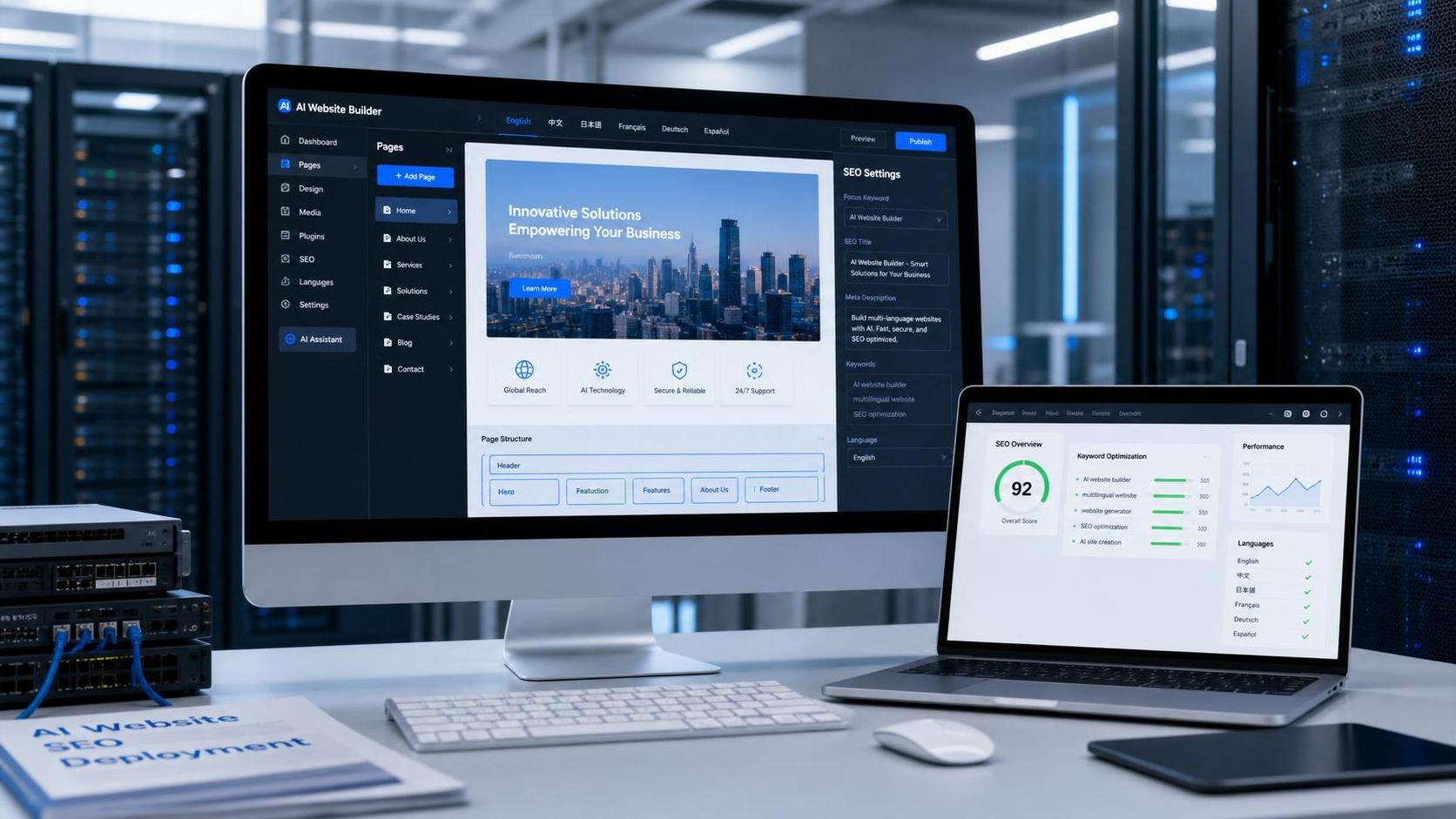
AI website building is not an abstract concept; it embeds artificial intelligence algorithms into the website creation process, achieving closed-loop automation from page layout and content generation to automatic TDK generation and multilingual translation. What is a multilingual website? A multilingual website is a site tailored to users in different regions and languages, providing localized content and experiences, directly impacting a company's overseas lead acquisition efficiency. How to build a multilingual website? Typical approaches include domain planning, language switching strategies, multilingual SEO tags (hreflang), and hybrid machine-human translation with localized glossary maintenance. Does AI website building support SEO optimization? Modern AI website platforms typically integrate "AI keyword expansion + automatic TDK generation + AI image creation" capabilities, combined with site detection tools to continuously improve SEO scores, transforming technical capabilities into quantifiable traffic growth.

Industry Background and Market Analysis: Why Multilingual Standalone Sites Have Become Essential
The fragmentation of global traffic and the localization requirements of search and social media make it imperative for enterprises to rely on multilingual standalone sites to establish brand trust and conversion channels. Taking B2B manufacturing, e-commerce, and education as examples, the long decision-making cycles and high information verification demands highlight why enterprises need multilingual websites: they directly improve user retention and conversion rates while reducing overseas advertising costs. Yinyingbao Information Technology (Beijing) Co., Ltd., founded in 2013 and headquartered in Beijing, has focused on "technological innovation + localized services" for a decade. It offers an AI-driven all-in-one intelligent marketing platform supporting Chinese, English, and multilingual standalone site construction, combined with global CDN nodes and AI marketing engines. It has helped over 500,000 enterprises achieve global growth and was listed among China's Top 100 SaaS Companies in 2023.
Technical Performance, Comparative Analysis, and Security Compliance (Including Product Information)
When choosing AI website building, technical performance, SEO friendliness, and security are the three core considerations. Compared to traditional templated website construction, AI website building shortens launch cycles through NLP and multimodal generation, improves TDK quality, and automates localized content generation. However, complex interactions and customized functionalities still require engineering investments. For security and certificate deployment, it is recommended to adopt trusted certificate solutions to ensure data transmission and user trust, such as one-click integrated SSL certificates, supporting automatic CSR generation, domain ownership auto-verification, and certificate auto-deployment, combined with HSTS to enforce HTTPS usage for source protection. The table below lists common certificate parameters for quick decision-making comparisons:
Application Scenarios, Case Studies, and Adaptability—How Three Types of Enterprises Can Determine AI Website Building Suitability

Based on practical experience, AI website building adaptability falls into three categories: The first is small and medium-sized e-commerce and manufacturers seeking rapid overseas expansion, suitable for templated and multilingual automated standalone sites with controllable costs and fast launch speeds, answering "Is AI website building suitable for SMEs?" with a conclusion that most SMEs are good candidates. The second is brands and B2B enterprises requiring content strategies and customized pages, where AI website building is feasible with engineering budgets and long-term content investments. The third involves highly customized or strictly regulated industries (finance, healthcare), where AI website building can serve as an iterative tool but requires parallel traditional development initially to meet compliance and functional integrity. Real-world case: An e-commerce exporter achieved a 40% increase in overseas access speed and a 35% SEO score improvement through Yinyingbao's multilingual standalone sites, with ad conversion rates benefiting from high-CTR creative materials generated by its creative factory model.
Procurement and Selection Guide, FAQs, and Actionable Recommendations
When procuring AI website building, evaluate from four dimensions: requirements, tech stack, operational capabilities, and budget. Define target markets and traffic sources, determine multilingual support depth, verify platform SEO and CDN capabilities, confirm certificate and compliance workflows, and estimate daily content output needs and human intervention boundaries. Regarding "How much does AI website building cost?" pricing depends on functionality and service depth, with significant variations from basic multilingual templates to enterprise-grade customization. Common misconceptions include viewing AI as a complete replacement for SEO strategies or full localization automation; the optimal approach is a hybrid "AI + human" workflow. Why choose us? Yinyingbao leverages its self-developed AI backend, global server clusters, and Google Premier Partner status to offer closed-loop services from website building to SEO, social media, and ads. Contact us for a free industry-specific assessment and tailored solutions, or experience our certificate and site diagnostic tools immediately.
- Website Development
- Website Builder Platform
- Corporate website
- SSL Certificate
- Website detection
- Multilingual Independent Website
- Independent website building
- Yiyingbao
- SEO
- Independent Website
- AI Marketing Engine
- Multilingual website
- How to build a multilingual website?
- Why should businesses create multilingual websites?
- What is a multilingual website?
- What is the difference between AI website building and traditional website construction?
- Is AI website building suitable for small and medium-sized enterprises?
- Does AI website support SEO optimization?
- How much does AI website building generally cost?
Related Articles
 What types of websites is an AI-powered site generator with drag and drop suitable for?
 What Does an AI Website Building Service Include? A Breakdown of the Delivery Scope from Page Generation to SEO Deployment
 What Is the Difference Between Free Websites and Paid Websites? A Comprehensive Comparison of Features, SEO, and Long-Term Costs

Related Products
 EasyCamp SaaS Smart Website Marketing SystemE-Yingbao SaaS Smart Website Marketing System: AI-powered, zero-code website building. Rapidly launch multilingual independent e-commerce sites in just 10 minutes. Global server acceleration and AI-driven SEO optimization empower businesses to efficiently connect with global markets. The seamless integration of technology and user-friendly operation makes building e-commerce sites incredibly simple.
 AI+SEM Intelligent Advertising Marketing SystemAI+SEM drives intelligent ad creation, empowering full-funnel precision advertising marketing. The system automatically generates weekly/monthly reports, AI recommends keywords and target countries, monitors core metrics in real-time with intelligent alerts, and enables one-click high-conversion ad solutions to help quickly acquire customers and improve ROI.
 AI+SEO Dual Engine Optimization ServiceEasyWin AI+SEO Dual Engine Optimization System leverages AI-powered keyword mining, content generation, and comprehensive technical optimization to help foreign trade enterprises acquire high-quality organic traffic, significantly improving search rankings and conversion rates.
 AI+SNS Social Media Marketing SystemYingbao AI+SNS Social Media Marketing System - Precision social capture for the social media era. Supports one-click content synchronization across major platforms like Facebook and LinkedIn. AI intelligently rewrites posts for enhanced relevance. 24/7 AI customer service and user profiling analysis empower businesses to efficiently expand into global markets.
 AI+SEO营销解决方案易营宝AI+SEO营销解决方案,通过AI批量写作、智能生成TDK、精准关键词扩词等功能,全面优化网站SEO效果,提升流量与转化率。助力企业构建高效智能网站新生态。
 AI+SEM Advertising Marketing SolutionsAI+SEM Advertising Marketing Solution leverages AI technology to deeply empower SEM ad campaigns. It automatically generates weekly/monthly reports using AI, presenting account data across multiple dimensions for comprehensive insights into campaign performance and trends. The system precisely recommends keywords and target countries, intelligently generates high-conversion ad copy, and enables one-click activation of efficient campaign plans to help businesses rapidly acquire customers. Simultaneously, it monitors core metrics in real time, intelligently identifies abnormal fluctuations, and issues timely alerts to ensure stable, high-return advertising results.
 Domain Name ServicesEasyWin provides professional domain name services, including intelligent queries, one-stop registration, brand protection, and full lifecycle management, helping businesses build a digital brand image.
 EasyOperate B2C Cross-Border E-Commerce Platform & Independent WebsiteEasyStore B2C Cross-border E-commerce Independent Store is an intelligent website building and cross-border e-commerce integrated solution independently developed by EasyStore Information Technology (Beijing) Co., Ltd. The system is specially designed for small and medium-sized as well as large export enterprises, integrating 'website building, operation, marketing, advertising, and conversion' into one, helping enterprises quickly establish cross-border e-commerce independent stores to achieve brand globalization and global sales growth.
The platform supports multiple languages, multiple currencies, and multi-channel marketing, with built-in AI intelligent translation and SEO optimization systems, suitable for mainstream markets such as Southeast Asia, Europe and America, Latin America, and the Middle East, assisting Chinese manufacturing enterprises in efficiently deploying international e-commerce strategies. SSL证书易营宝提供专业SSL安全证书服务,包括单域名和泛域名证书,确保网站数据传输加密、身份验证和完整性保护,助力企业建立安全可信的在线业务环境。









