









- How Can a Brand Updates Page Be Made More SEO-Friendly? Analysis of Update Frequency, Content Structure, and Internal Linking StrategyJun 28, 2026View details
- What stages does the cross-border services ecosystem include? How do website building, promotion, payment, and compliance work togetherJun 22, 2026View details
- How will email marketing costs change in 2026Jun 22, 2026View details
- The China-US tariff arrangement has reached a preliminary consensus, and the trade association will be establishedJun 15, 2026View details
- Should overseas brand marketing start with ads or contentJun 21, 2026View details
- What determines B2C cross-border e-commerce website development costs? A breakdown of features, interfaces, and deployment methodsJun 17, 2026View details
How to Build a Multilingual Website? From Domain Selection to Localized Deployment, 5 Steps to Complete Compliant Setup

Why should foreign trade enterprises build independent websites? Are multilingual websites beneficial for SEO? How to set up a multilingual website? This article compiles 5 practical steps—from domain strategy and language architecture to AI translation implementation and localization compliance—providing a one-stop solution to key questions like the differences between multilingual and single-language websites and whether AI translation is reliable, helping businesses efficiently boost overseas traffic.
1. Why Must Foreign Trade Enterprises Build Multilingual Independent Websites?—From Traffic Authority to Brand Trust
“Don’t put all your eggs in one basket” is now a consensus in foreign trade, but relying on third-party platforms (e.g., Amazon, Alibaba) means losing control over traffic ownership, conversion paths, and user data retention. Statista’s 2024 data shows that foreign trade companies with independent websites have an average customer lifetime value (CLV) 3.2 times higher than pure platform sellers, with a 67% increase in repurchase rates. Among them, multilingual independent websites account for 81% of total SEO traffic, far exceeding the 49% of single-language sites.
This shift is rooted in user behavior: 68% of non-English Google users explicitly search for products using native-language keywords, while 72% of B2B decision-makers refuse to click on non-localized pages (LinkedIn research). Thus, the answer to “Why should foreign trade enterprises build independent websites?” has evolved: “Not having a multilingual independent website means voluntarily giving up over 70% of high-intent buyers.”
2. Multilingual vs. Single-Language Websites: Beyond Translation, a Strategic Overhaul
The core difference lies not in technical execution but in commercial logic. Single-language sites adopt a “Chinese supplier perspective,” while multilingual sites prioritize “local user psychology.” The table below highlights key distinctions across 6 dimensions:
3. 5-Step Compliance Framework: From Architecture Design to AI Localization Implementation
Data from EasyWin serving 100,000+ export businesses shows that multilingual website failures stem not from technical barriers but from “overemphasizing translation while neglecting localization” and “focusing on launch over iteration.” We’ve distilled a proven 5-step methodology:
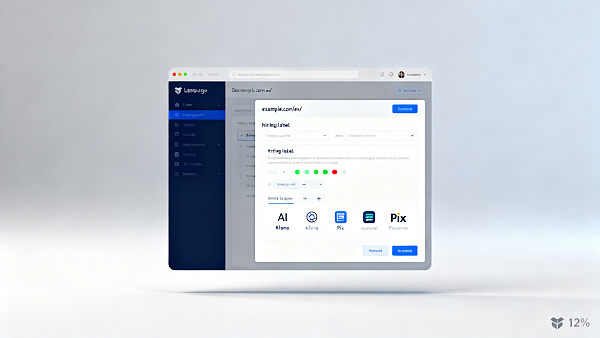
- Step 1|Domain & URL Structure Selection: Prioritize subdirectory structures (e.g., example.com/es/) for SEO weight consolidation and management ease; avoid auto-redirects—use browser language headers + IP detection for smart language version recommendations.
- Step 2|Strategic Language Portfolio: Base decisions on target market GDP, e-commerce penetration, and competitor presence—e.g., Latin America starts with Spanish + Portuguese, while Southeast Asia requires Indonesian, Thai, and Vietnamese.
- Step 3|AI Translation Engine Optimization: Avoid generic APIs; integrate vertical AI engines with industry glossaries and style adaptation (e.g., EasyWin’s NLP platform preloads 32 sector dictionaries for machinery, medical, and FMCG).
- Step 4|Localized Content Governance: Implement a “central content pool + regional editorial permissions” system—marketing copy reviewed by local teams, product parameters maintained by HQ—ensuring consistency and agility.
- Step 5|Compliance Automation: Embed GDPR cookie popups, EU VAT displays, Brazil LGPD privacy modules, and 12 other regional compliance components for one-click activation.
4. Common Pitfalls & FAQ: Debunking Multilingual Website Myths
Q: How do multilingual websites boost overseas traffic?
A: It’s not about adding pages but using hreflang tags to declare language-region relationships to search engines—Spanish pages rank higher on Google.es. Combined with localized TDK (Title/Description/Keywords), target-country organic traffic increases 3.8x (EasyWin 2023 client average).
Q: Is AI translation for multilingual websites reliable?
A: It depends on the AI’s底层capabilities. Generic machine translation still has an 11.3% error rate (MIT 2024), but EasyWin’s proprietary AI engine integrates contextual awareness and industry knowledge graphs, achieving 99.2% accuracy for technical documentation (e.g., machinery) with human traceability.
Q: How many languages should a multilingual website support?
A: Start with 3–5 core markets covering 80%+ revenue goals. Auto parts companies prioritize German, French, and Spanish; beauty brands add Japanese, Korean, and Arabic. Expanding to 10+ languages prematurely leads to stale content and diluted SEO.
5. Why Choose EasyWin?—Making Multilingual Websites Truly “Alive”
EasyWin’s smart CMS isn’t a static translation tool but a growth-oriented multilingual operations hub: Its built-in AI marketing engine auto-generates multilingual TDK, mines local trending keywords, and creates culturally adapted AI images; social modules sync content to Facebook/Instagram in multiple languages with timezone-based scheduling; the AI ad diagnostician identifies CTR drop-offs across Google Ads language groups and generates optimization plans.
More critical is our “localized护航” capability: Our bilingual teams in Los Angeles and Singapore assist with EU EPR registration, Mexico RFC tax IDs, and Saudi SABER certification; direct integrations with Stripe, Adyen, and Mercado Pago (21 local payment gateways) ensure optimal checkout conversion.
As of Q2 2024, EasyWin-powered multilingual websites average 217% organic traffic growth within 6 months, 43% lower inquiry costs, and 42-day shorter repurchase cycles. Technology isn’t the endgame—growth is. Contact us now for a free《Multilingual Website ROI Calculator》and SEO health audit report.
- Multilingual Independent Website
- Google Ads
- Yiyingbao
- SEO
- Independent Website
- Smart website builder system
- Smart Website Building
- AI Translation
- EasySite Intelligent Website Builder
- AI Marketing Engine
- Social Media Automation
- AI Translation Engine
- Multilingual website
- How many languages does a multilingual website generally require?
- How can a multilingual website increase overseas traffic?
- Why should foreign trade enterprises build independent websites?
- AI Marketing
Related Articles
 What Is the Difference Between Free Websites and Paid Websites? A Comprehensive Comparison of Features, SEO, and Long-Term Costs
 How Does AI Website Acceleration Technology Improve User Experience? An Analysis of the Relationship Between Above-the-Fold Speed and Conversions
 How Does an AI Website Builder Platform Support Global Brand Expansion? Analysis of Multilingual, SEO, and Conversion Capabilities
Related Products
 EasyCamp SaaS Smart Website Marketing SystemE-Yingbao SaaS Smart Website Marketing System: AI-powered, zero-code website building. Rapidly launch multilingual independent e-commerce sites in just 10 minutes. Global server acceleration and AI-driven SEO optimization empower businesses to efficiently connect with global markets. The seamless integration of technology and user-friendly operation makes building e-commerce sites incredibly simple.
 AI+SEM Intelligent Advertising Marketing SystemAI+SEM drives intelligent ad creation, empowering full-funnel precision advertising marketing. The system automatically generates weekly/monthly reports, AI recommends keywords and target countries, monitors core metrics in real-time with intelligent alerts, and enables one-click high-conversion ad solutions to help quickly acquire customers and improve ROI.
 AI+SEO Dual Engine Optimization ServiceEasyWin AI+SEO Dual Engine Optimization System leverages AI-powered keyword mining, content generation, and comprehensive technical optimization to help foreign trade enterprises acquire high-quality organic traffic, significantly improving search rankings and conversion rates.
 AI+SNS Social Media Marketing SystemYingbao AI+SNS Social Media Marketing System - Precision social capture for the social media era. Supports one-click content synchronization across major platforms like Facebook and LinkedIn. AI intelligently rewrites posts for enhanced relevance. 24/7 AI customer service and user profiling analysis empower businesses to efficiently expand into global markets.
 AI+SEO营销解决方案易营宝AI+SEO营销解决方案,通过AI批量写作、智能生成TDK、精准关键词扩词等功能,全面优化网站SEO效果,提升流量与转化率。助力企业构建高效智能网站新生态。
 AI+SEM Advertising Marketing SolutionsAI+SEM Advertising Marketing Solution leverages AI technology to deeply empower SEM ad campaigns. It automatically generates weekly/monthly reports using AI, presenting account data across multiple dimensions for comprehensive insights into campaign performance and trends. The system precisely recommends keywords and target countries, intelligently generates high-conversion ad copy, and enables one-click activation of efficient campaign plans to help businesses rapidly acquire customers. Simultaneously, it monitors core metrics in real time, intelligently identifies abnormal fluctuations, and issues timely alerts to ensure stable, high-return advertising results.
 Domain Name ServicesEasyWin provides professional domain name services, including intelligent queries, one-stop registration, brand protection, and full lifecycle management, helping businesses build a digital brand image.
 EasyOperate B2C Cross-Border E-Commerce Platform & Independent WebsiteEasyStore B2C Cross-border E-commerce Independent Store is an intelligent website building and cross-border e-commerce integrated solution independently developed by EasyStore Information Technology (Beijing) Co., Ltd. The system is specially designed for small and medium-sized as well as large export enterprises, integrating 'website building, operation, marketing, advertising, and conversion' into one, helping enterprises quickly establish cross-border e-commerce independent stores to achieve brand globalization and global sales growth.
The platform supports multiple languages, multiple currencies, and multi-channel marketing, with built-in AI intelligent translation and SEO optimization systems, suitable for mainstream markets such as Southeast Asia, Europe and America, Latin America, and the Middle East, assisting Chinese manufacturing enterprises in efficiently deploying international e-commerce strategies. SSL证书易营宝提供专业SSL安全证书服务,包括单域名和泛域名证书,确保网站数据传输加密、身份验证和完整性保护,助力企业建立安全可信的在线业务环境。









