









- What Does a Global Traffic Ecosystem Service Provider Do? What Are the Differences from a Single Advertising AgencyJul 16, 2026View details
- What should you focus on in the latest enterprise SaaS report? From renewal rates and delivery costs to overseas growth opportunitiesJul 12, 2026View details
- What signals are worth paying attention to in a cross-border marketing trend report? B2B companies should look at these 6 signalsJul 11, 2026View details
- How to Read a Cross-Border Marketing Trends Report? Five Key Dimensions for Evaluating Channel OpportunitiesJul 11, 2026View details
- Which channel has the highest ROI in the global traffic ecosystem? Comparative analysis of search, social media, and advertisingJul 10, 2026View details
- What multilingual website services are available in Sanya? Which model is more suitable for local businesses going global?Jul 08, 2026View details
- How to view the complete list of China SaaS companies in the top 100? Practical methods for screening website-building and marketing service providersJul 08, 2026View details
- How to view pricing in the global traffic ecosystem? Cost comparison of search, social media, and content channel advertisingJul 06, 2026View details
What accounts for the price differences among website SEO optimization companies?
Where do the pricing differences among website SEO optimization companies lie? The answer often does not lie in whether it is “expensive” or “cheap” itself, but in the service scope, depth of execution, keyword strategy, technical capabilities, and whether it can ultimately generate effective inquiries. For business decision-makers and execution teams, what truly needs to be judged is not the high or low figure on a quotation sheet, but whether this investment corresponds to a practical website SEO optimization plan, clear SEO keyword research, a trackable optimization path, and the subsequent ability to support conversions. If you only compare prices, it is easy to buy a service that “did a lot but produced no results”; if you look clearly at the work content behind the pricing differences, it becomes easier to choose a website SEO optimization company that truly fits the company’s stage and goals.
Why do website SEO optimization companies’ quotations vary so much? First, see whether it is really the “same type of service”
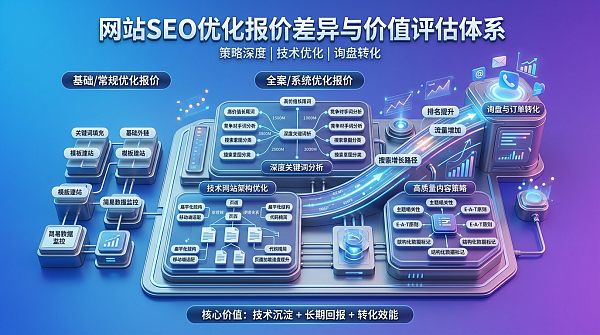
When comparing prices, many companies find that although all services are called “website SEO optimization,” some companies quote several thousand yuan per month, while others quote tens of thousands of yuan, or even more. On the surface, they are all called SEO, but in reality they may not be the same type of service at all.
The pricing difference first comes from different service models. Some companies provide basic services, such as limited keyword placement, page title adjustments, regular submission for indexing, and simple backlink building; others provide strategic services, including industry research, competitor analysis, on-site technical optimization, content planning, SEO keyword research, conversion path design, data review, and long-term iteration. The differences between the two in manpower, tools, experience, and result stability are very large.
Secondly, different optimization targets also directly affect pricing. A corporate showcase website with only a dozen pages is completely different in optimization difficulty from a website with a product database, information sections, regional pages, and multilingual versions. The former may only require basic structural organization and key page improvements, while the latter may involve more complex issues such as information architecture, bulk template optimization, crawl efficiency, page deduplication, and content system building.
In addition, industry competition determines SEO difficulty. For example, compared with ordinary local service industries, industries with high commercial value have a completely different cost level for obtaining organic rankings. The more commercially valuable the keywords are, the stronger the competition, the more refined the strategy required, and the higher the requirements for content and backlink resources, so the quotation is naturally higher.
Therefore, before looking at a quotation, companies should first confirm one thing: is the other party selling you a “basic operation package” or a “systematic SEO service aimed at growth”? If this step is not clarified, comparing prices itself is meaningless.
What companies should care about most is not the price list, but what key work is included in the quotation
A truly valuable website SEO optimization company usually does not have a quotation sheet that simply says “optimize several keywords,” but will clearly break down the service content. For companies, the following parts are the most worth focusing on.
First, whether it includes complete SEO keyword research. The problem with many low-cost SEO services is that keyword selection is not based on user search intent and the business conversion path, but simply picks some terms that seem easy to rank for yet have no real conversion value. High-quality SEO keyword research not only distinguishes between brand keywords, product keywords, question keywords, and scenario keywords, but also considers the search needs of customers at different stages, helping the website support exposure, inquiries, and transactions at the same time.
Second, whether there is a clear website SEO optimization plan. A mature plan is not just a sentence like “help you improve rankings,” but will explain on-site technical fixes, category page planning, content update strategy, page optimization logic, external resource building, periodic review metrics, and so on. If a company cannot clearly explain what it will do, why it will do it this way, and what problems it expects to improve first, then even a low quotation should be treated cautiously.
Third, whether technical optimization is valued. SEO is not just about writing articles and building backlinks. Website loading speed, mobile adaptation, URL structure, indexing control, broken links, duplicate pages, redundant code, structured data, sitemaps, and more all affect search engine crawling and ranking. For the integrated website + marketing services industry, the stronger the coordination between technology and marketing, the easier it is for a project to produce results.
Fourth, whether the focus is on conversion rather than just traffic. Some companies turn SEO into “ranking delivery,” but what businesses really need are leads and orders. A project that only pursues traffic and ignores page conversion capability may still have limited results even if rankings improve. Excellent service providers will also pay attention to landing page messaging, form paths, phone buttons, inquiry touchpoints, and content persuasiveness.
From this perspective, where the quotation differs essentially lies in “whether the company’s growth has truly been included in the optimization goals.”
Where is low-cost SEO usually cheap? And what exactly makes high-priced services expensive?
If SEO services are broken down, low-cost solutions are usually cheaper in the following aspects.
First is shallow strategy. There is no in-depth industry analysis, and competitor research is also lacking; only superficial keyword placement and template-based operations are done.
Second is weak execution. The amount of updated content is small, the quality is unstable, technical issue checks are incomplete, and much of the work stays at the “recommendation level” without actually being implemented into website revisions and continuous optimization.
Third is vague goals. Only ambiguous metrics are promised, such as “increase exposure” and “improve indexing,” but they are not linked to business pages, core keywords, or conversion results.
Fourth is limited communication. The project lacks monthly analysis, stage summaries, and adjustment recommendations, so the company cannot see what SEO has actually done or judge the return on investment.
High-priced services, on the other hand, are generally expensive in the following areas.
First is team capability. To truly do SEO well usually requires collaboration among multiple people in strategy, content, technology, data analysis, and more, rather than being completed by a single role. Second are tools and data resources. Professional companies rely on more systematic monitoring systems to analyze keyword fluctuations, indexing status, page performance, and competitive trends. Third is the degree of customization. The more a website SEO optimization plan is tailored to a company’s products, sales path, and market goals, the greater the workload and the higher the value.
For companies, there is no need to blindly pursue the most expensive option, but they must be alert to quotations that are “too cheap.” Because SEO is not a one-time purchase, but a growth project requiring continuous investment. If the early-stage strategy is wrong, the time and opportunity cost later is often even higher.
How can you judge whether a website SEO optimization company’s quotation is reasonable? Look at these 5 dimensions
When screening service providers, companies can directly use the following 5 dimensions to judge whether a quotation is reasonable, rather than simply looking at the total amount.
1. Whether diagnosis comes before quotation.
Responsible companies usually first understand the current website situation, industry competition, business goals, and historical data, and then provide a website SEO optimization plan that is closer to reality. If they immediately quote a standard package at the start, it often means the service is highly standardized, but not necessarily suitable for your business.
2. Whether stage goals are clearly defined.
SEO takes time to show results, but that does not mean the process cannot be managed. A reasonable service should be able to tell you: what will be solved first in phase 1, what will be focused on in phase 2, and how traffic and conversions will be expanded in phase 3, rather than vaguely saying “optimize gradually.”
3. Whether deliverables are clearly explained.
For example, a keyword database, page optimization checklist, content plan, technical fix recommendations, monthly reports, review meetings, and so on. The clearer the deliverables, the more controllable the subsequent execution, and the easier it is for companies to evaluate the service value.
4. Whether there is business understanding capability.
For decision-makers, this is more important than rankings alone. If a service provider does not understand who the industry customers are, how long the decision chain is, and where the product selling points lie, it will be difficult to turn search traffic into inquiries. A good SEO team does not only know how to drive traffic, but also understands the business.
5. Whether the input-output logic can be clearly explained.
SEO cannot promise absolute rankings, but an excellent team will explain: which keywords to enter through, which pages will receive the traffic, which content will address user concerns, and which metrics will be used to verify results. The clearer this logic is, the more reference value the quotation has.
Some companies also use a budget management-like approach internally to review marketing investment, for example by making stage goals, cost structure, and result evaluation into a more trackable system. This way of thinking has something in common with the coordination of process and results emphasized by the application strategies of budget performance management in financial management of public institutions. For SEO projects, only when things are measurable and reviewable does the quotation become not just a number, but an investment whose value can be verified.
At different business stages, the suitable SEO quotation range and service focus are not the same
Whether a quotation is appropriate also needs to be considered together with the company’s current stage.
If the company has just built its website or has a weak foundation, the focus should not be on pursuing a large number of keywords, but on first building a solid website foundation, including clear structure, complete pages, content basics, mobile experience, expression of core pages, and search engine crawlability. At this stage, it is more suitable to choose a service model of “website building + optimization coordination”; otherwise, if the website itself has too many problems, subsequent optimization efficiency will be very low.
If the company already has some traffic but inquiries are unstable, the focus should be on keyword quality, page conversion capability, and content support capability. The common problem for such companies is not a total lack of traffic, but inaccurate traffic and insufficient page persuasiveness. Whether conversion optimization is included in the quotation will be very critical.
If it is in a highly competitive industry or a nationwide market business, more systematic SEO is needed. At this time, the comparison is not about who can rank a few keywords, but who can build a more complete content matrix, category system, and long-term growth mechanism. Such projects usually have higher quotations, but if the service depth is sufficient, they are also more likely to become long-term assets.
If it is a multi-region, multi-product, multilingual business, SEO work will involve more page templates, data structures, and localized content logic, and a simple low-cost package will be difficult to support truly effective results.
In other words, companies should not first ask “How much does SEO cost?” but should first ask “What problem do I most need to solve right now?” Different problems naturally mean different service focuses and quotation structures.
When choosing a website SEO optimization company, do not overlook these details that are easy pitfalls
In addition to the quotation itself, the following details will also directly affect the cooperation result.
Overpromising. If the other party directly promises that a large number of core keywords will reach the first page in a short period, especially without explaining the method and prerequisites, extra caution is needed. SEO is affected by multiple factors such as industry competition, website foundation, content quality, and search engine algorithms. Reliable companies usually provide target ranges and execution paths rather than absolute guarantees.
Only talking about keywords, not pages. Keyword ranking is only the entry point; what truly generates inquiries is page content and conversion design. If a service provider never discusses your product pages, case study pages, FAQ pages, or landing page structure from beginning to end, then it is very likely they are only doing superficial SEO.
Only sending reports, not pushing changes. Some companies provide many data charts, but the core website problems are never actually implemented and resolved. Companies should confirm whether the other party truly has the ability to push execution, especially the ability to coordinate with website building, content, and technical teams.
Unclear cooperation boundaries. What is the SEO company responsible for, what requires internal company cooperation, how long content review cycles take, who executes technical changes, and how monthly communication is arranged—these should all be clarified in advance. The clearer the boundaries, the more controllable the subsequent results.
For companies that care about both cost and long-term growth, a reliable website SEO optimization company should be able not only to clearly explain “why the quotation is set this way,” but also to prove “where the money will be spent and how it will produce results.”
Summary: The core of quotation differences among website SEO optimization companies lies in whether the service value can truly be implemented
Where do the quotation differences among website SEO optimization companies lie? In the final analysis, they lie in strategic depth, execution quality, technical capability, keyword research level, and whether optimization is truly carried out around business growth. A low price is not necessarily useless, but it is very likely to cover only basic actions; a high price is not necessarily always worth it either. The key is whether there is a clear website SEO optimization plan, verifiable deliverables, and execution logic aligned with business goals.
For business decision-makers, the correct way to compare is not just to look at how much it costs per month, but to see whether the quotation solves your most important current problem: is the website foundation weak, is traffic low, are keywords inaccurate, or is there traffic without conversion? For the execution level, the focus should be on checking specific work items, collaboration mechanisms, and review methods.
When you turn “price comparison” into “value judgment,” it becomes much easier to choose a website SEO optimization company that truly suits you, and to turn SEO from a cost item into a continuously accumulated growth asset.
Related Articles


Related Products
 EasyCamp SaaS Smart Website Marketing SystemE-Yingbao SaaS Smart Website Marketing System: AI-powered, zero-code website building. Rapidly launch multilingual independent e-commerce sites in just 10 minutes. Global server acceleration and AI-driven SEO optimization empower businesses to efficiently connect with global markets. The seamless integration of technology and user-friendly operation makes building e-commerce sites incredibly simple.
 AI+SEM Intelligent Advertising Marketing SystemAI+SEM drives intelligent ad creation, empowering full-funnel precision advertising marketing. The system automatically generates weekly/monthly reports, AI recommends keywords and target countries, monitors core metrics in real-time with intelligent alerts, and enables one-click high-conversion ad solutions to help quickly acquire customers and improve ROI.
 AI+SEO Dual Engine Optimization ServiceEasyWin AI+SEO Dual Engine Optimization System leverages AI-powered keyword mining, content generation, and comprehensive technical optimization to help foreign trade enterprises acquire high-quality organic traffic, significantly improving search rankings and conversion rates.
 AI+SNS Social Media Marketing SystemYingbao AI+SNS Social Media Marketing System - Precision social capture for the social media era. Supports one-click content synchronization across major platforms like Facebook and LinkedIn. AI intelligently rewrites posts for enhanced relevance. 24/7 AI customer service and user profiling analysis empower businesses to efficiently expand into global markets.
 AI+SEO营销解决方案易营宝AI+SEO营销解决方案,通过AI批量写作、智能生成TDK、精准关键词扩词等功能,全面优化网站SEO效果,提升流量与转化率。助力企业构建高效智能网站新生态。
 AI+SEM Advertising Marketing SolutionsAI+SEM Advertising Marketing Solution leverages AI technology to deeply empower SEM ad campaigns. It automatically generates weekly/monthly reports using AI, presenting account data across multiple dimensions for comprehensive insights into campaign performance and trends. The system precisely recommends keywords and target countries, intelligently generates high-conversion ad copy, and enables one-click activation of efficient campaign plans to help businesses rapidly acquire customers. Simultaneously, it monitors core metrics in real time, intelligently identifies abnormal fluctuations, and issues timely alerts to ensure stable, high-return advertising results.
 Domain Name ServicesEasyWin provides professional domain name services, including intelligent queries, one-stop registration, brand protection, and full lifecycle management, helping businesses build a digital brand image.
 EasyOperate B2C Cross-Border E-Commerce Platform & Independent WebsiteEasyStore B2C Cross-border E-commerce Independent Store is an intelligent website building and cross-border e-commerce integrated solution independently developed by EasyStore Information Technology (Beijing) Co., Ltd. The system is specially designed for small and medium-sized as well as large export enterprises, integrating 'website building, operation, marketing, advertising, and conversion' into one, helping enterprises quickly establish cross-border e-commerce independent stores to achieve brand globalization and global sales growth.
The platform supports multiple languages, multiple currencies, and multi-channel marketing, with built-in AI intelligent translation and SEO optimization systems, suitable for mainstream markets such as Southeast Asia, Europe and America, Latin America, and the Middle East, assisting Chinese manufacturing enterprises in efficiently deploying international e-commerce strategies. SSL证书易营宝提供专业SSL安全证书服务,包括单域名和泛域名证书,确保网站数据传输加密、身份验证和完整性保护,助力企业建立安全可信的在线业务环境。









