









- How to assess foreign trade website development trends?Looking at 2026 changes from multilingual,AI content to conversion pathsJul 04, 2026View details
- What are the new trends in multilingual marketing data analytics tools in 2026? Focus on attribution、automation and complianceJul 04, 2026View details
- Is Brand Globalization Marketing Consulting Worth Buying? At What Stage Should Companies Bring It InJul 01, 2026View details
- Cross-Border Marketing Trend Research: Why More and More Companies Are Starting to Deploy AI Search and GEO OptimizationJun 30, 2026View details
- Cross-Border Marketing Trend Research: How Independent Sites, AI Content, and Short-Video Customer Acquisition Are ChangingJun 30, 2026View details
- How Can a Brand Updates Page Be Made More SEO-Friendly? Analysis of Update Frequency, Content Structure, and Internal Linking StrategyJun 28, 2026View details
- What stages does the cross-border services ecosystem include? How do website building, promotion, payment, and compliance work togetherJun 22, 2026View details
- How will email marketing costs change in 2026Jun 22, 2026View details
Will a multilingual foreign trade website affect SEO? The key lies in the structure
Will a multilingual foreign trade website affect SEO? The answer does not depend on the number of languages, but on whether the website architecture is clear, whether the content is independent, and whether the signals are accurate. For integrated website and marketing service projects, multilingual sites can either expand search coverage or, due to improper technical handling, cause indexing confusion, diluted authority, and ranking fluctuations. Therefore, what truly needs to be evaluated is not “whether to build a multilingual site,” but “how to turn multilingual content into a growth asset that search engines can correctly understand.”
I. Whether a multilingual foreign trade website affects SEO depends first on whether the impact is positive or negative
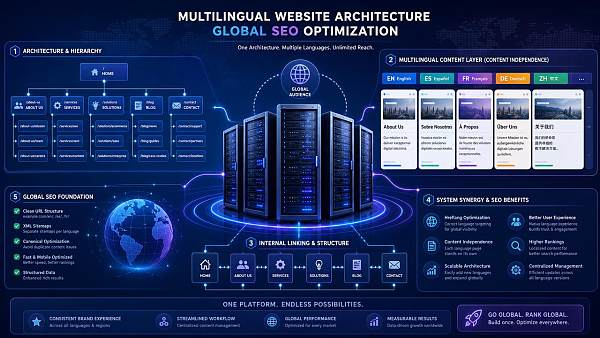
Will a multilingual foreign trade website affect SEO? This question is often simply understood as “the more languages, the more complex.” In fact, that is not the case. As long as the architecture is standardized, multilingual websites can often expand keyword coverage and increase organic traffic entry points in different national markets.
Conversely, if different language pages share the same set of content, automatic redirects are confusing, URLs are irregular, and hreflang is missing, then the answer to whether a multilingual foreign trade website affects SEO will tend to be negative. Search engines cannot determine the language and region corresponding to a page, which can easily lead to incorrect indexing.
Therefore, multilingualism itself is not the problem; architecture is the core. A well-designed website system will uniformly plan language versions, page relationships, indexing rules, internal links, and content update mechanisms, rather than patching them together later.
II. Which technical architectures are most likely to determine the success or failure of multilingual SEO?
When discussing whether a multilingual foreign trade website affects SEO, the first thing to look at is the URL structure. Common approaches include independent domains, subdomains, and subdirectories. All three can support SEO, but they apply under different conditions.
Independent domains are suitable for markets with a high degree of localization. Their advantage is strong regional signals, while their disadvantage is high maintenance cost. Subdomains facilitate technical isolation, but authority synergy is usually weaker than with subdirectories. Subdirectories are more suitable for unified operations and centralized authority accumulation, making them a common choice for many foreign trade websites.
In addition to URLs, the hreflang tag is also very important. Its function is not to directly improve rankings, but to tell search engines the corresponding relationships between pages in different languages and regions, reducing misdelivery and duplicate judgments.
In addition, the following technical points also require attention:
- Whether each language version has an independent and stable URL.
- Whether language switching keeps users on the corresponding content page instead of forcing them back to the homepage.
- Whether canonical points to itself to avoid incorrect consolidation.
- Whether the sitemap is split and submitted by language.
- Whether the server is stable and whether access speed in the target region is acceptable.
If these basic items are not handled well, then the answer to whether a multilingual foreign trade website affects SEO will usually be “yes, and the impact is obvious.”
III. Can content rank after translation? The core lies in uniqueness and search intent
Many websites see no results after launching multiple languages, not because the technology is entirely wrong, but because the content is only mechanically translated. Search engines are placing increasing emphasis on page value and local search intent. If pages in different languages are only translated word for word, it is often difficult to form real competitiveness.
Whether a multilingual foreign trade website affects SEO also depends on whether the content is rewritten for the target market. Users in different regions use different keywords, expression habits, and purchase concerns. For the same product, the search path in different countries may be completely different.
For example, product pages, solution pages, case study pages, and FAQ pages should all have language-specific independence and semantic adaptation, rather than being mass-generated solely through machine translation. The closer the content is to local needs, the easier it is for search engines to understand the page’s value.
In long-term content planning, a structured management approach can be referenced. When many companies work on cross-department budgets or annual planning, they often value both unified frameworks and detailed implementation, which is similar to the logic of multilingual SEO development. For example, content such as Strategies and Practices for Preparing Annual Investment Budgets in State-owned Enterprises essentially also emphasizes having a clear framework first, and then breaking it down for execution.
IV. Under what circumstances are multilingual websites more likely to face SEO risks?
Whether a multilingual foreign trade website affects SEO, many risks actually come from implementation details. The following types of issues are the most common and also the easiest to overlook.
1. Forced redirects after automatic language detection
If the system forces redirects based on IP or browser language, search engines may be unable to consistently access all versions during crawling, causing some pages to remain unindexed for a long time. A more reliable approach is to retain manual switching and allow crawlers to access pages normally.
2. High similarity of content across multiple language versions
Some industry terms have limited differences across languages, but the overall page structure, titles, meta descriptions, case studies, and application scenarios still need localization. Otherwise, search engines may suspect that the page lacks sufficient value, affecting ranking stability.
3. Page volume expands too quickly
Launching a large number of low-quality pages at one time will consume crawl budget. Instead of spreading across more than a dozen language sites, it is better to first deepen your presence in key markets and then gradually expand.
4. Disconnect between technology and marketing
If the website-building team only focuses on launching pages, while the marketing team only focuses on advertising conversions, problems will arise where keyword layout, landing page paths, and content structure are disconnected from each other. SEO performance will naturally struggle to achieve stable growth.
V. How to determine whether the current architecture is suitable for multilingual SEO?
To determine whether a multilingual foreign trade website affects SEO, you can first conduct a quick checkup. The focus is not on whether the pages look attractive, but on whether they have a foundation for long-term optimization.
If there are obvious risks in more than two items in the table, then whether a multilingual foreign trade website affects SEO cannot be solved only by content updates; the technical architecture must be adjusted first.
VI. When implementing a multilingual website, how can SEO and growth efficiency both be taken into account?
The ideal approach is not to build the website first and then add SEO afterward, but to unify search logic, content logic, and conversion logic during the website-building stage. This can both shorten the trial-and-error cycle and reduce later rework costs.
Integrated website and marketing service providers represented by E-Marketbao Information Technology (Beijing) Co., Ltd. usually coordinate intelligent website building, SEO optimization, content planning, data monitoring, and localized operations. With this approach, the answer to whether a multilingual foreign trade website affects SEO is more likely to become “it can improve the quality of global organic traffic.”
In practice, implementation can proceed in the following order:
- Identify priority countries and languages, and do not blindly pursue scale.
- Choose a unified and scalable URL structure.
- Complete the configuration of hreflang, sitemaps, and indexing rules.
- Rewrite core pages around local keywords.
- Continuously adjust page performance and content depth based on data.
If the company is simultaneously advancing multi-region business planning internally, it can also refer to the rhythm management approach emphasized in Strategies and Practices for Preparing Annual Investment Budgets in State-owned Enterprises, to clearly layer resource input, target markets, and execution priorities.
VII. Conclusion: Whether a multilingual foreign trade website affects SEO, the answer lies in the architectural design
Returning to the original question, will a multilingual foreign trade website affect SEO? Yes, but the impact is not necessarily a bad thing. If done well, a multilingual architecture can expand keyword coverage, improve regional relevance, and enhance organic traffic growth. If done poorly, it may bring duplicate content, incorrect indexing, and diluted authority.
What truly deserves priority treatment are URL strategy, hreflang configuration, content uniqueness, internal linking logic, and target-region access performance. Build these underlying capabilities solidly first, and then expand into multiple languages, so that SEO results become more controllable.
If you are evaluating a new or upgraded foreign trade website, it is recommended to first complete a multilingual SEO architecture audit to clarify which issues belong to the technical layer and which belong to the content layer, and then enter the execution stage. Only in this way can a multilingual website truly become an entry point for global growth rather than a burden requiring repeated fixes later.
Related Articles
 How can video news production be made more efficient?Breaking down the standard process from topic selection to editing
 How to assess foreign trade website development trends?Looking at 2026 changes from multilingual,AI content to conversion paths
 What are the new trends in multilingual marketing data analytics tools in 2026? Focus on attribution、automation and compliance



Related Products
 EasyCamp SaaS Smart Website Marketing SystemE-Yingbao SaaS Smart Website Marketing System: AI-powered, zero-code website building. Rapidly launch multilingual independent e-commerce sites in just 10 minutes. Global server acceleration and AI-driven SEO optimization empower businesses to efficiently connect with global markets. The seamless integration of technology and user-friendly operation makes building e-commerce sites incredibly simple.
 AI+SEM Intelligent Advertising Marketing SystemAI+SEM drives intelligent ad creation, empowering full-funnel precision advertising marketing. The system automatically generates weekly/monthly reports, AI recommends keywords and target countries, monitors core metrics in real-time with intelligent alerts, and enables one-click high-conversion ad solutions to help quickly acquire customers and improve ROI.
 AI+SEO Dual Engine Optimization ServiceEasyWin AI+SEO Dual Engine Optimization System leverages AI-powered keyword mining, content generation, and comprehensive technical optimization to help foreign trade enterprises acquire high-quality organic traffic, significantly improving search rankings and conversion rates.
 AI+SNS Social Media Marketing SystemYingbao AI+SNS Social Media Marketing System - Precision social capture for the social media era. Supports one-click content synchronization across major platforms like Facebook and LinkedIn. AI intelligently rewrites posts for enhanced relevance. 24/7 AI customer service and user profiling analysis empower businesses to efficiently expand into global markets.
 AI+SEO营销解决方案易营宝AI+SEO营销解决方案,通过AI批量写作、智能生成TDK、精准关键词扩词等功能,全面优化网站SEO效果,提升流量与转化率。助力企业构建高效智能网站新生态。
 AI+SEM Advertising Marketing SolutionsAI+SEM Advertising Marketing Solution leverages AI technology to deeply empower SEM ad campaigns. It automatically generates weekly/monthly reports using AI, presenting account data across multiple dimensions for comprehensive insights into campaign performance and trends. The system precisely recommends keywords and target countries, intelligently generates high-conversion ad copy, and enables one-click activation of efficient campaign plans to help businesses rapidly acquire customers. Simultaneously, it monitors core metrics in real time, intelligently identifies abnormal fluctuations, and issues timely alerts to ensure stable, high-return advertising results.
 Domain Name ServicesEasyWin provides professional domain name services, including intelligent queries, one-stop registration, brand protection, and full lifecycle management, helping businesses build a digital brand image.
 EasyOperate B2C Cross-Border E-Commerce Platform & Independent WebsiteEasyStore B2C Cross-border E-commerce Independent Store is an intelligent website building and cross-border e-commerce integrated solution independently developed by EasyStore Information Technology (Beijing) Co., Ltd. The system is specially designed for small and medium-sized as well as large export enterprises, integrating 'website building, operation, marketing, advertising, and conversion' into one, helping enterprises quickly establish cross-border e-commerce independent stores to achieve brand globalization and global sales growth.
The platform supports multiple languages, multiple currencies, and multi-channel marketing, with built-in AI intelligent translation and SEO optimization systems, suitable for mainstream markets such as Southeast Asia, Europe and America, Latin America, and the Middle East, assisting Chinese manufacturing enterprises in efficiently deploying international e-commerce strategies. SSL证书易营宝提供专业SSL安全证书服务,包括单域名和泛域名证书,确保网站数据传输加密、身份验证和完整性保护,助力企业建立安全可信的在线业务环境。









