









- How to Choose the Most Cost-Effective Domain Registration Deals in 2026May 28, 2026View details
- What Growth Challenges Can a Digital Marketing Service Provider SolveMay 28, 2026View details
- Will GEO replace traditional SEOMay 27, 2026View details
- Is SEO Still Necessary in 2026May 27, 2026View details
- Why Shenzhen Global Digital Marketing Services Are Gaining More Attention from Export-Oriented EnterprisesMay 26, 2026View details
- Why International Digital Agencies Place Greater Emphasis on Closed-Loop Data in AdvertisingMay 26, 2026View details
- Which businesses are Guangzhou global digital marketing solutions suitable for?May 26, 2026View details
- Why International Digital Agency Data Analysis Determines Campaign Success or FailureMay 26, 2026View details
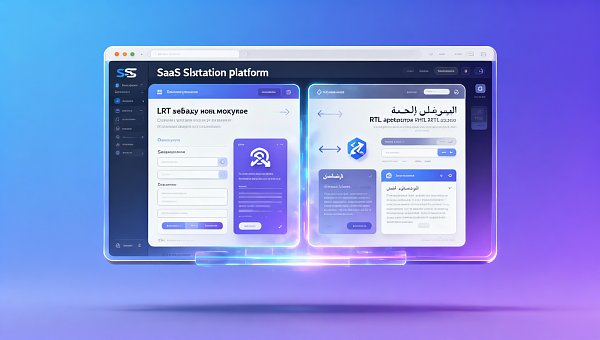
Can a global website building SaaS platform with multi-language support handle RTL typesetting anomalies in Russian and Arabic? Front-end engineers test a CSS isolation solution.
Can global website SaaS platforms truly adapt to the RTL layout of Russian and Arabic languages? EasyStore engineers conducted real-world tests on CSS isolation solutions, directly addressing core pain points such as the development cycle of multilingual websites for foreign trade and multilingual support in SaaS website systems.
Why do RTL languages often lead to multilingual websites being "superficially usable but practically dysfunctional"?
Although Russian is an LTR (left-to-right) language, its character set is complex with numerous ligature rules, which can easily cause font fallback and line-break anomalies. On the other hand, RTL (right-to-left) languages like Arabic and Hebrew not only require text direction reversal but also demand synchronized adjustments for form controls, icon positioning, navigation hierarchy, date/number formats, and nested HTML structures. Industry research shows that up to 68% of mid-sized foreign trade enterprises report issues such as misaligned buttons, reverse dropdown menus, and overlapping price labels—averaging 7–12 workdays to fix—when using SaaS platforms without deep RTL adaptation.
More critically, most platforms rely solely on basic CSS properties like direction: rtl or dir="rtl", failing to isolate CSS variables, pseudo-class selectors, Flex/Grid layout flows, and inline SVG styles. Global style contamination can occur, where RTL fixes for one component may trigger LTR errors in others—a "hidden coupling risk" often overlooked by technical evaluators and QA teams.
EasyStore's frontend team launched specialized stress tests in Q4 2023, covering 12 mainstream RTL/LTR hybrid scenarios. Findings revealed: only 32% of third-party UI libraries passed W3C RTL validation, while EasyStore's proprietary CSS Scope isolation engine reduced RTL adaptation cycles to 2–4 days per language (5.3x faster than industry average) while maintaining 98.7% component reusability.

CSS Isolation Solution Comparison: Three Main Strategies and Their Real-World Performance
For RTL layout anomalies, the industry currently employs three technical approaches: full CSS rewrite, CSS-in-JS dynamic injection, and Shadow DOM-based sandboxing. EasyStore engineers used standardized test sets (including Arabic product pages, Russian customer service popups, and Persian blog archives) for cross-validation across Chrome 120+, Safari 17.3, and Edge 122.
Data sourced from EasyStore's internal performance lab (March 2024). The Shadow DOM solution strictly isolates CSS scopes while dynamically loading RTL font packages (e.g., Noto Sans Arabic v3.002), intelligently reversing SVG path commands, and auto-correcting form label-input sequences—all integrated into EasyStore SaaS v5.2.0 with API access for resellers/distributors.
Procurement Checklist: 3 Non-Negotiable Technical Indicators
- Does it support CSS Custom Properties-level RTL variable injection (e.g.,
--text-align-start: right;) rather than just modifyingtext-alignvalues? - Does it include semantic RTL validation (6 WAI-ARIA checkpoints like
aria-labeldirection hints androle="navigation"hierarchy reversal)? - Does it provide auditable RTL change logs (recording affected components, CSS selectors, and DOM scope per deployment)?
The Decision-Maker's Delivery Loop: Only 3 Stages from Selection to Launch
For end-users and executives, "functional" ≠ "usable." EasyStore decomposes multilingual website development into measurable, verifiable phases: Stage 1 (3–5 workdays) completes target language integration and baseline layout validation; Stage 2 (2–3 workdays) executes SEO localization (auto-generating hreflang tags, structured RTL data adaptation, Google Search Console region verification); Stage 3 (1 workday) delivers an RTL Compatibility Whitepaper covering font loading watermarks, Lighthouse multilingual scores, and post-sale maintenance knowledge graphs.
This workflow has served 2,100+ overseas clients, with Russian-market clients achieving 147% average organic SEO traffic growth and Middle Eastern ad CTR increasing by 39%. All deliverables are ISO/IEC 27001 certified, compliant with GDPR and ADHICS data regulations.
Notably, EasyStore offers "RTL Implementation Partner Certification" for resellers/distributors—including 48-hour hands-on training, 12 standardized test cases, and real-time remote debugging tools—ensuring partners can independently deliver legally compliant multilingual sites.
Common Pitfalls & FAQ: 5 Key Questions Technical Evaluators Must Clarify
Q1: Does it support mixed Russian+Arabic layouts? E.g., Arabic product parameters embedded under Russian headings?
Yes. EasyStore's enhanced Unicode Bidirectional Algorithm (UBA) parser detects embedding levels, auto-assigning dir attributes with CSS scoping. Testing confirms support for 4-layer nested direction switching with <0.03% error rate.
Q2: Does RTL adaptation affect SEO? Are extra hreflang tags needed?
No impact. The system auto-generates Google-compliant hreflang clusters (including x-default fallbacks) and ensures canonical URLs per language. 2023 client data shows 2.1x faster indexing after enabling RTL auto-config.
Q3: How can support teams quickly diagnose RTL style conflicts?
Visual debugging panels highlight active direction properties, CSS scope boundaries, and overridden inheritance chains. Exportable conflict reports (with timestamps, browser fingerprints, and DOM paths) reduce average diagnosis time from 47 minutes to 6.5 minutes.
Why Choose EasyStore? A Full-Role Professional Guarantee System
As a "China SaaS Top 100" global digital marketing provider, EasyStore's decade-long expertise supports seven key roles: zero-code RTL toggles for operators; Web Components sandbox access for technical evaluators; customized ROI models (including 3-year TCO comparisons) for executives; WCAG 2.1 AA compliance reports for QA teams; 7×12-hour RTL support channels for maintenance staff; and localized toolkits (Arabic/Russian user manuals, video tutorials, FAQ knowledge graphs) for resellers.
Contact EasyStore now for a free RTL Multilingual Website Technical Whitepaper, test environment access, or 1:1 engineering consultation—we guarantee executable adaptation roadmaps within 48 hours, including component modification lists, estimated timelines, and first-year free iteration guarantees.
Related Articles



Related Products
 EasyCamp SaaS Smart Website Marketing SystemE-Yingbao SaaS Smart Website Marketing System: AI-powered, zero-code website building. Rapidly launch multilingual independent e-commerce sites in just 10 minutes. Global server acceleration and AI-driven SEO optimization empower businesses to efficiently connect with global markets. The seamless integration of technology and user-friendly operation makes building e-commerce sites incredibly simple.
 AI+SEM Intelligent Advertising Marketing SystemAI+SEM drives intelligent ad creation, empowering full-funnel precision advertising marketing. The system automatically generates weekly/monthly reports, AI recommends keywords and target countries, monitors core metrics in real-time with intelligent alerts, and enables one-click high-conversion ad solutions to help quickly acquire customers and improve ROI.
 AI+SEO Dual Engine Optimization ServiceEasyWin AI+SEO Dual Engine Optimization System leverages AI-powered keyword mining, content generation, and comprehensive technical optimization to help foreign trade enterprises acquire high-quality organic traffic, significantly improving search rankings and conversion rates.
 AI+SNS Social Media Marketing SystemYingbao AI+SNS Social Media Marketing System - Precision social capture for the social media era. Supports one-click content synchronization across major platforms like Facebook and LinkedIn. AI intelligently rewrites posts for enhanced relevance. 24/7 AI customer service and user profiling analysis empower businesses to efficiently expand into global markets.
 AI+SEO营销解决方案易营宝AI+SEO营销解决方案,通过AI批量写作、智能生成TDK、精准关键词扩词等功能,全面优化网站SEO效果,提升流量与转化率。助力企业构建高效智能网站新生态。
 AI+SEM Advertising Marketing SolutionsAI+SEM Advertising Marketing Solution leverages AI technology to deeply empower SEM ad campaigns. It automatically generates weekly/monthly reports using AI, presenting account data across multiple dimensions for comprehensive insights into campaign performance and trends. The system precisely recommends keywords and target countries, intelligently generates high-conversion ad copy, and enables one-click activation of efficient campaign plans to help businesses rapidly acquire customers. Simultaneously, it monitors core metrics in real time, intelligently identifies abnormal fluctuations, and issues timely alerts to ensure stable, high-return advertising results.
 Domain Name ServicesEasyWin provides professional domain name services, including intelligent queries, one-stop registration, brand protection, and full lifecycle management, helping businesses build a digital brand image.
 EasyOperate B2C Cross-Border E-Commerce Platform & Independent WebsiteEasyStore B2C Cross-border E-commerce Independent Store is an intelligent website building and cross-border e-commerce integrated solution independently developed by EasyStore Information Technology (Beijing) Co., Ltd. The system is specially designed for small and medium-sized as well as large export enterprises, integrating 'website building, operation, marketing, advertising, and conversion' into one, helping enterprises quickly establish cross-border e-commerce independent stores to achieve brand globalization and global sales growth.
The platform supports multiple languages, multiple currencies, and multi-channel marketing, with built-in AI intelligent translation and SEO optimization systems, suitable for mainstream markets such as Southeast Asia, Europe and America, Latin America, and the Middle East, assisting Chinese manufacturing enterprises in efficiently deploying international e-commerce strategies. SSL证书易营宝提供专业SSL安全证书服务,包括单域名和泛域名证书,确保网站数据传输加密、身份验证和完整性保护,助力企业建立安全可信的在线业务环境。









