









- What stages does the cross-border services ecosystem include? How do website building, promotion, payment, and compliance work togetherJun 22, 2026View details
- How will email marketing costs change in 2026Jun 22, 2026View details
- The China-US tariff arrangement has reached a preliminary consensus, and the trade association will be establishedJun 15, 2026View details
- Should overseas brand marketing start with ads or contentJun 21, 2026View details
- What determines B2C cross-border e-commerce website development costs? A breakdown of features, interfaces, and deployment methodsJun 17, 2026View details
- China-Morocco zero-tariff access, a breakthrough in the cost of Moroccan goods exports to ChinaJun 11, 2026View details
- What signal should be released for the suspension of exports to JapanJun 10, 2026View details
- China's May LNG imports rebounded, with increased volumes from Russia and Canada filling the Middle East supply gapJun 10, 2026View details
EU launches pilot green website certification: Chinese export companies' official websites must comply with the EN 15804+A2 standard
On 12 May 2026, the European Commission's Directorate-General for Environment officially launched the voluntary pilot program for 'Green Website Certification' (Green Website Certification). The program requires that the 'Sustainability' section of participating companies' official websites calculate and display product carbon footprints in accordance with the EN 15804+A2 standard, and verify data sources through an embedded IFrame with a real-time link to the EU Emissions Trading System (EU ETS) database. If Chinese export enterprises in electromechanical, building materials, and furniture sectors fail to complete the adaptation, they will face adverse impacts in access scoring on government procurement platforms in countries such as Germany and the Netherlands.
Event Overview
On 12 May 2026, the European Commission's Directorate-General for Environment announced the launch of the voluntary pilot program 'Green Website Certification'. According to publicly available information, the pilot requires that the 'Sustainability' section of participating companies' official websites must: (1) use the EN 15804+A2 standard to calculate product carbon footprints; (2) implement a real-time data source link to the EU ETS database through an embedded IFrame; (3) although this certification is voluntary in nature, it has practical business constraints for participating companies——companies that fail to adapt will affect their access scoring on government procurement platforms in countries such as Germany and the Netherlands.
Which market segments will be affected
Direct trading enterprises
Chinese export enterprises in electromechanical, building materials, and furniture categories, as entities directly facing EU buyers, are the most direct target of this pilot. Since their official websites are the first entry point for EU procurement review bodies to examine sustainability information disclosure, failure to display carbon footprint data compliant with the EN 15804+A2 standard and link to the EU ETS database as required will lead to lower access scores in government procurement, thereby affecting their ability to secure orders.
Processing and manufacturing enterprises
Manufacturing enterprises undertaking OEM/ODM roles in the above export categories, although they do not directly operate external-facing official websites, need to provide brand owners or exporters with traceable product-level carbon data calculated under EN 15804+A2. The current impact is reflected in the need for enterprises to cooperate with upstream customers in completing data interface development and verification processes, otherwise this will constrain the continuation of their qualification as compliant suppliers.
Supply chain service enterprises
Enterprises providing carbon accounting consulting, LCA modeling, database integration, and website technical integration services will see business demand rise as the pilot advances. The impact is mainly reflected in customers putting forward clear requirements for localized application capability of EN 15804+A2, EU ETS API integration experience, and compliant deployment capability for embedded IFrame. Non-standardized service solutions may be difficult to meet review and verification needs.
What key points should relevant enterprises or practitioners pay attention to, and how should they respond at present
Monitor whether the pilot scope will expand and the pace of mandatory implementation
At present, this is a voluntary pilot, but the linkage with government procurement scoring has already created de facto constraints. Enterprises need to continuously track subsequent announcements from the European Commission, with particular attention to the pilot end date, disclosure milestones for evaluation results, and whether transitional arrangements or a phased mandatory implementation path will be issued.
Identify the accounting boundaries and data gaps of your export products under EN 15804+A2
Electromechanical, building materials, and furniture products need to compare against the modular requirements in the appendices of EN 15804+A2 regarding 'construction products' and 'general product categories', and clarify the availability of data for stages such as A1–A3 (raw material acquisition, transport, production), C1–C4 (use, reuse, recycling, disposal). What is currently more worthy of attention is whether upstream raw material suppliers have EPD (Environmental Product Declaration) or verifiable electricity mix data.
Verify the compatibility of the existing official website technical architecture for EU ETS database IFrame embedding
API or IFrame calls provided by the EU ETS database need to meet CSP (Content Security Policy) and cross-domain access specifications. Enterprise IT teams or website service providers should test in advance the ability of mainstream CMS (such as WordPress, Shopify, and self-developed systems) to load the official EU ETS IFrame in an HTTPS environment, so as to avoid verification failure caused by browser blocking.
Differentiate between policy signals and the implementation pace of procurement practices
Government procurement platforms in Germany and the Netherlands have not yet simultaneously published revised texts of the scoring rules. Enterprises should not immediately carry out a comprehensive overhaul of their official websites, but should prioritize completing carbon footprint accounting and IFrame verification prototypes for 1–2 key export products, while retaining complete process documentation, so as to reserve interfaces and evidence chains for subsequent rapid response to review requirements.
Editorial Viewpoint / Industry Observation
Observably, this pilot is not a regulatory mandate yet, but a procedural signal targeting digital transparency in sustainability claims. It reflects the EU’s shift from verifying carbon data via third-party reports to requiring real-time, system-integrated disclosure at the point of market access. Analysis shows that its immediate impact lies less in compliance cost and more in exposing gaps between existing LCA practice in Chinese manufacturing and the interoperability expectations of EU digital procurement infrastructure. From an industry perspective, it functions primarily as a readiness test—not for carbon accounting capability alone, but for the ability to connect environmental data to official registries through standardized web interfaces.
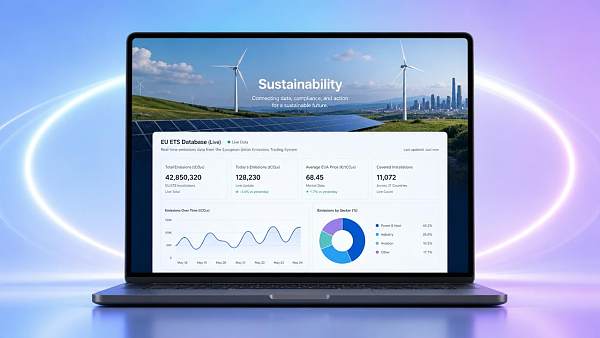
Conclusion: This pilot does not directly add a carbon tariff or mandatory certification, but incorporates sustainability information disclosure into the operating logic of digital procurement infrastructure. At present, it is more appropriate to understand it as a 'digital compliance stress test' for export enterprises, with its core value being to drive enterprises from static reporting thinking toward dynamic data connectivity capability. The industry needs to view its phased positioning rationally, avoiding both overreaction and underestimation of its significance in restructuring the role of official websites as digital trade portals.
Information source note:
Main source: Official announcement by the European Commission's Directorate-General for Environment (DG ENV) on 12 May 2026.
Parts requiring continued observation: the number of enterprises covered by the pilot, the revised texts of specific scoring rules on government procurement platforms in Germany/the Netherlands, and the official release timing of IFrame call interface documentation from the EU ETS database for third-party websites.
Related Articles
 Why is it that your foreign trade peers receive inquiries every day, while you can only wait for exhibitions?
 Foreign trade websites "look good but don’t convert"? Yiyingbao’s global language automatic adaptation, inquiries surge!
 Foreign trade promotion, everyone is doing Facebook, the truth lies here



Related Products
 EasyCamp SaaS Smart Website Marketing SystemE-Yingbao SaaS Smart Website Marketing System: AI-powered, zero-code website building. Rapidly launch multilingual independent e-commerce sites in just 10 minutes. Global server acceleration and AI-driven SEO optimization empower businesses to efficiently connect with global markets. The seamless integration of technology and user-friendly operation makes building e-commerce sites incredibly simple.
 AI+SEM Intelligent Advertising Marketing SystemAI+SEM drives intelligent ad creation, empowering full-funnel precision advertising marketing. The system automatically generates weekly/monthly reports, AI recommends keywords and target countries, monitors core metrics in real-time with intelligent alerts, and enables one-click high-conversion ad solutions to help quickly acquire customers and improve ROI.
 AI+SEO Dual Engine Optimization ServiceEasyWin AI+SEO Dual Engine Optimization System leverages AI-powered keyword mining, content generation, and comprehensive technical optimization to help foreign trade enterprises acquire high-quality organic traffic, significantly improving search rankings and conversion rates.
 AI+SNS Social Media Marketing SystemYingbao AI+SNS Social Media Marketing System - Precision social capture for the social media era. Supports one-click content synchronization across major platforms like Facebook and LinkedIn. AI intelligently rewrites posts for enhanced relevance. 24/7 AI customer service and user profiling analysis empower businesses to efficiently expand into global markets.
 AI+SEO营销解决方案易营宝AI+SEO营销解决方案,通过AI批量写作、智能生成TDK、精准关键词扩词等功能,全面优化网站SEO效果,提升流量与转化率。助力企业构建高效智能网站新生态。
 AI+SEM Advertising Marketing SolutionsAI+SEM Advertising Marketing Solution leverages AI technology to deeply empower SEM ad campaigns. It automatically generates weekly/monthly reports using AI, presenting account data across multiple dimensions for comprehensive insights into campaign performance and trends. The system precisely recommends keywords and target countries, intelligently generates high-conversion ad copy, and enables one-click activation of efficient campaign plans to help businesses rapidly acquire customers. Simultaneously, it monitors core metrics in real time, intelligently identifies abnormal fluctuations, and issues timely alerts to ensure stable, high-return advertising results.
 Domain Name ServicesEasyWin provides professional domain name services, including intelligent queries, one-stop registration, brand protection, and full lifecycle management, helping businesses build a digital brand image.
 EasyOperate B2C Cross-Border E-Commerce Platform & Independent WebsiteEasyStore B2C Cross-border E-commerce Independent Store is an intelligent website building and cross-border e-commerce integrated solution independently developed by EasyStore Information Technology (Beijing) Co., Ltd. The system is specially designed for small and medium-sized as well as large export enterprises, integrating 'website building, operation, marketing, advertising, and conversion' into one, helping enterprises quickly establish cross-border e-commerce independent stores to achieve brand globalization and global sales growth.
The platform supports multiple languages, multiple currencies, and multi-channel marketing, with built-in AI intelligent translation and SEO optimization systems, suitable for mainstream markets such as Southeast Asia, Europe and America, Latin America, and the Middle East, assisting Chinese manufacturing enterprises in efficiently deploying international e-commerce strategies. SSL证书易营宝提供专业SSL安全证书服务,包括单域名和泛域名证书,确保网站数据传输加密、身份验证和完整性保护,助力企业建立安全可信的在线业务环境。









