









- What stages does the cross-border services ecosystem include? How do website building, promotion, payment, and compliance work togetherJun 22, 2026View details
- How will email marketing costs change in 2026Jun 22, 2026View details
- The China-US tariff arrangement has reached a preliminary consensus, and the trade association will be establishedJun 15, 2026View details
- Should overseas brand marketing start with ads or contentJun 21, 2026View details
- What determines B2C cross-border e-commerce website development costs? A breakdown of features, interfaces, and deployment methodsJun 17, 2026View details
- China-Morocco zero-tariff access, a breakthrough in the cost of Moroccan goods exports to ChinaJun 11, 2026View details
- What signal should be released for the suspension of exports to JapanJun 10, 2026View details
- China's May LNG imports rebounded, with increased volumes from Russia and Canada filling the Middle East supply gapJun 10, 2026View details
U.S. FDA updates digital labeling guidance: Chinese export companies' official websites must embed multilingual instructions and real-time traceability interfaces
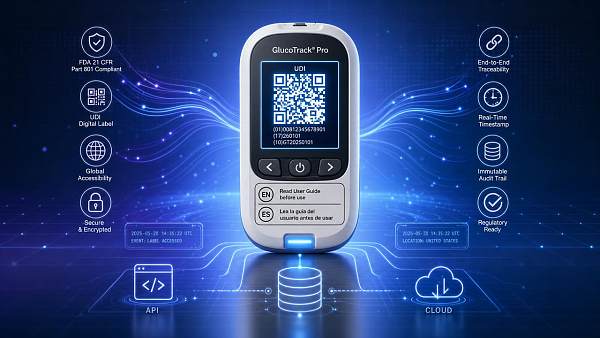
On May 12, 2026, the U.S. Food and Drug Administration (FDA) officially issued the revised Digital Labeling Compliance Guidance, for the first time designating corporate official websites as statutory labeling carriers, and setting out clear digital performance requirements for Chinese suppliers in specific product categories exporting to the United States. This policy directly affects the export ecosystem to the U.S. in highly regulated sectors such as food and medical devices, with the core shift being the extension of traditional paper/packaging labeling obligations to the technical capabilities of online platforms, marking an upgrade in regulatory logic from ‘product compliance’ to ‘full-chain digital trustworthiness’.
Event Overview
On May 12, 2026, the U.S. FDA officially released the revised Digital Labeling Compliance Guidance, mandating that from January 2027 onward, all suppliers exporting Class II and above medical devices, infant food, and dietary supplements to the United States must provide bilingual electronic instructions in English+Spanish on their corporate official websites, and support API integration with the FDA UDI (Unique Device Identification) and FSMA (Food Safety Modernization Act) systems to enable real-time batch-level traceability. This requirement does not replace existing packaging labels, but constitutes an independent compliance element; failure to comply may result in import customs clearance delays, escalated FDA on-site inspections, or the risk of importer rejection.
Which Sub-Sectors Will Be Affected
Direct trading enterprises: As the “Responsible Party” recognized by the FDA, they must assume primary responsibility for labeling content on their official websites. The impact is reflected in: ① official websites must complete the structured deployment and version management of bilingual instructions; ② API services must be developed in-house or procured to connect with FDA systems, with long technical validation cycles; ③ importers have already begun incorporating official website traceability capabilities into supplier admission assessments, directly affecting order acquisition.
Raw material sourcing enterprises: Although not directly registered with the FDA, if the raw materials they supply are used in regulated end products (such as infant formula base powder or sterile medical dressing substrates), they must provide downstream manufacturers with raw material batch data that can be embedded into traceability systems. The impact is reflected in: ① existing batch record formats (such as Excel ledgers) no longer meet API direct-connection requirements; ② a data collaboration mechanism with the manufacturing side must be established, otherwise traceability gaps in the end product will occur.
Processing and manufacturing enterprises: As the source of UDI/FSMA data, they undertake the triple tasks of batch number generation, code assignment, and instruction association. The impact is reflected in: ① existing MES/ERP systems generally lack external API modules, making retrofitting costly; ② instruction content must be dynamically bound to each batch (for example, different production dates corresponding to different allergen statements), which static webpages cannot support; ③ bilingual instructions require professional medical translation + localization adaptation, which cannot be covered by simple machine translation.
Supply chain service enterprises: Including cross-border compliance consulting, digital labeling SaaS providers, API integrators, etc. The impact is reflected in: ① service demand is shifting from “single-point certification guidance” to full-stack delivery of “official website-system-data”; ② providers need composite capabilities such as FDA UDI database parsing, Spanish medical terminology libraries, and FSMA Section 204 data mapping; ③ if small and medium-sized service providers only offer template-based website building, it will be difficult for them to pass importers’ technical due diligence.
Key Focus Areas and Response Measures for Relevant Enterprises or Practitioners
Confirm whether your products fall within the mandatory scope
Not all exported food/devices are applicable——only Class II and above medical devices in FDA classifications (including some home-use testing devices), infant food defined under CFR Title 21 Part 106, and dietary supplements regulated under the Dietary Supplement Health and Education Act (DSHEA). Enterprises must cross-check according to FDA product codes (Product Code) and classification databases to avoid misjudgment that unnecessarily expands the scope of rectification.
Differentiate between the two levels of “official website display” and “compliance interface”
Putting bilingual instructions online is only a surface-level action; the key is that the API interface must pass validation in FDA-designated test environments (such as FDA’s UDI Test System), and continuous availability of over 99.5% must be ensured. From the analysis, most Chinese official websites currently only satisfy front-end display requirements and have not deployed data middleware compliant with HL7/FHIR standards, leaving substantive compliance gaps.
Establish a cross-departmental collaboration mechanism
Instruction content involves regulatory affairs (compliance), medical affairs (clinical statements), IT departments (API development), and marketing departments (multilingual copywriting). A dedicated project team should be established and data ownership clearly defined. Observationally, some leading enterprises have already incorporated the “digital labeling responsible person” into quality management system (QMS) documentation, granting them sign-off authority equivalent to QA.
Editor’s View / Industry Observation
What is currently more noteworthy is that the FDA has not set any transition exemption period this time, and has directly linked official website traceability capabilities with FSMA Section 204 “critical tracking records”—this means the requirement is not an isolated labeling policy, but rather a technical support point embedded in the U.S. end-to-end food/device safety early warning system. It is more appropriately understood as: the FDA is using digital infrastructure to force the global supply chain to improve data granularity and system interoperability. For Chinese enterprises, the challenge lies not in translation or website building, but in breaking the long-standing separation among “business systems-compliance systems-marketing systems”.
Conclusion
The essence of this guidance is a shift in the regulatory paradigm: from verifying “whether the product is qualified” to verifying “whether the enterprise has trustworthy digital performance capabilities”. In the short term, it increases compliance costs; in the medium and long term, enterprises that take the lead in building official website traceability capabilities will gain structural advantages in importers’ preferred partner lists, intelligent sorting in overseas warehouses, and even FDA fast-track review channels. The rational conclusion from observation is: this is not a one-time response task, but an essential milestone in the globalization of digital infrastructure for Chinese enterprises.
Information Source Notes
Official sources: the Digital Labeling Compliance Guidance (Revision #3, May 2026), document number FDA-2026-DLG-001, published on the official U.S. FDA website; supporting technical document API Integration Specifications for Real-Time Batch Traceability v1.2. Items for continued observation: whether the FDA will release implementation FAQs for non-native English-speaking enterprises in Q4 2026; and whether the EU EMA and Japan PMDA will follow up with similar digital labeling requirements.
Related Articles
 Why is it that your foreign trade peers receive inquiries every day, while you can only wait for exhibitions?
 Foreign trade websites "look good but don’t convert"? Yiyingbao’s global language automatic adaptation, inquiries surge!
 Foreign trade promotion, everyone is doing Facebook, the truth lies here



Related Products
 EasyCamp SaaS Smart Website Marketing SystemE-Yingbao SaaS Smart Website Marketing System: AI-powered, zero-code website building. Rapidly launch multilingual independent e-commerce sites in just 10 minutes. Global server acceleration and AI-driven SEO optimization empower businesses to efficiently connect with global markets. The seamless integration of technology and user-friendly operation makes building e-commerce sites incredibly simple.
 AI+SEM Intelligent Advertising Marketing SystemAI+SEM drives intelligent ad creation, empowering full-funnel precision advertising marketing. The system automatically generates weekly/monthly reports, AI recommends keywords and target countries, monitors core metrics in real-time with intelligent alerts, and enables one-click high-conversion ad solutions to help quickly acquire customers and improve ROI.
 AI+SEO Dual Engine Optimization ServiceEasyWin AI+SEO Dual Engine Optimization System leverages AI-powered keyword mining, content generation, and comprehensive technical optimization to help foreign trade enterprises acquire high-quality organic traffic, significantly improving search rankings and conversion rates.
 AI+SNS Social Media Marketing SystemYingbao AI+SNS Social Media Marketing System - Precision social capture for the social media era. Supports one-click content synchronization across major platforms like Facebook and LinkedIn. AI intelligently rewrites posts for enhanced relevance. 24/7 AI customer service and user profiling analysis empower businesses to efficiently expand into global markets.
 AI+SEO营销解决方案易营宝AI+SEO营销解决方案,通过AI批量写作、智能生成TDK、精准关键词扩词等功能,全面优化网站SEO效果,提升流量与转化率。助力企业构建高效智能网站新生态。
 AI+SEM Advertising Marketing SolutionsAI+SEM Advertising Marketing Solution leverages AI technology to deeply empower SEM ad campaigns. It automatically generates weekly/monthly reports using AI, presenting account data across multiple dimensions for comprehensive insights into campaign performance and trends. The system precisely recommends keywords and target countries, intelligently generates high-conversion ad copy, and enables one-click activation of efficient campaign plans to help businesses rapidly acquire customers. Simultaneously, it monitors core metrics in real time, intelligently identifies abnormal fluctuations, and issues timely alerts to ensure stable, high-return advertising results.
 Domain Name ServicesEasyWin provides professional domain name services, including intelligent queries, one-stop registration, brand protection, and full lifecycle management, helping businesses build a digital brand image.
 EasyOperate B2C Cross-Border E-Commerce Platform & Independent WebsiteEasyStore B2C Cross-border E-commerce Independent Store is an intelligent website building and cross-border e-commerce integrated solution independently developed by EasyStore Information Technology (Beijing) Co., Ltd. The system is specially designed for small and medium-sized as well as large export enterprises, integrating 'website building, operation, marketing, advertising, and conversion' into one, helping enterprises quickly establish cross-border e-commerce independent stores to achieve brand globalization and global sales growth.
The platform supports multiple languages, multiple currencies, and multi-channel marketing, with built-in AI intelligent translation and SEO optimization systems, suitable for mainstream markets such as Southeast Asia, Europe and America, Latin America, and the Middle East, assisting Chinese manufacturing enterprises in efficiently deploying international e-commerce strategies. SSL证书易营宝提供专业SSL安全证书服务,包括单域名和泛域名证书,确保网站数据传输加密、身份验证和完整性保护,助力企业建立安全可信的在线业务环境。









