









- The China-US tariff arrangement has reached a preliminary consensus, and the trade association will be establishedJun 15, 2026View details
- What determines B2C cross-border e-commerce website development costs? A breakdown of features, interfaces, and deployment methodsJun 17, 2026View details
- China-Morocco zero-tariff access, a breakthrough in the cost of Moroccan goods exports to ChinaJun 11, 2026View details
- What signal should be released for the suspension of exports to JapanJun 10, 2026View details
- China's May LNG imports rebounded, with increased volumes from Russia and Canada filling the Middle East supply gapJun 10, 2026View details
- Will GEO change its SEO strategy?Jun 04, 2026View details
Cross-border foreign trade building site practical guide: how to go live and collect payment through local payment within 30 days?

This guide teaches you how to use an AI-driven multilingual foreign trade website system, enabling you to go live in 30 days and achieve local payment collection. It is suitable for market researchers and operational staff.

Against the backdrop of rapid cross-border business development, the main pain points faced by enterprises include: difficulties in multilingual content management, complexity in local payment integration, poor site performance and localized SEO effectiveness, and diverse compliance and tax requirements. This article addresses general internet service scenarios, providing an actionable 30-day roadmap and technical implementation recommendations—from project preparation, website setup, payment integration to post-launch operations—to help users responsible for building and managing websites quickly establish a revenue-generating independent site. It incorporates best practices for enterprise-level multilingual CMS and global website SaaS platforms, offering reusable checklists and optimization tips.
Phase One: Days 1–7—Project Preparation and Technology Selection
The first week of project initiation determines launch efficiency and future scalability. Core tasks include defining target markets, organizing product and logistics strategies, selecting a suitable multilingual foreign trade website system, and finalizing payment and compliance solutions. Follow these steps:
Market and User Persona: Based on target countries’ consumption habits, language preferences, dominant social media, and search channels, create actionable user personas (e.g., Southeast Asia relies on mobile social media for traffic, while Europe and the U.S. emphasize branding and on-site conversion).
Tech Stack and SaaS Evaluation: Prioritize systems supporting multilingual, responsive self-service website builders, enterprise-grade multilingual CMS, and full-stack SEO modules. Evaluate features like multi-currency switching, IP localization, 300+ language auto-translation, global CDN nodes, and automated SSL issuance.
Payment and Compliance Checklist: Confirm common payment methods in target markets (credit cards, local wallets, bank transfers) and list required credentials (company registration, payment licenses, tax IDs) and risk control requirements. Pre-engage payment providers to clarify integration workflows and KYC needs.
Domain, Hosting, and Performance Goals: Choose SEO- and localization-friendly domain strategies (top-level or country-specific domains) and plan CDN, server regions, and caching to ensure local access speeds outperform competitors (e.g., page load times under 3 seconds).
After completing these steps, the team should draft a project plan with timelines and responsibilities, laying the foundation for the build phase.
Phase Two: Days 8–18—Website Setup and Content Preparation (Including Multilingual and SEO)
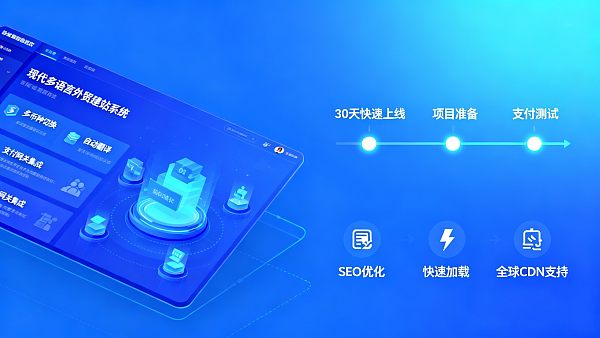
In these ten days, the goal is to build the site framework, complete multilingual page templates, and deploy the first batch of products and essential content (policy pages, shipping info, FAQs). Follow a modular workflow to avoid structural inconsistencies before launch. Key actions:
1. Site Structure and Template Setup
Use drag-and-drop tools from responsive self-service website systems to save front-end development time. Start with homepage, category pages, product detail pages, checkout pages, and mobile-adaptive templates. Ensure clear URL structures with language and country parameters (e.g., /en-us/product/ or subdomains) and auto-generate sitemaps and standardized tags for search engine crawling and ranking.
2. Multilingual Content and Auto-Translation Strategy
Combine AI translation with human review: Use AI-powered multilingual website systems for initial drafts, then have native speakers refine brand tone and industry terminology. Prioritize localizing purchase flows, return policies, and payment prompts, as these directly impact conversion. Leverage systems’ auto-generated TDK to ensure unique, optimized meta tags and descriptions for each language version.
3. Content SEO and Technical Optimization
After deploying full-stack SEO modules, optimize page speed (image compression, lazy loading, preloading key resources), add structured data markup (products, reviews, breadcrumbs), and configure hreflang tags to avoid multilingual page cannibalization. Expand keyword strategies to semantically related long-tail queries, covering search intent and localized expressions.
For higher efficiency, consider integrating mature all-in-one platforms, such as SaaS solutions combining AI marketing engines and social media APIs, to accelerate content generation and traffic conversion. For enterprise-grade cross-border e-commerce setups, refer to EasyB2C Cross-Border Marketplace for template-driven cloud deployment.
Phase Three: Days 19–25—Localized Payment Integration and Revenue Testing
Payment integration is critical for cross-border independent sites to achieve local collections. Success hinges on combining localized payment solutions, compliance, and end-to-end testing. Follow this checklist:
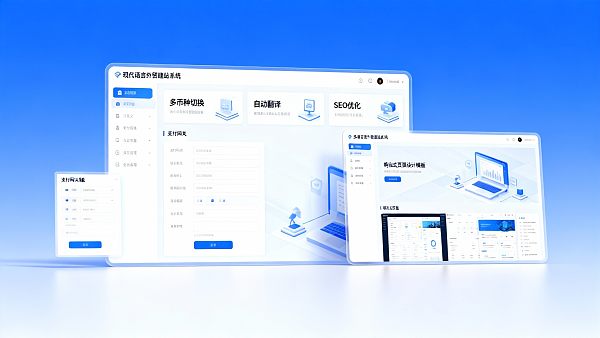
Payment Gateway Selection: Prioritize providers supporting multi-currency switching and auto-exchange rate display, compatible with credit cards (Visa/Mastercard), local wallets (e.g., GoPay, ShopeePay in Southeast Asia), and bank transfers.
Compliance and Risk Control: Ensure PCI-DSS compliance or use hosted payment pages to reduce compliance costs. Configure risk rules (transaction frequency, amount thresholds, IP/device fingerprints) and sync with logistics and CRM systems for abnormal order handling.
Payment Flow and UX: Minimize checkout fields, display local language and currency, and integrate common local payment methods. A/B test different flows (one-page vs. multi-step checkout) to optimize conversion.
End-to-End Testing: Simulate real orders with different currencies, country IPs, payment methods, and refund flows to validate settlement speed, refund processes, and reconciliation accuracy. Retain test logs for provider communication.
After this phase, the site should support stable revenue collection, ready for traffic campaigns and market promotions.
Phase Four: Days 26–30—Traffic Preparation and Pre-Launch Optimization
The final five days focus on traffic preparation, ad setup, and conversion optimization. The goal is to ensure visible traffic entry points and smooth conversion paths on launch day. Key steps:
Pre-Launch Marketing and Ad Setup
Activate multi-channel campaigns during warm-up: Google Ads for search and shopping, social platforms (Facebook/Instagram/TikTok) for short videos and interactive ads. Use AI ad managers to optimize creatives and bidding, pre-generating high-CTR ad copy and multilingual assets to reduce initial costs and enable rapid iteration.
Conversion Tracking and Analytics
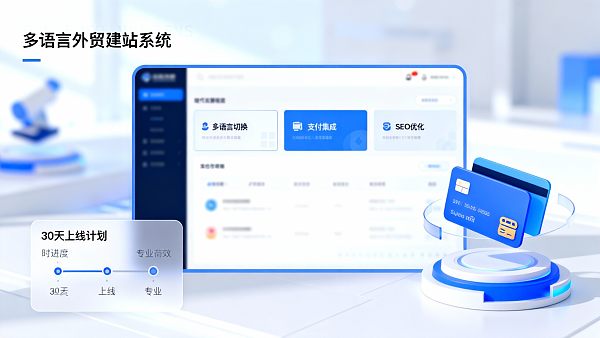
Pre-launch, configure full conversion tracking (Google Analytics/GA4, pixels, UTM parameters) and integrate CRM to track repeat purchases and user lifetime value. Enable behavioral tracking and tagging for personalized recommendations and email marketing.
Pre-Launch Checklist
Page speed, mobile responsiveness, and checkout flow testing completed.
Payment and refund flows validated, compliance materials ready.
SEO basics (hreflang, sitemap, robots) and initial ad plans deployed.
After these steps, the site can launch within 30 days with local payment capabilities. Post-launch, use data-driven optimization for traffic structure and product page conversion.
Summary and Actionable Recommendations
With clear project planning and phased execution, combined with AI-driven multilingual foreign trade website systems and enterprise-grade multilingual CMS, cross-border sites can go from 0 to 1 in 30 days. Key factors: choosing a global website SaaS platform supporting multi-currency switching, AI translation, and full-stack SEO; pre-aligning local payment and compliance requirements; and completing end-to-end validation pre-launch. Technical and operational synergy significantly shortens launch cycles and boosts revenue success.
If you’re in the research or preparation phase, consult professional service providers to leverage mature cross-border e-commerce capabilities and region-specific solutions, avoiding trial and error. For solution details or a 30-day implementation template and quote, contact our advisory team for customized launch support.
- Foreign Trade Website Development
- Mobile-friendly
- TikTok
- Yiyingbao
- SEO
- Independent Website
- AI Translation
- AI Marketing Engine
- Multilingual Foreign Trade Website System
- Global Website Building SaaS Platform
- Cross-border E-commerce Website
- Responsive self-service website system
- AI multilingual website system
- Geo-targeted Website Solution
- Enterprise-Grade Multilingual CMS
- Cross-border E-commerce Website
- Foreign Trade Website System
- Multilingual Website System
Related Articles
 Does a responsive corporate website need to be built? Applicable scenarios, advantages and upgrade criteria
 How much does responsive website development cost? Design, front-end, and functionality development expenses make up the total
 What Should You Pay Attention to in Responsive Website Development? Page Adaptation, Speed and SEO Key Points

Related Products
 EasyCamp SaaS Smart Website Marketing SystemE-Yingbao SaaS Smart Website Marketing System: AI-powered, zero-code website building. Rapidly launch multilingual independent e-commerce sites in just 10 minutes. Global server acceleration and AI-driven SEO optimization empower businesses to efficiently connect with global markets. The seamless integration of technology and user-friendly operation makes building e-commerce sites incredibly simple.
 AI+SEM Intelligent Advertising Marketing SystemAI+SEM drives intelligent ad creation, empowering full-funnel precision advertising marketing. The system automatically generates weekly/monthly reports, AI recommends keywords and target countries, monitors core metrics in real-time with intelligent alerts, and enables one-click high-conversion ad solutions to help quickly acquire customers and improve ROI.
 AI+SEO Dual Engine Optimization ServiceEasyWin AI+SEO Dual Engine Optimization System leverages AI-powered keyword mining, content generation, and comprehensive technical optimization to help foreign trade enterprises acquire high-quality organic traffic, significantly improving search rankings and conversion rates.
 AI+SNS Social Media Marketing SystemYingbao AI+SNS Social Media Marketing System - Precision social capture for the social media era. Supports one-click content synchronization across major platforms like Facebook and LinkedIn. AI intelligently rewrites posts for enhanced relevance. 24/7 AI customer service and user profiling analysis empower businesses to efficiently expand into global markets.
 AI+SEO营销解决方案易营宝AI+SEO营销解决方案,通过AI批量写作、智能生成TDK、精准关键词扩词等功能,全面优化网站SEO效果,提升流量与转化率。助力企业构建高效智能网站新生态。
 AI+SEM Advertising Marketing SolutionsAI+SEM Advertising Marketing Solution leverages AI technology to deeply empower SEM ad campaigns. It automatically generates weekly/monthly reports using AI, presenting account data across multiple dimensions for comprehensive insights into campaign performance and trends. The system precisely recommends keywords and target countries, intelligently generates high-conversion ad copy, and enables one-click activation of efficient campaign plans to help businesses rapidly acquire customers. Simultaneously, it monitors core metrics in real time, intelligently identifies abnormal fluctuations, and issues timely alerts to ensure stable, high-return advertising results.
 Domain Name ServicesEasyWin provides professional domain name services, including intelligent queries, one-stop registration, brand protection, and full lifecycle management, helping businesses build a digital brand image.
 EasyOperate B2C Cross-Border E-Commerce Platform & Independent WebsiteEasyStore B2C Cross-border E-commerce Independent Store is an intelligent website building and cross-border e-commerce integrated solution independently developed by EasyStore Information Technology (Beijing) Co., Ltd. The system is specially designed for small and medium-sized as well as large export enterprises, integrating 'website building, operation, marketing, advertising, and conversion' into one, helping enterprises quickly establish cross-border e-commerce independent stores to achieve brand globalization and global sales growth.
The platform supports multiple languages, multiple currencies, and multi-channel marketing, with built-in AI intelligent translation and SEO optimization systems, suitable for mainstream markets such as Southeast Asia, Europe and America, Latin America, and the Middle East, assisting Chinese manufacturing enterprises in efficiently deploying international e-commerce strategies. SSL证书易营宝提供专业SSL安全证书服务,包括单域名和泛域名证书,确保网站数据传输加密、身份验证和完整性保护,助力企业建立安全可信的在线业务环境。









