









- How to assess foreign trade website development trends?Looking at 2026 changes from multilingual,AI content to conversion pathsJul 04, 2026View details
- What are the new trends in multilingual marketing data analytics tools in 2026? Focus on attribution、automation and complianceJul 04, 2026View details
- Is Brand Globalization Marketing Consulting Worth Buying? At What Stage Should Companies Bring It InJul 01, 2026View details
- Cross-Border Marketing Trend Research: Why More and More Companies Are Starting to Deploy AI Search and GEO OptimizationJun 30, 2026View details
- Cross-Border Marketing Trend Research: How Independent Sites, AI Content, and Short-Video Customer Acquisition Are ChangingJun 30, 2026View details
- How Can a Brand Updates Page Be Made More SEO-Friendly? Analysis of Update Frequency, Content Structure, and Internal Linking StrategyJun 28, 2026View details
What to do if your overseas website is slow? Enterprise-grade CDN, DNS and performance optimization in action

What to do if your overseas website loads slowly? This article provides practical solutions using enterprise-grade CDN, DNS, and performance optimization techniques to identify bottlenecks and implement acceleration strategies, improving overseas loading speeds and conversion rates. Targeting users, business decision-makers, project managers, and operations teams, it covers a complete technical path from fault diagnosis, network layer optimization, to frontend rendering and backend architecture, supported by case studies and quantifiable metrics to help B2B and B2C enterprises quickly restore global user experience, reduce churn, and lower customer acquisition costs.
1. First Step: Efficiently Diagnosing the Root Causes of Slow Overseas Access
The first step in addressing "What to do if your overseas website loads slowly?" is precise diagnosis. We recommend using synthetic monitoring alongside real user monitoring (RUM): synthetic monitoring allows scripted load testing from multiple country nodes to pinpoint DNS resolution time, TCP handshake, TLS setup, time to first byte (TTFB), and resource loading sequence; RUM reflects real user performance across different network conditions. The diagnostic process should include: 1) DNS resolution time comparison (local vs. authoritative resolution); 2) routing and packet loss detection (using traceroute and mtr); 3) CDN back-to-origin and cache hit rate analysis; 4) identification of critical rendering path blockers (key CSS/JS/fonts); and 5) mobile network adaptation and bandwidth jitter. Quantifiable metrics (e.g., TTFB, LCP, CLS variations) help determine whether issues lie at the network, transport, or application layer, avoiding blind vendor switching or ineffective investments.
2. Enterprise CDN Deployment: Strategy Matters More Than Single-Point Acceleration
Enterprise CDN isn't about choosing vendors with the most nodes but designing acceleration strategies aligned with business needs. Key deployment aspects include: edge node coverage and quality assessment, caching policies (long-term static caching, dynamic content fragment caching, API caching rules), origin optimization (Origin Shield, back-to-origin bandwidth bundling), and multi-path disaster recovery. For foreign trade independent sites (How to Build a Foreign Trade Independent Site?), we recommend multi-POP deployment with intelligent routing, combining localized caching to place critical rendering resources and multilingual pages on the nearest nodes, reducing cross-ocean back-to-origin frequency. Enable HTTP/2 or HTTP/3, Brotli compression, lazy image loading, and edge-side includes (ESI) to significantly reduce time to interactivity (TTI). Key metrics should focus on cache hit rates, back-to-origin traffic ratio, and TTI, with A/B testing to validate improvements.
3. DNS and Anycast Optimization: Reducing Resolution and Routing Delays
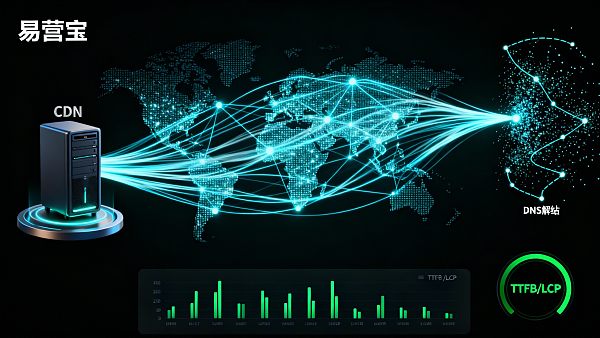
DNS resolution is a common bottleneck affecting overseas access, especially with complex query chains or improper TTL settings. Enterprises should adopt Anycast DNS to shorten resolution paths, improve availability, and optimize TTL strategies to balance frequent updates with cache efficiency. Specific measures include: globally distributed authoritative DNS services, DNSSEC for resolution integrity, and co-locating authoritative resolution with CDN nodes to reduce recursive lookup time. Ensure domain registration and WHOIS information compliance to avoid misjudgment or hijacking. For cross-border markets, implement secondary domain strategies and intelligent resolution rules (based on geography, ASN, or network quality), while monitoring resolution success rates and average latency. For compliance or backup issues, leverage professional services for rapid resolution to minimize access fluctuations caused by backup delays.Domestic ICP Filing Service
4. Frontend and Backend Parallel Optimization: Full-Stack Acceleration from Resources to Rendering
Frontend optimization and backend refactoring must progress in parallel to fundamentally improve overseas user experience. Frontend priorities include: streamlining critical rendering resources, enabling Critical CSS, deferring non-essential JS, preconnecting third-party domains (preconnect/preload), and using WebP/AVIF images with responsive loading. Backend focuses include: transport compression (Brotli/Gzip), Keep-Alive connections, database read/write separation with caching layers (Redis, CDN), and reducing origin requests via local or edge caching. For commercial pages on foreign trade sites, strategically split static and dynamic content with differentiated CDN caching rules to maximize concurrency without compromising personalized recommendations. Continuous monitoring and alerts (error rates, timeouts, 95/99 percentile response times) form a long-term optimization loop, ensuring no performance regression with each release.

Summary and Actionable Recommendations
Summary: The effective approach to "What to do if your overseas website loads slowly?" is data-driven, layer-by-layer troubleshooting combined with enterprise CDN and DNS strategies, plus parallel frontend/backend optimization. Establish baselines via synthetic and real user monitoring, choose CDN vendors supporting Anycast and edge computing, optimize DNS resolution policies, and plan caching and back-to-origin strategies to significantly reduce TTFB and above-the-fold load times, boosting SEO and conversions. Leveraging global server clusters, AI-driven site-building tools, and compliant professional services, we provide one-stop solutions for overseas enterprises. For compliance or deployment issues, use our Domestic ICP Filing Service to expedite approvals with year-round advisory support. Contact us now for a free performance diagnosis and customized acceleration plan to help your independent site achieve faster global loading and higher conversions.
Related Articles
 Should marketing-oriented website development start with design or with defining the conversion path?A planning method to avoid rework
 Are maintenance costs high for multilingual SEO on a marketing-oriented website?Break down content、labor and technical expenses
 EU EPR new regulations updated,independent site checkout page must embed DPR-ID



Related Products
 EasyCamp SaaS Smart Website Marketing SystemE-Yingbao SaaS Smart Website Marketing System: AI-powered, zero-code website building. Rapidly launch multilingual independent e-commerce sites in just 10 minutes. Global server acceleration and AI-driven SEO optimization empower businesses to efficiently connect with global markets. The seamless integration of technology and user-friendly operation makes building e-commerce sites incredibly simple.
 AI+SEM Intelligent Advertising Marketing SystemAI+SEM drives intelligent ad creation, empowering full-funnel precision advertising marketing. The system automatically generates weekly/monthly reports, AI recommends keywords and target countries, monitors core metrics in real-time with intelligent alerts, and enables one-click high-conversion ad solutions to help quickly acquire customers and improve ROI.
 AI+SEO Dual Engine Optimization ServiceEasyWin AI+SEO Dual Engine Optimization System leverages AI-powered keyword mining, content generation, and comprehensive technical optimization to help foreign trade enterprises acquire high-quality organic traffic, significantly improving search rankings and conversion rates.
 AI+SNS Social Media Marketing SystemYingbao AI+SNS Social Media Marketing System - Precision social capture for the social media era. Supports one-click content synchronization across major platforms like Facebook and LinkedIn. AI intelligently rewrites posts for enhanced relevance. 24/7 AI customer service and user profiling analysis empower businesses to efficiently expand into global markets.
 AI+SEO营销解决方案易营宝AI+SEO营销解决方案,通过AI批量写作、智能生成TDK、精准关键词扩词等功能,全面优化网站SEO效果,提升流量与转化率。助力企业构建高效智能网站新生态。
 AI+SEM Advertising Marketing SolutionsAI+SEM Advertising Marketing Solution leverages AI technology to deeply empower SEM ad campaigns. It automatically generates weekly/monthly reports using AI, presenting account data across multiple dimensions for comprehensive insights into campaign performance and trends. The system precisely recommends keywords and target countries, intelligently generates high-conversion ad copy, and enables one-click activation of efficient campaign plans to help businesses rapidly acquire customers. Simultaneously, it monitors core metrics in real time, intelligently identifies abnormal fluctuations, and issues timely alerts to ensure stable, high-return advertising results.
 Domain Name ServicesEasyWin provides professional domain name services, including intelligent queries, one-stop registration, brand protection, and full lifecycle management, helping businesses build a digital brand image.
 EasyOperate B2C Cross-Border E-Commerce Platform & Independent WebsiteEasyStore B2C Cross-border E-commerce Independent Store is an intelligent website building and cross-border e-commerce integrated solution independently developed by EasyStore Information Technology (Beijing) Co., Ltd. The system is specially designed for small and medium-sized as well as large export enterprises, integrating 'website building, operation, marketing, advertising, and conversion' into one, helping enterprises quickly establish cross-border e-commerce independent stores to achieve brand globalization and global sales growth.
The platform supports multiple languages, multiple currencies, and multi-channel marketing, with built-in AI intelligent translation and SEO optimization systems, suitable for mainstream markets such as Southeast Asia, Europe and America, Latin America, and the Middle East, assisting Chinese manufacturing enterprises in efficiently deploying international e-commerce strategies. SSL证书易营宝提供专业SSL安全证书服务,包括单域名和泛域名证书,确保网站数据传输加密、身份验证和完整性保护,助力企业建立安全可信的在线业务环境。









