









- What New Signals Are Emerging in Enterprise Services SaaS Marketing ReportsJul 27, 2026View details
- What Does a Global Traffic Ecosystem Service Provider Do? What Are the Differences from a Single Advertising AgencyJul 16, 2026View details
- What should you focus on in the latest enterprise SaaS report? From renewal rates and delivery costs to overseas growth opportunitiesJul 12, 2026View details
- What signals are worth paying attention to in a cross-border marketing trend report? B2B companies should look at these 6 signalsJul 11, 2026View details
- How to Read a Cross-Border Marketing Trends Report? Five Key Dimensions for Evaluating Channel OpportunitiesJul 11, 2026View details
- Which channel has the highest ROI in the global traffic ecosystem? Comparative analysis of search, social media, and advertisingJul 10, 2026View details
- What multilingual website services are available in Sanya? Which model is more suitable for local businesses going global?Jul 08, 2026View details
- How to view the complete list of China SaaS companies in the top 100? Practical methods for screening website-building and marketing service providersJul 08, 2026View details
How to Identify High-Converting Keywords in SEO Keyword Research
Conducting effective SEO keyword research is not just about finding high-traffic keywords, but more importantly, identifying conversion keywords that drive inquiries and sales. For website operators, marketing managers, and decision-makers, the truly valuable question is never "how high is the search volume of this keyword," but rather "are the users behind this keyword already close to making an inquiry, price comparison, purchase, or cooperation decision?" If you choose the wrong keywords, no matter how much content you create, it may only bring a bunch of visits without any conversions. This article will combine search engine optimization methods, SEO content optimization, and website SEO optimization solutions to break down the high-value keyword selection process, helping you move from "having traffic" to "having conversions."
First, determine the search intent: conversion keywords are not trending terms, but rather terms that are closer to action.

From the perspective of search intent, when users search for "SEO keyword research: how to find the right conversion keywords," their core needs are usually not to understand the basic definitions, but to solve two practical problems: first, how to determine which keywords are more likely to bring inquiries and sales; and second, how to invest limited SEO resources in keywords that are truly commercially valuable.
For business decision-makers, the focus is on return on investment, customer acquisition costs, and whether keywords can support business growth. For executives, the focus is on the specifics of keyword research, filtering, grouping, and placement. For roles related to after-sales service, quality control, and safety management, the focus is on whether the content accurately conveys product capabilities, service stability, delivery guarantees, and risk control capabilities. End consumers and channel partners are more concerned with whether the company is professional, trustworthy, and capable of solving real problems.
Therefore, the keywords that should truly be prioritized are not necessarily the broadest terms in the industry, but rather those that already convey a clear demand, a solution intent, a comparison intent, and a purchasing intent. For example, "SEO optimization" is a broad term, while terms like "how to implement an SEO optimization plan," "improving SEO inquiries for foreign trade websites," and "how to choose an SEO service company" are often closer to the conversion stage.
Which keywords are easier to convert: First, look at the business stage behind the keywords.
The most effective way to identify conversion keywords is not to look at search volume alone, but to break down keywords according to the user's decision-making stage.
The first category is problem-solving keywords. These keywords typically contain expressions like "how to," "how to improve," "why," and "solutions," indicating that users are aware of the problem and are looking for solutions. Examples include "how to optimize a website with a high bounce rate," "what to do about slow indexing of foreign trade websites," and "how to improve inquiries through SEO content optimization." These keywords are suitable for educational content, helping businesses build professional trust.
The second category is comparison keywords. These keywords typically include expressions like "which is better," "which one is better," "comparison," "price," "cost," "service," and "recommendation," indicating that users have entered the screening stage. Examples include "how to choose an SEO company," "which is better, independent website SEO or advertising," and "website SEO optimization solution costs." While these keywords may not have the highest search volume, they are closer to conversion rates.
The third category is keywords specifically targeting buyers. These keywords typically indicate a strong need and a clear business focus, such as "foreign trade B2B website building services," "multilingual website SEO optimization services," and "overseas website access acceleration solutions." These keywords are often the most worthwhile to focus on because the searchers are more likely to already have a budget, timeline, and project goals.
The fourth category is brand trust-related keywords. Users might search for company names, service reputation, case studies, qualifications, rankings, etc., indicating they are making a final decision. For companies with established brand recognition, these keywords often directly influence the final transaction.
In other words, the core criterion for judging conversion keywords is not "how big the keyword is", but "how far is the person corresponding to this keyword from taking action".
When selecting conversion keywords, you should look at these 5 dimensions.
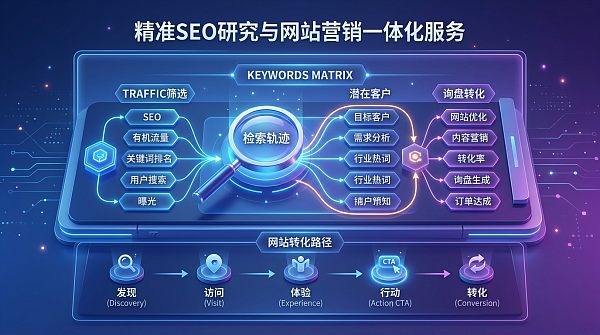
If you want to make your SEO keyword research more closely aligned with business results, it is recommended to prioritize filtering based on the following 5 dimensions.
1. Strength of Commercial Intent : Examine whether the keywords contain obvious signals of purchase, inquiry, cooperation, deployment, pricing, or solutions. The stronger the commercial intent, the higher the conversion potential.
2. Clarity of Needs <br>The more specific the term, the closer it is to the actual need. For example, "website building" is too general, while "multilingual B2B website building for foreign trade" is more specific; "website optimization" is too broad, while "website optimization solutions to improve overseas access speed" is more business-oriented.
3. Alignment with Business Capabilities <br>Not all high-intent keywords are suitable for optimization. Only keywords that align with your core products, service delivery capabilities, and case experience are worth investing in. Otherwise, even if you achieve rankings, it will be difficult to generate conversions.
4. Landing Page Capability <br>Whether a keyword can convert depends not only on the keyword itself, but also on whether the page can answer the user's question, provide credible evidence, and offer a clear entry point for action. If the page cannot handle the conversion, even the best keywords will be lost.
5. Conversion Path Obstacles <br>Some keywords may have traffic, but users need to jump through many steps before they can inquire; other keywords may have less traffic, but the landing page highly matches the user's needs, resulting in higher conversion rates. SEO content optimization should consider the entire conversion path, not just entry-level traffic.
For example, for foreign trade companies, users search for more than just "website building." They often also pay attention to whether the website loads quickly and stably overseas, and whether it affects inquiry submissions. If a page can explain the value of a solution by incorporating overseas access experience, stability, and security, it's more likely to prompt action. Capabilities like global CDN acceleration for foreign trade B2B website building are best integrated naturally into conversion-oriented content related to "optimizing the foreign trade website experience," "improving cross-border access speed," and "reducing bounce rate and increasing inquiries," rather than simply piling up functional terms.
In practice, finding keywords by working backward from the business scenario is more effective than blindly searching using tools.
When conducting SEO keyword research, many companies tend to simply open a tool and export a bunch of keywords. However, this often only yields "related keywords," not "high-converting keywords." A more effective method is to work backward from the business scenario.
Step 1: List out the actual business objectives.
For example, whether you want to increase inquiries, promote a multilingual website, acquire foreign trade website clients, or promote channel cooperation, the corresponding keyword structure will be completely different.
Step 2: Organize the customer's actual questions.
The questions that sales, customer service, after-sales, agents, and implementation teams encounter on a daily basis are often the most valuable sources of conversion keywords. What users ask, what they worry about, and what they compare—all of these are worth compiling into a keyword library.
Step 3: Expand vocabulary based on scenarios, rather than industry-specific terms.
For example, focusing on "foreign trade B2B official website" can lead to: "What to do if it loads slowly overseas?", "How to optimize a high bounce rate for an independent website?", "How to improve the stability of a multilingual website?", and "Does website loading speed affect inquiries?". These types of keywords are more likely to capture demand than simply focusing on "website SEO".
Step 4: Verify using the search results page.
Put the candidate keywords into a search engine and observe the actual results. If the first page mainly contains tutorials and articles, it indicates an informational focus; if the first page mainly contains service pages, case study pages, and product pages, it suggests a stronger commercial intent. This judgment is crucial.
Step 5: Establish a keyword hierarchy mechanism.
It is recommended to categorize keywords into at least five types: brand keywords, problem keywords, solution keywords, conversion keywords, and long-tail keywords. This way, when planning content and developing a website SEO optimization strategy, you will know which keywords are responsible for driving traffic and which keywords are responsible for generating sales.
Why do many keywords generate traffic but no inquiries? The problem usually lies not in keyword tools, but in the keyword selection logic.
There are three common misconceptions about corporate SEO.
Myth 1: Overly pursuing high search volume.
High search volume does not necessarily equate to high conversion rates. Many broad keywords are highly competitive, and users with diverse intents end up attracting less targeted visits.
Myth 2: Only looking at the ranking, ignoring the page load.
Even if a keyword ranks highly, it will be difficult to convert users if the page content is vague, lacks case studies, or has no clear forms or contact information.
Myth 3: Content and business are disconnected.
Some articles cover many basic SEO concepts but fail to truly address clients' concerns regarding "cost, effectiveness, risks, applicable scenarios, and implementation timeline." Even if such content is indexed, it's unlikely to generate commercial value.
Especially for B2B companies, conversions are often not completed with a single click, but rather through multiple interactions to gradually build trust. Therefore, keyword strategy should align with the decision-making chain: first, use question keywords to gain attention; then, use solution keywords to establish professional awareness; and finally, use service keywords, case study keywords, and brand keywords to handle inquiries.
How to write high-converting content: Create a closed loop between keywords, pages, and action goals.
Once you've identified the right conversion keywords, your content creation must be upgraded accordingly; otherwise, you'll just be stuck with a "pretty keyword table." Truly effective SEO content optimization focuses on enabling users to quickly make informed decisions within the page.
A high-conversion page should typically include these elements: clearly stating who it is suitable for, what problem it solves, why it is trustworthy, how the solution will be implemented, how the results will be measured, and how to contact the user in the next step.
For example, when a user searches for "what to do if slow overseas access affects inquiries," the page shouldn't just explain what CDN is, but clearly tell the user that slow website loading increases bounce rate, weakens brand trust, and affects form submission; then explain how access stability and first-screen experience are improved through global node caching, intelligent scheduling, dynamic request optimization, and edge security protection. Only in this way can technological value truly be transformed into business value.
For companies offering integrated website and marketing services, this is also key to differentiation. Users don't want isolated capabilities; they want a holistic solution encompassing website building, content creation, SEO, ad placement, and optimized user experience. SEO is more likely to translate into sustainable growth when keyword research, on-page strategy, and actual service capabilities are aligned.
How can businesses determine whether a batch of keywords is worth pursuing?
If you need to make a quicker judgment, you can use a simplified standard: can these keywords simultaneously meet five conditions: clear user needs, high business relevance, page compatibility, competitive advantage, and clear conversion path? The more conditions met, the more worthwhile it is to prioritize investment in them.
Furthermore, it is recommended that companies not delegate keyword research solely to the content team, but rather involve marketing, sales, customer service, and technology teams. This is because true conversion keywords are often found in cross-departmental business feedback, not just in keyword tools.
For example, some businesses later discovered that before making a formal inquiry, users were most concerned not with price, but with "how fast will it load for overseas customers," "whether it will frequently fail to load," and "whether the website's stability will affect the brand image." If these concerns can be clearly addressed in the content beforehand, page conversion rates will significantly improve. Focusing keywords and content around these real questions is often more effective than chasing generic traffic.
In summary: Finding the right conversion keywords is essentially about finding the people most likely to make a purchase.
The focus of SEO keyword research has never been just "finding keywords," but rather identifying which searches reveal genuine needs, clear questions, and actions. For businesses, truly high-value keywords aren't necessarily the most popular, but they are always closer to business goals, easier for pages to load, and more likely to generate inquiries and sales.
If you want your website's SEO optimization strategy to truly generate growth value, it's recommended to start with search intent and build a keyword system around question words, solution words, and procurement words, then combine this with high-volume pages and output of genuine business capabilities. By doing so, SEO content optimization won't just remain at the traffic level, but will become a long-term asset driving brand trust, inquiry growth, and sales conversion.
Related Articles



Related Products
 EasyCamp SaaS Smart Website Marketing SystemE-Yingbao SaaS Smart Website Marketing System: AI-powered, zero-code website building. Rapidly launch multilingual independent e-commerce sites in just 10 minutes. Global server acceleration and AI-driven SEO optimization empower businesses to efficiently connect with global markets. The seamless integration of technology and user-friendly operation makes building e-commerce sites incredibly simple.
 AI+SEM Intelligent Advertising Marketing SystemAI+SEM drives intelligent ad creation, empowering full-funnel precision advertising marketing. The system automatically generates weekly/monthly reports, AI recommends keywords and target countries, monitors core metrics in real-time with intelligent alerts, and enables one-click high-conversion ad solutions to help quickly acquire customers and improve ROI.
 AI+SEO Dual Engine Optimization ServiceEasyWin AI+SEO Dual Engine Optimization System leverages AI-powered keyword mining, content generation, and comprehensive technical optimization to help foreign trade enterprises acquire high-quality organic traffic, significantly improving search rankings and conversion rates.
 AI+SNS Social Media Marketing SystemYingbao AI+SNS Social Media Marketing System - Precision social capture for the social media era. Supports one-click content synchronization across major platforms like Facebook and LinkedIn. AI intelligently rewrites posts for enhanced relevance. 24/7 AI customer service and user profiling analysis empower businesses to efficiently expand into global markets.
 AI+SEO营销解决方案易营宝AI+SEO营销解决方案,通过AI批量写作、智能生成TDK、精准关键词扩词等功能,全面优化网站SEO效果,提升流量与转化率。助力企业构建高效智能网站新生态。
 AI+SEM Advertising Marketing SolutionsAI+SEM Advertising Marketing Solution leverages AI technology to deeply empower SEM ad campaigns. It automatically generates weekly/monthly reports using AI, presenting account data across multiple dimensions for comprehensive insights into campaign performance and trends. The system precisely recommends keywords and target countries, intelligently generates high-conversion ad copy, and enables one-click activation of efficient campaign plans to help businesses rapidly acquire customers. Simultaneously, it monitors core metrics in real time, intelligently identifies abnormal fluctuations, and issues timely alerts to ensure stable, high-return advertising results.
 Domain Name ServicesEasyWin provides professional domain name services, including intelligent queries, one-stop registration, brand protection, and full lifecycle management, helping businesses build a digital brand image.
 EasyOperate B2C Cross-Border E-Commerce Platform & Independent WebsiteEasyStore B2C Cross-border E-commerce Independent Store is an intelligent website building and cross-border e-commerce integrated solution independently developed by EasyStore Information Technology (Beijing) Co., Ltd. The system is specially designed for small and medium-sized as well as large export enterprises, integrating 'website building, operation, marketing, advertising, and conversion' into one, helping enterprises quickly establish cross-border e-commerce independent stores to achieve brand globalization and global sales growth.
The platform supports multiple languages, multiple currencies, and multi-channel marketing, with built-in AI intelligent translation and SEO optimization systems, suitable for mainstream markets such as Southeast Asia, Europe and America, Latin America, and the Middle East, assisting Chinese manufacturing enterprises in efficiently deploying international e-commerce strategies. SSL证书易营宝提供专业SSL安全证书服务,包括单域名和泛域名证书,确保网站数据传输加密、身份验证和完整性保护,助力企业建立安全可信的在线业务环境。









